SUBSCRIBE TO OUR FREE NEWSLETTER
Daily news & progressive opinion—funded by the people, not the corporations—delivered straight to your inbox.
5
#000000
#FFFFFF
To donate by check, phone, or other method, see our More Ways to Give page.


Daily news & progressive opinion—funded by the people, not the corporations—delivered straight to your inbox.

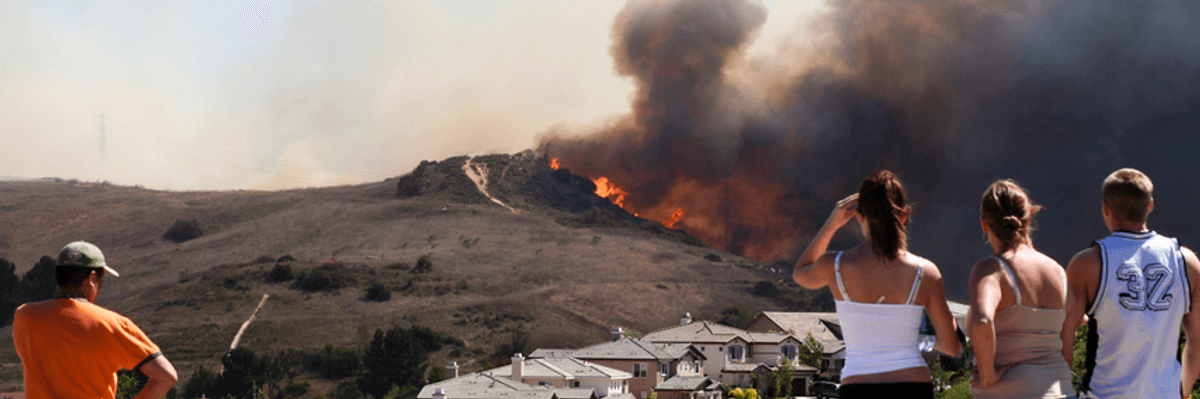
How does the Democratic National Committee's decision to pass Tom Perez's resolution that reversed a ban on donations from fossil fuel companies--companies that, "for at least six decades," were "aware of the risks of climate change, and their products' role in exacerbating those risks"--speak to workers impacted by storms, fires, drought, and other disasters made worse by global warming and climate change? The answer: it doesn't. (Image: Asero)
Last month, Trader Joe's finally began to repair its store in northwest Santa Rosa, California, which was badly damaged in the fires last October. The "most destructive in state history" (until this year) and likely driven in part by climate change, the Santa Rosa fires destroyed many businesses, from hotels to mom and pop pizza shops. Like Trader Joe's, some of these businesses are just beginning to rebuild. Others will remain closed for good.
Of course, when the fires destroyed businesses, they also destroyed jobs. Thousands of workers--unorganized and organized, white collar, blue collar, precarious--lost their homes and livelihoods. Some went on unemployment; others had to rely on government assistance to eat and to take care of their families. Many lost jobs that they will never get back.
The same story about work and climate change catastrophes is shared--though certainly in different degrees and in different ways--by the women and men of Puerto Rico and Houston and Florida. It is shared by the people in Northern California who are fleeing now fires fueled by water-starved trees and shrubs and grasses.
How does the Democratic National Committee's decision to pass Tom Perez's resolution that reversed a ban on donations from fossil fuel companies--companies that, "for at least six decades," were "aware of the risks of climate change, and their products' role in exacerbating those risks"--speak to these workers?
The answer, clearly, is that the resolution does not speak to them. That it does not can be attributed, in no small measure, to the just transition framework in which the resolution is steeped. This framework calls for a rapid transition away from fossil fuels to 100% clean energy, and for policies and programs--such as job training, income support, the provision of green economy opportunities--to protect oil, gas and coal industry workers who would lose their jobs as a result.
It is a laudable framework, and help for workers in fossil fuel industries is clearly what justice demands.
But the women and men who are fleeing fires--the hairstylists, cashiers, real estate agents, small business accountants, maintenance workers, cooks, dental technicians, grocery store managers--all of these people the framework effectively disappears as workers, and does so through such just transition binaries as "labor vs. community" or "labor vs. disadvantaged/low income people." When it comes to work, these women and men simply have no identity as workers because they are not labor, i.e., workers organized in and around the fossil fuel industry.
Then there's this problem of time.
At the heart of just transition lies an unspoken presumption that while transition is urgent, climate change crises are nevertheless relatively far-off. Consequently, we have time to transition, and in ways that will be a win-win for labor and for "communities."
Yet, given that many workers have already lost jobs or have had their jobs upended by weather extremes that can be explained in part by climate change (and thus the burning of fossil fuels), this presumption about time suggests that just transition is business-as-usual in the face of many workers' suffering.
By passing a resolution grounded in the just transition framework, the DNC can cynically present itself as speaking for all workers even as it embraces the companies responsible for the conditions that have harmed a broad swath of working people unattached to the fossil fuel industry. At the same time, it can ignore the urgency of transition for a whole range of workers who are in need of a just and accelerated response to climate change.
The way around this game is for us to begin to articulate just transition in terms that include a more expansive view of working people. We must also, however, unfailingly affirm and assert the obvious: the women and men whose lives and jobs have been, and are, radically disrupted by the "new normal" of extreme fires, floods, heat waves, 100 year rains, and hurricanes, are workers.

Dear Common Dreams reader, It’s been nearly 30 years since I co-founded Common Dreams with my late wife, Lina Newhouser. We had the radical notion that journalism should serve the public good, not corporate profits. It was clear to us from the outset what it would take to build such a project. No paid advertisements. No corporate sponsors. No millionaire publisher telling us what to think or do. Many people said we wouldn't last a year, but we proved those doubters wrong. Together with a tremendous team of journalists and dedicated staff, we built an independent media outlet free from the constraints of profits and corporate control. Our mission has always been simple: To inform. To inspire. To ignite change for the common good. Building Common Dreams was not easy. Our survival was never guaranteed. When you take on the most powerful forces—Wall Street greed, fossil fuel industry destruction, Big Tech lobbyists, and uber-rich oligarchs who have spent billions upon billions rigging the economy and democracy in their favor—the only bulwark you have is supporters who believe in your work. But here’s the urgent message from me today. It's never been this bad out there. And it's never been this hard to keep us going. At the very moment Common Dreams is most needed, the threats we face are intensifying. We need your support now more than ever. We don't accept corporate advertising and never will. We don't have a paywall because we don't think people should be blocked from critical news based on their ability to pay. Everything we do is funded by the donations of readers like you. When everyone does the little they can afford, we are strong. But if that support retreats or dries up, so do we. Will you donate now to make sure Common Dreams not only survives but thrives? —Craig Brown, Co-founder |
Last month, Trader Joe's finally began to repair its store in northwest Santa Rosa, California, which was badly damaged in the fires last October. The "most destructive in state history" (until this year) and likely driven in part by climate change, the Santa Rosa fires destroyed many businesses, from hotels to mom and pop pizza shops. Like Trader Joe's, some of these businesses are just beginning to rebuild. Others will remain closed for good.
Of course, when the fires destroyed businesses, they also destroyed jobs. Thousands of workers--unorganized and organized, white collar, blue collar, precarious--lost their homes and livelihoods. Some went on unemployment; others had to rely on government assistance to eat and to take care of their families. Many lost jobs that they will never get back.
The same story about work and climate change catastrophes is shared--though certainly in different degrees and in different ways--by the women and men of Puerto Rico and Houston and Florida. It is shared by the people in Northern California who are fleeing now fires fueled by water-starved trees and shrubs and grasses.
How does the Democratic National Committee's decision to pass Tom Perez's resolution that reversed a ban on donations from fossil fuel companies--companies that, "for at least six decades," were "aware of the risks of climate change, and their products' role in exacerbating those risks"--speak to these workers?
The answer, clearly, is that the resolution does not speak to them. That it does not can be attributed, in no small measure, to the just transition framework in which the resolution is steeped. This framework calls for a rapid transition away from fossil fuels to 100% clean energy, and for policies and programs--such as job training, income support, the provision of green economy opportunities--to protect oil, gas and coal industry workers who would lose their jobs as a result.
It is a laudable framework, and help for workers in fossil fuel industries is clearly what justice demands.
But the women and men who are fleeing fires--the hairstylists, cashiers, real estate agents, small business accountants, maintenance workers, cooks, dental technicians, grocery store managers--all of these people the framework effectively disappears as workers, and does so through such just transition binaries as "labor vs. community" or "labor vs. disadvantaged/low income people." When it comes to work, these women and men simply have no identity as workers because they are not labor, i.e., workers organized in and around the fossil fuel industry.
Then there's this problem of time.
At the heart of just transition lies an unspoken presumption that while transition is urgent, climate change crises are nevertheless relatively far-off. Consequently, we have time to transition, and in ways that will be a win-win for labor and for "communities."
Yet, given that many workers have already lost jobs or have had their jobs upended by weather extremes that can be explained in part by climate change (and thus the burning of fossil fuels), this presumption about time suggests that just transition is business-as-usual in the face of many workers' suffering.
By passing a resolution grounded in the just transition framework, the DNC can cynically present itself as speaking for all workers even as it embraces the companies responsible for the conditions that have harmed a broad swath of working people unattached to the fossil fuel industry. At the same time, it can ignore the urgency of transition for a whole range of workers who are in need of a just and accelerated response to climate change.
The way around this game is for us to begin to articulate just transition in terms that include a more expansive view of working people. We must also, however, unfailingly affirm and assert the obvious: the women and men whose lives and jobs have been, and are, radically disrupted by the "new normal" of extreme fires, floods, heat waves, 100 year rains, and hurricanes, are workers.

Last month, Trader Joe's finally began to repair its store in northwest Santa Rosa, California, which was badly damaged in the fires last October. The "most destructive in state history" (until this year) and likely driven in part by climate change, the Santa Rosa fires destroyed many businesses, from hotels to mom and pop pizza shops. Like Trader Joe's, some of these businesses are just beginning to rebuild. Others will remain closed for good.
Of course, when the fires destroyed businesses, they also destroyed jobs. Thousands of workers--unorganized and organized, white collar, blue collar, precarious--lost their homes and livelihoods. Some went on unemployment; others had to rely on government assistance to eat and to take care of their families. Many lost jobs that they will never get back.
The same story about work and climate change catastrophes is shared--though certainly in different degrees and in different ways--by the women and men of Puerto Rico and Houston and Florida. It is shared by the people in Northern California who are fleeing now fires fueled by water-starved trees and shrubs and grasses.
How does the Democratic National Committee's decision to pass Tom Perez's resolution that reversed a ban on donations from fossil fuel companies--companies that, "for at least six decades," were "aware of the risks of climate change, and their products' role in exacerbating those risks"--speak to these workers?
The answer, clearly, is that the resolution does not speak to them. That it does not can be attributed, in no small measure, to the just transition framework in which the resolution is steeped. This framework calls for a rapid transition away from fossil fuels to 100% clean energy, and for policies and programs--such as job training, income support, the provision of green economy opportunities--to protect oil, gas and coal industry workers who would lose their jobs as a result.
It is a laudable framework, and help for workers in fossil fuel industries is clearly what justice demands.
But the women and men who are fleeing fires--the hairstylists, cashiers, real estate agents, small business accountants, maintenance workers, cooks, dental technicians, grocery store managers--all of these people the framework effectively disappears as workers, and does so through such just transition binaries as "labor vs. community" or "labor vs. disadvantaged/low income people." When it comes to work, these women and men simply have no identity as workers because they are not labor, i.e., workers organized in and around the fossil fuel industry.
Then there's this problem of time.
At the heart of just transition lies an unspoken presumption that while transition is urgent, climate change crises are nevertheless relatively far-off. Consequently, we have time to transition, and in ways that will be a win-win for labor and for "communities."
Yet, given that many workers have already lost jobs or have had their jobs upended by weather extremes that can be explained in part by climate change (and thus the burning of fossil fuels), this presumption about time suggests that just transition is business-as-usual in the face of many workers' suffering.
By passing a resolution grounded in the just transition framework, the DNC can cynically present itself as speaking for all workers even as it embraces the companies responsible for the conditions that have harmed a broad swath of working people unattached to the fossil fuel industry. At the same time, it can ignore the urgency of transition for a whole range of workers who are in need of a just and accelerated response to climate change.
The way around this game is for us to begin to articulate just transition in terms that include a more expansive view of working people. We must also, however, unfailingly affirm and assert the obvious: the women and men whose lives and jobs have been, and are, radically disrupted by the "new normal" of extreme fires, floods, heat waves, 100 year rains, and hurricanes, are workers.