SUBSCRIBE TO OUR FREE NEWSLETTER
Daily news & progressive opinion—funded by the people, not the corporations—delivered straight to your inbox.
5
#000000
#FFFFFF
To donate by check, phone, or other method, see our More Ways to Give page.
Daily news & progressive opinion—funded by the people, not the corporations—delivered straight to your inbox.

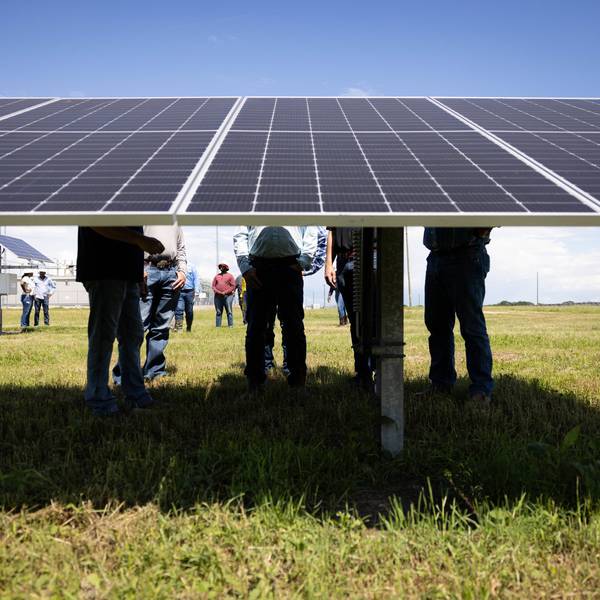
"While large-scale solar has grown here, the national marketplace is moving toward solar-with-storage at homes, businesses and parking areas." (Photo: Becker1999/Flickr/cc)
There's good news - outside of North Carolina - in the increasingly desperate fight to slow the climate crisis before its own momentum makes acceleration unstoppable. Economical storage, the long-sought Holy Grail of renewable energy, is surging in the marketplace while climate-wrecking fracked "natural" gas has begun to decline.
North Carolina is held back by Duke Energy executives' obsession with gas and their obstructionist strategy toward solar and storage as they cling to the increasingly risky plan to build the Atlantic Coast Pipeline and some 20 gas-fired power plants.
The difference? Market competition versus monopoly capture of customers, public and civic leaders, and public debate.
Gas will keep declining as people realize it's even worse than coal for the climate because much of it leaks, unburned, into the air.
Solar-with-storage projects are surging in many states by beating gas plants on economics and reliability. By 2026, the U.S. is expected to add storage capacity equal to 35 nuclear plants, generating $4 billion in annual savings. Some big utilities are already replacing gas with batteries, while gas-plant construction divisions of General Electric and Siemens are collapsing and Bloomberg's headline proclaims that "Natural Gas Drillers are Fighting for their Lives." Gas will keep declining as people realize it's even worse than coal for the climate because much of it leaks, unburned, into the air.
A Barron's cover story, "Dramatic advances in storage technology and declining costs of wind and solar energy are upending the electricity business," reports that storage stabilizes the grid and has become "a cheap and useful add-on for renewable power projects." Some utilities "will enjoy lucrative growth ... by combining renewable power with storage, while others could be left behind."
While large-scale solar has grown here, the national marketplace is moving toward solar-with-storage at homes, businesses and parking areas.
Energy storage is being analyzed by an NCSU-led team, and installers are already matching batteries with solar on homes and businesses. NC WARN's NC Clean Path 2025 strategy is gaining steam in key counties despite Duke Energy preventing regulators from even discussing it. Clean Path provides for quick replacement of coal and gas with solar power generated near where it's used, combined with batteries, energy-saving programs and on-bill financing - to benefit all customers.
Not only does solar-with-storage allow homes or businesses to use solar energy after dark. Those customers can be fairly compensated to allow the utility tap the batteries during periods of high usage, creating a virtual power plant. Several U.S. utilities and local governments are already choosing this approach over building gas-fired plants. Australia and London recently announced such projects, and it's a central feature of the Clean Path strategy.
All the economics and technology are available to rapidly replace coal and "natural" gas, save billions and create thousands of jobs across rural and urban North Carolina. Duke Energy's monopoly control only partially shelters it from such innovation.
But aren't solar panels in all Duke's TV ads, and doesn't North Carolina rank high in solar?
Duke Energy spends over $80 million annually in customers' money to make civic and bipartisan political leaders - and you - think this state is tackling the climate crisis.
Ah, the power of corporate PR. Duke Energy spends over $80 million annually in customers' money to make civic and bipartisan political leaders - and you - think this state is tackling the climate crisis. In fact, Duke and the Koch brothers are successfully limiting renewables and storage.
Duke's own data show its generation in the Carolinas is only 3% renewable - rising to only 7% in 2032, with little storage. Meanwhile, New York is committed to being 50% renewable by 2030, with 10 times the battery storage that Duke plans.
Duke Energy badly misled North Carolina about HB589, a bill that provides a ton of greenwashing and a few short-term aids to solar while masking the Duke-Koch effort to hamper renewables in the long term. The Charlotte Business Journal reports that Duke has essentially blocked storage projects by large-scale solar developers in the Carolinas.
Fortunately, utilities commissioner Dan Clodfelter, the Public Staff's Chris Ayers and Attorney General Josh Stein are changing the long-standing rubber-stamp of Duke Energy's "build plants, raise rates, control debate" business model. Local leaders are emerging too. Working with Clean Path volunteers, Chatham County commissioners recently made a move toward solarizing county-owned facilities.
North Carolinians must insist that Duke Energy get on the right side of the accelerating climate crisis by belatedly joining the clean energy revolution.
Dear Common Dreams reader, It’s been nearly 30 years since I co-founded Common Dreams with my late wife, Lina Newhouser. We had the radical notion that journalism should serve the public good, not corporate profits. It was clear to us from the outset what it would take to build such a project. No paid advertisements. No corporate sponsors. No millionaire publisher telling us what to think or do. Many people said we wouldn't last a year, but we proved those doubters wrong. Together with a tremendous team of journalists and dedicated staff, we built an independent media outlet free from the constraints of profits and corporate control. Our mission has always been simple: To inform. To inspire. To ignite change for the common good. Building Common Dreams was not easy. Our survival was never guaranteed. When you take on the most powerful forces—Wall Street greed, fossil fuel industry destruction, Big Tech lobbyists, and uber-rich oligarchs who have spent billions upon billions rigging the economy and democracy in their favor—the only bulwark you have is supporters who believe in your work. But here’s the urgent message from me today. It's never been this bad out there. And it's never been this hard to keep us going. At the very moment Common Dreams is most needed, the threats we face are intensifying. We need your support now more than ever. We don't accept corporate advertising and never will. We don't have a paywall because we don't think people should be blocked from critical news based on their ability to pay. Everything we do is funded by the donations of readers like you. When everyone does the little they can afford, we are strong. But if that support retreats or dries up, so do we. Will you donate now to make sure Common Dreams not only survives but thrives? —Craig Brown, Co-founder |
There's good news - outside of North Carolina - in the increasingly desperate fight to slow the climate crisis before its own momentum makes acceleration unstoppable. Economical storage, the long-sought Holy Grail of renewable energy, is surging in the marketplace while climate-wrecking fracked "natural" gas has begun to decline.
North Carolina is held back by Duke Energy executives' obsession with gas and their obstructionist strategy toward solar and storage as they cling to the increasingly risky plan to build the Atlantic Coast Pipeline and some 20 gas-fired power plants.
The difference? Market competition versus monopoly capture of customers, public and civic leaders, and public debate.
Gas will keep declining as people realize it's even worse than coal for the climate because much of it leaks, unburned, into the air.
Solar-with-storage projects are surging in many states by beating gas plants on economics and reliability. By 2026, the U.S. is expected to add storage capacity equal to 35 nuclear plants, generating $4 billion in annual savings. Some big utilities are already replacing gas with batteries, while gas-plant construction divisions of General Electric and Siemens are collapsing and Bloomberg's headline proclaims that "Natural Gas Drillers are Fighting for their Lives." Gas will keep declining as people realize it's even worse than coal for the climate because much of it leaks, unburned, into the air.
A Barron's cover story, "Dramatic advances in storage technology and declining costs of wind and solar energy are upending the electricity business," reports that storage stabilizes the grid and has become "a cheap and useful add-on for renewable power projects." Some utilities "will enjoy lucrative growth ... by combining renewable power with storage, while others could be left behind."
While large-scale solar has grown here, the national marketplace is moving toward solar-with-storage at homes, businesses and parking areas.
Energy storage is being analyzed by an NCSU-led team, and installers are already matching batteries with solar on homes and businesses. NC WARN's NC Clean Path 2025 strategy is gaining steam in key counties despite Duke Energy preventing regulators from even discussing it. Clean Path provides for quick replacement of coal and gas with solar power generated near where it's used, combined with batteries, energy-saving programs and on-bill financing - to benefit all customers.
Not only does solar-with-storage allow homes or businesses to use solar energy after dark. Those customers can be fairly compensated to allow the utility tap the batteries during periods of high usage, creating a virtual power plant. Several U.S. utilities and local governments are already choosing this approach over building gas-fired plants. Australia and London recently announced such projects, and it's a central feature of the Clean Path strategy.
All the economics and technology are available to rapidly replace coal and "natural" gas, save billions and create thousands of jobs across rural and urban North Carolina. Duke Energy's monopoly control only partially shelters it from such innovation.
But aren't solar panels in all Duke's TV ads, and doesn't North Carolina rank high in solar?
Duke Energy spends over $80 million annually in customers' money to make civic and bipartisan political leaders - and you - think this state is tackling the climate crisis.
Ah, the power of corporate PR. Duke Energy spends over $80 million annually in customers' money to make civic and bipartisan political leaders - and you - think this state is tackling the climate crisis. In fact, Duke and the Koch brothers are successfully limiting renewables and storage.
Duke's own data show its generation in the Carolinas is only 3% renewable - rising to only 7% in 2032, with little storage. Meanwhile, New York is committed to being 50% renewable by 2030, with 10 times the battery storage that Duke plans.
Duke Energy badly misled North Carolina about HB589, a bill that provides a ton of greenwashing and a few short-term aids to solar while masking the Duke-Koch effort to hamper renewables in the long term. The Charlotte Business Journal reports that Duke has essentially blocked storage projects by large-scale solar developers in the Carolinas.
Fortunately, utilities commissioner Dan Clodfelter, the Public Staff's Chris Ayers and Attorney General Josh Stein are changing the long-standing rubber-stamp of Duke Energy's "build plants, raise rates, control debate" business model. Local leaders are emerging too. Working with Clean Path volunteers, Chatham County commissioners recently made a move toward solarizing county-owned facilities.
North Carolinians must insist that Duke Energy get on the right side of the accelerating climate crisis by belatedly joining the clean energy revolution.
There's good news - outside of North Carolina - in the increasingly desperate fight to slow the climate crisis before its own momentum makes acceleration unstoppable. Economical storage, the long-sought Holy Grail of renewable energy, is surging in the marketplace while climate-wrecking fracked "natural" gas has begun to decline.
North Carolina is held back by Duke Energy executives' obsession with gas and their obstructionist strategy toward solar and storage as they cling to the increasingly risky plan to build the Atlantic Coast Pipeline and some 20 gas-fired power plants.
The difference? Market competition versus monopoly capture of customers, public and civic leaders, and public debate.
Gas will keep declining as people realize it's even worse than coal for the climate because much of it leaks, unburned, into the air.
Solar-with-storage projects are surging in many states by beating gas plants on economics and reliability. By 2026, the U.S. is expected to add storage capacity equal to 35 nuclear plants, generating $4 billion in annual savings. Some big utilities are already replacing gas with batteries, while gas-plant construction divisions of General Electric and Siemens are collapsing and Bloomberg's headline proclaims that "Natural Gas Drillers are Fighting for their Lives." Gas will keep declining as people realize it's even worse than coal for the climate because much of it leaks, unburned, into the air.
A Barron's cover story, "Dramatic advances in storage technology and declining costs of wind and solar energy are upending the electricity business," reports that storage stabilizes the grid and has become "a cheap and useful add-on for renewable power projects." Some utilities "will enjoy lucrative growth ... by combining renewable power with storage, while others could be left behind."
While large-scale solar has grown here, the national marketplace is moving toward solar-with-storage at homes, businesses and parking areas.
Energy storage is being analyzed by an NCSU-led team, and installers are already matching batteries with solar on homes and businesses. NC WARN's NC Clean Path 2025 strategy is gaining steam in key counties despite Duke Energy preventing regulators from even discussing it. Clean Path provides for quick replacement of coal and gas with solar power generated near where it's used, combined with batteries, energy-saving programs and on-bill financing - to benefit all customers.
Not only does solar-with-storage allow homes or businesses to use solar energy after dark. Those customers can be fairly compensated to allow the utility tap the batteries during periods of high usage, creating a virtual power plant. Several U.S. utilities and local governments are already choosing this approach over building gas-fired plants. Australia and London recently announced such projects, and it's a central feature of the Clean Path strategy.
All the economics and technology are available to rapidly replace coal and "natural" gas, save billions and create thousands of jobs across rural and urban North Carolina. Duke Energy's monopoly control only partially shelters it from such innovation.
But aren't solar panels in all Duke's TV ads, and doesn't North Carolina rank high in solar?
Duke Energy spends over $80 million annually in customers' money to make civic and bipartisan political leaders - and you - think this state is tackling the climate crisis.
Ah, the power of corporate PR. Duke Energy spends over $80 million annually in customers' money to make civic and bipartisan political leaders - and you - think this state is tackling the climate crisis. In fact, Duke and the Koch brothers are successfully limiting renewables and storage.
Duke's own data show its generation in the Carolinas is only 3% renewable - rising to only 7% in 2032, with little storage. Meanwhile, New York is committed to being 50% renewable by 2030, with 10 times the battery storage that Duke plans.
Duke Energy badly misled North Carolina about HB589, a bill that provides a ton of greenwashing and a few short-term aids to solar while masking the Duke-Koch effort to hamper renewables in the long term. The Charlotte Business Journal reports that Duke has essentially blocked storage projects by large-scale solar developers in the Carolinas.
Fortunately, utilities commissioner Dan Clodfelter, the Public Staff's Chris Ayers and Attorney General Josh Stein are changing the long-standing rubber-stamp of Duke Energy's "build plants, raise rates, control debate" business model. Local leaders are emerging too. Working with Clean Path volunteers, Chatham County commissioners recently made a move toward solarizing county-owned facilities.
North Carolinians must insist that Duke Energy get on the right side of the accelerating climate crisis by belatedly joining the clean energy revolution.