SUBSCRIBE TO OUR FREE NEWSLETTER
Daily news & progressive opinion—funded by the people, not the corporations—delivered straight to your inbox.
5
#000000
#FFFFFF
To donate by check, phone, or other method, see our More Ways to Give page.
Daily news & progressive opinion—funded by the people, not the corporations—delivered straight to your inbox.
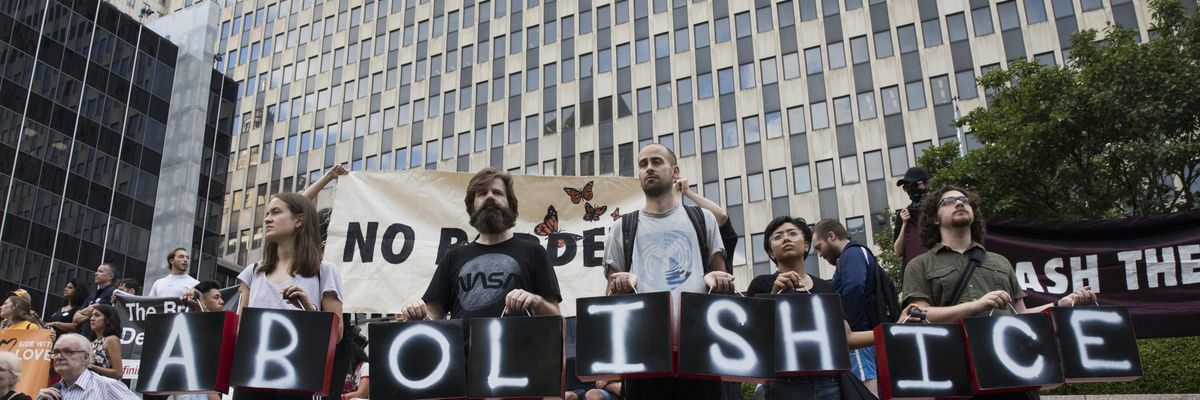
"The terror that ICE raids sow in our communities affects us all." (Photo by Drew Angerer/Getty Images)
Last week, Immigration and Customs Enforcement (ICE) carried out one of its largest raids in years, arresting more than 140 people in Ohio. But raids and family separation are only part of the total impact ICE has on our communities. The Trump administration has attempted to justify aggressive immigration enforcement by claiming they help make our cities safer, yet the opposite may be true.
Immigration advocates have raised concerns about public safety based on ICE's track record of abuse, militarized operations and propensity to identify themselves as the police. So far this year, seven immigrants have died while in ICE custody, with reports citing lack of medical care as a main factor. The cavalier attitude with which ICE conducts operations should be a cause of concern for us all, especially given that ICE has negligently detained or deported more than 20,000 U.S. citizens since 2003.
The terror that ICE raids sow in our communities affects us all. Increased fear in immigrant communities often results in a reluctance to call the police, cooperate with authorities or show up to court, the effects of which have already started to show. In 2017, sexual assault reports by Latinos in Los Angeles fell by 25 percent, while domestic violence reports declined by 10 percent. In Denver, following ICE arrests in the local courthouse, prosecutors reported that victims of domestic violence have refused to testify because of fear of being arrested.
The threat to our collective security extends to public health as well. Widespread fear has led to immigrants forgoing health care for themselves and even their U.S. citizen children, increasing health risks for all. There are also direct and tangible effects of the ICE violence. A 2017 study by the University of Michigan documented the health effects following a 2008 ICE raid in Iowa. The study found that Latina women, including those who were citizens, were more likely to have low birth-weight or premature babies following the raid.
While the immediate effects on health and safety have been documented, the long-term effects will take decades to fully understand. This includes not only the significant trauma inflicted on children separated from their parents while in immigration custody, but the devastating disruption ICE raids can have on their education. After raids took place in eastern Tennessee earlier this year, more than 500 children missed school the following day.
The fear and instability that accompanies these raids have thrust school officials into a role that has now become all too common for teachers, health-care professionals and social workers attempting to provide some sense of guidance and reassurance in a time of immense uncertainty. A survey of 5,400 teachers, principals and counselors conducted by the Civil Rights Project at UCLA found that 68 percent of administrators cited absenteeism among immigrant students as a problem, and 70 percent of principals and counselors reported academic decline among immigrant students.
These collateral consequences are rarely cited in conversations on immigration and enforcement, but highlight the human costs that we collectively pay. The United States detains more immigrants than any other country in the world, and ICE's ballooning budget and expansive detention policies run the risk of reshaping the character of our country.
Evidence documenting the destructive effects of ICE enforcement paints a clear picture as to the devastating toll these policies are taking on our society. We must stand together to protect our communities and call for an end to destructive policies that separate our families and destroy the social fabric of our communities.
Dear Common Dreams reader, It’s been nearly 30 years since I co-founded Common Dreams with my late wife, Lina Newhouser. We had the radical notion that journalism should serve the public good, not corporate profits. It was clear to us from the outset what it would take to build such a project. No paid advertisements. No corporate sponsors. No millionaire publisher telling us what to think or do. Many people said we wouldn't last a year, but we proved those doubters wrong. Together with a tremendous team of journalists and dedicated staff, we built an independent media outlet free from the constraints of profits and corporate control. Our mission has always been simple: To inform. To inspire. To ignite change for the common good. Building Common Dreams was not easy. Our survival was never guaranteed. When you take on the most powerful forces—Wall Street greed, fossil fuel industry destruction, Big Tech lobbyists, and uber-rich oligarchs who have spent billions upon billions rigging the economy and democracy in their favor—the only bulwark you have is supporters who believe in your work. But here’s the urgent message from me today. It's never been this bad out there. And it's never been this hard to keep us going. At the very moment Common Dreams is most needed, the threats we face are intensifying. We need your support now more than ever. We don't accept corporate advertising and never will. We don't have a paywall because we don't think people should be blocked from critical news based on their ability to pay. Everything we do is funded by the donations of readers like you. When everyone does the little they can afford, we are strong. But if that support retreats or dries up, so do we. Will you donate now to make sure Common Dreams not only survives but thrives? —Craig Brown, Co-founder |
Last week, Immigration and Customs Enforcement (ICE) carried out one of its largest raids in years, arresting more than 140 people in Ohio. But raids and family separation are only part of the total impact ICE has on our communities. The Trump administration has attempted to justify aggressive immigration enforcement by claiming they help make our cities safer, yet the opposite may be true.
Immigration advocates have raised concerns about public safety based on ICE's track record of abuse, militarized operations and propensity to identify themselves as the police. So far this year, seven immigrants have died while in ICE custody, with reports citing lack of medical care as a main factor. The cavalier attitude with which ICE conducts operations should be a cause of concern for us all, especially given that ICE has negligently detained or deported more than 20,000 U.S. citizens since 2003.
The terror that ICE raids sow in our communities affects us all. Increased fear in immigrant communities often results in a reluctance to call the police, cooperate with authorities or show up to court, the effects of which have already started to show. In 2017, sexual assault reports by Latinos in Los Angeles fell by 25 percent, while domestic violence reports declined by 10 percent. In Denver, following ICE arrests in the local courthouse, prosecutors reported that victims of domestic violence have refused to testify because of fear of being arrested.
The threat to our collective security extends to public health as well. Widespread fear has led to immigrants forgoing health care for themselves and even their U.S. citizen children, increasing health risks for all. There are also direct and tangible effects of the ICE violence. A 2017 study by the University of Michigan documented the health effects following a 2008 ICE raid in Iowa. The study found that Latina women, including those who were citizens, were more likely to have low birth-weight or premature babies following the raid.
While the immediate effects on health and safety have been documented, the long-term effects will take decades to fully understand. This includes not only the significant trauma inflicted on children separated from their parents while in immigration custody, but the devastating disruption ICE raids can have on their education. After raids took place in eastern Tennessee earlier this year, more than 500 children missed school the following day.
The fear and instability that accompanies these raids have thrust school officials into a role that has now become all too common for teachers, health-care professionals and social workers attempting to provide some sense of guidance and reassurance in a time of immense uncertainty. A survey of 5,400 teachers, principals and counselors conducted by the Civil Rights Project at UCLA found that 68 percent of administrators cited absenteeism among immigrant students as a problem, and 70 percent of principals and counselors reported academic decline among immigrant students.
These collateral consequences are rarely cited in conversations on immigration and enforcement, but highlight the human costs that we collectively pay. The United States detains more immigrants than any other country in the world, and ICE's ballooning budget and expansive detention policies run the risk of reshaping the character of our country.
Evidence documenting the destructive effects of ICE enforcement paints a clear picture as to the devastating toll these policies are taking on our society. We must stand together to protect our communities and call for an end to destructive policies that separate our families and destroy the social fabric of our communities.
Last week, Immigration and Customs Enforcement (ICE) carried out one of its largest raids in years, arresting more than 140 people in Ohio. But raids and family separation are only part of the total impact ICE has on our communities. The Trump administration has attempted to justify aggressive immigration enforcement by claiming they help make our cities safer, yet the opposite may be true.
Immigration advocates have raised concerns about public safety based on ICE's track record of abuse, militarized operations and propensity to identify themselves as the police. So far this year, seven immigrants have died while in ICE custody, with reports citing lack of medical care as a main factor. The cavalier attitude with which ICE conducts operations should be a cause of concern for us all, especially given that ICE has negligently detained or deported more than 20,000 U.S. citizens since 2003.
The terror that ICE raids sow in our communities affects us all. Increased fear in immigrant communities often results in a reluctance to call the police, cooperate with authorities or show up to court, the effects of which have already started to show. In 2017, sexual assault reports by Latinos in Los Angeles fell by 25 percent, while domestic violence reports declined by 10 percent. In Denver, following ICE arrests in the local courthouse, prosecutors reported that victims of domestic violence have refused to testify because of fear of being arrested.
The threat to our collective security extends to public health as well. Widespread fear has led to immigrants forgoing health care for themselves and even their U.S. citizen children, increasing health risks for all. There are also direct and tangible effects of the ICE violence. A 2017 study by the University of Michigan documented the health effects following a 2008 ICE raid in Iowa. The study found that Latina women, including those who were citizens, were more likely to have low birth-weight or premature babies following the raid.
While the immediate effects on health and safety have been documented, the long-term effects will take decades to fully understand. This includes not only the significant trauma inflicted on children separated from their parents while in immigration custody, but the devastating disruption ICE raids can have on their education. After raids took place in eastern Tennessee earlier this year, more than 500 children missed school the following day.
The fear and instability that accompanies these raids have thrust school officials into a role that has now become all too common for teachers, health-care professionals and social workers attempting to provide some sense of guidance and reassurance in a time of immense uncertainty. A survey of 5,400 teachers, principals and counselors conducted by the Civil Rights Project at UCLA found that 68 percent of administrators cited absenteeism among immigrant students as a problem, and 70 percent of principals and counselors reported academic decline among immigrant students.
These collateral consequences are rarely cited in conversations on immigration and enforcement, but highlight the human costs that we collectively pay. The United States detains more immigrants than any other country in the world, and ICE's ballooning budget and expansive detention policies run the risk of reshaping the character of our country.
Evidence documenting the destructive effects of ICE enforcement paints a clear picture as to the devastating toll these policies are taking on our society. We must stand together to protect our communities and call for an end to destructive policies that separate our families and destroy the social fabric of our communities.