SUBSCRIBE TO OUR FREE NEWSLETTER
Daily news & progressive opinion—funded by the people, not the corporations—delivered straight to your inbox.
5
#000000
#FFFFFF
To donate by check, phone, or other method, see our More Ways to Give page.
Daily news & progressive opinion—funded by the people, not the corporations—delivered straight to your inbox.
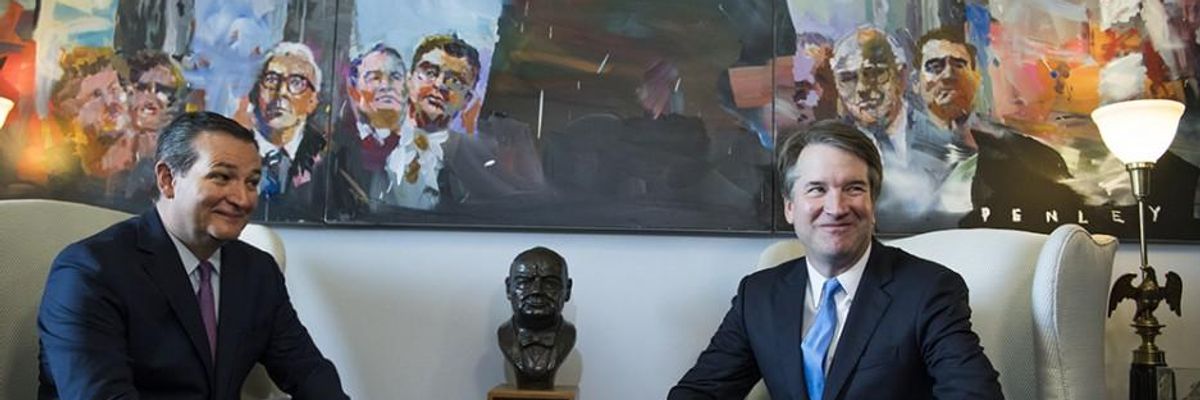
Supreme Court nominee Brett Kavanaugh, right, and Sen. Ted Cruz, R-Texas, conduct a photo-op in Russell Building before a meeting on July 17, 2018. (Photo By Tom Williams/CQ Roll Call)
By now, most of Supreme Court Justice Nominee Brett Kavanaugh's decisions and speeches have been pored over by both advocates and reporters. But comparatively little attention has been paid to a posture that has defined Kavanaugh's legal career: a consistent willingness to side with the rich and the powerful over the most vulnerable members of society.
While retiring Justice Anthony Kennedy generally has a pro-business voting record, he has often broken with the conservative wing of the court on civil rights cases and issues of environmental law. At times, this led Kennedy to rule in favor of civil rights and against powerful interests.
With Kavanaugh, there are few exceptions to a reliably anti-worker and anti-consumer record. In an analysis of 286 opinions authored by Kavanaugh as a D.C. Circuit Court of Appeals judge, Adam Feldman of Empirical SCOTUS found that Kavanaugh has "written almost entirely in favor of big businesses, employers in employment disputes, and against defendants in criminal cases." In fact, according to a leaked document obtained by POLITICO, the Trump administration recently asked corporate interest groups for help with Kavanaugh's confirmation, circulating a document touting that, "Kavanaugh helped kill President Obama's most destructive new environmental rules" and that he "has overruled federal regulators 75 times on cases involving clean air, consumer protections, net neutrality and other issues."
One of Kavanaugh's recent decisions, for example, concerned the constitutionality of the Consumer Financial Protection Bureau (CFPB), an agency created in the wake of the 2008 financial crisis that has resulted in nearly $12 billion in relief for consumers who were duped by banks or credit card companies. Kavanaugh found that the entire CFPB was unconstitutional, and even questioned a Supreme Court ruling from 1935 that upheld the constitutionality of independent agencies. His decision was overturned two years later by the full court, who called Kavanaugh's ruling "a wholesale attack on independent agencies...that, if accepted, would broadly transform modern government."
In case after case, Kavanaugh exhibits a preference for the more powerful party.
And in 2012, Kavanaugh dissented from a D.C. Circuit decision finding that the State Department had inappropriately fired an employee based solely on her age. Kavanaugh argued that the State Department's decision did not constitute age discrimination. Even though the agency itself did not dispute the reason for the employee's termination, Kavanaugh said it was "not a close call." As the majority wrote, "the necessary consequence of the Department's position is that it is also free from any statutory bar against terminating an employee...solely on account of his disability or race or religion or sex." In other words, Kavanaugh's ruling would have also allowed the agency to discriminate against people with disabilities, racial and religious minorities, and women.
And Kavanaugh's most prominent positions--his decision to block an unaccompanied young immigrant woman from having an abortion immediately or his criticism of John Roberts' decision upholding the Affordable Care Act (ACA)--would disproportionately harm low-income people. The most frequently cited reason among women getting an abortion is that having a child "would interfere with school, work or other responsibilities, and that they could not afford a child." Indeed, when women are denied abortions, they are more than three times more likely to experience poverty two years later. And the antipoverty effects of the ACA are undeniable. Medicaid--which the law expanded--is one of the most effective antipoverty programs in the country, reducing child poverty by 5.3 percentage points. And although the uninsured rate has increased slightly since Trump took office, it is still significantly lower than before the bill was passed.
But perhaps no decision better illustrates Kavanaugh's ideology than this: in an incident made famous by the documentary "Blackfish," Sea World trainer Dawn Brancheau died after being attacked by a killer whale--making her the third Sea World worker killed by the same whale. When the Occupational Safety and Health Administration fined Sea World $75,000 for safety violations, the company appealed to the D.C. Court of Appeals, where Kavanaugh served. The panel upheld OSHA's fine, but Kavanaugh dissented. In his view, "Many sports events and entertainment shows can be extremely dangerous for the participants." But, he reasoned, society should not "paternalistically decide that the participants in these...activities must be protected from themselves." Kavanaugh's position would undermine the entire foundation of workplace safety regulations.
As Ian Millhiser of ThinkProgress notes, Trump delegated the task of identifying Supreme Court nominees to the rightwing Federalist Society and Heritage Foundation, organizations that have made it their missions to dismantle federal regulations--everything from labor law to consumer protections to environmental rules. Kavanaugh's record suggests he would do just that.
In case after case, Kavanaugh exhibits a preference for the more powerful party--whether corporations, agencies, or the criminal justice system--over the less powerful--whether consumers, workers, or victims of pollution.
That alone should give every Senator pause before they vote on Kavanaugh's nomination.
Dear Common Dreams reader, It’s been nearly 30 years since I co-founded Common Dreams with my late wife, Lina Newhouser. We had the radical notion that journalism should serve the public good, not corporate profits. It was clear to us from the outset what it would take to build such a project. No paid advertisements. No corporate sponsors. No millionaire publisher telling us what to think or do. Many people said we wouldn't last a year, but we proved those doubters wrong. Together with a tremendous team of journalists and dedicated staff, we built an independent media outlet free from the constraints of profits and corporate control. Our mission has always been simple: To inform. To inspire. To ignite change for the common good. Building Common Dreams was not easy. Our survival was never guaranteed. When you take on the most powerful forces—Wall Street greed, fossil fuel industry destruction, Big Tech lobbyists, and uber-rich oligarchs who have spent billions upon billions rigging the economy and democracy in their favor—the only bulwark you have is supporters who believe in your work. But here’s the urgent message from me today. It's never been this bad out there. And it's never been this hard to keep us going. At the very moment Common Dreams is most needed, the threats we face are intensifying. We need your support now more than ever. We don't accept corporate advertising and never will. We don't have a paywall because we don't think people should be blocked from critical news based on their ability to pay. Everything we do is funded by the donations of readers like you. When everyone does the little they can afford, we are strong. But if that support retreats or dries up, so do we. Will you donate now to make sure Common Dreams not only survives but thrives? —Craig Brown, Co-founder |
By now, most of Supreme Court Justice Nominee Brett Kavanaugh's decisions and speeches have been pored over by both advocates and reporters. But comparatively little attention has been paid to a posture that has defined Kavanaugh's legal career: a consistent willingness to side with the rich and the powerful over the most vulnerable members of society.
While retiring Justice Anthony Kennedy generally has a pro-business voting record, he has often broken with the conservative wing of the court on civil rights cases and issues of environmental law. At times, this led Kennedy to rule in favor of civil rights and against powerful interests.
With Kavanaugh, there are few exceptions to a reliably anti-worker and anti-consumer record. In an analysis of 286 opinions authored by Kavanaugh as a D.C. Circuit Court of Appeals judge, Adam Feldman of Empirical SCOTUS found that Kavanaugh has "written almost entirely in favor of big businesses, employers in employment disputes, and against defendants in criminal cases." In fact, according to a leaked document obtained by POLITICO, the Trump administration recently asked corporate interest groups for help with Kavanaugh's confirmation, circulating a document touting that, "Kavanaugh helped kill President Obama's most destructive new environmental rules" and that he "has overruled federal regulators 75 times on cases involving clean air, consumer protections, net neutrality and other issues."
One of Kavanaugh's recent decisions, for example, concerned the constitutionality of the Consumer Financial Protection Bureau (CFPB), an agency created in the wake of the 2008 financial crisis that has resulted in nearly $12 billion in relief for consumers who were duped by banks or credit card companies. Kavanaugh found that the entire CFPB was unconstitutional, and even questioned a Supreme Court ruling from 1935 that upheld the constitutionality of independent agencies. His decision was overturned two years later by the full court, who called Kavanaugh's ruling "a wholesale attack on independent agencies...that, if accepted, would broadly transform modern government."
In case after case, Kavanaugh exhibits a preference for the more powerful party.
And in 2012, Kavanaugh dissented from a D.C. Circuit decision finding that the State Department had inappropriately fired an employee based solely on her age. Kavanaugh argued that the State Department's decision did not constitute age discrimination. Even though the agency itself did not dispute the reason for the employee's termination, Kavanaugh said it was "not a close call." As the majority wrote, "the necessary consequence of the Department's position is that it is also free from any statutory bar against terminating an employee...solely on account of his disability or race or religion or sex." In other words, Kavanaugh's ruling would have also allowed the agency to discriminate against people with disabilities, racial and religious minorities, and women.
And Kavanaugh's most prominent positions--his decision to block an unaccompanied young immigrant woman from having an abortion immediately or his criticism of John Roberts' decision upholding the Affordable Care Act (ACA)--would disproportionately harm low-income people. The most frequently cited reason among women getting an abortion is that having a child "would interfere with school, work or other responsibilities, and that they could not afford a child." Indeed, when women are denied abortions, they are more than three times more likely to experience poverty two years later. And the antipoverty effects of the ACA are undeniable. Medicaid--which the law expanded--is one of the most effective antipoverty programs in the country, reducing child poverty by 5.3 percentage points. And although the uninsured rate has increased slightly since Trump took office, it is still significantly lower than before the bill was passed.
But perhaps no decision better illustrates Kavanaugh's ideology than this: in an incident made famous by the documentary "Blackfish," Sea World trainer Dawn Brancheau died after being attacked by a killer whale--making her the third Sea World worker killed by the same whale. When the Occupational Safety and Health Administration fined Sea World $75,000 for safety violations, the company appealed to the D.C. Court of Appeals, where Kavanaugh served. The panel upheld OSHA's fine, but Kavanaugh dissented. In his view, "Many sports events and entertainment shows can be extremely dangerous for the participants." But, he reasoned, society should not "paternalistically decide that the participants in these...activities must be protected from themselves." Kavanaugh's position would undermine the entire foundation of workplace safety regulations.
As Ian Millhiser of ThinkProgress notes, Trump delegated the task of identifying Supreme Court nominees to the rightwing Federalist Society and Heritage Foundation, organizations that have made it their missions to dismantle federal regulations--everything from labor law to consumer protections to environmental rules. Kavanaugh's record suggests he would do just that.
In case after case, Kavanaugh exhibits a preference for the more powerful party--whether corporations, agencies, or the criminal justice system--over the less powerful--whether consumers, workers, or victims of pollution.
That alone should give every Senator pause before they vote on Kavanaugh's nomination.
By now, most of Supreme Court Justice Nominee Brett Kavanaugh's decisions and speeches have been pored over by both advocates and reporters. But comparatively little attention has been paid to a posture that has defined Kavanaugh's legal career: a consistent willingness to side with the rich and the powerful over the most vulnerable members of society.
While retiring Justice Anthony Kennedy generally has a pro-business voting record, he has often broken with the conservative wing of the court on civil rights cases and issues of environmental law. At times, this led Kennedy to rule in favor of civil rights and against powerful interests.
With Kavanaugh, there are few exceptions to a reliably anti-worker and anti-consumer record. In an analysis of 286 opinions authored by Kavanaugh as a D.C. Circuit Court of Appeals judge, Adam Feldman of Empirical SCOTUS found that Kavanaugh has "written almost entirely in favor of big businesses, employers in employment disputes, and against defendants in criminal cases." In fact, according to a leaked document obtained by POLITICO, the Trump administration recently asked corporate interest groups for help with Kavanaugh's confirmation, circulating a document touting that, "Kavanaugh helped kill President Obama's most destructive new environmental rules" and that he "has overruled federal regulators 75 times on cases involving clean air, consumer protections, net neutrality and other issues."
One of Kavanaugh's recent decisions, for example, concerned the constitutionality of the Consumer Financial Protection Bureau (CFPB), an agency created in the wake of the 2008 financial crisis that has resulted in nearly $12 billion in relief for consumers who were duped by banks or credit card companies. Kavanaugh found that the entire CFPB was unconstitutional, and even questioned a Supreme Court ruling from 1935 that upheld the constitutionality of independent agencies. His decision was overturned two years later by the full court, who called Kavanaugh's ruling "a wholesale attack on independent agencies...that, if accepted, would broadly transform modern government."
In case after case, Kavanaugh exhibits a preference for the more powerful party.
And in 2012, Kavanaugh dissented from a D.C. Circuit decision finding that the State Department had inappropriately fired an employee based solely on her age. Kavanaugh argued that the State Department's decision did not constitute age discrimination. Even though the agency itself did not dispute the reason for the employee's termination, Kavanaugh said it was "not a close call." As the majority wrote, "the necessary consequence of the Department's position is that it is also free from any statutory bar against terminating an employee...solely on account of his disability or race or religion or sex." In other words, Kavanaugh's ruling would have also allowed the agency to discriminate against people with disabilities, racial and religious minorities, and women.
And Kavanaugh's most prominent positions--his decision to block an unaccompanied young immigrant woman from having an abortion immediately or his criticism of John Roberts' decision upholding the Affordable Care Act (ACA)--would disproportionately harm low-income people. The most frequently cited reason among women getting an abortion is that having a child "would interfere with school, work or other responsibilities, and that they could not afford a child." Indeed, when women are denied abortions, they are more than three times more likely to experience poverty two years later. And the antipoverty effects of the ACA are undeniable. Medicaid--which the law expanded--is one of the most effective antipoverty programs in the country, reducing child poverty by 5.3 percentage points. And although the uninsured rate has increased slightly since Trump took office, it is still significantly lower than before the bill was passed.
But perhaps no decision better illustrates Kavanaugh's ideology than this: in an incident made famous by the documentary "Blackfish," Sea World trainer Dawn Brancheau died after being attacked by a killer whale--making her the third Sea World worker killed by the same whale. When the Occupational Safety and Health Administration fined Sea World $75,000 for safety violations, the company appealed to the D.C. Court of Appeals, where Kavanaugh served. The panel upheld OSHA's fine, but Kavanaugh dissented. In his view, "Many sports events and entertainment shows can be extremely dangerous for the participants." But, he reasoned, society should not "paternalistically decide that the participants in these...activities must be protected from themselves." Kavanaugh's position would undermine the entire foundation of workplace safety regulations.
As Ian Millhiser of ThinkProgress notes, Trump delegated the task of identifying Supreme Court nominees to the rightwing Federalist Society and Heritage Foundation, organizations that have made it their missions to dismantle federal regulations--everything from labor law to consumer protections to environmental rules. Kavanaugh's record suggests he would do just that.
In case after case, Kavanaugh exhibits a preference for the more powerful party--whether corporations, agencies, or the criminal justice system--over the less powerful--whether consumers, workers, or victims of pollution.
That alone should give every Senator pause before they vote on Kavanaugh's nomination.