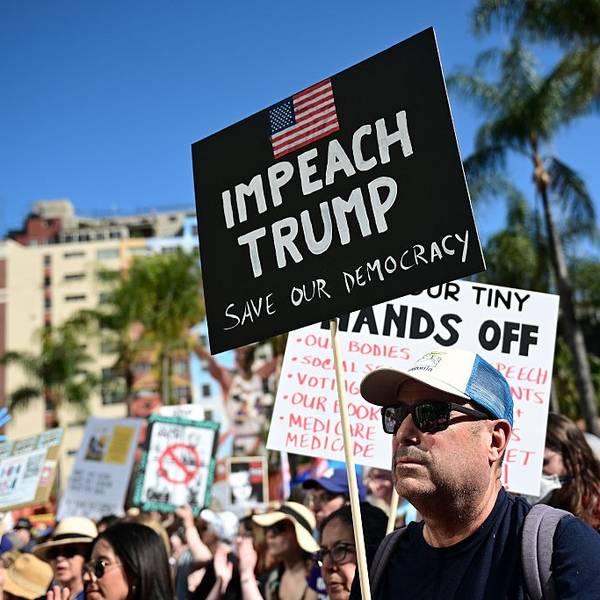
"As the agents on the ground executing Trump's xenophobic agenda, they have become the flesh and blood of the administration's worst impulses." (Photo: Screenshot/Rise & Resist)
'Abolish ICE' Doesn't Mean What Conservatives Say It Does
Abolishing ICE is not about lawlessness or open borders but about upholding our constitutional principles of defending people’s freedom from big government, government overreach and racial discrimination
In return, President Donald Trump, the Republican Party and other immigration hard-liners have argued that abolishing ICE would amount to open borders. So let's clear up some of the confusion and answer their questions about what "abolish ICE" really means.
Hard-liners: Unbelievable! Anyone who supports abolishing ICE is calling for open borders and ending enforcement of immigration laws.
Abolishing ICE is not about lawlessness or open borders but about upholding our constitutional principles of defending people's freedom from big government, government overreach and racial discrimination.
How so?
First, let's point out that ICE is a fairly new government agency, coming into existence in 2003, a post-9/11 legislation era. It's not an institution that's embedded in our history, like the U.S. Marine Corps, which saw its beginning in the American Revolution in 1775, when the Continental Congress authorized the first Marine battalions.
We obviously need to administer immigration laws in a rational manner while investigating serious offenses. There already exist, however, other capable law enforcement agencies that investigate terrorism, transnational drug rings, human trafficking and violent gangs.
With the creation of ICE, Congress duplicated an already bloated bureaucracy. We spend more on immigration enforcement than on all other federal law enforcement combined, including the Federal Bureau of Investigation, Drug Enforcement Administration, Secret Service, U.S. Marshals and Bureau of Alcohol, Tobacco, Firearms and Explosives.
We spend more on deporting college students or day laborers than investigating and jailing, as Trump put it, "bad hombres." Simple math will tell you this federal agency is a burden to taxpayers.
If we abolish ICE, then what's next? Abolish the police?
No one is calling to abolish any law enforcement agency that actually uses its resources to investigate, arrest and incarcerate those who threaten violent harm against the American people. While there are issues with all law enforcement agencies, ICE has been infamous for controversy and illegal conduct like racial profiling, harassing U.S. citizens and sexual assault against immigrants.
Are you vilifying ICE agents?
We are certain that many men and women who join ICE aspire to serve an agency that allows them to stop those who prey on innocent people. However, the agency's ill-devised mission, coupled with bad laws (enacted by both Republicans and Democrats), has forced ICE agents to persecute immigrants based simply on race, ethnicity or religion.
As the agents on the ground executing Trump's xenophobic agenda, they have become the flesh and blood of the administration's worst impulses.
Today ICE is infringing on the privacy of every American, using military-style cellphone surveillance and license plate tracking to monitor immigrants and the citizens they interact with.
So what? Fighting crime is messy, and we have to accept the collateral consequences of a few nannies being deported and some rights being violated.
Even some of ICE's own agents are calling for it to be dissolved, as they recognize that it's an ill-devised creation that's taking away from the critical work of investigating ruthless criminal organizations. There is something fundamentally wrong when ICE agents walk into kids' birthday parties or school parking lots and arrest parents in front of their children, especially when the majority of them have no violent criminal records.
ICE's own data finds that nearly two-thirds of immigrants arrested by its agents from October 2017 to March 2018 had no criminal convictions. That is up from 21 percent in the same period the year before and 13 percent the year before that.
Then what should we replace ICE with? Someone needs to enforce immigration laws.
We don't need to replace ICE. An efficient operation would separate the civil and criminal enforcement mechanisms from our immigration system. In other words, Citizenship and Immigration Services and the Department of Justice would process orderly notices and hearings when civil violations occur. Other law enforcement agencies, like the FBI or DEA, would investigate only those criminal matters that cause serious harm to others or our national security.
Everyone else who contributes to the country, pays taxes and upholds our freedoms and liberties should have a right to remain here, period. Just as a state trooper pursues the dangerous driver going 100 mph in a 65 mph highway, not the 70 mph car, so too can our immigration enforcement focus on the dangerous offenders.
Immigrants who came here illegally shouldn't be here to begin with. My ancestors followed the law.
America has always been a nation of immigrants, but for most of our history, our laws discriminated against newcomers based on race and religion. From 1790 to 1952, white legislators restricted citizenship to particular ethnic groups, with a consistent preference for whites from northwestern Europe. Today, ICE has become the embodiment of our nation's racist immigration policies.
Saliently, Europeans weren't given any legal authority to settle in indigenous people's land. Unless you are a descendant of Native Americans, you are the original "illegal" immigrant.
I'm not illegal!
You are right. In a true American democracy, no human being is illegal.

Urgent. It's never been this bad.
Dear Common Dreams reader, It’s been nearly 30 years since I co-founded Common Dreams with my late wife, Lina Newhouser. We had the radical notion that journalism should serve the public good, not corporate profits. It was clear to us from the outset what it would take to build such a project. No paid advertisements. No corporate sponsors. No millionaire publisher telling us what to think or do. Many people said we wouldn't last a year, but we proved those doubters wrong. Together with a tremendous team of journalists and dedicated staff, we built an independent media outlet free from the constraints of profits and corporate control. Our mission from the outset was simple. To inform. To inspire. To ignite change for the common good. Building Common Dreams was not easy. Our survival was never guaranteed. When you take on the most powerful forces—Wall Street greed, fossil fuel industry destruction, Big Tech lobbyists, and uber-rich oligarchs who have spent billions upon billions rigging the economy and democracy in their favor—the only bulwark you have is supporters who believe in your work. But here’s the urgent message from me today. It’s never been this bad out there. And it’s never been this hard to keep us going. At the very moment Common Dreams is most needed and doing some of its best and most important work, the threats we face are intensifying. Right now, with just four days to go in our Spring Campaign, we are not even halfway to our goal. When everyone does the little they can afford, we are strong. But if that support retreats or dries up, so do we. Can you make a gift right now to make sure Common Dreams not only survives but thrives? There is no backup plan or rainy day fund. There is only you. —Craig Brown, Co-founder |
In return, President Donald Trump, the Republican Party and other immigration hard-liners have argued that abolishing ICE would amount to open borders. So let's clear up some of the confusion and answer their questions about what "abolish ICE" really means.
Hard-liners: Unbelievable! Anyone who supports abolishing ICE is calling for open borders and ending enforcement of immigration laws.
Abolishing ICE is not about lawlessness or open borders but about upholding our constitutional principles of defending people's freedom from big government, government overreach and racial discrimination.
How so?
First, let's point out that ICE is a fairly new government agency, coming into existence in 2003, a post-9/11 legislation era. It's not an institution that's embedded in our history, like the U.S. Marine Corps, which saw its beginning in the American Revolution in 1775, when the Continental Congress authorized the first Marine battalions.
We obviously need to administer immigration laws in a rational manner while investigating serious offenses. There already exist, however, other capable law enforcement agencies that investigate terrorism, transnational drug rings, human trafficking and violent gangs.
With the creation of ICE, Congress duplicated an already bloated bureaucracy. We spend more on immigration enforcement than on all other federal law enforcement combined, including the Federal Bureau of Investigation, Drug Enforcement Administration, Secret Service, U.S. Marshals and Bureau of Alcohol, Tobacco, Firearms and Explosives.
We spend more on deporting college students or day laborers than investigating and jailing, as Trump put it, "bad hombres." Simple math will tell you this federal agency is a burden to taxpayers.
If we abolish ICE, then what's next? Abolish the police?
No one is calling to abolish any law enforcement agency that actually uses its resources to investigate, arrest and incarcerate those who threaten violent harm against the American people. While there are issues with all law enforcement agencies, ICE has been infamous for controversy and illegal conduct like racial profiling, harassing U.S. citizens and sexual assault against immigrants.
Are you vilifying ICE agents?
We are certain that many men and women who join ICE aspire to serve an agency that allows them to stop those who prey on innocent people. However, the agency's ill-devised mission, coupled with bad laws (enacted by both Republicans and Democrats), has forced ICE agents to persecute immigrants based simply on race, ethnicity or religion.
As the agents on the ground executing Trump's xenophobic agenda, they have become the flesh and blood of the administration's worst impulses.
Today ICE is infringing on the privacy of every American, using military-style cellphone surveillance and license plate tracking to monitor immigrants and the citizens they interact with.
So what? Fighting crime is messy, and we have to accept the collateral consequences of a few nannies being deported and some rights being violated.
Even some of ICE's own agents are calling for it to be dissolved, as they recognize that it's an ill-devised creation that's taking away from the critical work of investigating ruthless criminal organizations. There is something fundamentally wrong when ICE agents walk into kids' birthday parties or school parking lots and arrest parents in front of their children, especially when the majority of them have no violent criminal records.
ICE's own data finds that nearly two-thirds of immigrants arrested by its agents from October 2017 to March 2018 had no criminal convictions. That is up from 21 percent in the same period the year before and 13 percent the year before that.
Then what should we replace ICE with? Someone needs to enforce immigration laws.
We don't need to replace ICE. An efficient operation would separate the civil and criminal enforcement mechanisms from our immigration system. In other words, Citizenship and Immigration Services and the Department of Justice would process orderly notices and hearings when civil violations occur. Other law enforcement agencies, like the FBI or DEA, would investigate only those criminal matters that cause serious harm to others or our national security.
Everyone else who contributes to the country, pays taxes and upholds our freedoms and liberties should have a right to remain here, period. Just as a state trooper pursues the dangerous driver going 100 mph in a 65 mph highway, not the 70 mph car, so too can our immigration enforcement focus on the dangerous offenders.
Immigrants who came here illegally shouldn't be here to begin with. My ancestors followed the law.
America has always been a nation of immigrants, but for most of our history, our laws discriminated against newcomers based on race and religion. From 1790 to 1952, white legislators restricted citizenship to particular ethnic groups, with a consistent preference for whites from northwestern Europe. Today, ICE has become the embodiment of our nation's racist immigration policies.
Saliently, Europeans weren't given any legal authority to settle in indigenous people's land. Unless you are a descendant of Native Americans, you are the original "illegal" immigrant.
I'm not illegal!
You are right. In a true American democracy, no human being is illegal.
In return, President Donald Trump, the Republican Party and other immigration hard-liners have argued that abolishing ICE would amount to open borders. So let's clear up some of the confusion and answer their questions about what "abolish ICE" really means.
Hard-liners: Unbelievable! Anyone who supports abolishing ICE is calling for open borders and ending enforcement of immigration laws.
Abolishing ICE is not about lawlessness or open borders but about upholding our constitutional principles of defending people's freedom from big government, government overreach and racial discrimination.
How so?
First, let's point out that ICE is a fairly new government agency, coming into existence in 2003, a post-9/11 legislation era. It's not an institution that's embedded in our history, like the U.S. Marine Corps, which saw its beginning in the American Revolution in 1775, when the Continental Congress authorized the first Marine battalions.
We obviously need to administer immigration laws in a rational manner while investigating serious offenses. There already exist, however, other capable law enforcement agencies that investigate terrorism, transnational drug rings, human trafficking and violent gangs.
With the creation of ICE, Congress duplicated an already bloated bureaucracy. We spend more on immigration enforcement than on all other federal law enforcement combined, including the Federal Bureau of Investigation, Drug Enforcement Administration, Secret Service, U.S. Marshals and Bureau of Alcohol, Tobacco, Firearms and Explosives.
We spend more on deporting college students or day laborers than investigating and jailing, as Trump put it, "bad hombres." Simple math will tell you this federal agency is a burden to taxpayers.
If we abolish ICE, then what's next? Abolish the police?
No one is calling to abolish any law enforcement agency that actually uses its resources to investigate, arrest and incarcerate those who threaten violent harm against the American people. While there are issues with all law enforcement agencies, ICE has been infamous for controversy and illegal conduct like racial profiling, harassing U.S. citizens and sexual assault against immigrants.
Are you vilifying ICE agents?
We are certain that many men and women who join ICE aspire to serve an agency that allows them to stop those who prey on innocent people. However, the agency's ill-devised mission, coupled with bad laws (enacted by both Republicans and Democrats), has forced ICE agents to persecute immigrants based simply on race, ethnicity or religion.
As the agents on the ground executing Trump's xenophobic agenda, they have become the flesh and blood of the administration's worst impulses.
Today ICE is infringing on the privacy of every American, using military-style cellphone surveillance and license plate tracking to monitor immigrants and the citizens they interact with.
So what? Fighting crime is messy, and we have to accept the collateral consequences of a few nannies being deported and some rights being violated.
Even some of ICE's own agents are calling for it to be dissolved, as they recognize that it's an ill-devised creation that's taking away from the critical work of investigating ruthless criminal organizations. There is something fundamentally wrong when ICE agents walk into kids' birthday parties or school parking lots and arrest parents in front of their children, especially when the majority of them have no violent criminal records.
ICE's own data finds that nearly two-thirds of immigrants arrested by its agents from October 2017 to March 2018 had no criminal convictions. That is up from 21 percent in the same period the year before and 13 percent the year before that.
Then what should we replace ICE with? Someone needs to enforce immigration laws.
We don't need to replace ICE. An efficient operation would separate the civil and criminal enforcement mechanisms from our immigration system. In other words, Citizenship and Immigration Services and the Department of Justice would process orderly notices and hearings when civil violations occur. Other law enforcement agencies, like the FBI or DEA, would investigate only those criminal matters that cause serious harm to others or our national security.
Everyone else who contributes to the country, pays taxes and upholds our freedoms and liberties should have a right to remain here, period. Just as a state trooper pursues the dangerous driver going 100 mph in a 65 mph highway, not the 70 mph car, so too can our immigration enforcement focus on the dangerous offenders.
Immigrants who came here illegally shouldn't be here to begin with. My ancestors followed the law.
America has always been a nation of immigrants, but for most of our history, our laws discriminated against newcomers based on race and religion. From 1790 to 1952, white legislators restricted citizenship to particular ethnic groups, with a consistent preference for whites from northwestern Europe. Today, ICE has become the embodiment of our nation's racist immigration policies.
Saliently, Europeans weren't given any legal authority to settle in indigenous people's land. Unless you are a descendant of Native Americans, you are the original "illegal" immigrant.
I'm not illegal!
You are right. In a true American democracy, no human being is illegal.