

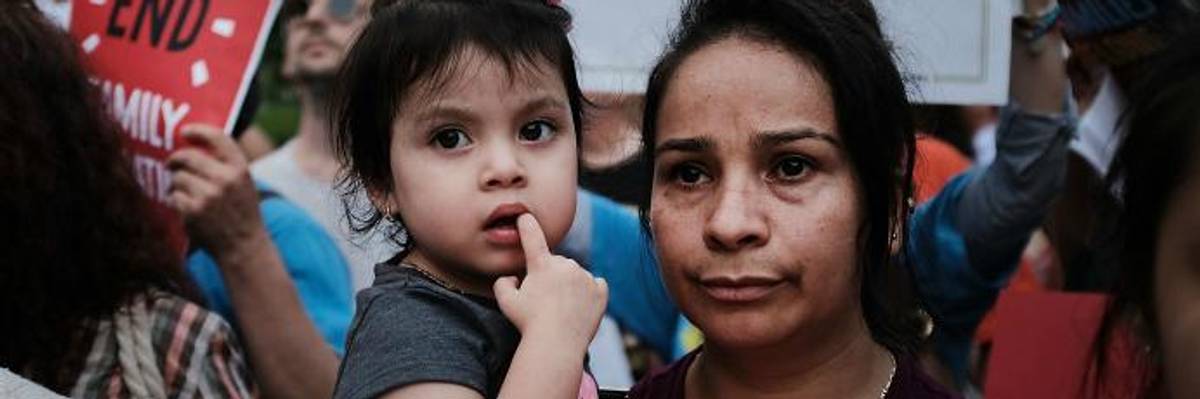
Immigrant rights advocates and others participate in rally and demonstration at the Federal Building in lower Manhattan against the Trump administration's policy that enables federal agents to take migrant children away from their parents at the border. (Photo: Spencer Platt/Getty Images)
Would God Really Snatch a Suckling Baby From Its Mother's Breast?
Trump's evil border policy is a look-the-other-way, not-my-fault species of moral putrefaction brought to you by the most ostentatiously Christian political party in one of the most noisily Christian nations on Earth
What if God were one of us?
Singer Joan Osborne famously asked that question in 1995. In her Grammy-nominated hit, "One Of Us," she envisions the author of all creation as "a slob like one of us, just a stranger on a bus trying to make his way home."
The idea of eternity contained in mortality was controversial. But it turns out that envisioning God as "one of us" is not at all uncommon. Indeed, our conceptions of God tend to be colored, perhaps inevitably, by our social affiliations. So says a new study in which University of North Carolina at Chapel Hill researchers tested 511 American Christians to see how they envision God.
The one thing respondents agreed on was that God does not resemble Michelangelo's stern old white man with a flowing beard. Other than that, there was no consensus. African Americans saw a God with African-American features. Young people saw a younger God. Liberals saw a loving God with younger, more feminine features. Conservatives saw a God who was white, older and who radiated power.
In other words, when we see God, we see ourselves and our values. But we may want to look again.
Granted, the Christian Bible offers no description. It does, however, say that God is love. And it does obligate God's people to love their neighbors.
Consider that, then consider this: On the same day the study was reported, CNN.com ran a story about an undocumented immigrant from Honduras who says federal authorities grabbed her infant daughter from her as the baby was being breastfed. When the mother complained, she was handcuffed.
It was just the latest outrage of the government's so-called "zero tolerance" immigration policy, i.e., its decision to criminally prosecute every person who attempts to illegally cross the U.S. border. Until that decision last month, detainees primarily faced civil deportation hearings.
Since that decision, hundreds of children have been separated from their parents. Some detainees say U.S. officials told them their children were being taken for baths, then stole them away. They say no one will tell them where their kids are. Toddlers are being left in an unknown land with strangers, crying for parents they cannot find. The emotional trauma America is inflicting on these kids is incalculable.
Let's be clear. No policy of any previous administration justifies this act of state-sponsored cruelty. No concern over border security excuses it. What our country is doing--what we are doing--is not "wrong," it is not "bad," it is not "misguided."
No, this is evil--a just-following-orders, look-the-other-way, not-my-fault species of moral putrefaction brought to you by the most ostentatiously Christian political party in one of the most noisily Christian nations on Earth. The hypocrisy of it reeks to, well...high heaven.
After all, the research says we tend to see God as an idealized version of ourselves. But members of that ostentatiously Christian party should ask themselves: Would God really snatch a suckling baby from its mother's breast? And if the answer is No, does it not suggest that they have made a deity of their fears and animosities, reposed their faith in their own righteous anger?
And heaven help the baby crying for her mother. Heaven help the political prisoner, the rape survivor, the exile, the broken and the abused, the "least of these" who come to this nation of noisy faith, seeking sanctuary. And heaven help us, too. Because we've been arguing the wrong question.
What if God were one of us? No.
What if God were one of them?
An Urgent Message From Our Co-Founder
Dear Common Dreams reader, It’s been nearly 30 years since I co-founded Common Dreams with my late wife, Lina Newhouser. We had the radical notion that journalism should serve the public good, not corporate profits. It was clear to us from the outset what it would take to build such a project. No paid advertisements. No corporate sponsors. No millionaire publisher telling us what to think or do. Many people said we wouldn't last a year, but we proved those doubters wrong. Together with a tremendous team of journalists and dedicated staff, we built an independent media outlet free from the constraints of profits and corporate control. Our mission has always been simple: To inform. To inspire. To ignite change for the common good. Building Common Dreams was not easy. Our survival was never guaranteed. When you take on the most powerful forces—Wall Street greed, fossil fuel industry destruction, Big Tech lobbyists, and uber-rich oligarchs who have spent billions upon billions rigging the economy and democracy in their favor—the only bulwark you have is supporters who believe in your work. But here’s the urgent message from me today. It's never been this bad out there. And it's never been this hard to keep us going. At the very moment Common Dreams is most needed, the threats we face are intensifying. We need your support now more than ever. We don't accept corporate advertising and never will. We don't have a paywall because we don't think people should be blocked from critical news based on their ability to pay. Everything we do is funded by the donations of readers like you. When everyone does the little they can afford, we are strong. But if that support retreats or dries up, so do we. Will you donate now to make sure Common Dreams not only survives but thrives? —Craig Brown, Co-founder |
What if God were one of us?
Singer Joan Osborne famously asked that question in 1995. In her Grammy-nominated hit, "One Of Us," she envisions the author of all creation as "a slob like one of us, just a stranger on a bus trying to make his way home."
The idea of eternity contained in mortality was controversial. But it turns out that envisioning God as "one of us" is not at all uncommon. Indeed, our conceptions of God tend to be colored, perhaps inevitably, by our social affiliations. So says a new study in which University of North Carolina at Chapel Hill researchers tested 511 American Christians to see how they envision God.
The one thing respondents agreed on was that God does not resemble Michelangelo's stern old white man with a flowing beard. Other than that, there was no consensus. African Americans saw a God with African-American features. Young people saw a younger God. Liberals saw a loving God with younger, more feminine features. Conservatives saw a God who was white, older and who radiated power.
In other words, when we see God, we see ourselves and our values. But we may want to look again.
Granted, the Christian Bible offers no description. It does, however, say that God is love. And it does obligate God's people to love their neighbors.
Consider that, then consider this: On the same day the study was reported, CNN.com ran a story about an undocumented immigrant from Honduras who says federal authorities grabbed her infant daughter from her as the baby was being breastfed. When the mother complained, she was handcuffed.
It was just the latest outrage of the government's so-called "zero tolerance" immigration policy, i.e., its decision to criminally prosecute every person who attempts to illegally cross the U.S. border. Until that decision last month, detainees primarily faced civil deportation hearings.
Since that decision, hundreds of children have been separated from their parents. Some detainees say U.S. officials told them their children were being taken for baths, then stole them away. They say no one will tell them where their kids are. Toddlers are being left in an unknown land with strangers, crying for parents they cannot find. The emotional trauma America is inflicting on these kids is incalculable.
Let's be clear. No policy of any previous administration justifies this act of state-sponsored cruelty. No concern over border security excuses it. What our country is doing--what we are doing--is not "wrong," it is not "bad," it is not "misguided."
No, this is evil--a just-following-orders, look-the-other-way, not-my-fault species of moral putrefaction brought to you by the most ostentatiously Christian political party in one of the most noisily Christian nations on Earth. The hypocrisy of it reeks to, well...high heaven.
After all, the research says we tend to see God as an idealized version of ourselves. But members of that ostentatiously Christian party should ask themselves: Would God really snatch a suckling baby from its mother's breast? And if the answer is No, does it not suggest that they have made a deity of their fears and animosities, reposed their faith in their own righteous anger?
And heaven help the baby crying for her mother. Heaven help the political prisoner, the rape survivor, the exile, the broken and the abused, the "least of these" who come to this nation of noisy faith, seeking sanctuary. And heaven help us, too. Because we've been arguing the wrong question.
What if God were one of us? No.
What if God were one of them?
What if God were one of us?
Singer Joan Osborne famously asked that question in 1995. In her Grammy-nominated hit, "One Of Us," she envisions the author of all creation as "a slob like one of us, just a stranger on a bus trying to make his way home."
The idea of eternity contained in mortality was controversial. But it turns out that envisioning God as "one of us" is not at all uncommon. Indeed, our conceptions of God tend to be colored, perhaps inevitably, by our social affiliations. So says a new study in which University of North Carolina at Chapel Hill researchers tested 511 American Christians to see how they envision God.
The one thing respondents agreed on was that God does not resemble Michelangelo's stern old white man with a flowing beard. Other than that, there was no consensus. African Americans saw a God with African-American features. Young people saw a younger God. Liberals saw a loving God with younger, more feminine features. Conservatives saw a God who was white, older and who radiated power.
In other words, when we see God, we see ourselves and our values. But we may want to look again.
Granted, the Christian Bible offers no description. It does, however, say that God is love. And it does obligate God's people to love their neighbors.
Consider that, then consider this: On the same day the study was reported, CNN.com ran a story about an undocumented immigrant from Honduras who says federal authorities grabbed her infant daughter from her as the baby was being breastfed. When the mother complained, she was handcuffed.
It was just the latest outrage of the government's so-called "zero tolerance" immigration policy, i.e., its decision to criminally prosecute every person who attempts to illegally cross the U.S. border. Until that decision last month, detainees primarily faced civil deportation hearings.
Since that decision, hundreds of children have been separated from their parents. Some detainees say U.S. officials told them their children were being taken for baths, then stole them away. They say no one will tell them where their kids are. Toddlers are being left in an unknown land with strangers, crying for parents they cannot find. The emotional trauma America is inflicting on these kids is incalculable.
Let's be clear. No policy of any previous administration justifies this act of state-sponsored cruelty. No concern over border security excuses it. What our country is doing--what we are doing--is not "wrong," it is not "bad," it is not "misguided."
No, this is evil--a just-following-orders, look-the-other-way, not-my-fault species of moral putrefaction brought to you by the most ostentatiously Christian political party in one of the most noisily Christian nations on Earth. The hypocrisy of it reeks to, well...high heaven.
After all, the research says we tend to see God as an idealized version of ourselves. But members of that ostentatiously Christian party should ask themselves: Would God really snatch a suckling baby from its mother's breast? And if the answer is No, does it not suggest that they have made a deity of their fears and animosities, reposed their faith in their own righteous anger?
And heaven help the baby crying for her mother. Heaven help the political prisoner, the rape survivor, the exile, the broken and the abused, the "least of these" who come to this nation of noisy faith, seeking sanctuary. And heaven help us, too. Because we've been arguing the wrong question.
What if God were one of us? No.
What if God were one of them?