SUBSCRIBE TO OUR FREE NEWSLETTER
Daily news & progressive opinion—funded by the people, not the corporations—delivered straight to your inbox.
5
#000000
#FFFFFF
To donate by check, phone, or other method, see our More Ways to Give page.


Daily news & progressive opinion—funded by the people, not the corporations—delivered straight to your inbox.

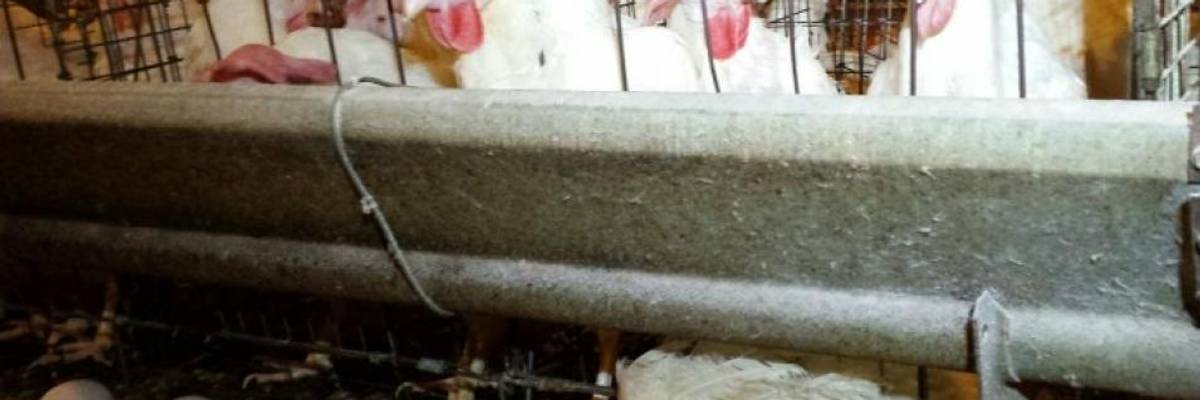
At the Hillandale facility in Turner, Maine, a hen lies trapped under the wires of her cage. Many birds become trapped by their wings, necks, and legs, and are unable to reach food or water. (Photo: The HSUS)
You don't find what you're not looking for, or so the saying goes.
Big Ag has been able to keep what they're doing behind closed doors for decades. There's a reason why we know very little about what happens on factory farms.
"Over the past several decades, more and more whistleblowers and undercover investigations have alerted the public to the atrocities happening behind these closed doors."
Sympathetic legislators have helped make sure no one finds anything out of the ordinary in any of these facilities - they've made it as close to illegal as possible for people to even look at these operations.
We only have whistleblowers to thank for what we do know. Over the years, brave people have come forward and revealed dangerous and unhealthy conditions in industrial animal agriculture facilities.
This goes all the way back to the days of Upton Sinclair's The Jungle.
In this important book, Sinclair disclosed the harsh reality inside Chicago's meatpacking plants in the early 1900's. And since then, whistleblowers have found their way inside industrial factory farms and revealed equally, if not worse, animal welfare abuses, horrific working conditions, and countless food safety violations.
As we continue to grapple with the mess that has become our food industry, one question comes to the forefront:
Thousands of pigs confined to gestation crates, hundreds of thousands of de-beaked chickens unable to walk, dairy cows standing in a slurry of their own manure-- these conditions violate our sensibilities-- and occasionally our laws.
And this is a Big Threat to Big Ag.
Over the past several decades, more and more whistleblowers and undercover investigations have alerted the public to the atrocities happening behind these closed doors.
We're talking really gruesome Okja-esque scenarios:
These conditions are disgusting instances of animal abuse, and they also pose a great risk to public health, our food supply, and the environment.
Here's the real kicker: Big Ag has so much influence over our elected officials that their profits trump the safety of our food supply. Instead of fixing unhealthy, unethical, or inhumane conditions, several states have instead criminalized whistleblowing-- so that it's even less likely these abuses would ever be brought to light. "Ag-gag" laws punish whistleblowers from disclosing conditions within industrial agricultural facilities.
This legislation has been defeated in over 20 states, but it's been enacted in 11. Of these, laws have been struck down in three (Utah, Idaho, and Wyoming) and are currently being challenged in Iowa and North Carolina.
North Carolina's law is written so broadly that it would also ban undercover investigations of any private entity, including nursing homes and daycare centers. Food & Water Watch is a plaintiff, being represented by Public Justice, in the challenge to North Carolina's law along with eight other animal welfare, press freedom, food safety, and government watchdog groups.
A federal district court recently threw out our lawsuit due to a lack of standing, but just this week the United States Court of Appeals for the Fourth Circuit ruled that the lawsuit can go forward, reversing the decision of the federal district court.
But ag-gag laws are just the tip of the iceberg.
The real solution to this problem is to get rid of factory farms entirely, and that's why we're calling on elected officials at all levels of government to take steps to overhaul our food system. We need equitable and sustainable public policy in order to fundamentally change the the way we produce food in the U.S., and that starts with a ban on factory farms.

Dear Common Dreams reader, It’s been nearly 30 years since I co-founded Common Dreams with my late wife, Lina Newhouser. We had the radical notion that journalism should serve the public good, not corporate profits. It was clear to us from the outset what it would take to build such a project. No paid advertisements. No corporate sponsors. No millionaire publisher telling us what to think or do. Many people said we wouldn't last a year, but we proved those doubters wrong. Together with a tremendous team of journalists and dedicated staff, we built an independent media outlet free from the constraints of profits and corporate control. Our mission has always been simple: To inform. To inspire. To ignite change for the common good. Building Common Dreams was not easy. Our survival was never guaranteed. When you take on the most powerful forces—Wall Street greed, fossil fuel industry destruction, Big Tech lobbyists, and uber-rich oligarchs who have spent billions upon billions rigging the economy and democracy in their favor—the only bulwark you have is supporters who believe in your work. But here’s the urgent message from me today. It's never been this bad out there. And it's never been this hard to keep us going. At the very moment Common Dreams is most needed, the threats we face are intensifying. We need your support now more than ever. We don't accept corporate advertising and never will. We don't have a paywall because we don't think people should be blocked from critical news based on their ability to pay. Everything we do is funded by the donations of readers like you. When everyone does the little they can afford, we are strong. But if that support retreats or dries up, so do we. Will you donate now to make sure Common Dreams not only survives but thrives? —Craig Brown, Co-founder |
You don't find what you're not looking for, or so the saying goes.
Big Ag has been able to keep what they're doing behind closed doors for decades. There's a reason why we know very little about what happens on factory farms.
"Over the past several decades, more and more whistleblowers and undercover investigations have alerted the public to the atrocities happening behind these closed doors."
Sympathetic legislators have helped make sure no one finds anything out of the ordinary in any of these facilities - they've made it as close to illegal as possible for people to even look at these operations.
We only have whistleblowers to thank for what we do know. Over the years, brave people have come forward and revealed dangerous and unhealthy conditions in industrial animal agriculture facilities.
This goes all the way back to the days of Upton Sinclair's The Jungle.
In this important book, Sinclair disclosed the harsh reality inside Chicago's meatpacking plants in the early 1900's. And since then, whistleblowers have found their way inside industrial factory farms and revealed equally, if not worse, animal welfare abuses, horrific working conditions, and countless food safety violations.
As we continue to grapple with the mess that has become our food industry, one question comes to the forefront:
Thousands of pigs confined to gestation crates, hundreds of thousands of de-beaked chickens unable to walk, dairy cows standing in a slurry of their own manure-- these conditions violate our sensibilities-- and occasionally our laws.
And this is a Big Threat to Big Ag.
Over the past several decades, more and more whistleblowers and undercover investigations have alerted the public to the atrocities happening behind these closed doors.
We're talking really gruesome Okja-esque scenarios:
These conditions are disgusting instances of animal abuse, and they also pose a great risk to public health, our food supply, and the environment.
Here's the real kicker: Big Ag has so much influence over our elected officials that their profits trump the safety of our food supply. Instead of fixing unhealthy, unethical, or inhumane conditions, several states have instead criminalized whistleblowing-- so that it's even less likely these abuses would ever be brought to light. "Ag-gag" laws punish whistleblowers from disclosing conditions within industrial agricultural facilities.
This legislation has been defeated in over 20 states, but it's been enacted in 11. Of these, laws have been struck down in three (Utah, Idaho, and Wyoming) and are currently being challenged in Iowa and North Carolina.
North Carolina's law is written so broadly that it would also ban undercover investigations of any private entity, including nursing homes and daycare centers. Food & Water Watch is a plaintiff, being represented by Public Justice, in the challenge to North Carolina's law along with eight other animal welfare, press freedom, food safety, and government watchdog groups.
A federal district court recently threw out our lawsuit due to a lack of standing, but just this week the United States Court of Appeals for the Fourth Circuit ruled that the lawsuit can go forward, reversing the decision of the federal district court.
But ag-gag laws are just the tip of the iceberg.
The real solution to this problem is to get rid of factory farms entirely, and that's why we're calling on elected officials at all levels of government to take steps to overhaul our food system. We need equitable and sustainable public policy in order to fundamentally change the the way we produce food in the U.S., and that starts with a ban on factory farms.
You don't find what you're not looking for, or so the saying goes.
Big Ag has been able to keep what they're doing behind closed doors for decades. There's a reason why we know very little about what happens on factory farms.
"Over the past several decades, more and more whistleblowers and undercover investigations have alerted the public to the atrocities happening behind these closed doors."
Sympathetic legislators have helped make sure no one finds anything out of the ordinary in any of these facilities - they've made it as close to illegal as possible for people to even look at these operations.
We only have whistleblowers to thank for what we do know. Over the years, brave people have come forward and revealed dangerous and unhealthy conditions in industrial animal agriculture facilities.
This goes all the way back to the days of Upton Sinclair's The Jungle.
In this important book, Sinclair disclosed the harsh reality inside Chicago's meatpacking plants in the early 1900's. And since then, whistleblowers have found their way inside industrial factory farms and revealed equally, if not worse, animal welfare abuses, horrific working conditions, and countless food safety violations.
As we continue to grapple with the mess that has become our food industry, one question comes to the forefront:
Thousands of pigs confined to gestation crates, hundreds of thousands of de-beaked chickens unable to walk, dairy cows standing in a slurry of their own manure-- these conditions violate our sensibilities-- and occasionally our laws.
And this is a Big Threat to Big Ag.
Over the past several decades, more and more whistleblowers and undercover investigations have alerted the public to the atrocities happening behind these closed doors.
We're talking really gruesome Okja-esque scenarios:
These conditions are disgusting instances of animal abuse, and they also pose a great risk to public health, our food supply, and the environment.
Here's the real kicker: Big Ag has so much influence over our elected officials that their profits trump the safety of our food supply. Instead of fixing unhealthy, unethical, or inhumane conditions, several states have instead criminalized whistleblowing-- so that it's even less likely these abuses would ever be brought to light. "Ag-gag" laws punish whistleblowers from disclosing conditions within industrial agricultural facilities.
This legislation has been defeated in over 20 states, but it's been enacted in 11. Of these, laws have been struck down in three (Utah, Idaho, and Wyoming) and are currently being challenged in Iowa and North Carolina.
North Carolina's law is written so broadly that it would also ban undercover investigations of any private entity, including nursing homes and daycare centers. Food & Water Watch is a plaintiff, being represented by Public Justice, in the challenge to North Carolina's law along with eight other animal welfare, press freedom, food safety, and government watchdog groups.
A federal district court recently threw out our lawsuit due to a lack of standing, but just this week the United States Court of Appeals for the Fourth Circuit ruled that the lawsuit can go forward, reversing the decision of the federal district court.
But ag-gag laws are just the tip of the iceberg.
The real solution to this problem is to get rid of factory farms entirely, and that's why we're calling on elected officials at all levels of government to take steps to overhaul our food system. We need equitable and sustainable public policy in order to fundamentally change the the way we produce food in the U.S., and that starts with a ban on factory farms.