SUBSCRIBE TO OUR FREE NEWSLETTER
Daily news & progressive opinion—funded by the people, not the corporations—delivered straight to your inbox.
5
#000000
#FFFFFF
To donate by check, phone, or other method, see our More Ways to Give page.
Daily news & progressive opinion—funded by the people, not the corporations—delivered straight to your inbox.
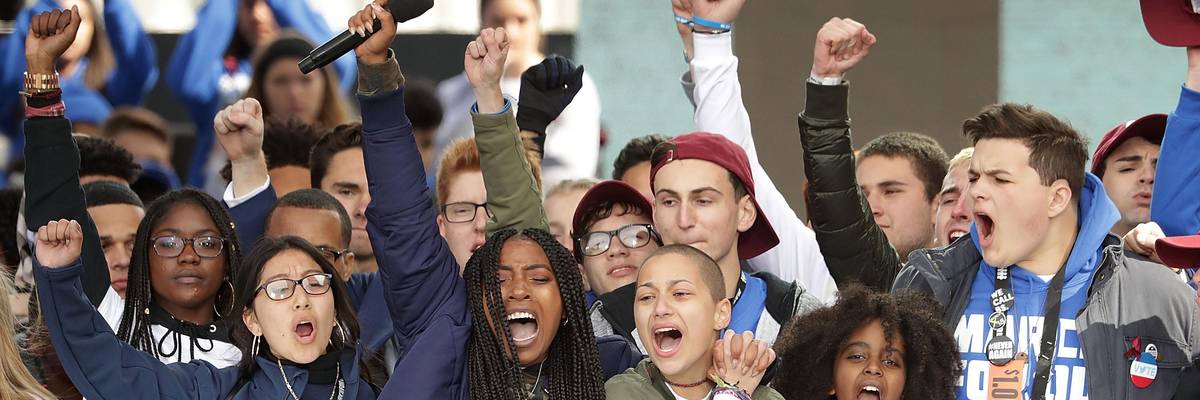
Students from Marjory Stoneman Douglas High School, including Emma Gonzalez (C), stand together on stage with other young victims of gun violence at the conclusion of the March for Our Lives rally on March 24, 2018 in Washington, DC. (Photo: Chip Somodevilla/Getty Images)
On Valentine's Day, 17 people were killed at Marjory Stoneman Douglas High School in Parkland, Fla. Rather than grieve silently or out of public view, student leaders took hold of their own narrative by rejecting the common platitudes of "thoughts and prayers" that are typically offered after such all-too-common tragedies.
The Parkland students demanded action from lawmakers in Tallahassee, from the President and from Congress. In Tallahassee, they achieved the previously unthinkable: improvements on gun control in a state where Republicans control both houses of the legislature and the governor's mansion. Even the President sat down with some Parkland students and other gun violence survivors. In his hand, the President held a card that read, "I hear you." He mumbled about banning bump stocks and then turned his attention elsewhere. And needless to say, the Republican-controlled House and Senate have done nothing to address gun violence since Parkland.
But the Parkland students are resilient, and they have shown savvy and determination in the gun control policy debate, which often resembles a ritualized kabuki play. One of the ways that the students have shown their moxie is by going after the financial ties between the NRA and politicians. They have also gone after the links between commercial brands and the NRA to weaken those sources of financial support. For example, they forced the major airlines to drop discounts for NRA members. They also instigated a boycott of advertisers on Laura Ingraham's Fox News show after she attacked one of the Parkland student leaders. (I warned about the risk of boycotts as a consequence of corporate political activity here.)
My local grocery store, Publix, stepped into this maelstrom when it decided to support Adam Putnam, who is running for the GOP nomination for Florida governor. Putnam has referred to himself as "a proud NRA sellout" who brags about his A+ rating from the group. The Associated Press has reported Publix has given Putnam $413,000 over the past three years.
The Parkland students decided to stage die-ins at two Publix stores near Marjory Stoneman Douglas High School to protest the company's support for Putnam. Publix's reaction was swift. The grocer announced that it would immediately suspend all corporate political donations. The Parkland students are making brands accountable that become entangled in the NRA-politician nexus.
The other way the Parkland students are showing a deft understanding of politics is by encouraging students, many of whom are on the cusp of turning 18, to register to vote and oust politicians cozy with the NRA. Thus, the students may want to keep an eye on a lawsuit by the League of Women Voters of Florida challenging a ban on early voting on Florida state university grounds.
The complaint alleges that the Florida Secretary of State is violating the Constitution by banning early voting on public university grounds, which he has since 2014. This ban makes it harder for college students who live on campus to vote early. The ban also treats them differently than their senior citizen counterparts who often vote early at the senior centers where they live. Plaintiffs in the case raise equal protection claims about disparate treatment of voters because of the campus ban as well as Twenty-Sixth Amendment arguments. (The Twenty-Sixth Amendment lowered the voting age to 18.) In the complaint, the lawyers argue that the voter drives inspired by the Parkland students may be for naught if those new voters find barriers to voting on campus.
This case is just getting started, so it may be a while before Florida college students find a remedy. But if I were the Secretary of State of Florida, I might think about lifting the campus ban and allow early voting because the Parkland students are not playing around. Using the democratic process and political protest, they are fighting for their --and by extension--our lives.
Dear Common Dreams reader, It’s been nearly 30 years since I co-founded Common Dreams with my late wife, Lina Newhouser. We had the radical notion that journalism should serve the public good, not corporate profits. It was clear to us from the outset what it would take to build such a project. No paid advertisements. No corporate sponsors. No millionaire publisher telling us what to think or do. Many people said we wouldn't last a year, but we proved those doubters wrong. Together with a tremendous team of journalists and dedicated staff, we built an independent media outlet free from the constraints of profits and corporate control. Our mission has always been simple: To inform. To inspire. To ignite change for the common good. Building Common Dreams was not easy. Our survival was never guaranteed. When you take on the most powerful forces—Wall Street greed, fossil fuel industry destruction, Big Tech lobbyists, and uber-rich oligarchs who have spent billions upon billions rigging the economy and democracy in their favor—the only bulwark you have is supporters who believe in your work. But here’s the urgent message from me today. It's never been this bad out there. And it's never been this hard to keep us going. At the very moment Common Dreams is most needed, the threats we face are intensifying. We need your support now more than ever. We don't accept corporate advertising and never will. We don't have a paywall because we don't think people should be blocked from critical news based on their ability to pay. Everything we do is funded by the donations of readers like you. When everyone does the little they can afford, we are strong. But if that support retreats or dries up, so do we. Will you donate now to make sure Common Dreams not only survives but thrives? —Craig Brown, Co-founder |
On Valentine's Day, 17 people were killed at Marjory Stoneman Douglas High School in Parkland, Fla. Rather than grieve silently or out of public view, student leaders took hold of their own narrative by rejecting the common platitudes of "thoughts and prayers" that are typically offered after such all-too-common tragedies.
The Parkland students demanded action from lawmakers in Tallahassee, from the President and from Congress. In Tallahassee, they achieved the previously unthinkable: improvements on gun control in a state where Republicans control both houses of the legislature and the governor's mansion. Even the President sat down with some Parkland students and other gun violence survivors. In his hand, the President held a card that read, "I hear you." He mumbled about banning bump stocks and then turned his attention elsewhere. And needless to say, the Republican-controlled House and Senate have done nothing to address gun violence since Parkland.
But the Parkland students are resilient, and they have shown savvy and determination in the gun control policy debate, which often resembles a ritualized kabuki play. One of the ways that the students have shown their moxie is by going after the financial ties between the NRA and politicians. They have also gone after the links between commercial brands and the NRA to weaken those sources of financial support. For example, they forced the major airlines to drop discounts for NRA members. They also instigated a boycott of advertisers on Laura Ingraham's Fox News show after she attacked one of the Parkland student leaders. (I warned about the risk of boycotts as a consequence of corporate political activity here.)
My local grocery store, Publix, stepped into this maelstrom when it decided to support Adam Putnam, who is running for the GOP nomination for Florida governor. Putnam has referred to himself as "a proud NRA sellout" who brags about his A+ rating from the group. The Associated Press has reported Publix has given Putnam $413,000 over the past three years.
The Parkland students decided to stage die-ins at two Publix stores near Marjory Stoneman Douglas High School to protest the company's support for Putnam. Publix's reaction was swift. The grocer announced that it would immediately suspend all corporate political donations. The Parkland students are making brands accountable that become entangled in the NRA-politician nexus.
The other way the Parkland students are showing a deft understanding of politics is by encouraging students, many of whom are on the cusp of turning 18, to register to vote and oust politicians cozy with the NRA. Thus, the students may want to keep an eye on a lawsuit by the League of Women Voters of Florida challenging a ban on early voting on Florida state university grounds.
The complaint alleges that the Florida Secretary of State is violating the Constitution by banning early voting on public university grounds, which he has since 2014. This ban makes it harder for college students who live on campus to vote early. The ban also treats them differently than their senior citizen counterparts who often vote early at the senior centers where they live. Plaintiffs in the case raise equal protection claims about disparate treatment of voters because of the campus ban as well as Twenty-Sixth Amendment arguments. (The Twenty-Sixth Amendment lowered the voting age to 18.) In the complaint, the lawyers argue that the voter drives inspired by the Parkland students may be for naught if those new voters find barriers to voting on campus.
This case is just getting started, so it may be a while before Florida college students find a remedy. But if I were the Secretary of State of Florida, I might think about lifting the campus ban and allow early voting because the Parkland students are not playing around. Using the democratic process and political protest, they are fighting for their --and by extension--our lives.
On Valentine's Day, 17 people were killed at Marjory Stoneman Douglas High School in Parkland, Fla. Rather than grieve silently or out of public view, student leaders took hold of their own narrative by rejecting the common platitudes of "thoughts and prayers" that are typically offered after such all-too-common tragedies.
The Parkland students demanded action from lawmakers in Tallahassee, from the President and from Congress. In Tallahassee, they achieved the previously unthinkable: improvements on gun control in a state where Republicans control both houses of the legislature and the governor's mansion. Even the President sat down with some Parkland students and other gun violence survivors. In his hand, the President held a card that read, "I hear you." He mumbled about banning bump stocks and then turned his attention elsewhere. And needless to say, the Republican-controlled House and Senate have done nothing to address gun violence since Parkland.
But the Parkland students are resilient, and they have shown savvy and determination in the gun control policy debate, which often resembles a ritualized kabuki play. One of the ways that the students have shown their moxie is by going after the financial ties between the NRA and politicians. They have also gone after the links between commercial brands and the NRA to weaken those sources of financial support. For example, they forced the major airlines to drop discounts for NRA members. They also instigated a boycott of advertisers on Laura Ingraham's Fox News show after she attacked one of the Parkland student leaders. (I warned about the risk of boycotts as a consequence of corporate political activity here.)
My local grocery store, Publix, stepped into this maelstrom when it decided to support Adam Putnam, who is running for the GOP nomination for Florida governor. Putnam has referred to himself as "a proud NRA sellout" who brags about his A+ rating from the group. The Associated Press has reported Publix has given Putnam $413,000 over the past three years.
The Parkland students decided to stage die-ins at two Publix stores near Marjory Stoneman Douglas High School to protest the company's support for Putnam. Publix's reaction was swift. The grocer announced that it would immediately suspend all corporate political donations. The Parkland students are making brands accountable that become entangled in the NRA-politician nexus.
The other way the Parkland students are showing a deft understanding of politics is by encouraging students, many of whom are on the cusp of turning 18, to register to vote and oust politicians cozy with the NRA. Thus, the students may want to keep an eye on a lawsuit by the League of Women Voters of Florida challenging a ban on early voting on Florida state university grounds.
The complaint alleges that the Florida Secretary of State is violating the Constitution by banning early voting on public university grounds, which he has since 2014. This ban makes it harder for college students who live on campus to vote early. The ban also treats them differently than their senior citizen counterparts who often vote early at the senior centers where they live. Plaintiffs in the case raise equal protection claims about disparate treatment of voters because of the campus ban as well as Twenty-Sixth Amendment arguments. (The Twenty-Sixth Amendment lowered the voting age to 18.) In the complaint, the lawyers argue that the voter drives inspired by the Parkland students may be for naught if those new voters find barriers to voting on campus.
This case is just getting started, so it may be a while before Florida college students find a remedy. But if I were the Secretary of State of Florida, I might think about lifting the campus ban and allow early voting because the Parkland students are not playing around. Using the democratic process and political protest, they are fighting for their --and by extension--our lives.