SUBSCRIBE TO OUR FREE NEWSLETTER
Daily news & progressive opinion—funded by the people, not the corporations—delivered straight to your inbox.
5
#000000
#FFFFFF
To donate by check, phone, or other method, see our More Ways to Give page.


Daily news & progressive opinion—funded by the people, not the corporations—delivered straight to your inbox.

"It's not hard to understand how it could put a damper on your morale to be working hard and struggling to get by while your boss is being rewarded hundreds -- or even thousands -- of times more than you on payday." (Photo: Shutterstock)
Mattel is one of the largest toy-making companies on earth. Turns out it's one of the biggest manufacturers of income inequality, too.
Last year, the Barbie doll manufacturer paid its CEO nearly 5,000 times as much as its median worker.
This stunning revelation is the result of a new regulation that requires U.S. publicly held corporations to report their CEO-worker pay ratios to the Securities and Exchange Commission.
Mattel's gap is the widest reported so far. But most other big U.S. companies also have staggering divides. According to a new report by the staff of Minnesota Congressman Keith Ellison, the first 225 large corporations to release their numbers had pay ratios averaging 339 to 1.
"This immense inequality is a crisis for our economy and our democracy," said Ellison, a longtime advocate of pay gap disclosure.
What's good for these CEOs, however, is actually bad for business.
A CNBC analysis of the new pay ratio data, for example, suggests that companies with large pay disparities have lower profits per employee.
Why might that be? According to a recent study by a Harvard Business professor, companies tend to perform poorly if workers feel they're not paid fairly. The study's author said workers who feel that way are likely to lack motivation and even quit their jobs.
It's not hard to understand how it could put a damper on your morale to be working hard and struggling to get by while your boss is being rewarded hundreds -- or even thousands -- of times more than you on payday.
Doug Smith, a former partner at the big McKinsey management consulting firm, argues that the economic costs of huge pay gaps go far beyond the problems of low employee morale and high turnover.
"Instead of building a real economy beneficial to all," Smith says, "these unethical pay practices spread outsourcing, offshoring, tax avoidance, downsizing, and the substitution of good-paying permanent jobs with temporary, precarious employment."
There's a growing movement to use the new pay ratio data to encourage corporations to narrow their gaps. Portland, Oregon will soon become the first city to impose a tax penalty on companies with pay gaps above 100 to 1.
Charlie Hales, Portland's mayor when the law was passed in late 2016, argued that it made good business sense to encourage narrower gaps.
In a former job at an employee-owned engineering firm, Hales had seen firsthand how a small pay ratio boosted the bottom line. "Everyone worked a little harder because your success was my success," Hales said. "And that egalitarian culture led to a strong work ethic that drove the corporation to success."
With the new pay ratio data now coming out, lawmakers in six states -- California, Connecticut, Illinois, Massachusetts, Minnesota, and Rhode Island -- are considering Portland-style pay ratio taxes.
Narrowing the divides within U.S. corporations may not automatically leave us all whistling away while we work. But we'll all pay a price if we keep fiddling while extreme inequality burns down our economy.

Dear Common Dreams reader, It’s been nearly 30 years since I co-founded Common Dreams with my late wife, Lina Newhouser. We had the radical notion that journalism should serve the public good, not corporate profits. It was clear to us from the outset what it would take to build such a project. No paid advertisements. No corporate sponsors. No millionaire publisher telling us what to think or do. Many people said we wouldn't last a year, but we proved those doubters wrong. Together with a tremendous team of journalists and dedicated staff, we built an independent media outlet free from the constraints of profits and corporate control. Our mission has always been simple: To inform. To inspire. To ignite change for the common good. Building Common Dreams was not easy. Our survival was never guaranteed. When you take on the most powerful forces—Wall Street greed, fossil fuel industry destruction, Big Tech lobbyists, and uber-rich oligarchs who have spent billions upon billions rigging the economy and democracy in their favor—the only bulwark you have is supporters who believe in your work. But here’s the urgent message from me today. It's never been this bad out there. And it's never been this hard to keep us going. At the very moment Common Dreams is most needed, the threats we face are intensifying. We need your support now more than ever. We don't accept corporate advertising and never will. We don't have a paywall because we don't think people should be blocked from critical news based on their ability to pay. Everything we do is funded by the donations of readers like you. When everyone does the little they can afford, we are strong. But if that support retreats or dries up, so do we. Will you donate now to make sure Common Dreams not only survives but thrives? —Craig Brown, Co-founder |
Mattel is one of the largest toy-making companies on earth. Turns out it's one of the biggest manufacturers of income inequality, too.
Last year, the Barbie doll manufacturer paid its CEO nearly 5,000 times as much as its median worker.
This stunning revelation is the result of a new regulation that requires U.S. publicly held corporations to report their CEO-worker pay ratios to the Securities and Exchange Commission.
Mattel's gap is the widest reported so far. But most other big U.S. companies also have staggering divides. According to a new report by the staff of Minnesota Congressman Keith Ellison, the first 225 large corporations to release their numbers had pay ratios averaging 339 to 1.
"This immense inequality is a crisis for our economy and our democracy," said Ellison, a longtime advocate of pay gap disclosure.
What's good for these CEOs, however, is actually bad for business.
A CNBC analysis of the new pay ratio data, for example, suggests that companies with large pay disparities have lower profits per employee.
Why might that be? According to a recent study by a Harvard Business professor, companies tend to perform poorly if workers feel they're not paid fairly. The study's author said workers who feel that way are likely to lack motivation and even quit their jobs.
It's not hard to understand how it could put a damper on your morale to be working hard and struggling to get by while your boss is being rewarded hundreds -- or even thousands -- of times more than you on payday.
Doug Smith, a former partner at the big McKinsey management consulting firm, argues that the economic costs of huge pay gaps go far beyond the problems of low employee morale and high turnover.
"Instead of building a real economy beneficial to all," Smith says, "these unethical pay practices spread outsourcing, offshoring, tax avoidance, downsizing, and the substitution of good-paying permanent jobs with temporary, precarious employment."
There's a growing movement to use the new pay ratio data to encourage corporations to narrow their gaps. Portland, Oregon will soon become the first city to impose a tax penalty on companies with pay gaps above 100 to 1.
Charlie Hales, Portland's mayor when the law was passed in late 2016, argued that it made good business sense to encourage narrower gaps.
In a former job at an employee-owned engineering firm, Hales had seen firsthand how a small pay ratio boosted the bottom line. "Everyone worked a little harder because your success was my success," Hales said. "And that egalitarian culture led to a strong work ethic that drove the corporation to success."
With the new pay ratio data now coming out, lawmakers in six states -- California, Connecticut, Illinois, Massachusetts, Minnesota, and Rhode Island -- are considering Portland-style pay ratio taxes.
Narrowing the divides within U.S. corporations may not automatically leave us all whistling away while we work. But we'll all pay a price if we keep fiddling while extreme inequality burns down our economy.
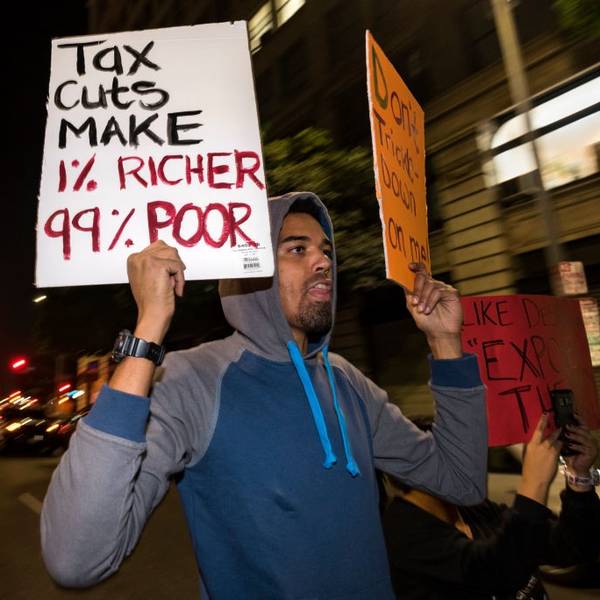
Mattel is one of the largest toy-making companies on earth. Turns out it's one of the biggest manufacturers of income inequality, too.
Last year, the Barbie doll manufacturer paid its CEO nearly 5,000 times as much as its median worker.
This stunning revelation is the result of a new regulation that requires U.S. publicly held corporations to report their CEO-worker pay ratios to the Securities and Exchange Commission.
Mattel's gap is the widest reported so far. But most other big U.S. companies also have staggering divides. According to a new report by the staff of Minnesota Congressman Keith Ellison, the first 225 large corporations to release their numbers had pay ratios averaging 339 to 1.
"This immense inequality is a crisis for our economy and our democracy," said Ellison, a longtime advocate of pay gap disclosure.
What's good for these CEOs, however, is actually bad for business.
A CNBC analysis of the new pay ratio data, for example, suggests that companies with large pay disparities have lower profits per employee.
Why might that be? According to a recent study by a Harvard Business professor, companies tend to perform poorly if workers feel they're not paid fairly. The study's author said workers who feel that way are likely to lack motivation and even quit their jobs.
It's not hard to understand how it could put a damper on your morale to be working hard and struggling to get by while your boss is being rewarded hundreds -- or even thousands -- of times more than you on payday.
Doug Smith, a former partner at the big McKinsey management consulting firm, argues that the economic costs of huge pay gaps go far beyond the problems of low employee morale and high turnover.
"Instead of building a real economy beneficial to all," Smith says, "these unethical pay practices spread outsourcing, offshoring, tax avoidance, downsizing, and the substitution of good-paying permanent jobs with temporary, precarious employment."
There's a growing movement to use the new pay ratio data to encourage corporations to narrow their gaps. Portland, Oregon will soon become the first city to impose a tax penalty on companies with pay gaps above 100 to 1.
Charlie Hales, Portland's mayor when the law was passed in late 2016, argued that it made good business sense to encourage narrower gaps.
In a former job at an employee-owned engineering firm, Hales had seen firsthand how a small pay ratio boosted the bottom line. "Everyone worked a little harder because your success was my success," Hales said. "And that egalitarian culture led to a strong work ethic that drove the corporation to success."
With the new pay ratio data now coming out, lawmakers in six states -- California, Connecticut, Illinois, Massachusetts, Minnesota, and Rhode Island -- are considering Portland-style pay ratio taxes.
Narrowing the divides within U.S. corporations may not automatically leave us all whistling away while we work. But we'll all pay a price if we keep fiddling while extreme inequality burns down our economy.