SUBSCRIBE TO OUR FREE NEWSLETTER
Daily news & progressive opinion—funded by the people, not the corporations—delivered straight to your inbox.
5
#000000
#FFFFFF
To donate by check, phone, or other method, see our More Ways to Give page.
Daily news & progressive opinion—funded by the people, not the corporations—delivered straight to your inbox.
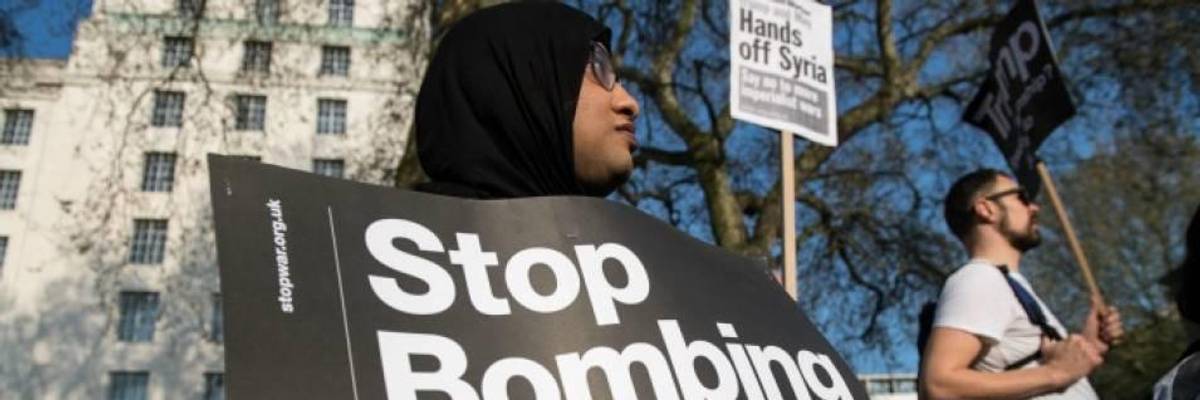
"American political culture has devolved from the Vietnam era, when pacifists were marginalized, to a kneejerk bellicosity in which they don't exist as part of the debate." (Photo: Chris J Ratcliffe/Getty Images)
At this writing, President Trump is considering "the possibility of retaliation in Syria in response to a suspected chemical attack on young children and families in the Syrian city of Douma," reported CBS News. "If it's the Russians, if it's Syria, if it's Iran, if it's all of them together, we'll figure it out," Trump said. "Nothing's off the table," including a military attack by the United States.
Whether that possibility involves a cruise missile strike, drone attacks or conventional bombing raids by fighter jets, this is deadly serious business. People, mostly innocent civilians and Syrian grunts who had nothing to do with the "suspected" chemical attack, will die. People will be injured. Survivors will be traumatized. An attack could escalate and expand the current conflict, leading to more death and destruction.
The stakes are high, but U.S. policymakers are as glibly insouciant as if they were choosing between Hulu and Netflix. This is not new or Trumpian. It's always been like this. American leaders don't take these life-and-death decisions seriously.
If the United States were a sane country populated by rational, civically-engaged citizens, Americans would pour derision and ridicule on anyone who seriously considered raining bombs over a "suspected" anything. And the skepticism in this case ought to be exponentially greater considering that this is Syria.
We've already been down this "Syria's Assad regime used chemical weapons against their own people so we should bomb his forces" road. It happened under Obama. What is certain here is uncertainty: maybe it's true, maybe it's not. As legendary investigative journalist Seymour Hersh pointed out in 2014, the Defense Intelligence Agency (DIA) believed that at least one major faction of the Syrian opposition, the al-Nusra Front, possessed significant manufacturing facilities and stockpiles of sarin nerve agent and other proscribed toxic chemicals.
Whatever happened to innocent until proven guilty? Since when is "maybe they did it, maybe they didn't, oh well" sufficient?
American political culture has devolved from the Vietnam era, when pacifists were marginalized, to a kneejerk bellicosity in which they don't exist as part of the debate.
To its credit, The New York Times -- still with blood on its hands from its unwholesome publishing of Judith Miller's pro-Iraq War screeds -- has printed statements by those who oppose rushing into war with Syria. "We would prefer to start with a proper investigation," the newspaper quoted Britain's ambassador to the United Nations. It also ran letters to the editor that expressed doubts about Syria's motivations and Trump's trustworthiness.
Nowhere to be found was a pacifist: someone who opposes war, all war, no matter what. Nor were there any anti-interventionists: people who say Syria is not our business and should be left to sort out its own affairs.
It's the same at The Washington Post. Some writers there wonder aloud whether Trump's sabre-rattling is more "Wag the Dog" than "Doctor Strangelove": if he bombs Syria, will it be to take our minds off the Russia stuff? Also, weirdly, this headline: "Something for Trump to keep in mind on Syria: His strikes last year were pretty popular." How does Amber Phillips sleep at night? Again: no pacifists. No anti-interventionists.
It's not like they're not out there in Real America. The nativist America Firsters who formed the core of Team Trump in 2016 included a lot of isolationists -- and Trump ran on a no-more-nation-building platform. They're disgusted more by the cost of the bombs we drop on Muslim countries than the lives they destroy; if there's any nation-building to be done, they ask quite reasonably, why not start with America's own rusted-out, broken-down infrastructure?
Getting the paper out every day is a miracle. Editors can be forgiven for sometimes forgetting to cover all the bases by offering a wide spectrum of solutions to the problems covered by their news stories and debated in their opinion sections. The same goes for the producers laboring through cable news' 24-7 news cycle. At a certain point, however, they ought to take a step back and consider the effect of their editorial decisions. They've created a relentless culture of ultraviolence, a debate without diversity between those who want bombs and those who want even more wars, to the point that not going to war isn't even something we get to consider as a legitimate option.
Dear Common Dreams reader, It’s been nearly 30 years since I co-founded Common Dreams with my late wife, Lina Newhouser. We had the radical notion that journalism should serve the public good, not corporate profits. It was clear to us from the outset what it would take to build such a project. No paid advertisements. No corporate sponsors. No millionaire publisher telling us what to think or do. Many people said we wouldn't last a year, but we proved those doubters wrong. Together with a tremendous team of journalists and dedicated staff, we built an independent media outlet free from the constraints of profits and corporate control. Our mission has always been simple: To inform. To inspire. To ignite change for the common good. Building Common Dreams was not easy. Our survival was never guaranteed. When you take on the most powerful forces—Wall Street greed, fossil fuel industry destruction, Big Tech lobbyists, and uber-rich oligarchs who have spent billions upon billions rigging the economy and democracy in their favor—the only bulwark you have is supporters who believe in your work. But here’s the urgent message from me today. It's never been this bad out there. And it's never been this hard to keep us going. At the very moment Common Dreams is most needed, the threats we face are intensifying. We need your support now more than ever. We don't accept corporate advertising and never will. We don't have a paywall because we don't think people should be blocked from critical news based on their ability to pay. Everything we do is funded by the donations of readers like you. When everyone does the little they can afford, we are strong. But if that support retreats or dries up, so do we. Will you donate now to make sure Common Dreams not only survives but thrives? —Craig Brown, Co-founder |
At this writing, President Trump is considering "the possibility of retaliation in Syria in response to a suspected chemical attack on young children and families in the Syrian city of Douma," reported CBS News. "If it's the Russians, if it's Syria, if it's Iran, if it's all of them together, we'll figure it out," Trump said. "Nothing's off the table," including a military attack by the United States.
Whether that possibility involves a cruise missile strike, drone attacks or conventional bombing raids by fighter jets, this is deadly serious business. People, mostly innocent civilians and Syrian grunts who had nothing to do with the "suspected" chemical attack, will die. People will be injured. Survivors will be traumatized. An attack could escalate and expand the current conflict, leading to more death and destruction.
The stakes are high, but U.S. policymakers are as glibly insouciant as if they were choosing between Hulu and Netflix. This is not new or Trumpian. It's always been like this. American leaders don't take these life-and-death decisions seriously.
If the United States were a sane country populated by rational, civically-engaged citizens, Americans would pour derision and ridicule on anyone who seriously considered raining bombs over a "suspected" anything. And the skepticism in this case ought to be exponentially greater considering that this is Syria.
We've already been down this "Syria's Assad regime used chemical weapons against their own people so we should bomb his forces" road. It happened under Obama. What is certain here is uncertainty: maybe it's true, maybe it's not. As legendary investigative journalist Seymour Hersh pointed out in 2014, the Defense Intelligence Agency (DIA) believed that at least one major faction of the Syrian opposition, the al-Nusra Front, possessed significant manufacturing facilities and stockpiles of sarin nerve agent and other proscribed toxic chemicals.
Whatever happened to innocent until proven guilty? Since when is "maybe they did it, maybe they didn't, oh well" sufficient?
American political culture has devolved from the Vietnam era, when pacifists were marginalized, to a kneejerk bellicosity in which they don't exist as part of the debate.
To its credit, The New York Times -- still with blood on its hands from its unwholesome publishing of Judith Miller's pro-Iraq War screeds -- has printed statements by those who oppose rushing into war with Syria. "We would prefer to start with a proper investigation," the newspaper quoted Britain's ambassador to the United Nations. It also ran letters to the editor that expressed doubts about Syria's motivations and Trump's trustworthiness.
Nowhere to be found was a pacifist: someone who opposes war, all war, no matter what. Nor were there any anti-interventionists: people who say Syria is not our business and should be left to sort out its own affairs.
It's the same at The Washington Post. Some writers there wonder aloud whether Trump's sabre-rattling is more "Wag the Dog" than "Doctor Strangelove": if he bombs Syria, will it be to take our minds off the Russia stuff? Also, weirdly, this headline: "Something for Trump to keep in mind on Syria: His strikes last year were pretty popular." How does Amber Phillips sleep at night? Again: no pacifists. No anti-interventionists.
It's not like they're not out there in Real America. The nativist America Firsters who formed the core of Team Trump in 2016 included a lot of isolationists -- and Trump ran on a no-more-nation-building platform. They're disgusted more by the cost of the bombs we drop on Muslim countries than the lives they destroy; if there's any nation-building to be done, they ask quite reasonably, why not start with America's own rusted-out, broken-down infrastructure?
Getting the paper out every day is a miracle. Editors can be forgiven for sometimes forgetting to cover all the bases by offering a wide spectrum of solutions to the problems covered by their news stories and debated in their opinion sections. The same goes for the producers laboring through cable news' 24-7 news cycle. At a certain point, however, they ought to take a step back and consider the effect of their editorial decisions. They've created a relentless culture of ultraviolence, a debate without diversity between those who want bombs and those who want even more wars, to the point that not going to war isn't even something we get to consider as a legitimate option.
At this writing, President Trump is considering "the possibility of retaliation in Syria in response to a suspected chemical attack on young children and families in the Syrian city of Douma," reported CBS News. "If it's the Russians, if it's Syria, if it's Iran, if it's all of them together, we'll figure it out," Trump said. "Nothing's off the table," including a military attack by the United States.
Whether that possibility involves a cruise missile strike, drone attacks or conventional bombing raids by fighter jets, this is deadly serious business. People, mostly innocent civilians and Syrian grunts who had nothing to do with the "suspected" chemical attack, will die. People will be injured. Survivors will be traumatized. An attack could escalate and expand the current conflict, leading to more death and destruction.
The stakes are high, but U.S. policymakers are as glibly insouciant as if they were choosing between Hulu and Netflix. This is not new or Trumpian. It's always been like this. American leaders don't take these life-and-death decisions seriously.
If the United States were a sane country populated by rational, civically-engaged citizens, Americans would pour derision and ridicule on anyone who seriously considered raining bombs over a "suspected" anything. And the skepticism in this case ought to be exponentially greater considering that this is Syria.
We've already been down this "Syria's Assad regime used chemical weapons against their own people so we should bomb his forces" road. It happened under Obama. What is certain here is uncertainty: maybe it's true, maybe it's not. As legendary investigative journalist Seymour Hersh pointed out in 2014, the Defense Intelligence Agency (DIA) believed that at least one major faction of the Syrian opposition, the al-Nusra Front, possessed significant manufacturing facilities and stockpiles of sarin nerve agent and other proscribed toxic chemicals.
Whatever happened to innocent until proven guilty? Since when is "maybe they did it, maybe they didn't, oh well" sufficient?
American political culture has devolved from the Vietnam era, when pacifists were marginalized, to a kneejerk bellicosity in which they don't exist as part of the debate.
To its credit, The New York Times -- still with blood on its hands from its unwholesome publishing of Judith Miller's pro-Iraq War screeds -- has printed statements by those who oppose rushing into war with Syria. "We would prefer to start with a proper investigation," the newspaper quoted Britain's ambassador to the United Nations. It also ran letters to the editor that expressed doubts about Syria's motivations and Trump's trustworthiness.
Nowhere to be found was a pacifist: someone who opposes war, all war, no matter what. Nor were there any anti-interventionists: people who say Syria is not our business and should be left to sort out its own affairs.
It's the same at The Washington Post. Some writers there wonder aloud whether Trump's sabre-rattling is more "Wag the Dog" than "Doctor Strangelove": if he bombs Syria, will it be to take our minds off the Russia stuff? Also, weirdly, this headline: "Something for Trump to keep in mind on Syria: His strikes last year were pretty popular." How does Amber Phillips sleep at night? Again: no pacifists. No anti-interventionists.
It's not like they're not out there in Real America. The nativist America Firsters who formed the core of Team Trump in 2016 included a lot of isolationists -- and Trump ran on a no-more-nation-building platform. They're disgusted more by the cost of the bombs we drop on Muslim countries than the lives they destroy; if there's any nation-building to be done, they ask quite reasonably, why not start with America's own rusted-out, broken-down infrastructure?
Getting the paper out every day is a miracle. Editors can be forgiven for sometimes forgetting to cover all the bases by offering a wide spectrum of solutions to the problems covered by their news stories and debated in their opinion sections. The same goes for the producers laboring through cable news' 24-7 news cycle. At a certain point, however, they ought to take a step back and consider the effect of their editorial decisions. They've created a relentless culture of ultraviolence, a debate without diversity between those who want bombs and those who want even more wars, to the point that not going to war isn't even something we get to consider as a legitimate option.