SUBSCRIBE TO OUR FREE NEWSLETTER
Daily news & progressive opinion—funded by the people, not the corporations—delivered straight to your inbox.
5
#000000
#FFFFFF
To donate by check, phone, or other method, see our More Ways to Give page.
Daily news & progressive opinion—funded by the people, not the corporations—delivered straight to your inbox.
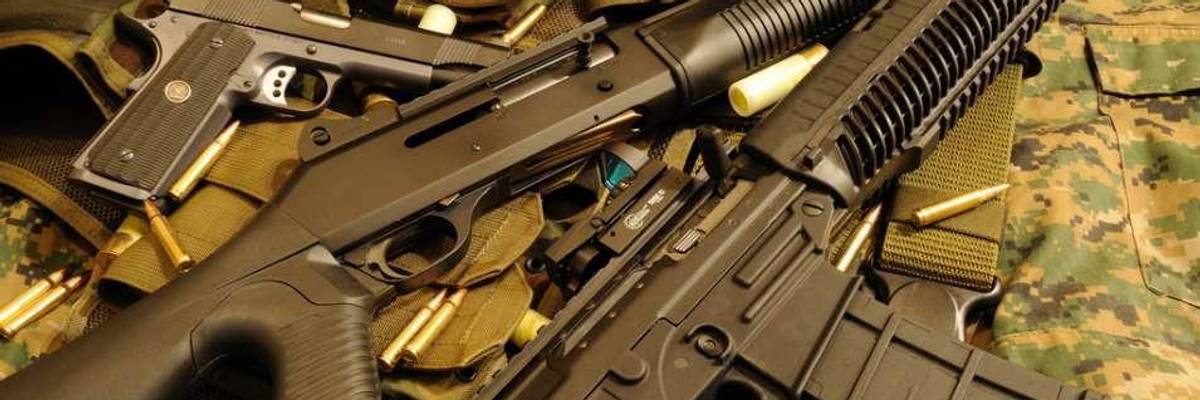
"It's hard to estimate how many deaths the US is responsible for overseas, especially indirect ones and those that have resulted from illegal gun trading." (Photo: Chayak / Flickr)
I live next door to the world's biggest gun manufacturer. Here in Mexico, the murder rates are close to civil war levels. They broke records last year, for a total of 41,217 homicides, with 25,339 first degree murders over the course of the year. And those are the official figures - which if anything, tend to under report reality.
President Trump has labeled Mexican migrants heading to the US as "criminals" but has ironically overlooked the fact 70% the guns coming into Mexico originate in the US.
President Trump has labeled Mexican migrants heading to the US as "criminals" but has ironically overlooked the fact 70% the guns coming into Mexico originate in the US. With the recent shooting in the YouTube headquarters, the inspiring movements of young people demanding gun control, and Black Lives Matter protesting police impunity - the issue of systemic, deathly violence in the US is receiving important attention. But the impact of of that violence outside US borders is largely going under the radar.
In every measurable way, the U.S is head honcho of the global violence industry: it is the biggest arms exporter, it dominates global military spending, it sold a majority of guns, globally, in 2016, with the UK in second place at just under 10%, and it has been the leading arms dealer in the world for 25 of the past 26 years.
It's hard to estimate how many deaths the US is responsible for overseas, especially indirect ones and those that have resulted from illegal gun trading (which is how most guns arrive in Mexico). But analyst Nicolas J.S. Davies estimated that "about 2.4 million Iraqis have been killed as a result of the illegal invasion of their country by the United States and the United Kingdom" and "about 1.2 million Afghans and Pakistanis have been killed as a result of the U.S. invasion of Afghanistan in 2001" and more in Libya, Somalia, Syria and Yemen.
It's important to consider how the U.S's violence overseas could be contributing to a culture of violence and a glorification of murder within it's borders. It's also important to remember how profitable the guns and ammunition industry is, and that like the drug trade, US companies have every interest in a strong demand for guns in and outside US borders.
Now, there are around 300 million guns in Mexico - despite the fact that the country has just one shop (hidden discretely down a small lane in the capital) where they can be bought.
An IBIS report on the guns and ammunition manufacturing industry noted that "In response to a weakening domestic military market, industry players have increasingly sought growth in exports." That growth in exports has been a key factor in the percentage of murders here committed with guns increasing from 15% in 1997 to 66% in 2017. Now, there are around 300 million guns in Mexico - despite the fact that the country has just one shop (hidden discretely down a small lane in the capital) where they can be bought.
The figures are almost bad in nearby Central American countries El Salvador and Honduras - both with some of the highest murder rates in the world. In El Salvador, between 2014 and 2016, 49% of recovered guns had been originally bought in the US, and for the same period in Honduras, 45% were originally bought in the US. Indeed, while the mainstream, Western media focuses on the drug trade across the Americas, it is gun traffickers coming from the US who are exploiting US gun laws to sell guns over the border.
Dear Common Dreams reader, It’s been nearly 30 years since I co-founded Common Dreams with my late wife, Lina Newhouser. We had the radical notion that journalism should serve the public good, not corporate profits. It was clear to us from the outset what it would take to build such a project. No paid advertisements. No corporate sponsors. No millionaire publisher telling us what to think or do. Many people said we wouldn't last a year, but we proved those doubters wrong. Together with a tremendous team of journalists and dedicated staff, we built an independent media outlet free from the constraints of profits and corporate control. Our mission has always been simple: To inform. To inspire. To ignite change for the common good. Building Common Dreams was not easy. Our survival was never guaranteed. When you take on the most powerful forces—Wall Street greed, fossil fuel industry destruction, Big Tech lobbyists, and uber-rich oligarchs who have spent billions upon billions rigging the economy and democracy in their favor—the only bulwark you have is supporters who believe in your work. But here’s the urgent message from me today. It's never been this bad out there. And it's never been this hard to keep us going. At the very moment Common Dreams is most needed, the threats we face are intensifying. We need your support now more than ever. We don't accept corporate advertising and never will. We don't have a paywall because we don't think people should be blocked from critical news based on their ability to pay. Everything we do is funded by the donations of readers like you. When everyone does the little they can afford, we are strong. But if that support retreats or dries up, so do we. Will you donate now to make sure Common Dreams not only survives but thrives? —Craig Brown, Co-founder |
I live next door to the world's biggest gun manufacturer. Here in Mexico, the murder rates are close to civil war levels. They broke records last year, for a total of 41,217 homicides, with 25,339 first degree murders over the course of the year. And those are the official figures - which if anything, tend to under report reality.
President Trump has labeled Mexican migrants heading to the US as "criminals" but has ironically overlooked the fact 70% the guns coming into Mexico originate in the US.
President Trump has labeled Mexican migrants heading to the US as "criminals" but has ironically overlooked the fact 70% the guns coming into Mexico originate in the US. With the recent shooting in the YouTube headquarters, the inspiring movements of young people demanding gun control, and Black Lives Matter protesting police impunity - the issue of systemic, deathly violence in the US is receiving important attention. But the impact of of that violence outside US borders is largely going under the radar.
In every measurable way, the U.S is head honcho of the global violence industry: it is the biggest arms exporter, it dominates global military spending, it sold a majority of guns, globally, in 2016, with the UK in second place at just under 10%, and it has been the leading arms dealer in the world for 25 of the past 26 years.
It's hard to estimate how many deaths the US is responsible for overseas, especially indirect ones and those that have resulted from illegal gun trading (which is how most guns arrive in Mexico). But analyst Nicolas J.S. Davies estimated that "about 2.4 million Iraqis have been killed as a result of the illegal invasion of their country by the United States and the United Kingdom" and "about 1.2 million Afghans and Pakistanis have been killed as a result of the U.S. invasion of Afghanistan in 2001" and more in Libya, Somalia, Syria and Yemen.
It's important to consider how the U.S's violence overseas could be contributing to a culture of violence and a glorification of murder within it's borders. It's also important to remember how profitable the guns and ammunition industry is, and that like the drug trade, US companies have every interest in a strong demand for guns in and outside US borders.
Now, there are around 300 million guns in Mexico - despite the fact that the country has just one shop (hidden discretely down a small lane in the capital) where they can be bought.
An IBIS report on the guns and ammunition manufacturing industry noted that "In response to a weakening domestic military market, industry players have increasingly sought growth in exports." That growth in exports has been a key factor in the percentage of murders here committed with guns increasing from 15% in 1997 to 66% in 2017. Now, there are around 300 million guns in Mexico - despite the fact that the country has just one shop (hidden discretely down a small lane in the capital) where they can be bought.
The figures are almost bad in nearby Central American countries El Salvador and Honduras - both with some of the highest murder rates in the world. In El Salvador, between 2014 and 2016, 49% of recovered guns had been originally bought in the US, and for the same period in Honduras, 45% were originally bought in the US. Indeed, while the mainstream, Western media focuses on the drug trade across the Americas, it is gun traffickers coming from the US who are exploiting US gun laws to sell guns over the border.
I live next door to the world's biggest gun manufacturer. Here in Mexico, the murder rates are close to civil war levels. They broke records last year, for a total of 41,217 homicides, with 25,339 first degree murders over the course of the year. And those are the official figures - which if anything, tend to under report reality.
President Trump has labeled Mexican migrants heading to the US as "criminals" but has ironically overlooked the fact 70% the guns coming into Mexico originate in the US.
President Trump has labeled Mexican migrants heading to the US as "criminals" but has ironically overlooked the fact 70% the guns coming into Mexico originate in the US. With the recent shooting in the YouTube headquarters, the inspiring movements of young people demanding gun control, and Black Lives Matter protesting police impunity - the issue of systemic, deathly violence in the US is receiving important attention. But the impact of of that violence outside US borders is largely going under the radar.
In every measurable way, the U.S is head honcho of the global violence industry: it is the biggest arms exporter, it dominates global military spending, it sold a majority of guns, globally, in 2016, with the UK in second place at just under 10%, and it has been the leading arms dealer in the world for 25 of the past 26 years.
It's hard to estimate how many deaths the US is responsible for overseas, especially indirect ones and those that have resulted from illegal gun trading (which is how most guns arrive in Mexico). But analyst Nicolas J.S. Davies estimated that "about 2.4 million Iraqis have been killed as a result of the illegal invasion of their country by the United States and the United Kingdom" and "about 1.2 million Afghans and Pakistanis have been killed as a result of the U.S. invasion of Afghanistan in 2001" and more in Libya, Somalia, Syria and Yemen.
It's important to consider how the U.S's violence overseas could be contributing to a culture of violence and a glorification of murder within it's borders. It's also important to remember how profitable the guns and ammunition industry is, and that like the drug trade, US companies have every interest in a strong demand for guns in and outside US borders.
Now, there are around 300 million guns in Mexico - despite the fact that the country has just one shop (hidden discretely down a small lane in the capital) where they can be bought.
An IBIS report on the guns and ammunition manufacturing industry noted that "In response to a weakening domestic military market, industry players have increasingly sought growth in exports." That growth in exports has been a key factor in the percentage of murders here committed with guns increasing from 15% in 1997 to 66% in 2017. Now, there are around 300 million guns in Mexico - despite the fact that the country has just one shop (hidden discretely down a small lane in the capital) where they can be bought.
The figures are almost bad in nearby Central American countries El Salvador and Honduras - both with some of the highest murder rates in the world. In El Salvador, between 2014 and 2016, 49% of recovered guns had been originally bought in the US, and for the same period in Honduras, 45% were originally bought in the US. Indeed, while the mainstream, Western media focuses on the drug trade across the Americas, it is gun traffickers coming from the US who are exploiting US gun laws to sell guns over the border.