SUBSCRIBE TO OUR FREE NEWSLETTER
Daily news & progressive opinion—funded by the people, not the corporations—delivered straight to your inbox.
5
#000000
#FFFFFF
To donate by check, phone, or other method, see our More Ways to Give page.
Daily news & progressive opinion—funded by the people, not the corporations—delivered straight to your inbox.
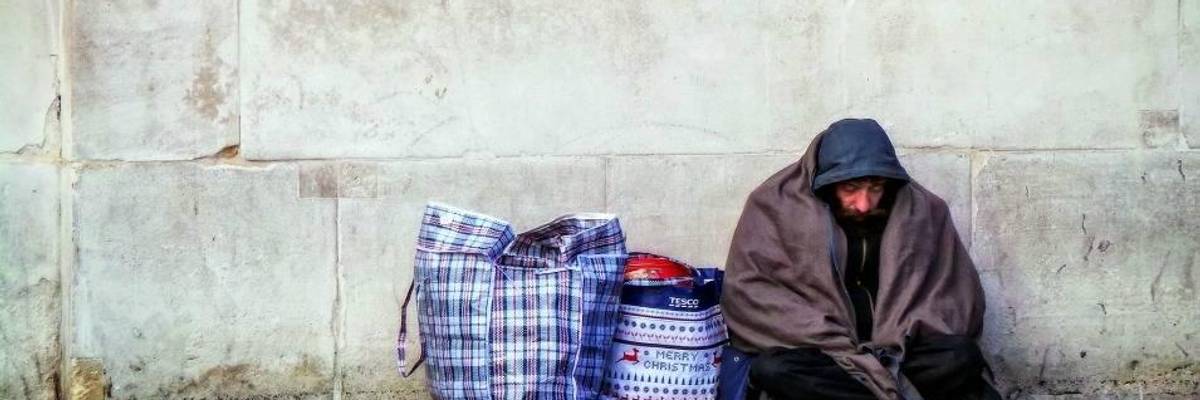
While the right to live with dignity is denied to so many, the right to carry a firearm is treated as unbreakable and sacred. (Photo: Garry Knight/cc/flickr)
There are homeless folks with guns and there are homeless folks with mental illness. Just like there are housed people with guns and there are housed people with mental illness. The only difference between people experiencing homelessness and people living in houses is money. One group can afford a place to live and the other can not.
Because people without financial means grow desperate and seek help, people who experience homelessness lose their privacy when they come in from the cold. Before long, caseworkers, shelter staff, center volunteers all learn about their personal lives, their employment status, their health issues, their family structure and their guns.
How do people with nothing get their hands on guns? Well, like most folks who find themselves living on the streets, they had the guns - and often, concealed carry permits - when they lost their job, their health, their home. Surely the second amendment was intended to protect the most vulnerable of the population. Unless you subscribe to the theory that the second amendment was actually created to protect the wealth class. While the latter idea seems entirely more likely, as the law stands today: everyone has the right to bear arms. Nobody has to make a public tadoo about it, either - unless they seek shelter.
How long would you live in your car before you swallowed your pride, cast off your privacy and went to a shelter? Maybe you could stand it a long time. Maybe the local truck stop doesn't police the back parking lot and they have a shower you can use. Or maybe you have kids, so you have to give in earlier than you'd like, and go get help.
When a person presents themselves to a shelter, they have to disclose everything. Oh sure, some people lie. You'd lie too if you were on the tenth bite of a misery sandwich and everything and everyone you'd relied upon had let you down. But a homeless person is unlikely to lie long about having a weapon. Most shelters search people's belongings upon arrival. Medications have to be reported as well. So those psych meds aren't going to stay secret for long, either.
Put yourself through a few real life scenarios.
First case:
You're a homeless mom and you have a treated mental illness. You take your medicine faithfully and see your doctor regularly. You also have three kids ranging in age from twelve to 18 months. Your landlord never maintained the septic system and one day it backed up into the mobile home where you and your kids lived. You've worked every day since your husband left about three weeks after he heard you were expecting the third child. You have zero savings and no money to start over when the codes enforcement officer declares the mobile home unfit for human habitation.
You load all that you can into your eleven year old jeep and stay at a cheap hotel for a few weeks. Eventually, the expenses of even the dingiest of hotels become too great and you head for a shelter. The shelter locks up your medicine for you. They would also lock up your gun if you brought it into the building so you keep it in your car. Remember, you have a concealed carry permit and you fear for yourself and your children as your life becomes more and more precarious. You are especially afraid that your husband will resurface and take the eldest child with him.
Second case:
You are a veteran with a wife and two small children. You receive partial disability and you're a stay at home dad. Your wife loses her low wage temp job and you can't hold it together financially. Before long, your landlord asks you to leave. A friend tells you about a shelter. You bring your wife and kids there. You have a concealed carry permit, a firearm, but no car to keep it in. You too have a mental illness, but no longer trust the government and refuse to take your medicine or go to counseling. Your mental illness is completely untreated unless you count the alcohol that helps you calm down. Your binge alcohol treatments become more intense now that you and your family have lost your home.
Before long, your drinking becomes a problem at the shelter. The staff mandates you undergo a psychiatric evaluation if you want to keep your family sheltered. Your case worker receives documentation of your mental illness. She tells you to get your prescriptions filled. You refuse. Tensions rise and your locker is searched at the shelter. The staff finds several weapons: one is a gun the other are knives. The weapons are seized and the only way to get them back is to leave. Mentally unstable you choose your gun over your wife and kids.
Neither of the people featured in these cases had a police record. Until they lost their homes their personal business was their own. This anecdotal evidence - and there is much anecdotal evidence - proves that mental illness is no reason to take away a person's weapon. Untreated mental illness may be. But unless a person voluntarily surrenders their right to privacy, society can't know who is treated and who is not.
What are the real hazards that face America? People need guaranteed access to affordable housing, food, education, healthcare and jobs. But none of that is protected under the U.S. Constitution. The one thing that's guaranteed to Americans is guns. Perhaps the early 21st century is when the constitution is amended to assure access to those things that preserve life and restrict access to those things that take life.
Dear Common Dreams reader, It’s been nearly 30 years since I co-founded Common Dreams with my late wife, Lina Newhouser. We had the radical notion that journalism should serve the public good, not corporate profits. It was clear to us from the outset what it would take to build such a project. No paid advertisements. No corporate sponsors. No millionaire publisher telling us what to think or do. Many people said we wouldn't last a year, but we proved those doubters wrong. Together with a tremendous team of journalists and dedicated staff, we built an independent media outlet free from the constraints of profits and corporate control. Our mission has always been simple: To inform. To inspire. To ignite change for the common good. Building Common Dreams was not easy. Our survival was never guaranteed. When you take on the most powerful forces—Wall Street greed, fossil fuel industry destruction, Big Tech lobbyists, and uber-rich oligarchs who have spent billions upon billions rigging the economy and democracy in their favor—the only bulwark you have is supporters who believe in your work. But here’s the urgent message from me today. It's never been this bad out there. And it's never been this hard to keep us going. At the very moment Common Dreams is most needed, the threats we face are intensifying. We need your support now more than ever. We don't accept corporate advertising and never will. We don't have a paywall because we don't think people should be blocked from critical news based on their ability to pay. Everything we do is funded by the donations of readers like you. When everyone does the little they can afford, we are strong. But if that support retreats or dries up, so do we. Will you donate now to make sure Common Dreams not only survives but thrives? —Craig Brown, Co-founder |
There are homeless folks with guns and there are homeless folks with mental illness. Just like there are housed people with guns and there are housed people with mental illness. The only difference between people experiencing homelessness and people living in houses is money. One group can afford a place to live and the other can not.
Because people without financial means grow desperate and seek help, people who experience homelessness lose their privacy when they come in from the cold. Before long, caseworkers, shelter staff, center volunteers all learn about their personal lives, their employment status, their health issues, their family structure and their guns.
How do people with nothing get their hands on guns? Well, like most folks who find themselves living on the streets, they had the guns - and often, concealed carry permits - when they lost their job, their health, their home. Surely the second amendment was intended to protect the most vulnerable of the population. Unless you subscribe to the theory that the second amendment was actually created to protect the wealth class. While the latter idea seems entirely more likely, as the law stands today: everyone has the right to bear arms. Nobody has to make a public tadoo about it, either - unless they seek shelter.
How long would you live in your car before you swallowed your pride, cast off your privacy and went to a shelter? Maybe you could stand it a long time. Maybe the local truck stop doesn't police the back parking lot and they have a shower you can use. Or maybe you have kids, so you have to give in earlier than you'd like, and go get help.
When a person presents themselves to a shelter, they have to disclose everything. Oh sure, some people lie. You'd lie too if you were on the tenth bite of a misery sandwich and everything and everyone you'd relied upon had let you down. But a homeless person is unlikely to lie long about having a weapon. Most shelters search people's belongings upon arrival. Medications have to be reported as well. So those psych meds aren't going to stay secret for long, either.
Put yourself through a few real life scenarios.
First case:
You're a homeless mom and you have a treated mental illness. You take your medicine faithfully and see your doctor regularly. You also have three kids ranging in age from twelve to 18 months. Your landlord never maintained the septic system and one day it backed up into the mobile home where you and your kids lived. You've worked every day since your husband left about three weeks after he heard you were expecting the third child. You have zero savings and no money to start over when the codes enforcement officer declares the mobile home unfit for human habitation.
You load all that you can into your eleven year old jeep and stay at a cheap hotel for a few weeks. Eventually, the expenses of even the dingiest of hotels become too great and you head for a shelter. The shelter locks up your medicine for you. They would also lock up your gun if you brought it into the building so you keep it in your car. Remember, you have a concealed carry permit and you fear for yourself and your children as your life becomes more and more precarious. You are especially afraid that your husband will resurface and take the eldest child with him.
Second case:
You are a veteran with a wife and two small children. You receive partial disability and you're a stay at home dad. Your wife loses her low wage temp job and you can't hold it together financially. Before long, your landlord asks you to leave. A friend tells you about a shelter. You bring your wife and kids there. You have a concealed carry permit, a firearm, but no car to keep it in. You too have a mental illness, but no longer trust the government and refuse to take your medicine or go to counseling. Your mental illness is completely untreated unless you count the alcohol that helps you calm down. Your binge alcohol treatments become more intense now that you and your family have lost your home.
Before long, your drinking becomes a problem at the shelter. The staff mandates you undergo a psychiatric evaluation if you want to keep your family sheltered. Your case worker receives documentation of your mental illness. She tells you to get your prescriptions filled. You refuse. Tensions rise and your locker is searched at the shelter. The staff finds several weapons: one is a gun the other are knives. The weapons are seized and the only way to get them back is to leave. Mentally unstable you choose your gun over your wife and kids.
Neither of the people featured in these cases had a police record. Until they lost their homes their personal business was their own. This anecdotal evidence - and there is much anecdotal evidence - proves that mental illness is no reason to take away a person's weapon. Untreated mental illness may be. But unless a person voluntarily surrenders their right to privacy, society can't know who is treated and who is not.
What are the real hazards that face America? People need guaranteed access to affordable housing, food, education, healthcare and jobs. But none of that is protected under the U.S. Constitution. The one thing that's guaranteed to Americans is guns. Perhaps the early 21st century is when the constitution is amended to assure access to those things that preserve life and restrict access to those things that take life.
There are homeless folks with guns and there are homeless folks with mental illness. Just like there are housed people with guns and there are housed people with mental illness. The only difference between people experiencing homelessness and people living in houses is money. One group can afford a place to live and the other can not.
Because people without financial means grow desperate and seek help, people who experience homelessness lose their privacy when they come in from the cold. Before long, caseworkers, shelter staff, center volunteers all learn about their personal lives, their employment status, their health issues, their family structure and their guns.
How do people with nothing get their hands on guns? Well, like most folks who find themselves living on the streets, they had the guns - and often, concealed carry permits - when they lost their job, their health, their home. Surely the second amendment was intended to protect the most vulnerable of the population. Unless you subscribe to the theory that the second amendment was actually created to protect the wealth class. While the latter idea seems entirely more likely, as the law stands today: everyone has the right to bear arms. Nobody has to make a public tadoo about it, either - unless they seek shelter.
How long would you live in your car before you swallowed your pride, cast off your privacy and went to a shelter? Maybe you could stand it a long time. Maybe the local truck stop doesn't police the back parking lot and they have a shower you can use. Or maybe you have kids, so you have to give in earlier than you'd like, and go get help.
When a person presents themselves to a shelter, they have to disclose everything. Oh sure, some people lie. You'd lie too if you were on the tenth bite of a misery sandwich and everything and everyone you'd relied upon had let you down. But a homeless person is unlikely to lie long about having a weapon. Most shelters search people's belongings upon arrival. Medications have to be reported as well. So those psych meds aren't going to stay secret for long, either.
Put yourself through a few real life scenarios.
First case:
You're a homeless mom and you have a treated mental illness. You take your medicine faithfully and see your doctor regularly. You also have three kids ranging in age from twelve to 18 months. Your landlord never maintained the septic system and one day it backed up into the mobile home where you and your kids lived. You've worked every day since your husband left about three weeks after he heard you were expecting the third child. You have zero savings and no money to start over when the codes enforcement officer declares the mobile home unfit for human habitation.
You load all that you can into your eleven year old jeep and stay at a cheap hotel for a few weeks. Eventually, the expenses of even the dingiest of hotels become too great and you head for a shelter. The shelter locks up your medicine for you. They would also lock up your gun if you brought it into the building so you keep it in your car. Remember, you have a concealed carry permit and you fear for yourself and your children as your life becomes more and more precarious. You are especially afraid that your husband will resurface and take the eldest child with him.
Second case:
You are a veteran with a wife and two small children. You receive partial disability and you're a stay at home dad. Your wife loses her low wage temp job and you can't hold it together financially. Before long, your landlord asks you to leave. A friend tells you about a shelter. You bring your wife and kids there. You have a concealed carry permit, a firearm, but no car to keep it in. You too have a mental illness, but no longer trust the government and refuse to take your medicine or go to counseling. Your mental illness is completely untreated unless you count the alcohol that helps you calm down. Your binge alcohol treatments become more intense now that you and your family have lost your home.
Before long, your drinking becomes a problem at the shelter. The staff mandates you undergo a psychiatric evaluation if you want to keep your family sheltered. Your case worker receives documentation of your mental illness. She tells you to get your prescriptions filled. You refuse. Tensions rise and your locker is searched at the shelter. The staff finds several weapons: one is a gun the other are knives. The weapons are seized and the only way to get them back is to leave. Mentally unstable you choose your gun over your wife and kids.
Neither of the people featured in these cases had a police record. Until they lost their homes their personal business was their own. This anecdotal evidence - and there is much anecdotal evidence - proves that mental illness is no reason to take away a person's weapon. Untreated mental illness may be. But unless a person voluntarily surrenders their right to privacy, society can't know who is treated and who is not.
What are the real hazards that face America? People need guaranteed access to affordable housing, food, education, healthcare and jobs. But none of that is protected under the U.S. Constitution. The one thing that's guaranteed to Americans is guns. Perhaps the early 21st century is when the constitution is amended to assure access to those things that preserve life and restrict access to those things that take life.