SUBSCRIBE TO OUR FREE NEWSLETTER
Daily news & progressive opinion—funded by the people, not the corporations—delivered straight to your inbox.
5
#000000
#FFFFFF
To donate by check, phone, or other method, see our More Ways to Give page.
Daily news & progressive opinion—funded by the people, not the corporations—delivered straight to your inbox.
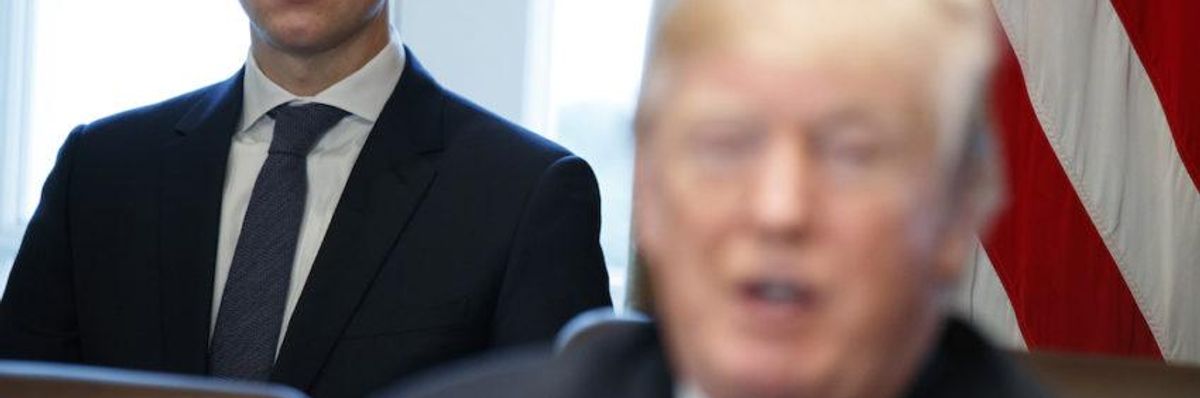
White House senior adviser Jared Kushner listens as President Trump speaks during a 2017 Cabinet meeting at the White House. (Photo: Evan Vucci / AP)
Much has been made of the investigation by special counsel Robert Mueller into whether Donald Trump's presidential campaign colluded with Russian operatives or the Russian government to win the November 2016 election. While there is yet to emerge solid evidence that attempted Russian meddling actually impacted the election's outcome, in recent days Mueller's probe may have turned in a far more damning direction: how Trump's family members may have used the president's political power to obtain business advantages, and specifically how Trump son-in-law Jared Kushner may be deeply implicated.
Several recent reports offer strong suggestions of corruption. First, The Washington Post reported Feb. 27 that officials from four other countries--namely the United Arab Emirates, China, Mexico and Israel--apparently discussed ways to exploit Kushner's business needs in order for their countries to obtain favorable U.S. policies. A day later The New York Times revealed that Kushner Companies last year received more than $500 million in loans from Apollo Global Management and Citigroup after Kushner met with those companies' representatives at the White House. On March 1, Think Progress reported that Apollo "benefited from three rule changes [under Trump] relaxing pipeline safety regulations." The next day, March 2, according to The Intercept, Kushner Companies reportedly approached the government of Qatar for loans and, after being rebuffed, President Trump backed a Saudi Arabian blockade of Qatar, bizarrely accusing the latter country of financing terrorism networks.
On the domestic front, Trump family members seem to be using government to fill their coffers by extracting loans for their businesses in exchange for favors. Even the appearance of impropriety and quid pro quo between the Trump family and the companies that lend it money ought to outright disqualify all those involved from policymaking and rule changes.
On the foreign policy front, the optics are even worse. If there is any link between Qatar's refusal to grant Kushner Companies a loan and the Trump administration's actions against that country, we can only conclude that American foreign policy is being wielded as a tool to punish those who might harm the Trump family's business interests. Indeed, NBC reported four unnamed sources revealed that "Qatari government officials visiting the U.S. in late January and early February considered turning over to Mueller what they believe is evidence of efforts by their country's Persian Gulf neighbors in coordination with Kushner to hurt their country," but that ultimately, "The Qatari officials decided against cooperating with Mueller for now out of fear it would further strain the country's relations with the White House."
Upon accepting a position as the president's adviser, Kushner ought to have completely divested himself from his extensive domestic and international business dealings, but he has chosen not to do so. Instead he retains more than $700 million worth of real estate holdings and related businesses. Within this context it should come as no surprise that Kushner's security clearance was downgraded, given how easily he could be approached in efforts to trade American favors in exchange for loans or business deals.
Right from the start, Kushner and the Trump family's businesses were considered problematic in terms of whether the Trumps would put their personal financial empires before the country's interests. Just the appearance of the various situations Kushner has been caught in are deeply suspicious and can be traced back to the 2016 election, when he obtained a massive $285 million loan for his company's property from Deutsche Bank. At that time the bank was engaged in a legal battle with the U.S. government over charges of mortgage fraud, which should have negated any dealings with the family member of a presidential candidate. Additionally, well into his tenure as the president's adviser, Kushner's sister, Nicole Kushner Meyer, was caught in China touting her brother's new political role while trying to lure Chinese investors for her family company's New Jersey housing development.
The politically inexperienced Kushner has also been put in charge of U.S. policy on a peace deal between Israelis and Palestinians. Yet earlier this year The New York Times revealed that just before his first diplomatic mission to Israel last year, Kushner's company received a $30 million infusion of cash from a major Israeli insurance company, Menora Mivtachim. How could Kushner possibly present himself as an impartial broker when he has investors in one of the two entities he is seeking to reconcile? If countries like Israel and China are attempting to exploit Kushner's position, it is because Kushner has essentially given them every indication that he would like them to do so. The scope of the Trump family's brazen financial dealings and the strong indications that they might be using the nation's foreign policy to enrich themselves is unprecedented.
Much of what has been revealed about Kushner's vulnerabilities are emerging through detailed, publicly available investigative news reports. Mueller's team need only confirm the veracity of the reports to determine if Kushner's presence in the White House gives the appearance of a serious conflict of interest. In any other time and with any other presidency, the mere whiff of personal financial gain through government positions would have been enough to generate demands for resignations and public apologies. But as we find out every day in this new reality under Trump, there seems to be no depth to which our national standards can fall in order to maintain this president's power.
Last November, when Mueller indicted former Trump campaign manager Paul Manafort, I wrote that the content of the indictments revealed a far more important aspect of the Trump presidency than possible collusion with Russia: how the people Trump has surrounded himself with are--like him--apparently interested in personal enrichment and greed more than anything else and appear willing to bend government rules toward that end.
As questions swirl about whether Mueller will now indict the president's son-in-law, there are also reports that Trump is frustrated and "now views [Kushner] as a liability because of his legal entanglements, the investigations of the Kushner family's real estate company and the publicity over having his security clearance downgraded." But in what is the president's habit of flip-flopping, he has alternatively expressed both support of and opposition to his son-in-law's presence in the White House.
Meanwhile on the political front there is a deafening silence from lawmakers, especially Republicans, on the appearance of Kushner's many conflicts of interest. If there had been even the tiniest fraction of such dealings during Barack Obama's presidency, conservatives would have been howling louder than anyone else about impeachment or resignation. Even in the very unlikely event that it turns out Kushner's business relations were kept scrupulously separate from his government-related work, the damage to his reputation as a U.S. government representative is done. Kushner and the entire Trump dynasty should be required to answer the question: What do they love more--their country or their money?
They cannot have it both ways.
Dear Common Dreams reader, It’s been nearly 30 years since I co-founded Common Dreams with my late wife, Lina Newhouser. We had the radical notion that journalism should serve the public good, not corporate profits. It was clear to us from the outset what it would take to build such a project. No paid advertisements. No corporate sponsors. No millionaire publisher telling us what to think or do. Many people said we wouldn't last a year, but we proved those doubters wrong. Together with a tremendous team of journalists and dedicated staff, we built an independent media outlet free from the constraints of profits and corporate control. Our mission has always been simple: To inform. To inspire. To ignite change for the common good. Building Common Dreams was not easy. Our survival was never guaranteed. When you take on the most powerful forces—Wall Street greed, fossil fuel industry destruction, Big Tech lobbyists, and uber-rich oligarchs who have spent billions upon billions rigging the economy and democracy in their favor—the only bulwark you have is supporters who believe in your work. But here’s the urgent message from me today. It's never been this bad out there. And it's never been this hard to keep us going. At the very moment Common Dreams is most needed, the threats we face are intensifying. We need your support now more than ever. We don't accept corporate advertising and never will. We don't have a paywall because we don't think people should be blocked from critical news based on their ability to pay. Everything we do is funded by the donations of readers like you. When everyone does the little they can afford, we are strong. But if that support retreats or dries up, so do we. Will you donate now to make sure Common Dreams not only survives but thrives? —Craig Brown, Co-founder |
Much has been made of the investigation by special counsel Robert Mueller into whether Donald Trump's presidential campaign colluded with Russian operatives or the Russian government to win the November 2016 election. While there is yet to emerge solid evidence that attempted Russian meddling actually impacted the election's outcome, in recent days Mueller's probe may have turned in a far more damning direction: how Trump's family members may have used the president's political power to obtain business advantages, and specifically how Trump son-in-law Jared Kushner may be deeply implicated.
Several recent reports offer strong suggestions of corruption. First, The Washington Post reported Feb. 27 that officials from four other countries--namely the United Arab Emirates, China, Mexico and Israel--apparently discussed ways to exploit Kushner's business needs in order for their countries to obtain favorable U.S. policies. A day later The New York Times revealed that Kushner Companies last year received more than $500 million in loans from Apollo Global Management and Citigroup after Kushner met with those companies' representatives at the White House. On March 1, Think Progress reported that Apollo "benefited from three rule changes [under Trump] relaxing pipeline safety regulations." The next day, March 2, according to The Intercept, Kushner Companies reportedly approached the government of Qatar for loans and, after being rebuffed, President Trump backed a Saudi Arabian blockade of Qatar, bizarrely accusing the latter country of financing terrorism networks.
On the domestic front, Trump family members seem to be using government to fill their coffers by extracting loans for their businesses in exchange for favors. Even the appearance of impropriety and quid pro quo between the Trump family and the companies that lend it money ought to outright disqualify all those involved from policymaking and rule changes.
On the foreign policy front, the optics are even worse. If there is any link between Qatar's refusal to grant Kushner Companies a loan and the Trump administration's actions against that country, we can only conclude that American foreign policy is being wielded as a tool to punish those who might harm the Trump family's business interests. Indeed, NBC reported four unnamed sources revealed that "Qatari government officials visiting the U.S. in late January and early February considered turning over to Mueller what they believe is evidence of efforts by their country's Persian Gulf neighbors in coordination with Kushner to hurt their country," but that ultimately, "The Qatari officials decided against cooperating with Mueller for now out of fear it would further strain the country's relations with the White House."
Upon accepting a position as the president's adviser, Kushner ought to have completely divested himself from his extensive domestic and international business dealings, but he has chosen not to do so. Instead he retains more than $700 million worth of real estate holdings and related businesses. Within this context it should come as no surprise that Kushner's security clearance was downgraded, given how easily he could be approached in efforts to trade American favors in exchange for loans or business deals.
Right from the start, Kushner and the Trump family's businesses were considered problematic in terms of whether the Trumps would put their personal financial empires before the country's interests. Just the appearance of the various situations Kushner has been caught in are deeply suspicious and can be traced back to the 2016 election, when he obtained a massive $285 million loan for his company's property from Deutsche Bank. At that time the bank was engaged in a legal battle with the U.S. government over charges of mortgage fraud, which should have negated any dealings with the family member of a presidential candidate. Additionally, well into his tenure as the president's adviser, Kushner's sister, Nicole Kushner Meyer, was caught in China touting her brother's new political role while trying to lure Chinese investors for her family company's New Jersey housing development.
The politically inexperienced Kushner has also been put in charge of U.S. policy on a peace deal between Israelis and Palestinians. Yet earlier this year The New York Times revealed that just before his first diplomatic mission to Israel last year, Kushner's company received a $30 million infusion of cash from a major Israeli insurance company, Menora Mivtachim. How could Kushner possibly present himself as an impartial broker when he has investors in one of the two entities he is seeking to reconcile? If countries like Israel and China are attempting to exploit Kushner's position, it is because Kushner has essentially given them every indication that he would like them to do so. The scope of the Trump family's brazen financial dealings and the strong indications that they might be using the nation's foreign policy to enrich themselves is unprecedented.
Much of what has been revealed about Kushner's vulnerabilities are emerging through detailed, publicly available investigative news reports. Mueller's team need only confirm the veracity of the reports to determine if Kushner's presence in the White House gives the appearance of a serious conflict of interest. In any other time and with any other presidency, the mere whiff of personal financial gain through government positions would have been enough to generate demands for resignations and public apologies. But as we find out every day in this new reality under Trump, there seems to be no depth to which our national standards can fall in order to maintain this president's power.
Last November, when Mueller indicted former Trump campaign manager Paul Manafort, I wrote that the content of the indictments revealed a far more important aspect of the Trump presidency than possible collusion with Russia: how the people Trump has surrounded himself with are--like him--apparently interested in personal enrichment and greed more than anything else and appear willing to bend government rules toward that end.
As questions swirl about whether Mueller will now indict the president's son-in-law, there are also reports that Trump is frustrated and "now views [Kushner] as a liability because of his legal entanglements, the investigations of the Kushner family's real estate company and the publicity over having his security clearance downgraded." But in what is the president's habit of flip-flopping, he has alternatively expressed both support of and opposition to his son-in-law's presence in the White House.
Meanwhile on the political front there is a deafening silence from lawmakers, especially Republicans, on the appearance of Kushner's many conflicts of interest. If there had been even the tiniest fraction of such dealings during Barack Obama's presidency, conservatives would have been howling louder than anyone else about impeachment or resignation. Even in the very unlikely event that it turns out Kushner's business relations were kept scrupulously separate from his government-related work, the damage to his reputation as a U.S. government representative is done. Kushner and the entire Trump dynasty should be required to answer the question: What do they love more--their country or their money?
They cannot have it both ways.
Much has been made of the investigation by special counsel Robert Mueller into whether Donald Trump's presidential campaign colluded with Russian operatives or the Russian government to win the November 2016 election. While there is yet to emerge solid evidence that attempted Russian meddling actually impacted the election's outcome, in recent days Mueller's probe may have turned in a far more damning direction: how Trump's family members may have used the president's political power to obtain business advantages, and specifically how Trump son-in-law Jared Kushner may be deeply implicated.
Several recent reports offer strong suggestions of corruption. First, The Washington Post reported Feb. 27 that officials from four other countries--namely the United Arab Emirates, China, Mexico and Israel--apparently discussed ways to exploit Kushner's business needs in order for their countries to obtain favorable U.S. policies. A day later The New York Times revealed that Kushner Companies last year received more than $500 million in loans from Apollo Global Management and Citigroup after Kushner met with those companies' representatives at the White House. On March 1, Think Progress reported that Apollo "benefited from three rule changes [under Trump] relaxing pipeline safety regulations." The next day, March 2, according to The Intercept, Kushner Companies reportedly approached the government of Qatar for loans and, after being rebuffed, President Trump backed a Saudi Arabian blockade of Qatar, bizarrely accusing the latter country of financing terrorism networks.
On the domestic front, Trump family members seem to be using government to fill their coffers by extracting loans for their businesses in exchange for favors. Even the appearance of impropriety and quid pro quo between the Trump family and the companies that lend it money ought to outright disqualify all those involved from policymaking and rule changes.
On the foreign policy front, the optics are even worse. If there is any link between Qatar's refusal to grant Kushner Companies a loan and the Trump administration's actions against that country, we can only conclude that American foreign policy is being wielded as a tool to punish those who might harm the Trump family's business interests. Indeed, NBC reported four unnamed sources revealed that "Qatari government officials visiting the U.S. in late January and early February considered turning over to Mueller what they believe is evidence of efforts by their country's Persian Gulf neighbors in coordination with Kushner to hurt their country," but that ultimately, "The Qatari officials decided against cooperating with Mueller for now out of fear it would further strain the country's relations with the White House."
Upon accepting a position as the president's adviser, Kushner ought to have completely divested himself from his extensive domestic and international business dealings, but he has chosen not to do so. Instead he retains more than $700 million worth of real estate holdings and related businesses. Within this context it should come as no surprise that Kushner's security clearance was downgraded, given how easily he could be approached in efforts to trade American favors in exchange for loans or business deals.
Right from the start, Kushner and the Trump family's businesses were considered problematic in terms of whether the Trumps would put their personal financial empires before the country's interests. Just the appearance of the various situations Kushner has been caught in are deeply suspicious and can be traced back to the 2016 election, when he obtained a massive $285 million loan for his company's property from Deutsche Bank. At that time the bank was engaged in a legal battle with the U.S. government over charges of mortgage fraud, which should have negated any dealings with the family member of a presidential candidate. Additionally, well into his tenure as the president's adviser, Kushner's sister, Nicole Kushner Meyer, was caught in China touting her brother's new political role while trying to lure Chinese investors for her family company's New Jersey housing development.
The politically inexperienced Kushner has also been put in charge of U.S. policy on a peace deal between Israelis and Palestinians. Yet earlier this year The New York Times revealed that just before his first diplomatic mission to Israel last year, Kushner's company received a $30 million infusion of cash from a major Israeli insurance company, Menora Mivtachim. How could Kushner possibly present himself as an impartial broker when he has investors in one of the two entities he is seeking to reconcile? If countries like Israel and China are attempting to exploit Kushner's position, it is because Kushner has essentially given them every indication that he would like them to do so. The scope of the Trump family's brazen financial dealings and the strong indications that they might be using the nation's foreign policy to enrich themselves is unprecedented.
Much of what has been revealed about Kushner's vulnerabilities are emerging through detailed, publicly available investigative news reports. Mueller's team need only confirm the veracity of the reports to determine if Kushner's presence in the White House gives the appearance of a serious conflict of interest. In any other time and with any other presidency, the mere whiff of personal financial gain through government positions would have been enough to generate demands for resignations and public apologies. But as we find out every day in this new reality under Trump, there seems to be no depth to which our national standards can fall in order to maintain this president's power.
Last November, when Mueller indicted former Trump campaign manager Paul Manafort, I wrote that the content of the indictments revealed a far more important aspect of the Trump presidency than possible collusion with Russia: how the people Trump has surrounded himself with are--like him--apparently interested in personal enrichment and greed more than anything else and appear willing to bend government rules toward that end.
As questions swirl about whether Mueller will now indict the president's son-in-law, there are also reports that Trump is frustrated and "now views [Kushner] as a liability because of his legal entanglements, the investigations of the Kushner family's real estate company and the publicity over having his security clearance downgraded." But in what is the president's habit of flip-flopping, he has alternatively expressed both support of and opposition to his son-in-law's presence in the White House.
Meanwhile on the political front there is a deafening silence from lawmakers, especially Republicans, on the appearance of Kushner's many conflicts of interest. If there had been even the tiniest fraction of such dealings during Barack Obama's presidency, conservatives would have been howling louder than anyone else about impeachment or resignation. Even in the very unlikely event that it turns out Kushner's business relations were kept scrupulously separate from his government-related work, the damage to his reputation as a U.S. government representative is done. Kushner and the entire Trump dynasty should be required to answer the question: What do they love more--their country or their money?
They cannot have it both ways.