

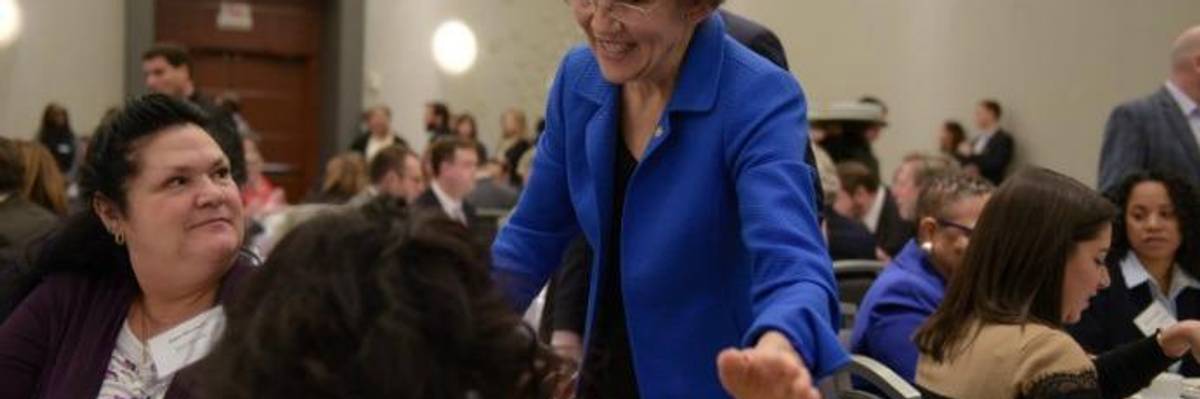
Sen. Elizabeth Warren (D-Mass.) admits criticizing those backing the bill that will loosen regulations on big Wall Street banks, including her fellow Democrats, doesn't make her the" most popular kid on the team." But, she says, "that's not why I ran for the Senate." (Photo: via Sen. Elizabeth Warren)
I Call It Like I See It on the #BankLobbyistAct
Saying Democrats are helping to roll back rules on big banks doesn’t make me the most popular kid on the team. But Massachusetts didn’t send me here to fight for big banks. The people of Massachusetts sent me here to fight for them.
I ran for the United States Senate because I wanted to protect working families from another financial crisis.
I spent most of my adult life studying how America's middle class was getting squeezed by rising costs and stagnant wages. The 2008 financial crisis was a punch to the gut for a lot of those families -- and a lot of them are still struggling to recover years later. I never dreamed of running for office. But when I realized that running for the Senate from Massachusetts was my best chance to try to help middle-class families and prevent another crisis from ever happening again, I ran.
"The people of Massachusetts didn't send me here to fight for big banks. They sent me here to fight for them."
Since I've come to the Senate, I've worked to reduce the risk of another crisis by pushing for stricter oversight and more accountability for the biggest banks. I've introduced bipartisan legislation to break up the biggest banks. I've pressed federal regulators to impose accountability on companies like Wells Fargo that break the law and cheat their customers -- and they've done it. I've led a bipartisan effort to stop the Federal Reserve from re-creating the kind of backdoor bailout of big banks that happened in 2008.
I've also worked with my colleagues to try to tailor the rules for community banks and credit unions, institutions that didn't cause the 2008 crash. In 2015, I introduced a bill with each of my Democratic colleagues on the Banking Committee that loosened the rules on banks and credit unions with under $10 billion in assets -- true community institutions -- while also creating new consumer protections for servicemembers. I fought alongside my colleagues to pass that bill, and I'd do it again. But that proposal didn't have enough goodies for Wall Street -- so it went nowhere.
This week, the Senate began advancing a bill that reduces oversight of some of the biggest banks in the country. The independent Congressional Budget Office says the bill will increase the risk of future bailouts. It's a dangerous proposal. Senate Republicans voted unanimously for it -- but the bill wouldn't be on track to becoming the law without the support of more than a dozen Senate Democrats.
That's just the truth. But since I called out some of my Democratic colleagues for their support, I've been taking heat from fellow Democrats. I get it -- no one likes to be criticized, let alone by someone on their team. And let's be totally clear: I agree with my Democratic colleagues a heck of a lot more than I agree with my Republican ones.
But there's a long history in Washington of members of both parties teaming up to deregulate banks -- followed soon after by a financial crisis. It happened in the early 1980s when there was bipartisan support for deregulating savings and loans associations -- and the S&L crisis hit a few years later. It happened in 1999 and 2000 with the repeal of Glass-Steagall and the passage of a bill to reduce oversight of derivatives -- and a devastating financial crisis built on giant megabanks and risky derivatives hit within a decade. And now, with help from some Democrats, it's on track to happen again.
Saying that doesn't make me the most popular kid on the team. But that's not why I ran for the Senate. The people of Massachusetts didn't send me here to fight for big banks. They sent me here to fight for them. And so long as I am privileged to hold this job, that's exactly what I'm going to do.
An Urgent Message From Our Co-Founder
Dear Common Dreams reader, It’s been nearly 30 years since I co-founded Common Dreams with my late wife, Lina Newhouser. We had the radical notion that journalism should serve the public good, not corporate profits. It was clear to us from the outset what it would take to build such a project. No paid advertisements. No corporate sponsors. No millionaire publisher telling us what to think or do. Many people said we wouldn't last a year, but we proved those doubters wrong. Together with a tremendous team of journalists and dedicated staff, we built an independent media outlet free from the constraints of profits and corporate control. Our mission has always been simple: To inform. To inspire. To ignite change for the common good. Building Common Dreams was not easy. Our survival was never guaranteed. When you take on the most powerful forces—Wall Street greed, fossil fuel industry destruction, Big Tech lobbyists, and uber-rich oligarchs who have spent billions upon billions rigging the economy and democracy in their favor—the only bulwark you have is supporters who believe in your work. But here’s the urgent message from me today. It's never been this bad out there. And it's never been this hard to keep us going. At the very moment Common Dreams is most needed, the threats we face are intensifying. We need your support now more than ever. We don't accept corporate advertising and never will. We don't have a paywall because we don't think people should be blocked from critical news based on their ability to pay. Everything we do is funded by the donations of readers like you. When everyone does the little they can afford, we are strong. But if that support retreats or dries up, so do we. Will you donate now to make sure Common Dreams not only survives but thrives? —Craig Brown, Co-founder |
I ran for the United States Senate because I wanted to protect working families from another financial crisis.
I spent most of my adult life studying how America's middle class was getting squeezed by rising costs and stagnant wages. The 2008 financial crisis was a punch to the gut for a lot of those families -- and a lot of them are still struggling to recover years later. I never dreamed of running for office. But when I realized that running for the Senate from Massachusetts was my best chance to try to help middle-class families and prevent another crisis from ever happening again, I ran.
"The people of Massachusetts didn't send me here to fight for big banks. They sent me here to fight for them."
Since I've come to the Senate, I've worked to reduce the risk of another crisis by pushing for stricter oversight and more accountability for the biggest banks. I've introduced bipartisan legislation to break up the biggest banks. I've pressed federal regulators to impose accountability on companies like Wells Fargo that break the law and cheat their customers -- and they've done it. I've led a bipartisan effort to stop the Federal Reserve from re-creating the kind of backdoor bailout of big banks that happened in 2008.
I've also worked with my colleagues to try to tailor the rules for community banks and credit unions, institutions that didn't cause the 2008 crash. In 2015, I introduced a bill with each of my Democratic colleagues on the Banking Committee that loosened the rules on banks and credit unions with under $10 billion in assets -- true community institutions -- while also creating new consumer protections for servicemembers. I fought alongside my colleagues to pass that bill, and I'd do it again. But that proposal didn't have enough goodies for Wall Street -- so it went nowhere.
This week, the Senate began advancing a bill that reduces oversight of some of the biggest banks in the country. The independent Congressional Budget Office says the bill will increase the risk of future bailouts. It's a dangerous proposal. Senate Republicans voted unanimously for it -- but the bill wouldn't be on track to becoming the law without the support of more than a dozen Senate Democrats.
That's just the truth. But since I called out some of my Democratic colleagues for their support, I've been taking heat from fellow Democrats. I get it -- no one likes to be criticized, let alone by someone on their team. And let's be totally clear: I agree with my Democratic colleagues a heck of a lot more than I agree with my Republican ones.
But there's a long history in Washington of members of both parties teaming up to deregulate banks -- followed soon after by a financial crisis. It happened in the early 1980s when there was bipartisan support for deregulating savings and loans associations -- and the S&L crisis hit a few years later. It happened in 1999 and 2000 with the repeal of Glass-Steagall and the passage of a bill to reduce oversight of derivatives -- and a devastating financial crisis built on giant megabanks and risky derivatives hit within a decade. And now, with help from some Democrats, it's on track to happen again.
Saying that doesn't make me the most popular kid on the team. But that's not why I ran for the Senate. The people of Massachusetts didn't send me here to fight for big banks. They sent me here to fight for them. And so long as I am privileged to hold this job, that's exactly what I'm going to do.
I ran for the United States Senate because I wanted to protect working families from another financial crisis.
I spent most of my adult life studying how America's middle class was getting squeezed by rising costs and stagnant wages. The 2008 financial crisis was a punch to the gut for a lot of those families -- and a lot of them are still struggling to recover years later. I never dreamed of running for office. But when I realized that running for the Senate from Massachusetts was my best chance to try to help middle-class families and prevent another crisis from ever happening again, I ran.
"The people of Massachusetts didn't send me here to fight for big banks. They sent me here to fight for them."
Since I've come to the Senate, I've worked to reduce the risk of another crisis by pushing for stricter oversight and more accountability for the biggest banks. I've introduced bipartisan legislation to break up the biggest banks. I've pressed federal regulators to impose accountability on companies like Wells Fargo that break the law and cheat their customers -- and they've done it. I've led a bipartisan effort to stop the Federal Reserve from re-creating the kind of backdoor bailout of big banks that happened in 2008.
I've also worked with my colleagues to try to tailor the rules for community banks and credit unions, institutions that didn't cause the 2008 crash. In 2015, I introduced a bill with each of my Democratic colleagues on the Banking Committee that loosened the rules on banks and credit unions with under $10 billion in assets -- true community institutions -- while also creating new consumer protections for servicemembers. I fought alongside my colleagues to pass that bill, and I'd do it again. But that proposal didn't have enough goodies for Wall Street -- so it went nowhere.
This week, the Senate began advancing a bill that reduces oversight of some of the biggest banks in the country. The independent Congressional Budget Office says the bill will increase the risk of future bailouts. It's a dangerous proposal. Senate Republicans voted unanimously for it -- but the bill wouldn't be on track to becoming the law without the support of more than a dozen Senate Democrats.
That's just the truth. But since I called out some of my Democratic colleagues for their support, I've been taking heat from fellow Democrats. I get it -- no one likes to be criticized, let alone by someone on their team. And let's be totally clear: I agree with my Democratic colleagues a heck of a lot more than I agree with my Republican ones.
But there's a long history in Washington of members of both parties teaming up to deregulate banks -- followed soon after by a financial crisis. It happened in the early 1980s when there was bipartisan support for deregulating savings and loans associations -- and the S&L crisis hit a few years later. It happened in 1999 and 2000 with the repeal of Glass-Steagall and the passage of a bill to reduce oversight of derivatives -- and a devastating financial crisis built on giant megabanks and risky derivatives hit within a decade. And now, with help from some Democrats, it's on track to happen again.
Saying that doesn't make me the most popular kid on the team. But that's not why I ran for the Senate. The people of Massachusetts didn't send me here to fight for big banks. They sent me here to fight for them. And so long as I am privileged to hold this job, that's exactly what I'm going to do.