SUBSCRIBE TO OUR FREE NEWSLETTER
Daily news & progressive opinion—funded by the people, not the corporations—delivered straight to your inbox.
5
#000000
#FFFFFF
To donate by check, phone, or other method, see our More Ways to Give page.
Daily news & progressive opinion—funded by the people, not the corporations—delivered straight to your inbox.
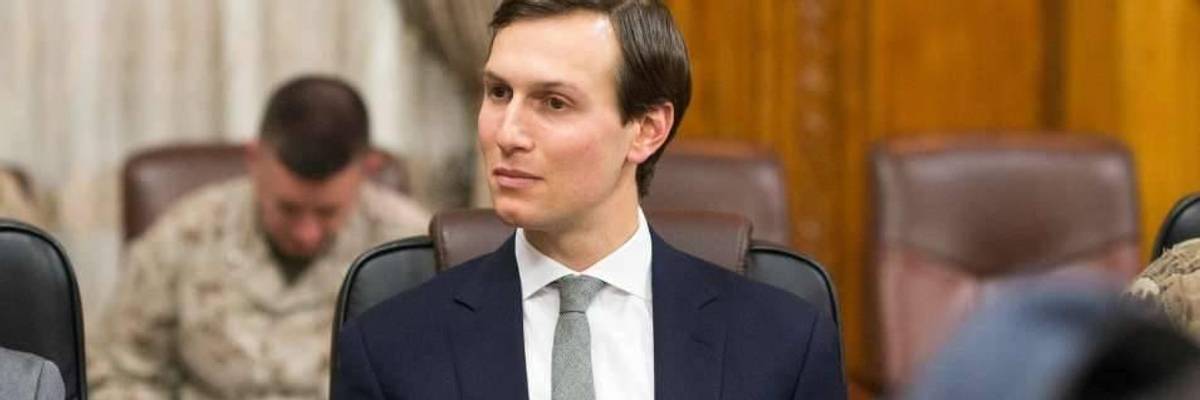
"Perhaps Kushner tells himself that the American public is already so cynical about big money's takeover of our democracy that his own apparent, or real, conflicts are chicken feed by comparison." (Photo: Chairman of the Joint Chiefs of Staff/Flickr/cc)
Before I turn to Jared Kushner, let me ask: Do you believe the U.S. government does the right thing all or most of the time?
The Gallup organization started asking this question in 1963, when over 70 percent of Americans said they did. Since then, the percent has steadily declined. By 2016, before Trump became president, only 16 percent of Americans agreed.
Government ethics officials have compared Trump's administration to a game of whack-a-mole--go after one potential violation, and others pop up.
Why the decline? Surely various disappointments and scandals played a part--Vietnam, Watergate, Iran-Contra, "weapons of mass destruction," the Wall Street bailout.
But the largest factor by far has been the rise of big money in politics. Most people no longer believe their voices count.
That view is backed by solid research. Princeton professor Martin Gilens and Professor Benjamin Page of Northwestern University analyzed 1,799 policy issues that came before Congress, and found "the preferences of the average American appear to have only a miniscule, near-zero, statistically non-significant impact upon public policy."
Instead, Gilens and Page concluded, lawmakers respond to the policy demands of wealthy individuals and moneyed business interests--those with the most lobbying prowess and deepest pockets to bankroll campaigns.
It's likely far worse now. Gilens and Page's data came from 1981 to 2002, before the Supreme Court opened the floodgates to big money in its Citizens United and McCutcheon decisions.
Trump and Bernie Sanders--authoritarian populist and progressive populist, respectively--based their shockingly successful campaigns on the public's outrage at the corruption of our democracy by big money. Sanders called for a "political revolution." Trump promised to "drain the swamp."
Trump hasn't drained it, of course. He's turned the entire government into a giant bog of lobbyists, real estate moguls, Wall Streeters, and billionaires.
Which brings us to Jared Kushner, the putative swamp-drainer's son-in-law, and major advisor.
Kushner may yet be indicted in Robert Mueller's investigation. But it could turn out that Kushner's most significant contribution to the stench of this administration will come from his financial conflicts of interest.
When he took the White House job, Kushner chose not to follow the usual practice of wealthy people when they join administrations--putting their assets into blind trusts managed by outside experts.
Instead, Kushner retained control over the vast majority of his interest in Kushner Companies, worth as much as $761 million, according to government ethics filings.
So how has Kushner separated his business dealings from his dealings on behalf of the United States? He hasn't.
The Times reported last week that after the CEOs of Citigroup and Apollo Global Management attended White House meetings set up by Kushner, the two firms loaned the Kushner family business more than $500 million.
Furthermore, once the loan was received, the Securities and Exchange Commission dropped an inquiry of Apollo Global Management.
Last spring, Kushner's real-estate firm sought hundreds of millions of dollars directly from the Qatar government, for its distressed property on Fifth Avenue, reports The Intercept. Soon after Qatar turned down the request, Kushner supported a diplomatic assault on Qatar that sparked a crisis continuing today.
Kushner is such an easy mark that officials in at least four countries have privately discussed ways to manipulate him with financial deals, according to U.S. intelligence.
Kushner insists that he's done nothing wrong, and there's no direct evidence he has profited off his position in White House or put personal financial interests ahead of the interests of the American public.
Conflicts of interest are always difficult to prove, which is why we have ethics rules to avoid even the appearance of such conflicts.
But that's not the point. Conflicts of interest are always difficult to prove, which is why we have ethics rules to avoid even the appearance of such conflicts.
And it sure looks as if Kushner is using his White House perch to make money for himself, just as is his father-in-law.
It's as bad for a government official to look as if he's lining his pockets as for him to actually do so, because the appearance of corruption undermines public trust just as readily as the real thing. And trust is what distinguishes an advanced democracy from a banana republic.
But Trump and the members of his family he's brought into his White House don't give a hoot about public trust. They have utter contempt for the common good. Government ethics officials have compared Trump's administration to a game of whack-a-mole--go after one potential violation, and others pop up.
Perhaps Kushner tells himself that the American public is already so cynical about big money's takeover of our democracy that his own apparent, or real, conflicts are chicken feed by comparison.
Which may be true. But by adding to the distrust, Kushner is doing his own bit to destroy American democracy--actions almost as treasonous as if he colluded with Russians to make his father-in-law president.
Dear Common Dreams reader, It’s been nearly 30 years since I co-founded Common Dreams with my late wife, Lina Newhouser. We had the radical notion that journalism should serve the public good, not corporate profits. It was clear to us from the outset what it would take to build such a project. No paid advertisements. No corporate sponsors. No millionaire publisher telling us what to think or do. Many people said we wouldn't last a year, but we proved those doubters wrong. Together with a tremendous team of journalists and dedicated staff, we built an independent media outlet free from the constraints of profits and corporate control. Our mission has always been simple: To inform. To inspire. To ignite change for the common good. Building Common Dreams was not easy. Our survival was never guaranteed. When you take on the most powerful forces—Wall Street greed, fossil fuel industry destruction, Big Tech lobbyists, and uber-rich oligarchs who have spent billions upon billions rigging the economy and democracy in their favor—the only bulwark you have is supporters who believe in your work. But here’s the urgent message from me today. It's never been this bad out there. And it's never been this hard to keep us going. At the very moment Common Dreams is most needed, the threats we face are intensifying. We need your support now more than ever. We don't accept corporate advertising and never will. We don't have a paywall because we don't think people should be blocked from critical news based on their ability to pay. Everything we do is funded by the donations of readers like you. When everyone does the little they can afford, we are strong. But if that support retreats or dries up, so do we. Will you donate now to make sure Common Dreams not only survives but thrives? —Craig Brown, Co-founder |
Before I turn to Jared Kushner, let me ask: Do you believe the U.S. government does the right thing all or most of the time?
The Gallup organization started asking this question in 1963, when over 70 percent of Americans said they did. Since then, the percent has steadily declined. By 2016, before Trump became president, only 16 percent of Americans agreed.
Government ethics officials have compared Trump's administration to a game of whack-a-mole--go after one potential violation, and others pop up.
Why the decline? Surely various disappointments and scandals played a part--Vietnam, Watergate, Iran-Contra, "weapons of mass destruction," the Wall Street bailout.
But the largest factor by far has been the rise of big money in politics. Most people no longer believe their voices count.
That view is backed by solid research. Princeton professor Martin Gilens and Professor Benjamin Page of Northwestern University analyzed 1,799 policy issues that came before Congress, and found "the preferences of the average American appear to have only a miniscule, near-zero, statistically non-significant impact upon public policy."
Instead, Gilens and Page concluded, lawmakers respond to the policy demands of wealthy individuals and moneyed business interests--those with the most lobbying prowess and deepest pockets to bankroll campaigns.
It's likely far worse now. Gilens and Page's data came from 1981 to 2002, before the Supreme Court opened the floodgates to big money in its Citizens United and McCutcheon decisions.
Trump and Bernie Sanders--authoritarian populist and progressive populist, respectively--based their shockingly successful campaigns on the public's outrage at the corruption of our democracy by big money. Sanders called for a "political revolution." Trump promised to "drain the swamp."
Trump hasn't drained it, of course. He's turned the entire government into a giant bog of lobbyists, real estate moguls, Wall Streeters, and billionaires.
Which brings us to Jared Kushner, the putative swamp-drainer's son-in-law, and major advisor.
Kushner may yet be indicted in Robert Mueller's investigation. But it could turn out that Kushner's most significant contribution to the stench of this administration will come from his financial conflicts of interest.
When he took the White House job, Kushner chose not to follow the usual practice of wealthy people when they join administrations--putting their assets into blind trusts managed by outside experts.
Instead, Kushner retained control over the vast majority of his interest in Kushner Companies, worth as much as $761 million, according to government ethics filings.
So how has Kushner separated his business dealings from his dealings on behalf of the United States? He hasn't.
The Times reported last week that after the CEOs of Citigroup and Apollo Global Management attended White House meetings set up by Kushner, the two firms loaned the Kushner family business more than $500 million.
Furthermore, once the loan was received, the Securities and Exchange Commission dropped an inquiry of Apollo Global Management.
Last spring, Kushner's real-estate firm sought hundreds of millions of dollars directly from the Qatar government, for its distressed property on Fifth Avenue, reports The Intercept. Soon after Qatar turned down the request, Kushner supported a diplomatic assault on Qatar that sparked a crisis continuing today.
Kushner is such an easy mark that officials in at least four countries have privately discussed ways to manipulate him with financial deals, according to U.S. intelligence.
Kushner insists that he's done nothing wrong, and there's no direct evidence he has profited off his position in White House or put personal financial interests ahead of the interests of the American public.
Conflicts of interest are always difficult to prove, which is why we have ethics rules to avoid even the appearance of such conflicts.
But that's not the point. Conflicts of interest are always difficult to prove, which is why we have ethics rules to avoid even the appearance of such conflicts.
And it sure looks as if Kushner is using his White House perch to make money for himself, just as is his father-in-law.
It's as bad for a government official to look as if he's lining his pockets as for him to actually do so, because the appearance of corruption undermines public trust just as readily as the real thing. And trust is what distinguishes an advanced democracy from a banana republic.
But Trump and the members of his family he's brought into his White House don't give a hoot about public trust. They have utter contempt for the common good. Government ethics officials have compared Trump's administration to a game of whack-a-mole--go after one potential violation, and others pop up.
Perhaps Kushner tells himself that the American public is already so cynical about big money's takeover of our democracy that his own apparent, or real, conflicts are chicken feed by comparison.
Which may be true. But by adding to the distrust, Kushner is doing his own bit to destroy American democracy--actions almost as treasonous as if he colluded with Russians to make his father-in-law president.
Before I turn to Jared Kushner, let me ask: Do you believe the U.S. government does the right thing all or most of the time?
The Gallup organization started asking this question in 1963, when over 70 percent of Americans said they did. Since then, the percent has steadily declined. By 2016, before Trump became president, only 16 percent of Americans agreed.
Government ethics officials have compared Trump's administration to a game of whack-a-mole--go after one potential violation, and others pop up.
Why the decline? Surely various disappointments and scandals played a part--Vietnam, Watergate, Iran-Contra, "weapons of mass destruction," the Wall Street bailout.
But the largest factor by far has been the rise of big money in politics. Most people no longer believe their voices count.
That view is backed by solid research. Princeton professor Martin Gilens and Professor Benjamin Page of Northwestern University analyzed 1,799 policy issues that came before Congress, and found "the preferences of the average American appear to have only a miniscule, near-zero, statistically non-significant impact upon public policy."
Instead, Gilens and Page concluded, lawmakers respond to the policy demands of wealthy individuals and moneyed business interests--those with the most lobbying prowess and deepest pockets to bankroll campaigns.
It's likely far worse now. Gilens and Page's data came from 1981 to 2002, before the Supreme Court opened the floodgates to big money in its Citizens United and McCutcheon decisions.
Trump and Bernie Sanders--authoritarian populist and progressive populist, respectively--based their shockingly successful campaigns on the public's outrage at the corruption of our democracy by big money. Sanders called for a "political revolution." Trump promised to "drain the swamp."
Trump hasn't drained it, of course. He's turned the entire government into a giant bog of lobbyists, real estate moguls, Wall Streeters, and billionaires.
Which brings us to Jared Kushner, the putative swamp-drainer's son-in-law, and major advisor.
Kushner may yet be indicted in Robert Mueller's investigation. But it could turn out that Kushner's most significant contribution to the stench of this administration will come from his financial conflicts of interest.
When he took the White House job, Kushner chose not to follow the usual practice of wealthy people when they join administrations--putting their assets into blind trusts managed by outside experts.
Instead, Kushner retained control over the vast majority of his interest in Kushner Companies, worth as much as $761 million, according to government ethics filings.
So how has Kushner separated his business dealings from his dealings on behalf of the United States? He hasn't.
The Times reported last week that after the CEOs of Citigroup and Apollo Global Management attended White House meetings set up by Kushner, the two firms loaned the Kushner family business more than $500 million.
Furthermore, once the loan was received, the Securities and Exchange Commission dropped an inquiry of Apollo Global Management.
Last spring, Kushner's real-estate firm sought hundreds of millions of dollars directly from the Qatar government, for its distressed property on Fifth Avenue, reports The Intercept. Soon after Qatar turned down the request, Kushner supported a diplomatic assault on Qatar that sparked a crisis continuing today.
Kushner is such an easy mark that officials in at least four countries have privately discussed ways to manipulate him with financial deals, according to U.S. intelligence.
Kushner insists that he's done nothing wrong, and there's no direct evidence he has profited off his position in White House or put personal financial interests ahead of the interests of the American public.
Conflicts of interest are always difficult to prove, which is why we have ethics rules to avoid even the appearance of such conflicts.
But that's not the point. Conflicts of interest are always difficult to prove, which is why we have ethics rules to avoid even the appearance of such conflicts.
And it sure looks as if Kushner is using his White House perch to make money for himself, just as is his father-in-law.
It's as bad for a government official to look as if he's lining his pockets as for him to actually do so, because the appearance of corruption undermines public trust just as readily as the real thing. And trust is what distinguishes an advanced democracy from a banana republic.
But Trump and the members of his family he's brought into his White House don't give a hoot about public trust. They have utter contempt for the common good. Government ethics officials have compared Trump's administration to a game of whack-a-mole--go after one potential violation, and others pop up.
Perhaps Kushner tells himself that the American public is already so cynical about big money's takeover of our democracy that his own apparent, or real, conflicts are chicken feed by comparison.
Which may be true. But by adding to the distrust, Kushner is doing his own bit to destroy American democracy--actions almost as treasonous as if he colluded with Russians to make his father-in-law president.