SUBSCRIBE TO OUR FREE NEWSLETTER
Daily news & progressive opinion—funded by the people, not the corporations—delivered straight to your inbox.
5
#000000
#FFFFFF
To donate by check, phone, or other method, see our More Ways to Give page.
Daily news & progressive opinion—funded by the people, not the corporations—delivered straight to your inbox.
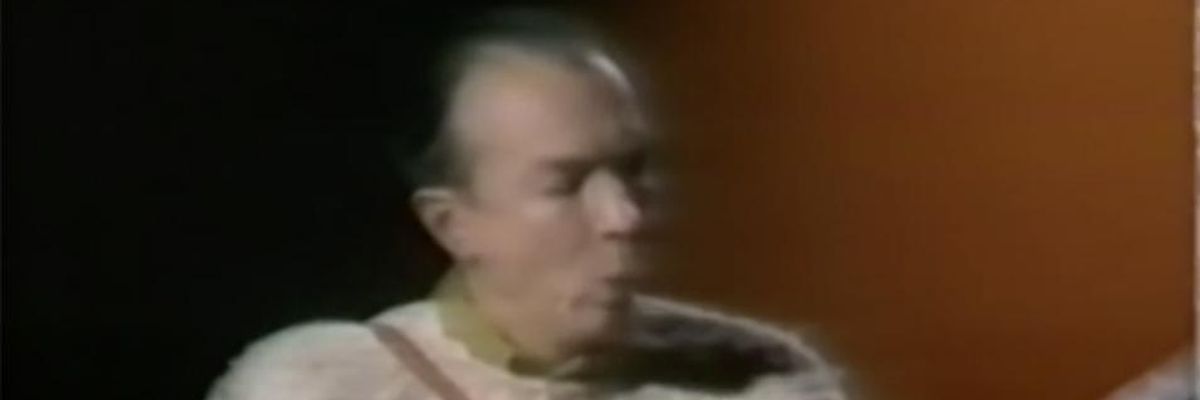
Fifty years ago today (February 25, 1968) Pete Seeger sang the controversial anti-war song "Waist Deep in the Big Muddy" on the Smothers Brothers Comedy Hour show on CBS. (Screen shot)
I'm shocked that the media overlooked this important milestone in American musical and political history. Fifty years ago today (February 25, 1968) Pete Seeger sang the controversial anti-war song "Waist Deep in the Big Muddy" on the Smothers Brothers Comedy Hour show on CBS.
Pete had been blacklisted from network television since the 1950s because of his leftist politics, so for the Smothers brothers to invite him to sing on their popular show -- much less to sing a powerful anti-war song in the midst of the Vietnam war -- was an act of courage. What made Pete's appearance controversial was that he had performed "Big Muddy" on the Smothers Brothers show the previous September, but CBS refused to broadcast it and removed it from the tape. An angry Tom Smothers made sure that the story of the censorship appeared in the media. Because of the bad press, an outcry among the public, and probably because the Vietnam War had become even more unpopular, the Smothers Brothers were allowed to invite Seeger back later in the season, when he again sang "Waist Deep in the Big Muddy," which was clearly metaphor for the Vietnam war.
Pete first sang a medley of anti-war song, then launched into "Big Muddy." Here's a video of Pete's performance 50 years ago today:
For those unfamiliar with Pete's political and musical story, here's my tribute to him, published in The Nation after he died in January 2014.
This country and this world are at a monumental crossroads. US voters have an opportunity to beat back the forces of fascism and confront the billionaires who are rigging the economy, our media system, and our democracy, making it increasingly impossible for ordinary people to get by. We’re not just talking about the election. We’re talking about what must be done once these fascist elements are vanquished from power. We need a bolder set of solutions than what either major party has so far been willing to offer and a working-class movement ready to fight like hell for it. Trump didn't emerge from nowhere. The conditions that fueled MAGA authoritarianism were created by decades of radical neoliberal economic policies and a corrupt political system dominated by corporate interests. They slashed taxes on the super-rich, promising that the benefits would trickle down. They said giveaways to the corporate titans would make life more affordable for the rest of us. It was all bullshit. And when a bitter, betrayed populace searches for someone to blame, right-wing demagogues have little trouble finding scapegoats. People know when they're being lied to, but you won't hear any of this from the corporate media. Only independent journalism—powered and funded by people who believe in building a better world—can deliver truly trustworthy daily news. If you share our vision, please contribute whatever you can to sustain our work. |
I'm shocked that the media overlooked this important milestone in American musical and political history. Fifty years ago today (February 25, 1968) Pete Seeger sang the controversial anti-war song "Waist Deep in the Big Muddy" on the Smothers Brothers Comedy Hour show on CBS.
Pete had been blacklisted from network television since the 1950s because of his leftist politics, so for the Smothers brothers to invite him to sing on their popular show -- much less to sing a powerful anti-war song in the midst of the Vietnam war -- was an act of courage. What made Pete's appearance controversial was that he had performed "Big Muddy" on the Smothers Brothers show the previous September, but CBS refused to broadcast it and removed it from the tape. An angry Tom Smothers made sure that the story of the censorship appeared in the media. Because of the bad press, an outcry among the public, and probably because the Vietnam War had become even more unpopular, the Smothers Brothers were allowed to invite Seeger back later in the season, when he again sang "Waist Deep in the Big Muddy," which was clearly metaphor for the Vietnam war.
Pete first sang a medley of anti-war song, then launched into "Big Muddy." Here's a video of Pete's performance 50 years ago today:
For those unfamiliar with Pete's political and musical story, here's my tribute to him, published in The Nation after he died in January 2014.