SUBSCRIBE TO OUR FREE NEWSLETTER
Daily news & progressive opinion—funded by the people, not the corporations—delivered straight to your inbox.
5
#000000
#FFFFFF
To donate by check, phone, or other method, see our More Ways to Give page.


Daily news & progressive opinion—funded by the people, not the corporations—delivered straight to your inbox.

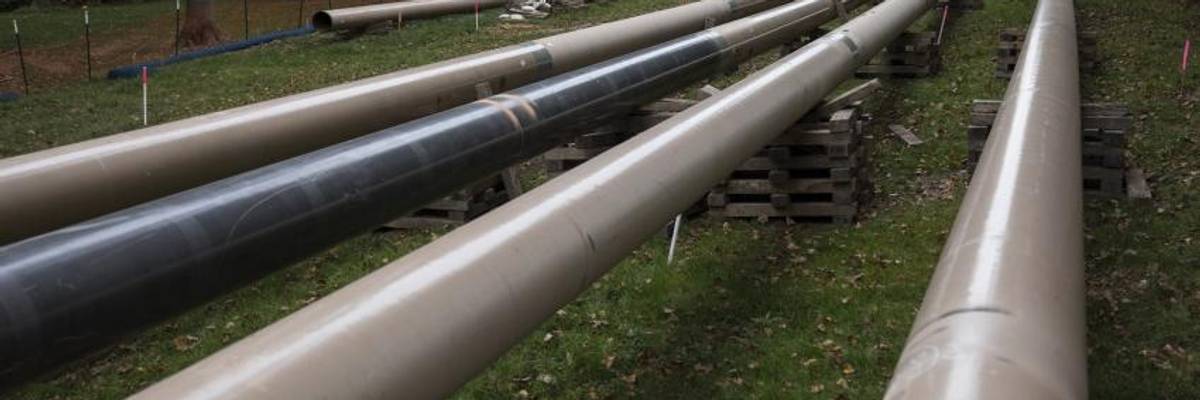
Private homes surround Sunoco's 20 inch gas liquids pipeline along a right-of-way October 5, 2017 in Marchwood, Pennsylvania. Many nearby residents are aware of the possible well water contamination they could experience from the horizontal drilling with Sunoco Pipeline's $3 billion Mariner East 2 expansion project. (Photo by Robert Nickelsberg/Getty Images)
It seems that every week brings more bad news about the construction of Sunoco's Mariner East 2 pipeline. While Pennsylvania communities, water protectors and landowners fight to stop the project, a larger question remains: What is this massive, dangerous pipeline actually for? The one word answer might surprise you: plastics.
"Ineos's pro-fracking agenda has spawned a citizen movement in Europe, where residents are fighting to prevent the company's plans to frack the United Kingdom."
The Mariner East 2 won't carry "natural gas" for heating your house or operating a stove. It will transport highly volatile liquids that will mostly be shipped overseas to be turned into plastics by a giant chemical corporation with a terrible environmental record.
In other words, Sunoco and its parent company Energy Transfer Partners are putting Pennsylvania communities at risk--from the immediate negative impacts of fracking in the western parts of the state, to the long-term risks to families living near the 350-mile pipeline--in order to supply a giant corporation making plastic pellets, many of which wind up littering shorelines across Europe.
My organization, Food & Water Watch, has been digging deep into Ineos, the massive chemical conglomerate profiting from the fracked gas liquids out of Pennsylvania. Ineos founder and chairman Jim Ratcliffe amassed his petrochemical empire in short order, thanks to risky bets and highly leveraged takeovers and acquisitions. The Mariner East 2 pipeline represents one more dangerous Ineos "innovation"--it delivers fracked hydrocarbons to the Marcus Hook facility near Philadelphia, where they are loaded onto the company's "dragon ships" headed to facilities in Scotland and Norway.
Turning fossil fuels into plastic is a dirty business. The company's 71 facilities across 18 countries are responsible for a vast array of accidents, chemical leaks, fires and explosions, and substantial air and climate pollution. This appalling record includes a towering chemical fire in Germany, toxic air pollution in Scotland and plastic pellets littering the oceans.
The Mariner East 2 project is, at every step along the way, a disaster for clean air, clean water and a livable planet. But a big picture assessment of the damage it will do is not part of the debate over this project, and there is little doubt that Energy Transfer Partners and Ineos would like to keep it that way. If residents of Pennsylvania found out that local fracking was fueling a resurgence in European petrochemical manufacturing, even more of them would be compelled to join the growing opposition to these risky, climate-wrecking projects.
This kind of mobilization is already happening elsewhere. Ineos's pro-fracking agenda has spawned a citizen movement in Europe, where residents are fighting to prevent the company's plans to frack the United Kingdom. The company remains committed to their dirty goal, going so far as to pursue an astonishing legal injunction intended to stifle England's anti-fracking movement. The company's efforts are not stopping citizens from speaking up, and some European political leaders are calling for a ban on fracking, which is obviously bad news for Ineos.
Unfortunately, Pennsylvania's Democratic Governor Tom Wolf has not shown the same courage. Even though Sunoco's pipeline drilling has been a series of disasters--from drilling fluid spills to punctured aquifers--Wolf has not taken action to protect Pennsylvanians. In one of his few public comments about the project, Governor Wolf declared that pipelines like this are necessary to "live the life we want."
For most of us, "the life we want" does not mean building a pipeline full of explosive liquids near schools and homes. It does not include delivering air and water pollution to our neighbors in western Pennsylvania. And it certainly does not include more petrochemical pollution and plastic trash littering our oceans.
Thanks to grassroots opposition, direct action and legal challenges, the Mariner East 2 pipeline is already way behind schedule. But once you consider the damage it will inflict if it is ever functional, delays aren't enough. It must be stopped.

Dear Common Dreams reader, It’s been nearly 30 years since I co-founded Common Dreams with my late wife, Lina Newhouser. We had the radical notion that journalism should serve the public good, not corporate profits. It was clear to us from the outset what it would take to build such a project. No paid advertisements. No corporate sponsors. No millionaire publisher telling us what to think or do. Many people said we wouldn't last a year, but we proved those doubters wrong. Together with a tremendous team of journalists and dedicated staff, we built an independent media outlet free from the constraints of profits and corporate control. Our mission has always been simple: To inform. To inspire. To ignite change for the common good. Building Common Dreams was not easy. Our survival was never guaranteed. When you take on the most powerful forces—Wall Street greed, fossil fuel industry destruction, Big Tech lobbyists, and uber-rich oligarchs who have spent billions upon billions rigging the economy and democracy in their favor—the only bulwark you have is supporters who believe in your work. But here’s the urgent message from me today. It's never been this bad out there. And it's never been this hard to keep us going. At the very moment Common Dreams is most needed, the threats we face are intensifying. We need your support now more than ever. We don't accept corporate advertising and never will. We don't have a paywall because we don't think people should be blocked from critical news based on their ability to pay. Everything we do is funded by the donations of readers like you. When everyone does the little they can afford, we are strong. But if that support retreats or dries up, so do we. Will you donate now to make sure Common Dreams not only survives but thrives? —Craig Brown, Co-founder |
It seems that every week brings more bad news about the construction of Sunoco's Mariner East 2 pipeline. While Pennsylvania communities, water protectors and landowners fight to stop the project, a larger question remains: What is this massive, dangerous pipeline actually for? The one word answer might surprise you: plastics.
"Ineos's pro-fracking agenda has spawned a citizen movement in Europe, where residents are fighting to prevent the company's plans to frack the United Kingdom."
The Mariner East 2 won't carry "natural gas" for heating your house or operating a stove. It will transport highly volatile liquids that will mostly be shipped overseas to be turned into plastics by a giant chemical corporation with a terrible environmental record.
In other words, Sunoco and its parent company Energy Transfer Partners are putting Pennsylvania communities at risk--from the immediate negative impacts of fracking in the western parts of the state, to the long-term risks to families living near the 350-mile pipeline--in order to supply a giant corporation making plastic pellets, many of which wind up littering shorelines across Europe.
My organization, Food & Water Watch, has been digging deep into Ineos, the massive chemical conglomerate profiting from the fracked gas liquids out of Pennsylvania. Ineos founder and chairman Jim Ratcliffe amassed his petrochemical empire in short order, thanks to risky bets and highly leveraged takeovers and acquisitions. The Mariner East 2 pipeline represents one more dangerous Ineos "innovation"--it delivers fracked hydrocarbons to the Marcus Hook facility near Philadelphia, where they are loaded onto the company's "dragon ships" headed to facilities in Scotland and Norway.
Turning fossil fuels into plastic is a dirty business. The company's 71 facilities across 18 countries are responsible for a vast array of accidents, chemical leaks, fires and explosions, and substantial air and climate pollution. This appalling record includes a towering chemical fire in Germany, toxic air pollution in Scotland and plastic pellets littering the oceans.
The Mariner East 2 project is, at every step along the way, a disaster for clean air, clean water and a livable planet. But a big picture assessment of the damage it will do is not part of the debate over this project, and there is little doubt that Energy Transfer Partners and Ineos would like to keep it that way. If residents of Pennsylvania found out that local fracking was fueling a resurgence in European petrochemical manufacturing, even more of them would be compelled to join the growing opposition to these risky, climate-wrecking projects.
This kind of mobilization is already happening elsewhere. Ineos's pro-fracking agenda has spawned a citizen movement in Europe, where residents are fighting to prevent the company's plans to frack the United Kingdom. The company remains committed to their dirty goal, going so far as to pursue an astonishing legal injunction intended to stifle England's anti-fracking movement. The company's efforts are not stopping citizens from speaking up, and some European political leaders are calling for a ban on fracking, which is obviously bad news for Ineos.
Unfortunately, Pennsylvania's Democratic Governor Tom Wolf has not shown the same courage. Even though Sunoco's pipeline drilling has been a series of disasters--from drilling fluid spills to punctured aquifers--Wolf has not taken action to protect Pennsylvanians. In one of his few public comments about the project, Governor Wolf declared that pipelines like this are necessary to "live the life we want."
For most of us, "the life we want" does not mean building a pipeline full of explosive liquids near schools and homes. It does not include delivering air and water pollution to our neighbors in western Pennsylvania. And it certainly does not include more petrochemical pollution and plastic trash littering our oceans.
Thanks to grassroots opposition, direct action and legal challenges, the Mariner East 2 pipeline is already way behind schedule. But once you consider the damage it will inflict if it is ever functional, delays aren't enough. It must be stopped.

It seems that every week brings more bad news about the construction of Sunoco's Mariner East 2 pipeline. While Pennsylvania communities, water protectors and landowners fight to stop the project, a larger question remains: What is this massive, dangerous pipeline actually for? The one word answer might surprise you: plastics.
"Ineos's pro-fracking agenda has spawned a citizen movement in Europe, where residents are fighting to prevent the company's plans to frack the United Kingdom."
The Mariner East 2 won't carry "natural gas" for heating your house or operating a stove. It will transport highly volatile liquids that will mostly be shipped overseas to be turned into plastics by a giant chemical corporation with a terrible environmental record.
In other words, Sunoco and its parent company Energy Transfer Partners are putting Pennsylvania communities at risk--from the immediate negative impacts of fracking in the western parts of the state, to the long-term risks to families living near the 350-mile pipeline--in order to supply a giant corporation making plastic pellets, many of which wind up littering shorelines across Europe.
My organization, Food & Water Watch, has been digging deep into Ineos, the massive chemical conglomerate profiting from the fracked gas liquids out of Pennsylvania. Ineos founder and chairman Jim Ratcliffe amassed his petrochemical empire in short order, thanks to risky bets and highly leveraged takeovers and acquisitions. The Mariner East 2 pipeline represents one more dangerous Ineos "innovation"--it delivers fracked hydrocarbons to the Marcus Hook facility near Philadelphia, where they are loaded onto the company's "dragon ships" headed to facilities in Scotland and Norway.
Turning fossil fuels into plastic is a dirty business. The company's 71 facilities across 18 countries are responsible for a vast array of accidents, chemical leaks, fires and explosions, and substantial air and climate pollution. This appalling record includes a towering chemical fire in Germany, toxic air pollution in Scotland and plastic pellets littering the oceans.
The Mariner East 2 project is, at every step along the way, a disaster for clean air, clean water and a livable planet. But a big picture assessment of the damage it will do is not part of the debate over this project, and there is little doubt that Energy Transfer Partners and Ineos would like to keep it that way. If residents of Pennsylvania found out that local fracking was fueling a resurgence in European petrochemical manufacturing, even more of them would be compelled to join the growing opposition to these risky, climate-wrecking projects.
This kind of mobilization is already happening elsewhere. Ineos's pro-fracking agenda has spawned a citizen movement in Europe, where residents are fighting to prevent the company's plans to frack the United Kingdom. The company remains committed to their dirty goal, going so far as to pursue an astonishing legal injunction intended to stifle England's anti-fracking movement. The company's efforts are not stopping citizens from speaking up, and some European political leaders are calling for a ban on fracking, which is obviously bad news for Ineos.
Unfortunately, Pennsylvania's Democratic Governor Tom Wolf has not shown the same courage. Even though Sunoco's pipeline drilling has been a series of disasters--from drilling fluid spills to punctured aquifers--Wolf has not taken action to protect Pennsylvanians. In one of his few public comments about the project, Governor Wolf declared that pipelines like this are necessary to "live the life we want."
For most of us, "the life we want" does not mean building a pipeline full of explosive liquids near schools and homes. It does not include delivering air and water pollution to our neighbors in western Pennsylvania. And it certainly does not include more petrochemical pollution and plastic trash littering our oceans.
Thanks to grassroots opposition, direct action and legal challenges, the Mariner East 2 pipeline is already way behind schedule. But once you consider the damage it will inflict if it is ever functional, delays aren't enough. It must be stopped.