SUBSCRIBE TO OUR FREE NEWSLETTER
Daily news & progressive opinion—funded by the people, not the corporations—delivered straight to your inbox.
5
#000000
#FFFFFF
To donate by check, phone, or other method, see our More Ways to Give page.
Daily news & progressive opinion—funded by the people, not the corporations—delivered straight to your inbox.
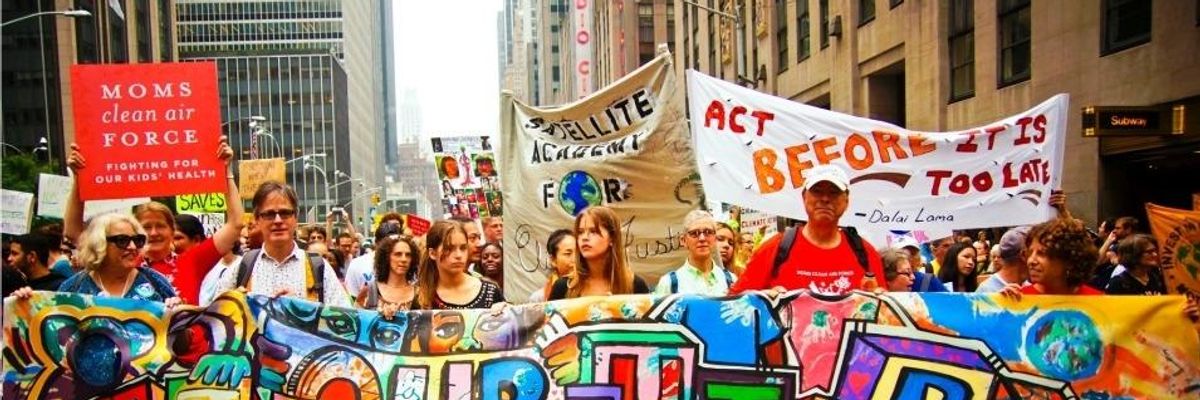
"We are calling on world leaders to come forward, not just in Bonn, but in the days, weeks, and months afterwards to say that they will stand on the right side of history, that they will be remembered for the decisions they take now," Morgan writes. (Photo: Light Brigading/Flickr/cc)
A common thread throughout history is that great leaders did the right thing at the right time, with courage and integrity. The current climate crisis has thrust our generation into such a moment in history.
"This year's climate-fuelled hurricanes, floods, and droughts will rapidly worsen if we fail to seize our moment. The sooner we act, the better."
Today, we face a threat and an opportunity like none we have seen before and have a small window of time in which to take decisive, bold action against climate change and deliver true security and justice for everyone.
It is not an easy challenge, but it's one we can achieve with a sense of shared leadership. The enormity of climate change could easily dwarf us individually, but collectively we can rise to the challenge.
We can't avert catastrophic climate change if only a few of us take action. It requires something of us all: from citizens to city mayors, from corporate CEOs to those on the frontlines of climate change, and world leaders too.
As politicians and non-state actors arrive in Bonn for the UN climate talks (COP23 - the Conference of the Parties of the UNFCCC) we will be looking for shared climate leadership to emerge.
In the two years since the Paris Climate Agreement signalled the intention to limit global warming to 1.5oC, world leaders have failed to deliver on their promise.
This was exposed in the UN Environment Programme's Emissions Gap Report 2017, which showed that the pledges countries have made would only deliver a third of what is needed to avoid the worst impacts of climate change. Climate action from the private sector and sub-national action is not enough to close the gap.
The World Meteorological Organisation's Greenhouse Gas Bulletin revealed that levels of carbon dioxide had surged at "record-breaking speed" to new highs in 2016. Rapidly increasing levels of CO2 and other greenhouse gases can spark unprecedented changes in climate systems, they warned.
Time is running out. This year's climate-fuelled hurricanes, floods and droughts will rapidly worsen if we fail to seize our moment. The sooner we act, the better. Bonn must help turn the tide.
Shared leadership. We can't go it alone.
That's the message G7 and G20 leaders gave to US President Donald Trump after he announced that the US would turn its back on the Paris agreement. The G7 and G20 held the line and recommitted to Paris, isolating Trump.
A large non-federal US delegation will attend next week's climate talks. They tell a different story about the reality of how the US is still committing to climate action, displaying the kind of leadership that we hear about in historic moments: the strength to stand up for what's right. Likewise, two members of Pacific Island Represent will be in Bonn to call on world leaders to honour their Paris commitments.
And they are not alone. In Norway, the first developed country to ratify the Paris Agreement, people are taking the Norwegian government to court over its Arctic oil drilling, exposing its climate hypocrisy. This lawsuit is part of a global wave of people litigating to hold governments and big polluters to account as the rapid pace of climate change outstrips our ability to adapt.
Leadership is having the courage to say enough is enough.
But they need support. Germany, as host of the UN climate talks with climate vulnerable Fiji, has an obligation to lead the way. Germany still doesn't have a plan to phase-out coal or combustion engines, unlike other European states like Italy, France and the UK. That is not shared leadership.
We are calling on world leaders to come forward, not just in Bonn, but in the days, weeks, and months afterwards to say that they will stand on the right side of history, that they will be remembered for the decisions they take now.
They will do so because the moment is here. This is our defining now.
Otherwise, history will only judge them harshly.
Dear Common Dreams reader, It’s been nearly 30 years since I co-founded Common Dreams with my late wife, Lina Newhouser. We had the radical notion that journalism should serve the public good, not corporate profits. It was clear to us from the outset what it would take to build such a project. No paid advertisements. No corporate sponsors. No millionaire publisher telling us what to think or do. Many people said we wouldn't last a year, but we proved those doubters wrong. Together with a tremendous team of journalists and dedicated staff, we built an independent media outlet free from the constraints of profits and corporate control. Our mission has always been simple: To inform. To inspire. To ignite change for the common good. Building Common Dreams was not easy. Our survival was never guaranteed. When you take on the most powerful forces—Wall Street greed, fossil fuel industry destruction, Big Tech lobbyists, and uber-rich oligarchs who have spent billions upon billions rigging the economy and democracy in their favor—the only bulwark you have is supporters who believe in your work. But here’s the urgent message from me today. It's never been this bad out there. And it's never been this hard to keep us going. At the very moment Common Dreams is most needed, the threats we face are intensifying. We need your support now more than ever. We don't accept corporate advertising and never will. We don't have a paywall because we don't think people should be blocked from critical news based on their ability to pay. Everything we do is funded by the donations of readers like you. When everyone does the little they can afford, we are strong. But if that support retreats or dries up, so do we. Will you donate now to make sure Common Dreams not only survives but thrives? —Craig Brown, Co-founder |
A common thread throughout history is that great leaders did the right thing at the right time, with courage and integrity. The current climate crisis has thrust our generation into such a moment in history.
"This year's climate-fuelled hurricanes, floods, and droughts will rapidly worsen if we fail to seize our moment. The sooner we act, the better."
Today, we face a threat and an opportunity like none we have seen before and have a small window of time in which to take decisive, bold action against climate change and deliver true security and justice for everyone.
It is not an easy challenge, but it's one we can achieve with a sense of shared leadership. The enormity of climate change could easily dwarf us individually, but collectively we can rise to the challenge.
We can't avert catastrophic climate change if only a few of us take action. It requires something of us all: from citizens to city mayors, from corporate CEOs to those on the frontlines of climate change, and world leaders too.
As politicians and non-state actors arrive in Bonn for the UN climate talks (COP23 - the Conference of the Parties of the UNFCCC) we will be looking for shared climate leadership to emerge.
In the two years since the Paris Climate Agreement signalled the intention to limit global warming to 1.5oC, world leaders have failed to deliver on their promise.
This was exposed in the UN Environment Programme's Emissions Gap Report 2017, which showed that the pledges countries have made would only deliver a third of what is needed to avoid the worst impacts of climate change. Climate action from the private sector and sub-national action is not enough to close the gap.
The World Meteorological Organisation's Greenhouse Gas Bulletin revealed that levels of carbon dioxide had surged at "record-breaking speed" to new highs in 2016. Rapidly increasing levels of CO2 and other greenhouse gases can spark unprecedented changes in climate systems, they warned.
Time is running out. This year's climate-fuelled hurricanes, floods and droughts will rapidly worsen if we fail to seize our moment. The sooner we act, the better. Bonn must help turn the tide.
Shared leadership. We can't go it alone.
That's the message G7 and G20 leaders gave to US President Donald Trump after he announced that the US would turn its back on the Paris agreement. The G7 and G20 held the line and recommitted to Paris, isolating Trump.
A large non-federal US delegation will attend next week's climate talks. They tell a different story about the reality of how the US is still committing to climate action, displaying the kind of leadership that we hear about in historic moments: the strength to stand up for what's right. Likewise, two members of Pacific Island Represent will be in Bonn to call on world leaders to honour their Paris commitments.
And they are not alone. In Norway, the first developed country to ratify the Paris Agreement, people are taking the Norwegian government to court over its Arctic oil drilling, exposing its climate hypocrisy. This lawsuit is part of a global wave of people litigating to hold governments and big polluters to account as the rapid pace of climate change outstrips our ability to adapt.
Leadership is having the courage to say enough is enough.
But they need support. Germany, as host of the UN climate talks with climate vulnerable Fiji, has an obligation to lead the way. Germany still doesn't have a plan to phase-out coal or combustion engines, unlike other European states like Italy, France and the UK. That is not shared leadership.
We are calling on world leaders to come forward, not just in Bonn, but in the days, weeks, and months afterwards to say that they will stand on the right side of history, that they will be remembered for the decisions they take now.
They will do so because the moment is here. This is our defining now.
Otherwise, history will only judge them harshly.
A common thread throughout history is that great leaders did the right thing at the right time, with courage and integrity. The current climate crisis has thrust our generation into such a moment in history.
"This year's climate-fuelled hurricanes, floods, and droughts will rapidly worsen if we fail to seize our moment. The sooner we act, the better."
Today, we face a threat and an opportunity like none we have seen before and have a small window of time in which to take decisive, bold action against climate change and deliver true security and justice for everyone.
It is not an easy challenge, but it's one we can achieve with a sense of shared leadership. The enormity of climate change could easily dwarf us individually, but collectively we can rise to the challenge.
We can't avert catastrophic climate change if only a few of us take action. It requires something of us all: from citizens to city mayors, from corporate CEOs to those on the frontlines of climate change, and world leaders too.
As politicians and non-state actors arrive in Bonn for the UN climate talks (COP23 - the Conference of the Parties of the UNFCCC) we will be looking for shared climate leadership to emerge.
In the two years since the Paris Climate Agreement signalled the intention to limit global warming to 1.5oC, world leaders have failed to deliver on their promise.
This was exposed in the UN Environment Programme's Emissions Gap Report 2017, which showed that the pledges countries have made would only deliver a third of what is needed to avoid the worst impacts of climate change. Climate action from the private sector and sub-national action is not enough to close the gap.
The World Meteorological Organisation's Greenhouse Gas Bulletin revealed that levels of carbon dioxide had surged at "record-breaking speed" to new highs in 2016. Rapidly increasing levels of CO2 and other greenhouse gases can spark unprecedented changes in climate systems, they warned.
Time is running out. This year's climate-fuelled hurricanes, floods and droughts will rapidly worsen if we fail to seize our moment. The sooner we act, the better. Bonn must help turn the tide.
Shared leadership. We can't go it alone.
That's the message G7 and G20 leaders gave to US President Donald Trump after he announced that the US would turn its back on the Paris agreement. The G7 and G20 held the line and recommitted to Paris, isolating Trump.
A large non-federal US delegation will attend next week's climate talks. They tell a different story about the reality of how the US is still committing to climate action, displaying the kind of leadership that we hear about in historic moments: the strength to stand up for what's right. Likewise, two members of Pacific Island Represent will be in Bonn to call on world leaders to honour their Paris commitments.
And they are not alone. In Norway, the first developed country to ratify the Paris Agreement, people are taking the Norwegian government to court over its Arctic oil drilling, exposing its climate hypocrisy. This lawsuit is part of a global wave of people litigating to hold governments and big polluters to account as the rapid pace of climate change outstrips our ability to adapt.
Leadership is having the courage to say enough is enough.
But they need support. Germany, as host of the UN climate talks with climate vulnerable Fiji, has an obligation to lead the way. Germany still doesn't have a plan to phase-out coal or combustion engines, unlike other European states like Italy, France and the UK. That is not shared leadership.
We are calling on world leaders to come forward, not just in Bonn, but in the days, weeks, and months afterwards to say that they will stand on the right side of history, that they will be remembered for the decisions they take now.
They will do so because the moment is here. This is our defining now.
Otherwise, history will only judge them harshly.