

SUBSCRIBE TO OUR FREE NEWSLETTER
Daily news & progressive opinion—funded by the people, not the corporations—delivered straight to your inbox.
5
#000000
#FFFFFF
To donate by check, phone, or other method, see our More Ways to Give page.
Daily news & progressive opinion—funded by the people, not the corporations—delivered straight to your inbox.

Since President Donald Trump withdrew from the Paris climate agreement in 2017, a number of local governments have taken it upon themselves to meet the deal's requirements to the extent that they can--but a new study finds that while those efforts are admirable and significant for individual states and communities, they are no match for the climate crisis fast accelerating by increased carbon emissions around the world.
Local leaders should continue doing what they can to combat the climate crisis, researchers at Data-Driven Yale found in their study. But until the United States--the world's largest driver of greenhouse gas emissions--is led by a government that prioritize a sharp reduction of carbon emissions and a shift to renewable energy, individual cities' and states' ability to slow the climate crisis will be minimal.
Examining the efforts of nearly 6,000 cities and states and 2,000 businesses--like California's advancement on Tuesday of a 100 percent renewable energy bill--found that those initiatives will only reduce U.S. carbon emissions by 1.5 billion to 2.2 billion metric tons by 2030.
In contrast, the United States' carbon output last just last year was 5.14 billion metric tons.
"When we look at the individual pledges the impact isn't that large, so we absolutely need national governments to pull through and do a lot of the heavy lifting," Dr. Angel Hsu, director of Data-Driven Yale, told The Guardian. "The actions of cities, companies, and states aren't insignificant but they can't do it by themselves. This shows everyone can be doing more. The current reductions are woefully inadequate and hopefully the actions of other entities will give national governments the confidence to be more ambitious."
The individual actions of forward-thinking governors and mayors, the study suggests, is no match for an administration which refuses to even acknowledge the consensus of 97 percent of climate scientists that human activity is contributing to the climate crisis, and which announced last week a plan under which states would be able to regulate their emissions from coal plants.
"The idea we just tighten our belt a bit isn't going to solve the problem. We need to stop using the atmosphere as a dumping ground, abandon fossil fuels, find other sources of energy and deal with the carbon debt we already have," Klaus Lackner, the director of Center for Negative Carbon Emissions at Arizona State University, told The Guardian.
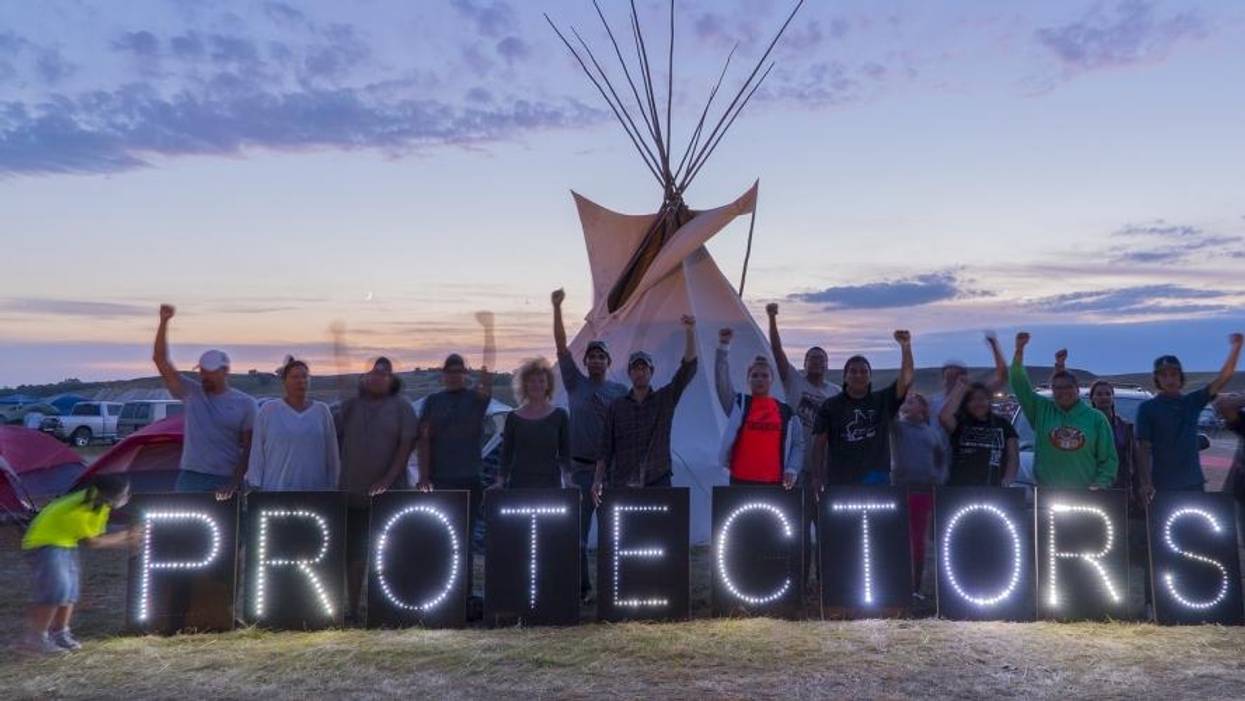
At the height of the movement at Standing Rock, Indigenous teens half a world away in Norway were tattooing their young bodies with an image of a black snake. Derived from Lakota prophecy, the creature had come to represent the controversial Dakota Access pipeline for the thousands of water protectors determined to try to stop it.
"This Indigenous-led disruption, the awakening resolve that was cultivated at Standing Rock, did not dissolve after February. Rather, it spread in so many different directions that we may never fully realize its reach."
It was a show of international solidarity between the Indigenous Sami and the Lakota. "They got tattoos because of the Norwegian money invested in the pipeline," said Jan Rune Maso, editor of the Sami news division of Norway's largest media company, NRK.
Rune Maso said the story about the tattoos was just one of about a hundred that his team of journalists covered over the course of the months-long pipeline battle in North Dakota. One of them, "The War on the Black Snake," was awarded top honors at a journalism conference held in Tromso in November. That story revealed large investments Norwegian banks had made to advance the $3.8 billion energy project, spurring a divestment campaign by the Sami Parliament.
The backstory can be told simply. As early as April 2016, Indigenous activists protested the pipeline's threat to the Standing Rock Sioux's primary water supply, the Missouri River. While battles were fought in federal courts, representatives of hundreds of Indigenous groups from around the world--the Maori, the Sami, and the Sarayaku, to name a few--arrived. Temporary communities of thousands were created on the reservation borderlands in nonviolent resistance against the crude oil project. Police arrested more than 800 people, and many water protectors faced attack dogs, concussion grenades, rubber bullets, and, once, a water cannon on a freezing night in November. Last February, armored vehicles and police in riot gear cleared the last of the encampments. Recently, investigative journalism by The Intercept has documented that the paramilitary security firm TigerSwan was hired by DAPL parent Energy Transfer Partners to guide North Dakota law enforcement in treating the movement as a "national security threat."
Oil now flows through the pipeline under the Missouri.
But this Indigenous-led disruption, the awakening resolve that was cultivated at Standing Rock, did not dissolve after February. Rather, it spread in so many different directions that we may never fully realize its reach. The spirit of resistance can easily be found in the half-dozen or so other pipeline battles across the United States. Beyond that, the movement amplified the greater struggle worldwide: treaty rights, sacred sites, and the overall stand to protect Indigenous land and life.
To be sure, post-colonization has always demanded acknowledgment of Indigenous autonomy. It's what spurred months of international advocacy when Haudenosaunee Chief Deskaheh attempted to speak before the League of Nations in Geneva, Switzerland, in 1923. He wanted to remind the world that European colonizers had honored Iroquois Confederacy nationhood upon entering treaty agreements under the two row wampum.
The stand at Standing Rock, then, was not anything new--just more modern.
Google the words "the next Standing Rock" and you get a smattering of circumstances, mostly posed in the form of a question: Bears Ears, Line 3, Yucca Mountain. "The Next Standing Rock?" the headlines ask.
The story of White Clay, Nebraska, is indicative. When the last tipis came down at Standing Rock, Clarence Matthew III, a middle-aged Sicangu Lakota man better known by his camp nickname, Curly, spared little time migrating to the South Dakota-Nebraska border. There, another fight for justice was mounting, for families living on the neighboring Pine Ridge Indian Reservation. This one focused on a decades-long dispute over beer sales targeted at Native American customers mostly prone to alcohol addiction.
Demands turned to broader issues: investigation of dozens of unsolved crimes in White Clay against Native Americans. "Once we got down there, they started telling us about the problems they've had, more than just alcohol, the murders, the rapes, and everything that was on the bad side of that alcohol problem," Matthew said. "It just broke my heart to hear all that."
Matthew had been caretaker of one of the main communities at Standing Rock, and he settled right in at Camp Justice at the edge of Pine Ridge. He was there with his "water protector family," others who have adopted camping as an active form of protest.
For all the momentum that the resistance at Standing Rock brought, the Indigenous rights movement in the 21st century faces increasing challenges. Tribal nations tread cautiously under the administration of Donald Trump. Internationally, the militarized protection of extractive energy projects and theft of land persist, despite glaring media attention paid to the rising number of Indigenous peoples killed or jailed for their activism in the face of it.
In a final push for re-election last fall, Standing Rock's Dave Archambault II gave what would be his last interview as chairman to tribal radio station KLND. Archambault used the airtime to speak matter-of-factly about how the movement had shifted the tribe's potent public image away from the reservation. "It used to be cool to be Indian; now it's cool to be from Standing Rock.
"This movement was significant, not just for Standing Rock, but for all of Indian Country and around the world. We made some noise and now we're starting to see other Indigenous communities rise up and say, Let us all speak now, and it's pretty powerful and moving," he said.
Less than a week later and on the same day that the state of North Dakota accepted a $15 million gift from Energy Transfer Partners, Archambault was unseated by former council member Mike Faith, who has said publicly that he believes the overall movement hurt Standing Rock's economy and neglected daily life for tribal members.
The difference of opinion between the two leaders is a conflict that often lies at the heart of tribal community: protecting the Earth or protecting the Indigenous peoples.
On the eve of Thanksgiving 2017, when the Keystone pipeline ruptured and spilled 210,000 gallons of oil in neighboring South Dakota, the newly elected Faith remained notably silent while water protectors responded with outrage, most loudly, closest to home.
"Ironically, this week most Americans will be sitting down and giving thanks when last year at this time my people were being shot, gassed, and beaten for trying to keep this very thing from happening," Chairman Harold Frazier from the neighboring Cheyenne River Sioux tribe said in a statement. Like Archambault and other tribal leaders, Frazier was arrested for participating in the Standing Rock occupation.
Leadership in the Indigenous world is not only a difficult balance, but also dangerous.
In Honduras, activist Bertha Zuniga Caceres is fighting for Indigenous rights in one of the most militarized regions in the world. She is the daughter of Berta Caceres, the Indigenous Lenca woman who was assassinated after leading a successful campaign to halt construction of the Agua Zarca Dam. Now she is seeking justice for her mother's death.
The 26-year-old Caceres is also campaigning to suspend all U.S. military aid to Honduras. In July, she survived an attack by a group of assailants wielding machetes. Just weeks earlier she had been named the new leader of the Council of Popular and Indigenous Organizations of Honduras, the nonprofit organization formerly led by her mother.
"Many organizations, many NGOs, many Indigenous groups are struggling in how to sustain the work that they are doing in the face of these attacks," said Katharina Rall, a researcher for Human Rights Watch.
Last year, after the military-style assaults on the camps at Standing Rock, Human Rights Watch expanded its agenda to include a program focused on the environment as a human right. "The fact that we now have an environment and human rights program at our organization is a reflection of this reality that a lot of people face," Rall said.
Meantime, the organization Global Witness reports that it has never been deadlier to take a stand against companies that steal land and destroy the Earth. In 2016, the watchdog group found that nearly four activists a week are murdered fighting against mining, logging, and other extractive resource development.
As disturbing as this reality is, it is unsurprising then to recall the military-style violence at Standing Rock: the rows of riot police pointing their guns at unarmed activists standing in the river; tanks shooting water in freezing temperatures at a crowd of people gathered on a bridge. In this one regard, Standing Rock was not unique in the world. It had become crucially important. Americans saw the global struggle faced by the estimated 370 million Indigenous people--the violence, stolen resources, colluding corporations and governments that go hand in hand with protecting the Earth.
Sustaining this awakening is the next great task.
Climate change poses one of the most serious reminders of why the sacred fires ignited at Standing Rock must continue to burn: Indigenous peoples and their knowledge and value systems matter.
"Climate change poses one of the most serious reminders of why the sacred fires ignited at Standing Rock must continue to burn: Indigenous peoples and their knowledge and value systems matter."
At November's COP23 climate conference in Bonn, Germany, Hindou Oumarou Ibrahim was dressed in traditional Mbororo regalia when she stood in a conference hall demanding that Indigenous knowledge systems be properly acknowledged in Paris Agreement negotiations. The girl who once tended cattle in the region of Chad bordering northeastern Nigeria has now become a bridge for her people and government officials making decisions impacting the fragile ecosystem of Lake Chad, the lifeline for the Mbororo.
"Traditional knowledge has kept us from century to century to be in harmony with Mother Earth," Ibrahim said. "These knowledges will make for all the difference, but we cannot wait years and years, because climate is changing, and it's impacting the Earth."
Other members of the Indigenous Caucus at Bonn say inserting traditional knowledge into the climate talks doesn't go far enough. Jannie Staffansson, a representative of the Saami Council, wants what Chief Deskaheh had petitioned to the League of Nations nearly a century earlier: sovereign recognition for Indigenous Peoples on an international scale. It would allow equity at the negotiating table--a level playing field to fairly deal with the consequences of a warming planet in the face of land grabs and natural resource extraction.
"Why is it always that Indigenous peoples need to pay for other people's wealth?" said Staffansson. She paused to check the Snapchat account she had been using to engage with a young Sami audience while at COP, a demographic similar to the teens who got tattoos of the black snake.
"I had friends that went to Standing Rock," said the 27-year-old. "I was envious of their trip to support self-determination. Self-determination and a just transition is what we have to take into account."
"We need climate justice in everything we do."

What a year it's been. The destructive antics of the Trump administration and Congress and a political discourse increasingly polluted by 'alternative facts' have frequently made many of us angry, sad, and sometimes just plain crazy.
Through it all, it's been inspiring to see a resistance movement gather strength and show its muscle. I've been awed by the work of racial justice activists, scientists, grassroots groups, immigrant rights groups, youth groups and many many others. Here's a snapshot of what a year in the resistance looked like for me.
January
The Women's March (one of the largest protest marches ever, coordinated across the nation and globally), held a day after President's Trump's inauguration (with its less-than-record attendance), showed where the true power of the people lies.
Like many of you, I joined the march with my family. Watching my kids (in their pink hats, of course) experience the crowds, point out their favorite signs, raise their voices in call-and-response chants--all of it gave me a thrill to think that a new generation was beginning to understand the power of peaceful protest in a democracy.
And we called out a dangerous new form of climate denial taking hold in the administration, especially with the nomination of Scott Pruitt as EPA administrator.
February
In courts across the nation, including in Hawaii, Washington, Virginia, New York, Massachusetts, Minnesota and Maryland, there were immediate challenges filed to President Trump's terrible 'Muslim Ban' executive order issued at the end of January.
As an immigrant myself, it was especially moving to join a large and diverse crowd of people marching in protest in Boston, and to see similar protests nationwide. At many major airports teams of lawyers also flocked in to offer pro bono assistance to travelers affected by the ban. (The Supreme Court has since allowed a modified version of the ban to go ahead but this is by no means the last word since it is still being litigated.)
March
We called out Scott Pruitt's lies on climate change, held the administration accountable on its rollback of protective health standards including an all-out attack on climate policies, and we urged Congress to resist harmful cuts to the EPA budget (and succeeded in fending off some of the most damaging cuts).
April
The March for Science March and the Peoples Climate March were the highlights of April. It was magnificent to join the throngs of people marching for climate, jobs and justice on that sweltering hot day in Washington DC. More importantly, we are building a movement that is about more than just that one day.
May
President Trump's destructive first budget proposal was shown up to be all bark and no bite since Congress actually controls the purse strings. We campaigned against the many awful elements of the Trump budget proposal, including cuts that would harm our nation's ability to prepare for climate and extreme weather disasters and cuts that would gut the EPA. (Harmful budget cuts are an ongoing threat. It's critical for constituents to continue to urge their policymakers to resist deep cuts to agency budgets that jeopardize the health and well-being of Americans.)
June
'We are still in!' declared states, cities, counties, tribes, businesses, investors, faith groups, colleges and universities, in prompt response to President Trump's shameful announcement that he intended to withdraw the US from the Paris Agreement.
Unfortunately, June also brought terrible heatwaves and wildfires, further evidence that the impacts of climate change are here and now, despite the climate denialism rampant in this administration.
July
One of the most satisfying ways to resist the madness wrought by this administration is to just carry on doing good science. In July, my colleagues and I released a new report, When Rising Seas Hit Home: Hard Choices Ahead for Hundreds of US Coastal Communities. The report highlights the threat of chronic coastal inundation exacerbated by sea level rise, and is accompanied by a fantastic online mapping tool.
Its findings challenge us to work toward solutions at the national, state and local level. Frontline communities facing these risks need help--and this should not be a partisan issue.
August-September
The nightmare hurricane season of 2017 unfolded in August and September, bringing Harvey, Irma, and Maria. Houston, Puerto Rico and the US Virgin Islands suffered particularly devastating impacts. Groups like Texas Environmental Justice Advocacy Services (t.e.j.a.s.), an Environmental Justice organization in Houston, rallied to call attention to urgent needs.
My colleagues and I wrote about the flood threats in Houston, especially the risks from toxic pollution and the need to keep environmental justice front and center in the recovery process. We also laid out the science of hurricanes and climate change, and called on Congress to take action to help devastated communities.
And, yes, we also pointed out the irony of the Trump administration's rollback of the federal flood risk management standard just a week before Harvey hit. And the how damaging the administration's proposed budget cuts to FEMA and HUD, key agencies for our nation's disaster response, would be.
October
Market trends, state policies, and federal tax incentives continued to drive a historic transition away from coal to cleaner forms of energy, despite the EPA's announcement that it would repeal the Clean Power Plan, the nation's first-ever limits on power plant carbon emissions. We called out Administrator Pruitt's cynical move to pander to fossil fuel interests while blatantly ignoring the EPA's mission to protect human health and the environment.
Terrible wildfires raged across Northern California, killing 44 people and causing billions of dollars of damage. Sadly, another example of how climate change is exacerbating risks to people and property.
November
I was in Bonn, Germany for COP23, the annual UN climate talks, where the Trump administration was rendered largely irrelevant and isolated in its stance on the Paris Agreement. Every other nation is steadfastly committed to the agreement, and the 'We Are Still In' coalition of US sub-national actors was there in full force to reiterate that the nation's clean energy and carbon-cutting progress will continue despite the retrograde actions of the Trump administration.
December
As we close out the year with the passage of a deeply unjust and harmful tax reform bill and a sober reckoning of this year's record-breaking disasters, including wildfires and hurricanes, there are lots of reasons to be very concerned.
Yet, there are some bits of good news too. The terribly destructive Thomas Fire in California is finally under control, for one. I also see signs all around that the resistance is alive and well-and gathering steam.
Just a few examples of positive developments:
We've seen a number of unqualified nominees proposed by the administration forced to withdraw recently because of public pressure;
Our nation's transition away from coal to cleaner power sources continues unabated, lowering power sector carbon emissions;
Many states continue to enhance the ambition of their clean energy policies;
Many people stood up to defend science (here's UCS' list of 2017 Science Defenders, example);
Congress roundly rejected many of the extreme budget cuts proposed by the administration;
The Alabama election demonstrated the power of African American voters (women especially), a historically disenfranchised segment of the population;
The National Defense Authorization Act recently signed by President Trump explicitly acknowledges that climate change is a direct threat to US national security. (Of course we had to then call him out for flip-flopping a week later when the administration released a National Security Strategy that doesn't even mention climate change!)
Hope for 2018
What gives me hope for 2018 is that Americans from all walks of life are now awake to the threats this administration poses to our democracy, our health, our climate, and basic human rights--and we're fighting back! Our movement is strongest when we work together, connecting our work to people's daily lives and concerns, and specifically aiming for solutions that are just.
The wins may not come easily and there's a lot of work ahead. This administration's attacks on science and our core values will very likely continue. But they are helping to forge our resistance and build its power. (Not to mention inspiring reams of incredibly biting, funny, incisive political satire-humor is sometimes the only way to handle the farcical extremes we've experienced this year!)

World climate negotiations concluded in Bonn, Germany recently after two painstaking weeks. Whilst many parties to the UN convention and other commentators choose to highlight any small steps forward in the talks, no matter how inadequate, Friends of the Earth opts to speak truth to power.
Asia Pacific is the region where the most people are already feeling the impacts of changes in the climate and Meena Raman of Friends of the Earth Malaysia spoke out in Bonn, saying "Every COP feels like a broken record. We are sick and tired of talkshops. Act!"
2017 has been a devastating year and is set to be one of the hottest three years on record. Around the globe people are paying with their lives and livelihoods for climate-exacerbated extreme weather events in the form of hurricanes, wildfires and heatwaves. Terrifyingly, new data shows that global emissions will rise again this year after several years of stagnation--world emissions have not even peaked yet when we need them to be falling fast. The disconnect between the scale of government action and the urgency of the climate crisis is as vast as ever.
And yet, the transition of world economies away from fossil fuels will happen. The energy transformation is as inevitable as climate change and its devastating impacts are real. The questions are; how fast will it be? who will benefit? and who will lose out?
Analysts believe the transition to clean energy sources is likely to happen faster than anyone expects. Even the Organisation for Economic Co-operation and Development (OECD) - not a body prone to invite instability - predicts that the pace of technological change will be underestimated.
"The energy transformation is as inevitable as climate change and its devastating impacts are real. The questions are; how fast will it be? who will benefit? and who will lose out?"
But if left to market forces guided by transnational corporations it is very likely to be unfair, slow and painful. We should be ready for the most rapid industrial transformation ever. And we should learn the lessons from history of other industrial shifts. Trade unions are already warning that transitions of industrial systems in the past have brought a lot of suffering for workers. People's jobs, livelihoods, connections to the land, family bonds and heritage have been lost.
With this in mind, environment and trade union movements have come together to call for a 'just transition'--a transition that leaves no-one behind. A transition that is fair and secures workers' jobs and livelihoods through the creation of decent opportunities. Done right we can simultaneously tackle the climate crisis and also inequality, employment and democratic crises.
In many ways we should not be afraid to see the back of the current system. We should not be under the illusion that today's economic model has brought universal benefits. The percentage of people in organised labour is decreasing and varies from country to country. Work frequently doesn't give people a decent income. Often low wages have to be subsidised. The relentless pursuit of growth has led to these times we live in characterized by gross inequality, more and more precarious work, and a deepening democratic deficit.
The concept of a just transition is already embedded in the 2015 Paris Agreement. Its preamble calls for "a just transition of the workforce and the creation of decent work and quality jobs". Yet most negotiators and governments are not really thinking about the social implications of climate policy. Luckily environmentalists and trade unionists and others are.
In Bonn Friends of the Earth International and the International Trade Unions Confederation co-organised a public event to demonstrate their common cause, share positive experiences of transition, and to plan for an economy that respects and protects workers' rights and benefits communities, not only employers.
Success stories came from all continents. In Australia efforts have been made to put a just transition into practice. Following the abrupt decisions to close a coal power plant, workers and other local actors came together and organized a successful campaign to get government support for a solar thermal plant providing 1500 jobs on the same site as the old coal plant--a powerful symbol. In another case from Australia, employees at a decommissioned coal plant fought for and won a worker transfer agreement covering jobs in other nearby plants as well as training--a rare example of legally binding transition provisions for workers.
As the climate talks drew to an end, Canada's unions were applauding the federal government for announcing plans to tie Canada's phase-out of coal-fired electricity with a just transition for affected workers and communities. Alberta's coal workers have been long awaiting support in response to the announced phase-out.
"It is vital that the transition away from the old polluting economy happens in collaboration with workers, starting with those most disproportionally affected."
In Scotland100,000 jobs in North Sea oil have already been lost. Now the government--under pressure from a coalition of environment groups and trade unions--has established a Just Transition Commission. It's a recent announcement and it is not yet clear who will sit on the commission or how it will work, only that it will "advise Scottish Ministers on adjusting to a more resource-efficient and sustainable economic model in a fair way which will help to tackle inequality and poverty." Such initiatives need to be shared, built on, improved and to become the norm as the transition accelerates.
It is vital that the transition away from the old polluting economy happens in collaboration with workers, starting with those most disproportionally affected. It should be publicly owned and address current power imbalances.
It remains to be seen whether governments, especially those in the developed world, can catch-up to the reality that fossil fuels must be left in the ground and transition to clean energy sources in time to minimize the effects of climate change. We know, for example, that the EU can afford just nine more years of burning gas and other fossil fuels at the current rate before it will have exhausted its share of the earth's remaining carbon budget. 2018 will be an absolutely critical year for the 1.5degC maximum temperature rise goal the Paris Agreement aspires to and which is a matter of survival for low-lying countries and vulnerable communities. The urgency cannot be understated.
In these circumstances, it is inspiring to see the diversity and strength of the movement coming together to demand that the transition from an extractive economy to a regenerative one happens in a fair and fast way. What unites this movement is our shared recognition of the gravity of the climate crisis, our shared desire for justice, and our common vision of 'Decent jobs on a living planet.'

I remember well the vibrancy that December evening in 2015 when word spread on the last day of the 21st UN climate summit that there would be an agreement -- the Paris Agreement.
After two decades of staring at a known and worsening global crisis of epic proportions, leaders of 196 nations, pushed mercilessly by UN, French, and US negotiators, finally decided to not allow the earth to burn up by 2100. The Eiffel Tower glowed with triumphant messages against a starry Paris sky.
For the first time, nations voluntarily agreed to reduce their carbon emissions and slow the rate of deforestation. That moment in Paris felt historic, hopeful, perhaps the most significant agreement among world leaders for the greater good of this earth since World War II.
Just two years later, as I stayed late on the last night of the 23rd UN climate summit in Bonn, Germany, I felt no such vibrancy and certainly no such history-making optimism. There was little. COP23 wasn't designed for major breakthroughs. Everyone conceded that.
But why not?
Once again, 2017 promises to be another of the hottest years in the historical record. After three years of stable global greenhouse gas emissions, 2017 will see a spike in emissions to record highs.
How many hurricanes the ferocity of Harvey, Irma, and Maria must be experienced in the US alone to stoke a greater sense of urgency? How many climate refugees need to be pushed from sub-Saharan Africa and Syria because of unrelenting drought? How much more Arctic ice needs to melt? How much sea-level rise can be tolerated in low-lying island nations -- and Miami Beach, for goodness sake -- before COP participants stop delaying greater ambitions prior to 2020, when a stronger Paris Agreement is to take effect?
Despite Trump's climate denial, the U.S. military labels the destabilizing impact of global climate change as the most serious national security threat facing the nation. Not immigration. Not terrorism. Not economic calamity. Climate change.
So where's the incitement, now, to reduce carbon emissions beyond the modest Paris pledges, an absolute necessity if we are to contain temperature rise to 1.5 degree C by 2100, the Paris goal? Where are the billions in promised funding to help the victims of climate impacts adapt and recover their losses and damages?
Nowhere yet in sight.
COP23 was not without incremental accomplishments. There were many, most boldly a coalition of US cities, states, and businesses pledging to do for climate mitigation what the Trump administration won't. Would a Hillary Clinton administration have done more? Hard to say. Trump's low-level State Department staffers pressed the common US goal of greater transparency and accountability in reporting climate action. Mostly, they provided cover for other developed nations to block progress on defining pathways to billions in financing adaptation and loss-and-damage funds.
Under Obama, the wealthiest nation on earth committed just $3 billion to global climate-related funds and paid only $1 billion before Trump's election. Last month, the U.S. House approved $36.5 billion in recovery funds to Florida and Texas alone, far less than half of what's needed. So it's not likely that Clinton negotiators would have been more forthcoming on finance in Bonn.
It doesn't help that the de facto leader of the free world, German Prime Minister Angela Merkel, can't form the coalition government she needs to lead her country and the EU. She told delegates at COP23 that Germany -- despite its massive investment in wind energy -- would not phase out coal by 2030 as promised, nor would it meet its carbon-reduction goals in the Paris agreement.
Meanwhile, China is building more solar panels than the rest of the world combined. But it is paying billions in Brazil and the Democratic Republic of the Congo to level carbon-sequestering rainforests for ranching and natural-resource extraction to help feed its population and manufacture the world's products.
Nineteen nations agreed to phase out coal by 2030, including Canada and the UK. But most were already close to doing so, and besides, they represent just three percent of the global coal burned for energy. Meanwhile, 1,600 coal-fired plants are planned or under construction in 62 countries.
When I interviewed Anote Tong, the former president of Kiribati, a Pacific island country threatened by sea-level rise, his comment, "How can I tell my grandchildren that they may not have a country in 25 years," nearly brought me to tears. Tong is at the mercy of G-20 leaders. He pleaded with them to act morally and humanely, not just geopolitically. Is that even possible?
If I've learned anything from covering four consecutive climate summits, it's that Paris was something of an anomaly. Most COPs, like COP23, produce progress around the edges of climate mitigation and promises to talk again next year. Always next year.
Nearly everyone in Bonn believes that climate change represents an existential threat to human life on earth. But it's clear that, for political reasons both complex and expedient, taking broad, immediate climate action is not a top priority for any of the world's largest polluters -- China, the US, India, the EU, Japan, Canada, Australia. Not even close.
Until it is, another year passes as nature responds ever-more furiously to the lack of progress.
Maybe next year, at COP24 in Poland, things will be different. Expectations are certainly different. The rulebook to govern the Paris Agreement must be completed. Nations must report how much more they will reduce carbon emissions. Billions in finance are expected to materialize or at least be identified.
Scientists say the window for climate action to curb global warming is still open. Let's hope so. We are rapidly running out of next years.

On Monday November 13th, climate scientists from the Tyndal center for Climate Change Research at the University of East Anglia presented their carbon emissions research to the UN climate negotiators at Bonn Germany. The data were shocking: After three years in which human-caused emissions appeared to be leveling off, global CO2 emissions are now rising again to record levels in 2017. Global emissions are on course rise this year by 2%. China's emissions are projected to rise by 3.5%. These may sound like small numbers but to climate scientists these are huge because if we're to keep global temperatures from rising by more than 2 degrees Centigrade, those emissions need to be falling sharply, not just leveling off, let alone rising. Colorado State University climate scientist Scott Denning said "We've got to cut emissions by half in the next decade, and by half again in the next two decades, as well. The fact that it's going up is like a red flag flashing light on the dashboard."
"The problem is, we live in an economy built on perpetual growth but we on a finite planet with limited resources and sinks."
The same day, the journal BioScience published a letter by more than 15,000 scientists from around the world that looks back at the human response to climate change and other environmental challenges in the 25 years since another large group of scientists published the 1992 "World Scientists Warning to Humanity."
This time the scientists wrote in part: "Since 1992, with the exception of stabilizing the stratospheric ozone layer, humanity has failed to make sufficient progress in generally solving these foreseen environmental challenges, and alarmingly, most of them are getting far worse." If we don't take immediate steps, "soon it will be too late to shift course away from our failing trajectory, and time is running out. " The goal of the letter, said William Ripple, distinguished professor in the college of Forestry at Oregon State University, and lead author of the new warning, is to "ignite a wide-spread public debate about the global environment and climate."
Ripple is right. We need a conversation, a global public debate about the global environment and how to save the planet, and we need to begin it right now.
As if on cue, in yesterday's New York Times, Professor Benjamin Fong launched a broadside placing the blame squarely where it needs to be. The problem isn't public ignorance, it isn't bad politicians, it isn't even bad companies:
The real culprit of the climate crisis is not any particular form of consumption, production or regulation but rather the very way in which we globally produce, which is for profit rather than for sustainability. So long as this order is in place, the crisis will continue and, given its progressive nature, worsen. This is a hard fact to confront. But averting our eyes from a seemingly intractable problem does not make it any less a problem. It should be stated plainly: It's capitalism that is at fault.
Changing the conversation
For far too long, polite conversation, public debate and consideration of policy initiatives have been subordinated to the imperatives of capitalist reproduction, above all profit maximization. Profit maximization and job creation go hand in hand and crucially depend upon economic growth. All "reasonable" solutions to the crisis of global warming take that as their starting point, a fundamental principle that cannot be challenged. This is the unspoken premise of carbon taxes: Carbon taxes do not threaten growth. They're simply another cost of doing business, another tax which moreover can be passed along to consumers. This is why ExxonMobil, Shell, BP and most big fossil fuel companies support carbon taxes as the lesser evil (cap and trade is the greater evil precisely because a cap would threaten growth, which is why cap and trade are not acceptable to business and why such schemes have all been either rejected outright as in the United States or so watered down as to be useless charades as in Europe, British Columbia and elsewhere). The oil companies are not looking to put themselves out of business. Industry and IEA studies project that global demand for fossil fuels will rise by 40% over the next few decades and the oil companies intend to cash in on this growth. To do so they need to deflect criticism by being good citizens, paying their carbon taxes, contributing to the "solution" or at least appearing to do so.
The problem is, we live in an economy built on perpetual growth but we on a finite planet with limited resources and sinks. To date, all efforts to "green" capitalism have foundered on this fundamental contradiction: maximizing profit and saving the planet are inherently in conflict and cannot be systematically aligned even if, here and there, they might coincide for a moment. That's because under capitalism, CEOs and corporate boards are not responsible to society, they're responsible to private shareholders. CEOs can embrace environmentalism when it boosts profits, as with energy efficiency, recycling, and new "green" products and the like. But saving the world requires that the pursuit of profits be systematically subordinated to ecological concerns--and this they cannot do. No corporate board can sacrifice earnings, let alone put itself out of business, just to save the humans because to do so would be to risk shareholder flight or worse. Profit-maximization is an iron rule of capitalism, a rule that trumps all else, and this sets the limits to ecological reform within capitalism--and not the other way around as the promoters of "green capitalism" imagined.
To save the humans we know we have to drastically cut fossil fuel consumption. But "Keep It in the Ground" is not just an abstraction and not just about future supplies. If we're going to radically suppress fossil fuel consumption in the here and now as we must, then this has to translate into drastic retrenchments and closures of industrial plants across the economy--and not just of coal mines, oil and gas companies but all the fossil fuel dependent industries: autos, trucking, petrochemical industries, airlines, shipping, construction and more.
What's more, the global ecological crisis we face is far bigger than just fossil fuels. We're not just overconsuming fossil fuels. We're overconsuming every resource on the planet, driving ourselves and countless other species to extinction. Ultimately, if we really want to save the planet, we're going to have to shut down or at least drastically retrench all kinds of resource-hogging, polluting, unnecessary, unsustainable industries and companies from fossil fuels to bottled water, from disposable products to agrichemicals, plastic junk to military weapons of destruction.
"There's no point in chanting 'Keep It in the Ground' if we don't have a jobs program for all those workers whose jobs need to be excessed to save those workers' children and ours. This is our dilemma."
Take just one: Cruise ships are the fastest growing sector of mass tourism on the planet. But they are by far the most polluting tourist indulgence ever invented: Large ships can burn more than 150 tons of the filthiest diesel bunker fuel per day, spewing out more fumes--and far more toxic fumes--than 5 million cars, polluting entire regions, the whole of southern Europe - and all this to ferry a few thousand boozy passengers about bashing coral reefs. There is just no way this industry can be made sustainable. The cost of the ticket for that party boat cruise is our children. The same can be said for dozens if not hundreds of industries, thousands of companies around the world. We can save these industries, save capitalism, or we can save the planet. We can't save both.
Needless to say, retrenching and closing down such industries would mean job losses, millions of job losses from here to China (pdf). Yet if we don't shut down those unsustainable industries we're doomed. What to do? There's no point in chanting "Keep It in the Ground" if we don't have a jobs program for all those workers whose jobs need to be excessed to save those workers' children and ours. This is our dilemma.
Planned, managed deindustrialization or unplanned, chaotic ecological collapse
Capitalism cannot solve this problem because no company can promising new jobs to unemployed coal miners, oil-drillers, automakers, airline pilots, chemists, plastic junk makers, and others whose jobs would be lost because their industries would have to be retrenched--and unemployed workers don't pay taxes. So CEOs, workers, and governments find that they all "need" to maximize growth, overconsumption, even pollution, to destroy their children's tomorrows to hang onto their jobs today. Thus we're all onboard the high-speed train of ravenous and ever-growing plunder and pollution.
"If we don't change the conversation, if we don't deal with the systemic problems of capitalism and come up with a viable alternative, our goose is cooked."
And as our locomotive races toward the cliff of ecological collapse, the only thoughts on the minds of our CEOS, capitalist economists, politicians and labor leaders is how to stoke the locomotive to get us there faster. Professor Fong is right: Corporations aren't necessarily evil. They just can't help themselves. They're doing what they're supposed to do for the benefit of their owners. But this means that so long as the global economy is based on capitalist private/corporate property and competitive production for market, we're doomed to collective social suicide and no amount of tinkering with the market can brake the drive to global ecological collapse.
We can't shop our way to sustainability because the problems we face cannot be solved by individual choices in the marketplace. They require collective democratic control over the economy to prioritize the needs of society and the environment. And they require local, national, regional and international economic planning to re-organize our economies, to provide new jobs to replace those jobs we need to abolish, and to rationally and fairly redeploy resources to those ends. In a paper I wrote for The Next System Project last year--"Six Theses on Saving the Planet"--I laid out my argument for ecosocialism as the only alternative to market-driven ecological collapse in the form of six theses:
Capitalism, not population is the main driver of planetary ecological collapse and it cannot be reformed enough to save the humans.
Green capitalism can't save us because companies can't commit economic suicide to save the humans. There's just no solution to our crisis within the framework of any conceivable capitalism.
The only alternative to market-driven ecological collapse is to transition to some sort of mostly planned, mostly publicly owned economy based on a global 'contraction and convergence' around a sustainable level of resource consumption that can provide a dignified living standard for all the world's peoples while leaving enough for future generations and other species.
Rational planning requires bottom-up democracy.
Democracy requires rough socioeconomic equality - which requires that we abolish extreme differences in incomes and wealth and enforce those rights already in theory guaranteed to us in the Universal Declaration of Rights (1949) including the right to work at fair compensation, the right to equal employment, the right to adequate food, housing, medical care, education, social services, and a comfortable retirement.
Far from "austerity," an ecosocialist future offers us liberation from the treadmill of consumerism, from the fetishism of commodities. Freeing ourselves from the toil of producing unnecessary and /or harmful products and services would free us to shorten the work day, to enjoy the leisure promised but never delivered by capitalism, to redefine the meaning of the standard of living to connote a way of life that is actually richer, while consuming less, to realize the fullest potential of every human being. This is the emancipatory promise of ecosocialism.
For some readers, my arguments may raise as many questions as they answer. Fine. But if we don't change the conversation, if we don't deal with the systemic problems of capitalism and come up with a viable alternative, our goose is cooked. So if not ecosocialism, then what? This is the public debate we need to be having right now. What are your thoughts?
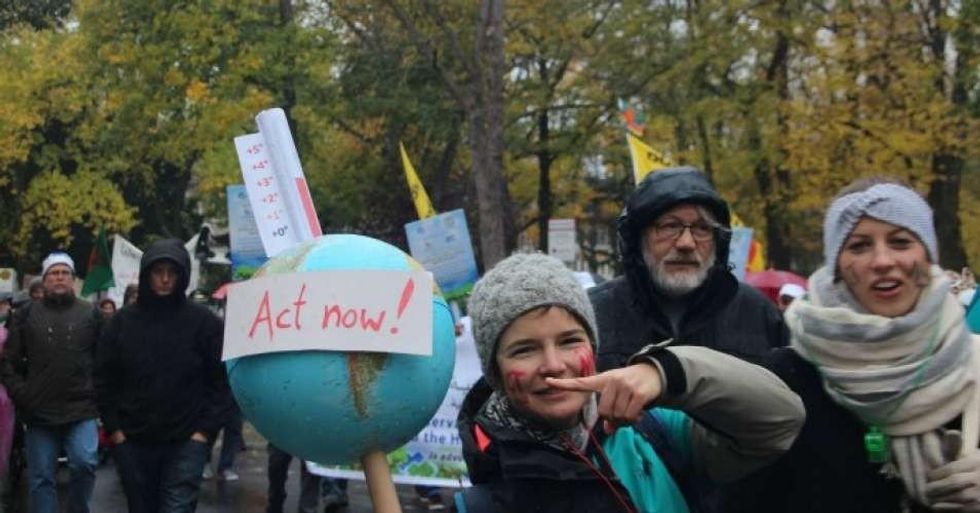
As the United Nations climate conference known as COP23 drew to a close on Friday, leaders from the global climate justice movement called for greater ambition to make the necessary transition away from fossil fuels.
"Our job is to get out there and demand the fossil free world that science and justice demand."
--Jamie Henn, 350.orgThe two-week summit in Bonn, Germany (but presided over by Fiji) saw delegates from nearly 200 countries work towards creating a "rulebook" for implementing the Paris climate accord, while protesters on the sidelines drew attention to the urgency of the crisis and its already-felt impacts on communities. As one indigenous activist at the conference said: "Life itself and the future of humanity is at stake."
Former NASA scientist James Hansen laid out the stakes as well.
"We are entering a period of consequences and are in danger of being too late," he said at the conference.
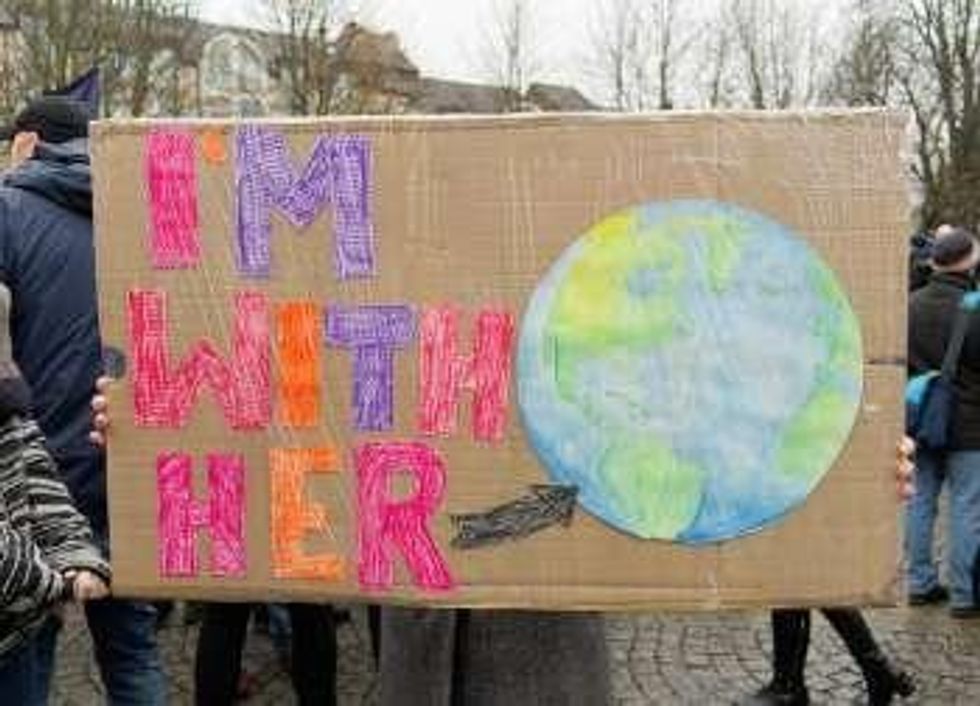
According to 350.org, "The Ambition Race Is On"--and it's a race the group is set on winning.
"There's one word that needs to define the year ahead: ambition," said 350.org strategy and communications director Jamie Henn. "2018 will be all about accelerating the transition away from fossil fuels to 100 percent renewable energy for all."
Many in the climate movement, however, have no hope that necessary push will come from those who govern.
According to Erika Lennon, senior attorney at the Washington, D.C.- and Geneva-based Center for International Environmental Law, "Avoiding the most dangerous impacts of climate change requires a paradigm shift to reduce emissions, something governments that are the most responsible for climate change do not seem ready to deliver. With the U.N. unable to deliver adequate ambition, it is time for judicial courts to step up and address climate damages caused by fossil fuels."
Sparks for that paradigm shift, says 350.org's Henn, are happening on the streets, as evidenced by events outside the climate summit's doors.
"The real news coming out of these talks is what happened outside the negotiating halls: massive protests at Germany's open pit coal mines with Pacific islanders standing in solidarity, governments joining a new initiative to power past coal, Norway's push to ditch oil and gas investments, and the emergence of non-state actors as a powerful force for change. The fight between fossils and renewables is underway and it's a fight we intend to win," he said.
"More ambition will never come from inside the climate talks, it has to come from the streets. Our job is to get out there and demand the fossil free world that science and justice demand," Henn added.
The summit also marks the first COP since president Donald Trump announced he would withdraw the U.S. from the Paris accord, making the nation a global outlier. Thanks to his anti-climate acts, the president was "taking a beating" at the conference.
The White House did, however, make its presence felt with a "ridiculous" fossil fuel-pitching panel.
But the European Union was also under fire for its failure to lead on climate action.
"The world's remaining carbon budget is shrinking with every year of insufficient progress," said Jagoda Munic, director of Friends of the Earth Europe. "The European Union claims to be a climate leader but this does not hold true as long as its economy is still based on fossil fuels. Next week the EU is set to announce plans for up to 90 new gas infrastructure projects--these are totally incompatible with the Paris Agreement. People power was visible here in Bonn and that strong people's movement is where the real climate leadership is."
COP24 takes place next year in Katowice, Poland.

Climate change, the most important issue currently affecting our planet and our species, is the subject of a global conference this week--yet it is barely a blip in media coverage. The 23rd Conference of Parties (COP23), which is the United Nation's annual international gathering on climate change, is taking place this week in Bonn, Germany, co-hosted by both Germany and the island nation of Fiji. As usual, country delegates and their staff are huddled in official meetings and panels while climate justice and environmental activists are attempting to hold them accountable from the outside.
But this year marks a special moment: Less than a year after the historic (but flawed) Paris Climate Accord was agreed upon in December 2015, the largest emitter of greenhouse gas emissions chose a climate change denier as president. Donald Trump quickly moved to undo Barack Obama's commitment to the Paris Climate Accord. Ten months into his presidency, Trump's administration is racing to lighten the regulatory load of polluting mega-corporations and revive the dying coal industry. COP23 attendees perceive an even greater urgency to address climate change within this political context.
U.S.-based climate justice activists who have traveled to COP23 are especially sensitive and more determined than ever to push for grass-roots change in mitigating climate change. One such activist making his voice heard at COP23 is Kali Akuno, co-founder and co-director of Cooperation Jackson (a network for sustainable development in Mississippi), and former executive director of the Peoples' Hurricane Relief Fund, established in New Orleans after Hurricane Katrina. Akuno, who is in Bonn as part of the It Takes Roots delegation, told me in an interview that he and others in his delegation are there "to strengthen the framework that we advanced in Paris two years ago, and that can best be summarized by making the argument to 'keep it in the ground.' " That phrase, which describes what best to do with fossil fuels, has been popularized over several years by leaders in the environmental justice movement and has been echoed at COP23. "There have to be major reductions [in emissions] at the source," Akuno warns, "if we are to keep to the goal of 1.5 degrees warming."
Alarmingly, however, global greenhouse gas emissions have spiked this year for the first time in three years, not because of Trump's election but because of Chinese resurgent reliance on coal. The Trump effect may still come next year or the year after. Regardless, if there is no slowing down and eventual reversal of emissions levels, there is absolutely no hope to mitigate a global climate disaster. As the residents of Houston, Puerto Rico and California realized this year, climate change is a global phenomenon and impacts all of us no matter where the emissions originate.
One climate justice activist who traveled a long way to attend the conference is Chief Ninawa Huni Kui, president of the Federation of the Huni Kui, an indigenous Amazonian tribe based in Acre, Brazil. He shared his insights with me in an interview from Bonn. "We understand what is happening and we believe that mother Earth is powerful, and part of her protests are terrible hurricanes, the flooding, the drought and the erratic seasons," Chief Ninawa said. "They're not talking about Mother Earth here in this conference of parties. They're talking about business, money, capital, carbon credits and fracking, and supposedly [about] offsetting pollution."
When asked how the U.S. withdrawal from the Paris Climate Accord was being felt in Bonn, Akuno explained that it has partly hindered progress but also fueled the determination of nations to power on without the U.S. "Many of us would argue that the United States and the Trump administration not being here to a certain degree has actually opened up more space," he said. "It's eliminated some of the blocks that the United States has traditionally registered." Still, how do you hold the world's economic superpower accountable for its contribution to climate change if its representatives are absent?
The Trump administration did make one appearance at COP23. It was the height of irony that at a global conference devoted to combating climate change, the White House decided to promote the very energy source that fuels climate change by audaciously sponsoring a panel featuring coal, natural gas and nuclear power as "clean" energies. White House energy adviser George Banks spoke alongside industry representatives and corporate fossil fuel executives in pushing the idea that "clean coal" and fracked gas could help reduce greenhouse gas emissions. The panel became a flashpoint for derision and anger from both the international community gathered in Bonn as well as the U.S.-based activists present.
Among those protesting the White House panel were two young indigenous members of Idle No More SF Bay, Isabella Zizi and Daniel Ilario, who are attending the COP23 as part of the same delegation as Akuno. They, too, shared their experience with me in an interview. Zizi described a powerful parade of people who protested the White House panel, and some among them held an impromptu press conference outside the location featuring indigenous representatives from all over the Americas. "That really just told the solid truth about what we have to deal with on the front lines in our own impacted communities when it comes to nuclear waste, fracking and coal."
So embarrassing and inappropriate was the White House panel promoting fossil fuels that even COP23's president, Fijian Prime Minister Frank Bainimarama, told the press, "I really don't want to get into an argument with the United States of America, but we all know what coal does and we all know the effects of coal mining ... we all know what coal does with regard to climate change."
Countering Trump's position on climate are several U.S. state governors who traveled to Bonn to present themselves as the new American leadership on climate. Among them is California Gov. Jerry Brown, who sees himself as a climate hero but who has been roundly criticized for promoting what many call "false solutions" to climate change, such as his state's cap and trade program. At a panel in Bonn, Brown felt the wrath of climate justice protesters (including Ilario) who interrupted his talk with the familiar refrain of "Keep it in the ground." According to Ilario, the irate governor responded, "Let's put you in the ground."
Ilario explained that he led the protest against Brown because, as a resident of the Bay area, his community is exposed to "five refineries that constantly pollute and are seeking to expand." Brown's signature cap-and-trade extension, AB 398, "allows these refineries to expand and it restricts us from the ability to locally cap carbon until 2030," Ilario said.
Brown's flippant response to him was a "shock," Ilario added, because he sees himself as fighting, "to protect the water, to protect the air, so we have a chance at having a next generation because right now that's not certain." Indeed, this year's U.N. climate conference appears similar to past conferences: While civil society representatives vocally demand basic rights to exist without fear of extinction, policy makers congratulate one another on preserving financial markets at the expense of humanity.
Chief Ninawa echoed Ilario's sentiment, saying "We are sad when we see that the governments and corporations are setting the table to get down to auctioning off the animals, buying and selling the plants, buying and selling the water, buying and selling the very air that we breathe." He added, "These gifts that the creator created for all of humanity are being auctioned off at these negotiations."
Ordinary people, who will pay the heaviest price for global warming, far outnumber the powerful political and financial elites trying to silence the masses. Negotiators need reminding that the preservation of financial markets and the energy economy means nothing if large swathes of our species will be wiped out. "There are only one or two governments that are making all the decisions and the people of world's voice isn't being heard," Chief Ninawa said. "Life itself and the future of humanity is at stake."

As the COP23 climate talks in Bonn, Germany come to a close, more than 50 groups and and high-profile climate advocates, including journalist Naomi Klein, are demanding a Climate Damages Tax to levy on companies that extract coal, oil, and natural gas "to pay for the damage and costs caused by climate change when these products are burnt, implemented nationally, regionally, or internationally."
"If the Pacific Islands are to survive, fossil fuels must be replaced with renewables. Even if we did this tomorrow, the Pacific will still face extreme impacts from climate change. The Pacific do not deserve to pay for this damage--the fossil fuel industry who have caused the problem should pay."
--Francois Martel, Pacific Islands Development Forum
The Climate Damages Declaration, which outlines the rationale behind implementing a global climate damages tax, points to "the ever growing numbers of people whose homes are lost, lives disrupted, critical ecosystems imperiled, and livelihoods ruined" due to anthropogenic climate change, emphasizing that "the countries and communities most deeply affected by irreversible climate change did not create these conditions."
Bangladesh, for example, "has a climate action plan, has implemented hundreds of climate projects on the ground, and we have invested taxpayers money into a climate change trust fund--all for a problem that we didn't create," said Saleemul Huq, director of the International Center for Climate Change and Development in Bangladesh.
The island of Seychelles, along with coastal communities worldwide, is "on the front line of sea level rise," said Ronny Jumeau, a signatory to the declaration and Seychelles' ambassador to the United Nations and United States.
"A key part of the solution is loss and damage finance--we need new sources of finance to cope with the impacts," Jumeau added. "A climate damages tax could provide a new source of finance, at scale, and in a fair way."
"A climate damages tax on the fossil fuel industry is one way to reverse the injustice of climate change, and ensure the fossil fuel industry pays for its damage--not poor people," said Julie-Anne Richards, international policy manager for the Climate Justice Program, which is also a signatory to the declaration.
Richards also lamented that "at COP23, rich countries have done everything they can to stymie discussion on ways to fund the poorest people on the front line of climate impacts," including the U.S. questioning climate impacts and promoting the fossil fuel industry--"the very industry making trillions of dollars of profits whilst it causes climate change."
Noting that the 2015 Paris Climate Agreement officially recognized "loss and damage," the declaration demands "the establishment of an initiative for loss and damage finance with a two year work plan identifying sources of revenue adequate to the scale of the problem in a predictable and fair way."
The declaration calls for the funds from the climate damages tax "to be allocated through the appropriate U.N. body, such as the Green Climate Fund or similar financial mechanism," and "the urgent replacement of fossil fuels, by mid-century at the latest," in favor of renewable sources of energy.
"If the Pacific Islands are to survive, fossil fuels must be replaced with renewables. Even if we did this tomorrow, the Pacific will still face extreme impacts from climate change," said Francois Martel, secretary general of the Pacific Islands Development Forum, another signatory. "The Pacific do not deserve to pay for this damage--the fossil fuel industry who have caused the problem should pay."

Protesters interrupted an event sponsored by the U.S. climate delegation at the UN climate summit in Bonn, Germany on Monday with a repackaged version of the song "God Bless the U.S.A." before staging a mass walkout.
Decried for its "absurd" attempt to push fossil fuels as a solution to the climate crisis, the event was one of only a few officially sponsored by the Trump administration's team during the talks.
The scene was captured on video by Axios correspondent Amy Harder:
The alternate lyrics sung by the protesters were transcribed as:
So you claim to be an American
But we see right through your greed;
It's killing across the world
for that coal money.
And we proudly stand up and tell you to
'Keep it in the ground.'
The people of the world unite...
and we are here to say -- [repeat]
Soon after the protest, the room was left nearly empty as many in attendance walked out:
John Fleming, a climate scientist at the Center for Biological Diversity, was among those saying it was ridiculous for the Trump administration to be openly pushing coal and other dirty fuels at the conference.
"It's patently absurd to suggest that coal has any role to play in solving the climate crisis," Fleming said in a statement. "Coal reserves dwarf the remaining carbon budget for staying under 2 degrees Celsius, let alone 1.5 degrees. Further use of coal is a death sentence for the planet."
He concluded, "At a time when renewable energy is becoming cheaper and even China and India are shifting more of their focus toward renewables, the panel's rhetoric was baseless and destructive."