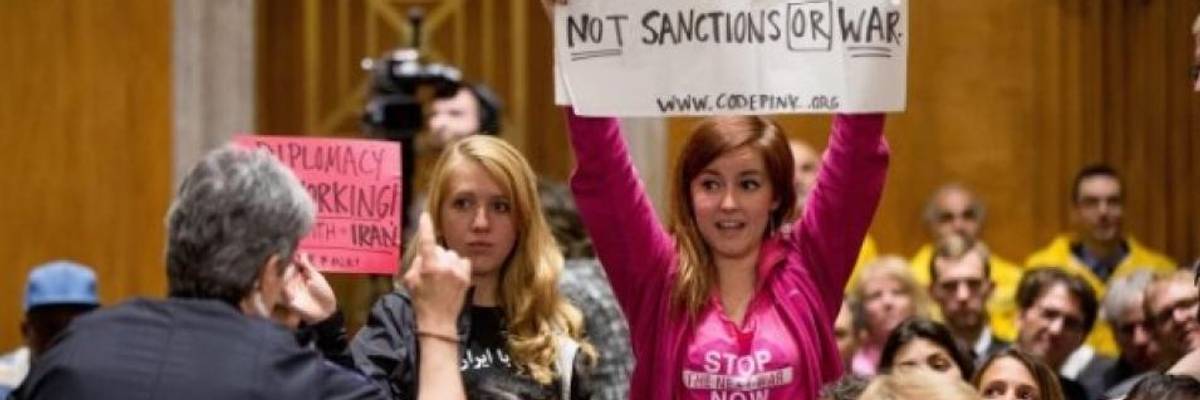
CODEPINK protesters at Congressional hearing on Iran in 2015. (Photo: CODEPINK)
To Support Diplomacy with North Korea, Defend Diplomacy with Iran
The Iran agreement is a shining example of what nations can accomplish with patient, open minded dialogue.
Under legislation passed ahead of the Iran Deal, the president has to certify Iran's compliance with the agreement every 90 days. So far Trump has certified Iran's compliance twice, but the second time, reports surfaced that Trump's advisors had to talk him out of decertifying. Since then, Trump has said he believes Iran is not in compliance, and the White House has reportedly pressured the intelligence community to find evidence that says as much. Meanwhile, the International Atomic Energy Agency (IAEA), the European Union, over 80 nuclear policy experts, Chairman of the Joint Chiefs Gen. Joseph Dunford and Secretary of Defense Jim Mattis are all saying Iran is upholding its end of the deal.
Since taking office, President Trump has brought our nation closer to not one but two new wars, each of which on their own would likely be more catastrophic than any American war since Vietnam. As Trump lobs threat after threat at North Korea, and publicly chides Secretary of State Rex Tillerson for pursuing a peaceful resolution to the conflict, he also appears poised to pull out of the Iran nuclear agreement, a move that would abruptly put war with Iran back on the table. But neither of these situations are unfolding in a bubble. How the administration handles the Iran agreement could very well make the difference in whether or not we can successfully negotiate an end to the Korean missile crisis.
As October 15, the next deadline for recertification of the deal, approaches, most signs point to Trump decertifying Iran's compliance whether or not there is material evidence to support such a claim, which would then line up a vote in Congress to reimpose sanctions.
In its own right, the Iran agreement is an achievement well worth protecting. Under the agreement, Iran forfeited 98 percent of its enriched uranium, decommissioned two-thirds of its centrifuges, and agreed to the most rigorous inspections regime in human history so the international community could ensure its compliance with the agreement. Iran's breakout time--the amount of time it would take Iran to produce enough uranium for one nuclear bomb--moved from a few months to at least a year thanks to the agreement. If the agreement collapses, all of the restrictions on and access to Iran's nuclear program goes away.
The threat of losing that peace of mind is bad enough, but the broader consequences of abandoning the deal could be even worse. Even President Obama, who made diplomacy with Iran a cornerstone of his foreign policy, threatened military action against Iran if diplomacy failed. Trump on the other hand appears to be actively seeking confrontation. Such a war would cost countless Iranian and American lives, and waste unfathomable amounts of taxpayer dollars. It would also destabilize yet another country in a region that's already been devastated by American interventionism.
The U.S. penchant for intervention is one of the chief justifications North Korea has put forward for developing nuclear weapons and pursuing more advanced capabilities. It sees its nuclear weapons as a deterrent to any thoughts of forcible regime change by the U.S. or other nations. In order to convince North Korea to scale back or abandon its nuclear weapons program, we'll need to offer significant security assurances, and that means coming to the table for a long, painstaking series of negotiations.
With Trump's increasingly threatening rhetoric and his latest twitter tantrum deriding Tillerson's efforts to jumpstart talks, it may seem like diplomacy is already off the table, but Trump's history of unexpected policy pivots makes anything possible. However, if the Trump administration walks away from the Iran agreement without cause, North Korea will see that as proof that the U.S. cannot be trusted, which could amount to a fatal blow to the only viable path out of the woods with North Korea.
The Iran agreement is a shining example of what nations can accomplish with patient, open minded dialogue. It offers the security of keeping Iran's path to a nuclear bomb blocked, it offers important lessons about how to get through negotiations with long-time adversaries, and it can serve as a model for future nonproliferation agreements.
The Iran agreement was a hard-won achievement not only for the negotiators, but also for the tens of thousands of concerned citizens who got involved and pressured their members of Congress to support diplomacy. The same activism is needed to protect the agreement now, and to push for a similar approach with North Korea. You can contact your members of Congress at the Capitol Switchboard at 202-224-3121.
If the Trump administration moves forward with its threats to pull out of the deal, Congress can and must intervene. Failure to do so could well land us in one or even two new wars of choice. Members of Congress should oppose efforts to reimpose sanctions on Iran without material evidence of a violation. They should speak out in defense of the Iran agreement, and in favor of pursuing negotiations with North Korea that might replicate its success.
We are at a crossroads
This country and this world are at a monumental crossroads. In a few short weeks, US voters will have an opportunity to beat back the forces of fascism and confront the billionaires who are rigging the economy, our media system, and our democracy, making it increasingly impossible for ordinary people to get by. We’re not just talking about the election. We’re talking about what must be done once these fascist elements are vanquished from power. We need a bolder set of solutions than what either major party has so far been willing to offer and a working-class movement ready to fight like hell for it. Trump didn't emerge from nowhere. The conditions that fueled MAGA authoritarianism were created by decades of radical neoliberal economic policies and a corrupt political system dominated by corporate interests. They slashed taxes on the super-rich, promising that the benefits would trickle down. They said giveaways to the corporate titans would make life more affordable for the rest of us. It was all bullshit. And when a bitter, betrayed populace searches for someone to blame, right-wing demagogues have little trouble finding scapegoats. People know when they're being lied to, but you won't hear any of this from the corporate media. Only independent journalism—powered and funded by people who believe in building a better world—can deliver truly trustworthy daily news. Our Fall Campaign is underway, and we need your help. To power our newsroom through the rest of the year, we need to raise $125,000 by midnight on October 31. So if you share our vision, please contribute whatever you can to sustain our work. |
Under legislation passed ahead of the Iran Deal, the president has to certify Iran's compliance with the agreement every 90 days. So far Trump has certified Iran's compliance twice, but the second time, reports surfaced that Trump's advisors had to talk him out of decertifying. Since then, Trump has said he believes Iran is not in compliance, and the White House has reportedly pressured the intelligence community to find evidence that says as much. Meanwhile, the International Atomic Energy Agency (IAEA), the European Union, over 80 nuclear policy experts, Chairman of the Joint Chiefs Gen. Joseph Dunford and Secretary of Defense Jim Mattis are all saying Iran is upholding its end of the deal.
Since taking office, President Trump has brought our nation closer to not one but two new wars, each of which on their own would likely be more catastrophic than any American war since Vietnam. As Trump lobs threat after threat at North Korea, and publicly chides Secretary of State Rex Tillerson for pursuing a peaceful resolution to the conflict, he also appears poised to pull out of the Iran nuclear agreement, a move that would abruptly put war with Iran back on the table. But neither of these situations are unfolding in a bubble. How the administration handles the Iran agreement could very well make the difference in whether or not we can successfully negotiate an end to the Korean missile crisis.
As October 15, the next deadline for recertification of the deal, approaches, most signs point to Trump decertifying Iran's compliance whether or not there is material evidence to support such a claim, which would then line up a vote in Congress to reimpose sanctions.
In its own right, the Iran agreement is an achievement well worth protecting. Under the agreement, Iran forfeited 98 percent of its enriched uranium, decommissioned two-thirds of its centrifuges, and agreed to the most rigorous inspections regime in human history so the international community could ensure its compliance with the agreement. Iran's breakout time--the amount of time it would take Iran to produce enough uranium for one nuclear bomb--moved from a few months to at least a year thanks to the agreement. If the agreement collapses, all of the restrictions on and access to Iran's nuclear program goes away.
The threat of losing that peace of mind is bad enough, but the broader consequences of abandoning the deal could be even worse. Even President Obama, who made diplomacy with Iran a cornerstone of his foreign policy, threatened military action against Iran if diplomacy failed. Trump on the other hand appears to be actively seeking confrontation. Such a war would cost countless Iranian and American lives, and waste unfathomable amounts of taxpayer dollars. It would also destabilize yet another country in a region that's already been devastated by American interventionism.
The U.S. penchant for intervention is one of the chief justifications North Korea has put forward for developing nuclear weapons and pursuing more advanced capabilities. It sees its nuclear weapons as a deterrent to any thoughts of forcible regime change by the U.S. or other nations. In order to convince North Korea to scale back or abandon its nuclear weapons program, we'll need to offer significant security assurances, and that means coming to the table for a long, painstaking series of negotiations.
With Trump's increasingly threatening rhetoric and his latest twitter tantrum deriding Tillerson's efforts to jumpstart talks, it may seem like diplomacy is already off the table, but Trump's history of unexpected policy pivots makes anything possible. However, if the Trump administration walks away from the Iran agreement without cause, North Korea will see that as proof that the U.S. cannot be trusted, which could amount to a fatal blow to the only viable path out of the woods with North Korea.
The Iran agreement is a shining example of what nations can accomplish with patient, open minded dialogue. It offers the security of keeping Iran's path to a nuclear bomb blocked, it offers important lessons about how to get through negotiations with long-time adversaries, and it can serve as a model for future nonproliferation agreements.
The Iran agreement was a hard-won achievement not only for the negotiators, but also for the tens of thousands of concerned citizens who got involved and pressured their members of Congress to support diplomacy. The same activism is needed to protect the agreement now, and to push for a similar approach with North Korea. You can contact your members of Congress at the Capitol Switchboard at 202-224-3121.
If the Trump administration moves forward with its threats to pull out of the deal, Congress can and must intervene. Failure to do so could well land us in one or even two new wars of choice. Members of Congress should oppose efforts to reimpose sanctions on Iran without material evidence of a violation. They should speak out in defense of the Iran agreement, and in favor of pursuing negotiations with North Korea that might replicate its success.
Under legislation passed ahead of the Iran Deal, the president has to certify Iran's compliance with the agreement every 90 days. So far Trump has certified Iran's compliance twice, but the second time, reports surfaced that Trump's advisors had to talk him out of decertifying. Since then, Trump has said he believes Iran is not in compliance, and the White House has reportedly pressured the intelligence community to find evidence that says as much. Meanwhile, the International Atomic Energy Agency (IAEA), the European Union, over 80 nuclear policy experts, Chairman of the Joint Chiefs Gen. Joseph Dunford and Secretary of Defense Jim Mattis are all saying Iran is upholding its end of the deal.
Since taking office, President Trump has brought our nation closer to not one but two new wars, each of which on their own would likely be more catastrophic than any American war since Vietnam. As Trump lobs threat after threat at North Korea, and publicly chides Secretary of State Rex Tillerson for pursuing a peaceful resolution to the conflict, he also appears poised to pull out of the Iran nuclear agreement, a move that would abruptly put war with Iran back on the table. But neither of these situations are unfolding in a bubble. How the administration handles the Iran agreement could very well make the difference in whether or not we can successfully negotiate an end to the Korean missile crisis.
As October 15, the next deadline for recertification of the deal, approaches, most signs point to Trump decertifying Iran's compliance whether or not there is material evidence to support such a claim, which would then line up a vote in Congress to reimpose sanctions.
In its own right, the Iran agreement is an achievement well worth protecting. Under the agreement, Iran forfeited 98 percent of its enriched uranium, decommissioned two-thirds of its centrifuges, and agreed to the most rigorous inspections regime in human history so the international community could ensure its compliance with the agreement. Iran's breakout time--the amount of time it would take Iran to produce enough uranium for one nuclear bomb--moved from a few months to at least a year thanks to the agreement. If the agreement collapses, all of the restrictions on and access to Iran's nuclear program goes away.
The threat of losing that peace of mind is bad enough, but the broader consequences of abandoning the deal could be even worse. Even President Obama, who made diplomacy with Iran a cornerstone of his foreign policy, threatened military action against Iran if diplomacy failed. Trump on the other hand appears to be actively seeking confrontation. Such a war would cost countless Iranian and American lives, and waste unfathomable amounts of taxpayer dollars. It would also destabilize yet another country in a region that's already been devastated by American interventionism.
The U.S. penchant for intervention is one of the chief justifications North Korea has put forward for developing nuclear weapons and pursuing more advanced capabilities. It sees its nuclear weapons as a deterrent to any thoughts of forcible regime change by the U.S. or other nations. In order to convince North Korea to scale back or abandon its nuclear weapons program, we'll need to offer significant security assurances, and that means coming to the table for a long, painstaking series of negotiations.
With Trump's increasingly threatening rhetoric and his latest twitter tantrum deriding Tillerson's efforts to jumpstart talks, it may seem like diplomacy is already off the table, but Trump's history of unexpected policy pivots makes anything possible. However, if the Trump administration walks away from the Iran agreement without cause, North Korea will see that as proof that the U.S. cannot be trusted, which could amount to a fatal blow to the only viable path out of the woods with North Korea.
The Iran agreement is a shining example of what nations can accomplish with patient, open minded dialogue. It offers the security of keeping Iran's path to a nuclear bomb blocked, it offers important lessons about how to get through negotiations with long-time adversaries, and it can serve as a model for future nonproliferation agreements.
The Iran agreement was a hard-won achievement not only for the negotiators, but also for the tens of thousands of concerned citizens who got involved and pressured their members of Congress to support diplomacy. The same activism is needed to protect the agreement now, and to push for a similar approach with North Korea. You can contact your members of Congress at the Capitol Switchboard at 202-224-3121.
If the Trump administration moves forward with its threats to pull out of the deal, Congress can and must intervene. Failure to do so could well land us in one or even two new wars of choice. Members of Congress should oppose efforts to reimpose sanctions on Iran without material evidence of a violation. They should speak out in defense of the Iran agreement, and in favor of pursuing negotiations with North Korea that might replicate its success.