

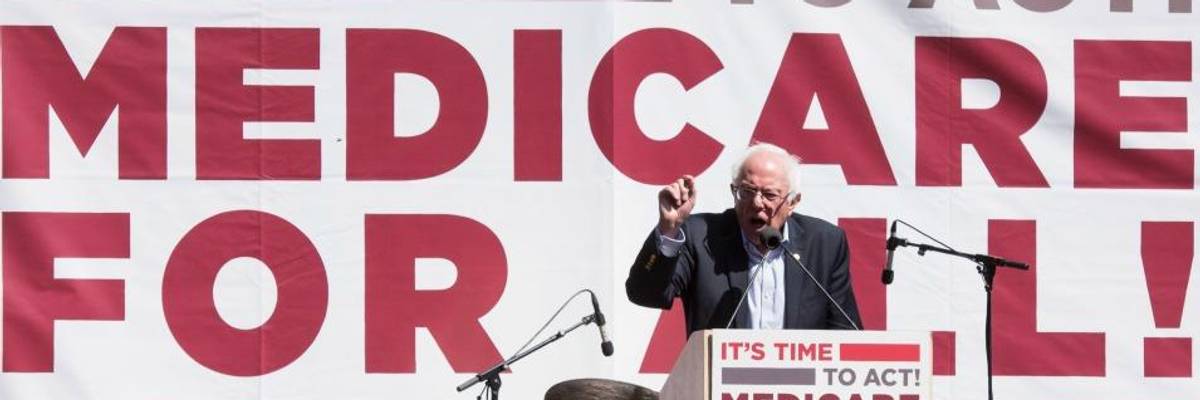
Just a day after giving a major foreign policy speech in Wisconsin, Sen. Bernie Sanders (I-Vt.) gave a speech on Medicare for All at the annual convention for the CNA/NNOC in San Francisco. (Photo: National Nurses United/flickr/cc)
Bernie Sanders Just Gave His Best Speech in 2 Years
He established liberal internationalism as a coherent foreign policy.
There's a lot of tsuris all over the place over the fact that Bernie Sanders and Amy Klobuchar will be putting on a show-pony debate next week on CNN with the Clueless Twins, Lindsey Graham and Bill Cassidy, on the subject of healthcare. Most of said tsuris revolves around the fear that the debate will get framed as Dog's Breakfast vs. Eeek! Socialism! I'm not wholly convinced that these fears are groundless; the elite political press is hungering to turn the Graham-Cassidy calamity into a Both Sides failure--here's all the evidence you'll ever need of that--and this might indeed be the vehicle through which they do that.
But what I do know is that Bernie Sanders is better versed on his position than either Graham or Cassidy are on the bill that bears their name. Also, there are more than a few signs that Sanders--who must always be kept separate from the more febrile of his followers--is more with the Democratic program than he's ever been. On Thursday, he gave a speech in which he set out a progressive approach to foreign policy that was clear, coherent, and was probably the best speech I've seen him give in two years.
He called out regime change for its own sake while, at the same time, defending the role of the United States in championing international human rights. (He did this by shrewdly pairing the catastrophic Iraq War with the Iran nuclear deal.) But the most impressive passage was the one in which Sanders pointed out that American foreign policy must now take into account the ongoing international effort to undermine liberal democracy being undertaken by Russia and other transnational oligarchical operations.
In both Europe and the United States, the international order which the United States helped establish over the past 70 years, one which put great emphasis on democracy and human rights, and promoted greater trade and economic development, is under great strain. Many Europeans are questioning the value of the European Union. Many Americans are questioning the value of the United Nations, of the transatlantic alliance, and other multilateral organizations. We also see a rise in authoritarianism and right wing extremism--both domestic and foreign--which further weakens this order by exploiting and amplifying resentments, stoking intolerance and fanning ethnic and racial hatreds among those in our societies who are struggling.
We saw this anti-democratic effort take place in the 2016 election right here in the United States, where we now know that the Russian government was engaged in a massive effort to undermine one of our greatest strengths: The integrity of our elections, and our faith in our own democracy. I found it incredible, by the way, that when the President of the United States spoke before the United Nations on Monday, he did not even mention that outrage. Well, I will. Today I say to Mr. Putin: we will not allow you to undermine American democracy or democracies around the world. In fact, our goal is to not only strengthen American democracy, but to work in solidarity with supporters of democracy around the globe, including in Russia. In the struggle of democracy versus authoritarianism, we intend to win.
When we talk about foreign policy it is clear that there are some who believe that the United States would be best served by withdrawing from the global community. I disagree. As the wealthiest and most powerful nation on earth, we have got to help lead the struggle to defend and expand a rules-based international order in which law, not might, makes right.
He drew a bright line from the dangers of domestic economic inequality, the rise of oligarchy here, the establishment of kleptocratic oligarchy elsewhere, and the danger all of these present to liberal democracies around the world. If anything, he spoke too little about the domestic strength required to carry out the program he has proposed abroad. Bernie Sanders: liberal internationalist. Damn. I think that guy can handle Lindsey Graham.
An Urgent Message From Our Co-Founder
Dear Common Dreams reader, It’s been nearly 30 years since I co-founded Common Dreams with my late wife, Lina Newhouser. We had the radical notion that journalism should serve the public good, not corporate profits. It was clear to us from the outset what it would take to build such a project. No paid advertisements. No corporate sponsors. No millionaire publisher telling us what to think or do. Many people said we wouldn't last a year, but we proved those doubters wrong. Together with a tremendous team of journalists and dedicated staff, we built an independent media outlet free from the constraints of profits and corporate control. Our mission has always been simple: To inform. To inspire. To ignite change for the common good. Building Common Dreams was not easy. Our survival was never guaranteed. When you take on the most powerful forces—Wall Street greed, fossil fuel industry destruction, Big Tech lobbyists, and uber-rich oligarchs who have spent billions upon billions rigging the economy and democracy in their favor—the only bulwark you have is supporters who believe in your work. But here’s the urgent message from me today. It's never been this bad out there. And it's never been this hard to keep us going. At the very moment Common Dreams is most needed, the threats we face are intensifying. We need your support now more than ever. We don't accept corporate advertising and never will. We don't have a paywall because we don't think people should be blocked from critical news based on their ability to pay. Everything we do is funded by the donations of readers like you. When everyone does the little they can afford, we are strong. But if that support retreats or dries up, so do we. Will you donate now to make sure Common Dreams not only survives but thrives? —Craig Brown, Co-founder |
There's a lot of tsuris all over the place over the fact that Bernie Sanders and Amy Klobuchar will be putting on a show-pony debate next week on CNN with the Clueless Twins, Lindsey Graham and Bill Cassidy, on the subject of healthcare. Most of said tsuris revolves around the fear that the debate will get framed as Dog's Breakfast vs. Eeek! Socialism! I'm not wholly convinced that these fears are groundless; the elite political press is hungering to turn the Graham-Cassidy calamity into a Both Sides failure--here's all the evidence you'll ever need of that--and this might indeed be the vehicle through which they do that.
But what I do know is that Bernie Sanders is better versed on his position than either Graham or Cassidy are on the bill that bears their name. Also, there are more than a few signs that Sanders--who must always be kept separate from the more febrile of his followers--is more with the Democratic program than he's ever been. On Thursday, he gave a speech in which he set out a progressive approach to foreign policy that was clear, coherent, and was probably the best speech I've seen him give in two years.
He called out regime change for its own sake while, at the same time, defending the role of the United States in championing international human rights. (He did this by shrewdly pairing the catastrophic Iraq War with the Iran nuclear deal.) But the most impressive passage was the one in which Sanders pointed out that American foreign policy must now take into account the ongoing international effort to undermine liberal democracy being undertaken by Russia and other transnational oligarchical operations.
In both Europe and the United States, the international order which the United States helped establish over the past 70 years, one which put great emphasis on democracy and human rights, and promoted greater trade and economic development, is under great strain. Many Europeans are questioning the value of the European Union. Many Americans are questioning the value of the United Nations, of the transatlantic alliance, and other multilateral organizations. We also see a rise in authoritarianism and right wing extremism--both domestic and foreign--which further weakens this order by exploiting and amplifying resentments, stoking intolerance and fanning ethnic and racial hatreds among those in our societies who are struggling.
We saw this anti-democratic effort take place in the 2016 election right here in the United States, where we now know that the Russian government was engaged in a massive effort to undermine one of our greatest strengths: The integrity of our elections, and our faith in our own democracy. I found it incredible, by the way, that when the President of the United States spoke before the United Nations on Monday, he did not even mention that outrage. Well, I will. Today I say to Mr. Putin: we will not allow you to undermine American democracy or democracies around the world. In fact, our goal is to not only strengthen American democracy, but to work in solidarity with supporters of democracy around the globe, including in Russia. In the struggle of democracy versus authoritarianism, we intend to win.
When we talk about foreign policy it is clear that there are some who believe that the United States would be best served by withdrawing from the global community. I disagree. As the wealthiest and most powerful nation on earth, we have got to help lead the struggle to defend and expand a rules-based international order in which law, not might, makes right.
He drew a bright line from the dangers of domestic economic inequality, the rise of oligarchy here, the establishment of kleptocratic oligarchy elsewhere, and the danger all of these present to liberal democracies around the world. If anything, he spoke too little about the domestic strength required to carry out the program he has proposed abroad. Bernie Sanders: liberal internationalist. Damn. I think that guy can handle Lindsey Graham.
There's a lot of tsuris all over the place over the fact that Bernie Sanders and Amy Klobuchar will be putting on a show-pony debate next week on CNN with the Clueless Twins, Lindsey Graham and Bill Cassidy, on the subject of healthcare. Most of said tsuris revolves around the fear that the debate will get framed as Dog's Breakfast vs. Eeek! Socialism! I'm not wholly convinced that these fears are groundless; the elite political press is hungering to turn the Graham-Cassidy calamity into a Both Sides failure--here's all the evidence you'll ever need of that--and this might indeed be the vehicle through which they do that.
But what I do know is that Bernie Sanders is better versed on his position than either Graham or Cassidy are on the bill that bears their name. Also, there are more than a few signs that Sanders--who must always be kept separate from the more febrile of his followers--is more with the Democratic program than he's ever been. On Thursday, he gave a speech in which he set out a progressive approach to foreign policy that was clear, coherent, and was probably the best speech I've seen him give in two years.
He called out regime change for its own sake while, at the same time, defending the role of the United States in championing international human rights. (He did this by shrewdly pairing the catastrophic Iraq War with the Iran nuclear deal.) But the most impressive passage was the one in which Sanders pointed out that American foreign policy must now take into account the ongoing international effort to undermine liberal democracy being undertaken by Russia and other transnational oligarchical operations.
In both Europe and the United States, the international order which the United States helped establish over the past 70 years, one which put great emphasis on democracy and human rights, and promoted greater trade and economic development, is under great strain. Many Europeans are questioning the value of the European Union. Many Americans are questioning the value of the United Nations, of the transatlantic alliance, and other multilateral organizations. We also see a rise in authoritarianism and right wing extremism--both domestic and foreign--which further weakens this order by exploiting and amplifying resentments, stoking intolerance and fanning ethnic and racial hatreds among those in our societies who are struggling.
We saw this anti-democratic effort take place in the 2016 election right here in the United States, where we now know that the Russian government was engaged in a massive effort to undermine one of our greatest strengths: The integrity of our elections, and our faith in our own democracy. I found it incredible, by the way, that when the President of the United States spoke before the United Nations on Monday, he did not even mention that outrage. Well, I will. Today I say to Mr. Putin: we will not allow you to undermine American democracy or democracies around the world. In fact, our goal is to not only strengthen American democracy, but to work in solidarity with supporters of democracy around the globe, including in Russia. In the struggle of democracy versus authoritarianism, we intend to win.
When we talk about foreign policy it is clear that there are some who believe that the United States would be best served by withdrawing from the global community. I disagree. As the wealthiest and most powerful nation on earth, we have got to help lead the struggle to defend and expand a rules-based international order in which law, not might, makes right.
He drew a bright line from the dangers of domestic economic inequality, the rise of oligarchy here, the establishment of kleptocratic oligarchy elsewhere, and the danger all of these present to liberal democracies around the world. If anything, he spoke too little about the domestic strength required to carry out the program he has proposed abroad. Bernie Sanders: liberal internationalist. Damn. I think that guy can handle Lindsey Graham.