SUBSCRIBE TO OUR FREE NEWSLETTER
Daily news & progressive opinion—funded by the people, not the corporations—delivered straight to your inbox.
5
#000000
#FFFFFF
To donate by check, phone, or other method, see our More Ways to Give page.
Daily news & progressive opinion—funded by the people, not the corporations—delivered straight to your inbox.
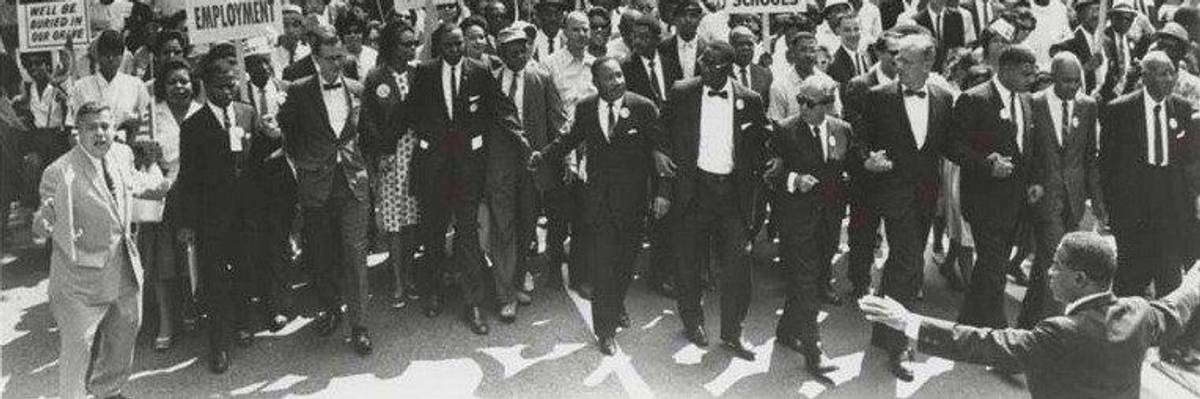
"This year's mass resistance efforts spark the beginning of the civic engagement needed to bring about the change we want to see," writes Gupta. "We must reject the systems that oppress and disadvantage people of color and immigrants." (Photo: Center for Jewish History, NYC)
Fifty-four years ago this week, on Aug. 28, 1963, hundreds of thousands of people gathered for the March on Washington for Jobs and Freedom. The event marked a turning point in our society in recognizing the need for civil rights and equality for African Americans. But it's painfully
clear we have yet to achieve the dream set forth that day by Dr. Martin Luther King Jr.
Fifty-four years ago this week, on Aug. 28, 1963, hundreds of thousands of people gathered for the March on Washington for Jobs and Freedom. The event marked a turning point in our society in recognizing the need for civil rights and equality for African Americans. But it's painfully
clear we have yet to achieve the dream set forth that day by Dr. Martin Luther King Jr.
Our nation remains divided along racial and class lines. The events in Charlottesville highlighted the terror that white supremacists still inflict upon people of color, religious minorities and the LGBTQ community.
But white supremacy goes well beyond the venomous hate spewed by neo-Nazis, Klansmen, and other white nationalists. It permeates our economic systems, workplaces and institutions.
During the 1963 march, future Congressman John Lewis said, "We march today for jobs and freedom, but we have nothing to be proud of. For hundreds and thousands of our brothers are not here. For they are receiving starvation wages, or no wages at all." To this day, wages and job opportunities for African-Americans, Latinos, and other minority groups remain woefully behind that of whites.
In the 50 years between the March on Washington and 2013, the unemployment rate for blacks was consistently twice as high as it was for whites. In July 2017, the unemployment rate was 7.4 percent for blacks and 5.1 percent for Latinos, but just 3.8 percent for whites.
Even getting a college education does not eliminate the disparity. One 2015 study found that while white households with college degrees have $180,000 in wealth on average, similarly educated black households have only $23,400. According to the Institute for Policy Studies, black households will not reach wealth parity with whites until 2241.
That's nearly 280 years after the March on Washington.
On multiple fronts, there are vibrant movements that show us another world is possible. The Movement for Black Lives is on the front lines of advancing black power, freedom and justice. In 2016, the collective launched a policy platform aimed at the heart of structural racism, including a call for living wages, universal health care, and a jobs program.
People of color cannot overcome persistent wealth and wage gaps when structural racism and violence are the foundations of U.S. society. That's why the Restaurant Opportunities Center and the Fight for $15's tremendous gains in winning raises for more than 20 million working people are so notable. These movements are demanding dignified jobs and helping stop profitable restaurants, healthcare corporations, and airlines from paying shamefully low wages to the people of color who work for them.
This year's mass resistance efforts spark the beginning of the civic engagement needed to bring about the change we want to see. We must reject the systems that oppress and disadvantage people of color and immigrants.
It is up to us to continue the legacy of those who sacrificed, marched and died for jobs and the freedom to build a just and inclusive society, at last.
Dear Common Dreams reader, It’s been nearly 30 years since I co-founded Common Dreams with my late wife, Lina Newhouser. We had the radical notion that journalism should serve the public good, not corporate profits. It was clear to us from the outset what it would take to build such a project. No paid advertisements. No corporate sponsors. No millionaire publisher telling us what to think or do. Many people said we wouldn't last a year, but we proved those doubters wrong. Together with a tremendous team of journalists and dedicated staff, we built an independent media outlet free from the constraints of profits and corporate control. Our mission has always been simple: To inform. To inspire. To ignite change for the common good. Building Common Dreams was not easy. Our survival was never guaranteed. When you take on the most powerful forces—Wall Street greed, fossil fuel industry destruction, Big Tech lobbyists, and uber-rich oligarchs who have spent billions upon billions rigging the economy and democracy in their favor—the only bulwark you have is supporters who believe in your work. But here’s the urgent message from me today. It's never been this bad out there. And it's never been this hard to keep us going. At the very moment Common Dreams is most needed, the threats we face are intensifying. We need your support now more than ever. We don't accept corporate advertising and never will. We don't have a paywall because we don't think people should be blocked from critical news based on their ability to pay. Everything we do is funded by the donations of readers like you. When everyone does the little they can afford, we are strong. But if that support retreats or dries up, so do we. Will you donate now to make sure Common Dreams not only survives but thrives? —Craig Brown, Co-founder |
Fifty-four years ago this week, on Aug. 28, 1963, hundreds of thousands of people gathered for the March on Washington for Jobs and Freedom. The event marked a turning point in our society in recognizing the need for civil rights and equality for African Americans. But it's painfully
clear we have yet to achieve the dream set forth that day by Dr. Martin Luther King Jr.
Our nation remains divided along racial and class lines. The events in Charlottesville highlighted the terror that white supremacists still inflict upon people of color, religious minorities and the LGBTQ community.
But white supremacy goes well beyond the venomous hate spewed by neo-Nazis, Klansmen, and other white nationalists. It permeates our economic systems, workplaces and institutions.
During the 1963 march, future Congressman John Lewis said, "We march today for jobs and freedom, but we have nothing to be proud of. For hundreds and thousands of our brothers are not here. For they are receiving starvation wages, or no wages at all." To this day, wages and job opportunities for African-Americans, Latinos, and other minority groups remain woefully behind that of whites.
In the 50 years between the March on Washington and 2013, the unemployment rate for blacks was consistently twice as high as it was for whites. In July 2017, the unemployment rate was 7.4 percent for blacks and 5.1 percent for Latinos, but just 3.8 percent for whites.
Even getting a college education does not eliminate the disparity. One 2015 study found that while white households with college degrees have $180,000 in wealth on average, similarly educated black households have only $23,400. According to the Institute for Policy Studies, black households will not reach wealth parity with whites until 2241.
That's nearly 280 years after the March on Washington.
On multiple fronts, there are vibrant movements that show us another world is possible. The Movement for Black Lives is on the front lines of advancing black power, freedom and justice. In 2016, the collective launched a policy platform aimed at the heart of structural racism, including a call for living wages, universal health care, and a jobs program.
People of color cannot overcome persistent wealth and wage gaps when structural racism and violence are the foundations of U.S. society. That's why the Restaurant Opportunities Center and the Fight for $15's tremendous gains in winning raises for more than 20 million working people are so notable. These movements are demanding dignified jobs and helping stop profitable restaurants, healthcare corporations, and airlines from paying shamefully low wages to the people of color who work for them.
This year's mass resistance efforts spark the beginning of the civic engagement needed to bring about the change we want to see. We must reject the systems that oppress and disadvantage people of color and immigrants.
It is up to us to continue the legacy of those who sacrificed, marched and died for jobs and the freedom to build a just and inclusive society, at last.
Fifty-four years ago this week, on Aug. 28, 1963, hundreds of thousands of people gathered for the March on Washington for Jobs and Freedom. The event marked a turning point in our society in recognizing the need for civil rights and equality for African Americans. But it's painfully
clear we have yet to achieve the dream set forth that day by Dr. Martin Luther King Jr.
Our nation remains divided along racial and class lines. The events in Charlottesville highlighted the terror that white supremacists still inflict upon people of color, religious minorities and the LGBTQ community.
But white supremacy goes well beyond the venomous hate spewed by neo-Nazis, Klansmen, and other white nationalists. It permeates our economic systems, workplaces and institutions.
During the 1963 march, future Congressman John Lewis said, "We march today for jobs and freedom, but we have nothing to be proud of. For hundreds and thousands of our brothers are not here. For they are receiving starvation wages, or no wages at all." To this day, wages and job opportunities for African-Americans, Latinos, and other minority groups remain woefully behind that of whites.
In the 50 years between the March on Washington and 2013, the unemployment rate for blacks was consistently twice as high as it was for whites. In July 2017, the unemployment rate was 7.4 percent for blacks and 5.1 percent for Latinos, but just 3.8 percent for whites.
Even getting a college education does not eliminate the disparity. One 2015 study found that while white households with college degrees have $180,000 in wealth on average, similarly educated black households have only $23,400. According to the Institute for Policy Studies, black households will not reach wealth parity with whites until 2241.
That's nearly 280 years after the March on Washington.
On multiple fronts, there are vibrant movements that show us another world is possible. The Movement for Black Lives is on the front lines of advancing black power, freedom and justice. In 2016, the collective launched a policy platform aimed at the heart of structural racism, including a call for living wages, universal health care, and a jobs program.
People of color cannot overcome persistent wealth and wage gaps when structural racism and violence are the foundations of U.S. society. That's why the Restaurant Opportunities Center and the Fight for $15's tremendous gains in winning raises for more than 20 million working people are so notable. These movements are demanding dignified jobs and helping stop profitable restaurants, healthcare corporations, and airlines from paying shamefully low wages to the people of color who work for them.
This year's mass resistance efforts spark the beginning of the civic engagement needed to bring about the change we want to see. We must reject the systems that oppress and disadvantage people of color and immigrants.
It is up to us to continue the legacy of those who sacrificed, marched and died for jobs and the freedom to build a just and inclusive society, at last.