SUBSCRIBE TO OUR FREE NEWSLETTER
Daily news & progressive opinion—funded by the people, not the corporations—delivered straight to your inbox.
5
#000000
#FFFFFF
To donate by check, phone, or other method, see our More Ways to Give page.
Daily news & progressive opinion—funded by the people, not the corporations—delivered straight to your inbox.
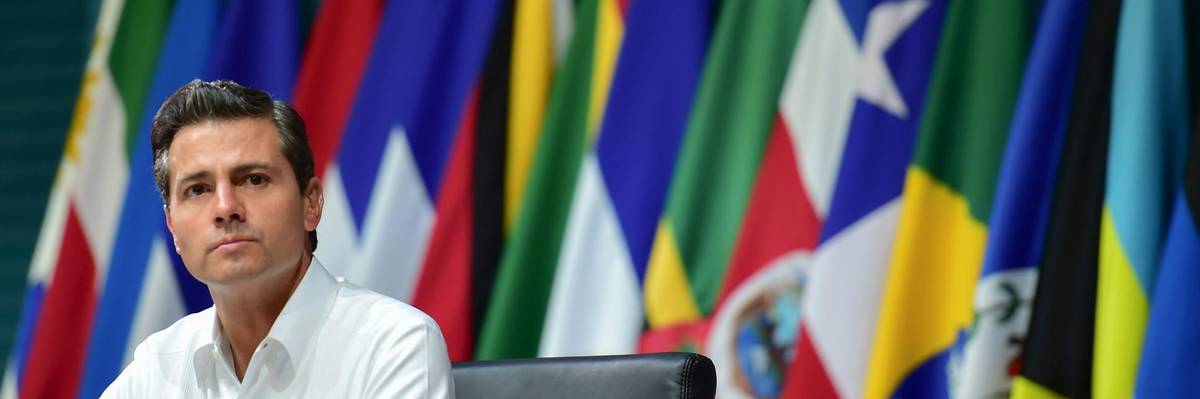
Canadian officials look towards bringing Mexican energy into NAFTA ahead of renegotiations. (Photo: Presidencia de la Republica Mexicana/Flickr/cc)
This past April U.S. President Donald Trump made comments about Canadian energy exports in relation to the upcoming renegotiation of the North American Free Trade Agreement (NAFTA) set to begin next month. On April 20, Trump said, "We can't let Canada or anybody else take advantage and do what they did to our workers and to our farmers. And again I want to also just mention: included in there is lumber, timber and energy."
At that time, The Globe and Mail reported, "Neither Canada's government nor oil industry have any idea what Trump was talking about when he warned that the U.S. will target Canada's energy sector in renegotiations of the North American free-trade agreement. Finance Minister Bill Morneau, in Washington at the International Monetary Fund and World Bank spring meetings, said he could not think of any energy-related trade disputes between the two countries."
That article speculated, "The United States is heavily dependent on Canada for oil and gas because it does not produce enough to meet demand. A more likely target for NAFTA negotiations is Mexico's energy sector, which has historically been the subject of government monopolies but has been opened up to private investment since 2013. One Canadian official, speaking on condition of anonymity, said bringing Mexican oil and gas under NAFTA would be an attractive prospect in trade talks."
Bringing Mexican energy into NAFTA implies the proportional sharing provision. That provision basically says that Canada must maintain at least the same level of oil and gas exports to the United States as it had supplied for the past thirty-six months. Author-activist Gordon Laxer has commented, "Proportionality, the de facto, mandatory-exporting clause applies only to Canada, since Mexico refused it."
In December 2013, Mexico ended 75 years of government control of its oil reserves when it passed an energy reform law that allows transnational corporations to explore and extract oil and gas. That reform is expected to attract as much as $15 billion of foreign investment annually and increase oil production to as much as 4 million barrels per day by 2025 and double natural gas production.
In March of this year, Ellen R. Wald wrote in Forbes magazine, "Since the Mexican state is no longer the only legal investor, owner, producer, buyer and seller of energy and energy products in Mexico, there is now a potential to renegotiate chapter six of NAFTA and eliminate the special provisions and carve outs for Mexico. This would not only help improve Mexico's energy situation, but improve trade relations amongst the three North American trade partners."
Then in May, the Los Angeles Times reported, "Duncan Wood, director of the Mexico Institute at the Washington, D.C.-based Wilson Center, [said] many Mexican government officials look forward to putting energy on the negotiating table because, with a Mexican presidential election coming in 2018, it would give the officials a chance to ensure Mexico's energy reform policies stay in place regardless of political fortunes. 'One way to do that is to get [the reforms] into the North American Free Trade Agreement, which for Mexico actually has the status of an international treaty, which guarantees it almost equivalent status as the constitution', Wood said. 'So this is another way of locking in the gains in Mexico in the near future.'"
Now the Associated Press reports, "The United States and Mexico are looking to boost energy ties as the two countries prepare for the renegotiation of the North American Free Trade Agreement, officials said Thursday [June 13]. U.S. Energy Secretary Rick Perry, who met in Mexico with his counterpart, Pedro Joaquin Coldwell, called the United States' southern neighbour 'a very, very important partner' on energy. ...Perry noted that NAFTA did not cover energy when the trade pact was implemented in 1994. 'I'm very supportive of the renegotiation', Perry said. 'To renegotiate this is good for all participants, particularly in the energy sector.'"
That article adds, "Perry said he expects to start exchanging letters on NAFTA with his counterparts in the coming weeks and hopes a new trade deal will allow for a North American energy strategy that 'will make the entire region a powerful energy source for the world'. ...President Enrique Pena Nieto's office said in a statement that he met privately with Perry and both parties agreed to co-operate on energy security and market integration."
For its part, the Trudeau government has given no indication it is concerned about the energy proportionality provision. In fact, in February, Natural Resources minister Jim Carr said the renegotiation of NAFTA would benefit the energy sector. Reuters reports, "Asked whether the energy industry could get a more favorable role than other parts of the economy in NAFTA renegotiations, Carr said, 'I think that's a real possibility'. ...Carr told reporters that Canada will continue to make the case that the integration of the energy sector is in the best interest of all three governments. 'I think the energy sector is one of those where the integration argument and the mutual benefit can be well advanced by Canada', said Carr."
The Council of Canadians is calling for an end to the energy proportionality provision given it is the antithesis of what is needed to take action to address climate change.
Dear Common Dreams reader, It’s been nearly 30 years since I co-founded Common Dreams with my late wife, Lina Newhouser. We had the radical notion that journalism should serve the public good, not corporate profits. It was clear to us from the outset what it would take to build such a project. No paid advertisements. No corporate sponsors. No millionaire publisher telling us what to think or do. Many people said we wouldn't last a year, but we proved those doubters wrong. Together with a tremendous team of journalists and dedicated staff, we built an independent media outlet free from the constraints of profits and corporate control. Our mission has always been simple: To inform. To inspire. To ignite change for the common good. Building Common Dreams was not easy. Our survival was never guaranteed. When you take on the most powerful forces—Wall Street greed, fossil fuel industry destruction, Big Tech lobbyists, and uber-rich oligarchs who have spent billions upon billions rigging the economy and democracy in their favor—the only bulwark you have is supporters who believe in your work. But here’s the urgent message from me today. It's never been this bad out there. And it's never been this hard to keep us going. At the very moment Common Dreams is most needed, the threats we face are intensifying. We need your support now more than ever. We don't accept corporate advertising and never will. We don't have a paywall because we don't think people should be blocked from critical news based on their ability to pay. Everything we do is funded by the donations of readers like you. When everyone does the little they can afford, we are strong. But if that support retreats or dries up, so do we. Will you donate now to make sure Common Dreams not only survives but thrives? —Craig Brown, Co-founder |
This past April U.S. President Donald Trump made comments about Canadian energy exports in relation to the upcoming renegotiation of the North American Free Trade Agreement (NAFTA) set to begin next month. On April 20, Trump said, "We can't let Canada or anybody else take advantage and do what they did to our workers and to our farmers. And again I want to also just mention: included in there is lumber, timber and energy."
At that time, The Globe and Mail reported, "Neither Canada's government nor oil industry have any idea what Trump was talking about when he warned that the U.S. will target Canada's energy sector in renegotiations of the North American free-trade agreement. Finance Minister Bill Morneau, in Washington at the International Monetary Fund and World Bank spring meetings, said he could not think of any energy-related trade disputes between the two countries."
That article speculated, "The United States is heavily dependent on Canada for oil and gas because it does not produce enough to meet demand. A more likely target for NAFTA negotiations is Mexico's energy sector, which has historically been the subject of government monopolies but has been opened up to private investment since 2013. One Canadian official, speaking on condition of anonymity, said bringing Mexican oil and gas under NAFTA would be an attractive prospect in trade talks."
Bringing Mexican energy into NAFTA implies the proportional sharing provision. That provision basically says that Canada must maintain at least the same level of oil and gas exports to the United States as it had supplied for the past thirty-six months. Author-activist Gordon Laxer has commented, "Proportionality, the de facto, mandatory-exporting clause applies only to Canada, since Mexico refused it."
In December 2013, Mexico ended 75 years of government control of its oil reserves when it passed an energy reform law that allows transnational corporations to explore and extract oil and gas. That reform is expected to attract as much as $15 billion of foreign investment annually and increase oil production to as much as 4 million barrels per day by 2025 and double natural gas production.
In March of this year, Ellen R. Wald wrote in Forbes magazine, "Since the Mexican state is no longer the only legal investor, owner, producer, buyer and seller of energy and energy products in Mexico, there is now a potential to renegotiate chapter six of NAFTA and eliminate the special provisions and carve outs for Mexico. This would not only help improve Mexico's energy situation, but improve trade relations amongst the three North American trade partners."
Then in May, the Los Angeles Times reported, "Duncan Wood, director of the Mexico Institute at the Washington, D.C.-based Wilson Center, [said] many Mexican government officials look forward to putting energy on the negotiating table because, with a Mexican presidential election coming in 2018, it would give the officials a chance to ensure Mexico's energy reform policies stay in place regardless of political fortunes. 'One way to do that is to get [the reforms] into the North American Free Trade Agreement, which for Mexico actually has the status of an international treaty, which guarantees it almost equivalent status as the constitution', Wood said. 'So this is another way of locking in the gains in Mexico in the near future.'"
Now the Associated Press reports, "The United States and Mexico are looking to boost energy ties as the two countries prepare for the renegotiation of the North American Free Trade Agreement, officials said Thursday [June 13]. U.S. Energy Secretary Rick Perry, who met in Mexico with his counterpart, Pedro Joaquin Coldwell, called the United States' southern neighbour 'a very, very important partner' on energy. ...Perry noted that NAFTA did not cover energy when the trade pact was implemented in 1994. 'I'm very supportive of the renegotiation', Perry said. 'To renegotiate this is good for all participants, particularly in the energy sector.'"
That article adds, "Perry said he expects to start exchanging letters on NAFTA with his counterparts in the coming weeks and hopes a new trade deal will allow for a North American energy strategy that 'will make the entire region a powerful energy source for the world'. ...President Enrique Pena Nieto's office said in a statement that he met privately with Perry and both parties agreed to co-operate on energy security and market integration."
For its part, the Trudeau government has given no indication it is concerned about the energy proportionality provision. In fact, in February, Natural Resources minister Jim Carr said the renegotiation of NAFTA would benefit the energy sector. Reuters reports, "Asked whether the energy industry could get a more favorable role than other parts of the economy in NAFTA renegotiations, Carr said, 'I think that's a real possibility'. ...Carr told reporters that Canada will continue to make the case that the integration of the energy sector is in the best interest of all three governments. 'I think the energy sector is one of those where the integration argument and the mutual benefit can be well advanced by Canada', said Carr."
The Council of Canadians is calling for an end to the energy proportionality provision given it is the antithesis of what is needed to take action to address climate change.
This past April U.S. President Donald Trump made comments about Canadian energy exports in relation to the upcoming renegotiation of the North American Free Trade Agreement (NAFTA) set to begin next month. On April 20, Trump said, "We can't let Canada or anybody else take advantage and do what they did to our workers and to our farmers. And again I want to also just mention: included in there is lumber, timber and energy."
At that time, The Globe and Mail reported, "Neither Canada's government nor oil industry have any idea what Trump was talking about when he warned that the U.S. will target Canada's energy sector in renegotiations of the North American free-trade agreement. Finance Minister Bill Morneau, in Washington at the International Monetary Fund and World Bank spring meetings, said he could not think of any energy-related trade disputes between the two countries."
That article speculated, "The United States is heavily dependent on Canada for oil and gas because it does not produce enough to meet demand. A more likely target for NAFTA negotiations is Mexico's energy sector, which has historically been the subject of government monopolies but has been opened up to private investment since 2013. One Canadian official, speaking on condition of anonymity, said bringing Mexican oil and gas under NAFTA would be an attractive prospect in trade talks."
Bringing Mexican energy into NAFTA implies the proportional sharing provision. That provision basically says that Canada must maintain at least the same level of oil and gas exports to the United States as it had supplied for the past thirty-six months. Author-activist Gordon Laxer has commented, "Proportionality, the de facto, mandatory-exporting clause applies only to Canada, since Mexico refused it."
In December 2013, Mexico ended 75 years of government control of its oil reserves when it passed an energy reform law that allows transnational corporations to explore and extract oil and gas. That reform is expected to attract as much as $15 billion of foreign investment annually and increase oil production to as much as 4 million barrels per day by 2025 and double natural gas production.
In March of this year, Ellen R. Wald wrote in Forbes magazine, "Since the Mexican state is no longer the only legal investor, owner, producer, buyer and seller of energy and energy products in Mexico, there is now a potential to renegotiate chapter six of NAFTA and eliminate the special provisions and carve outs for Mexico. This would not only help improve Mexico's energy situation, but improve trade relations amongst the three North American trade partners."
Then in May, the Los Angeles Times reported, "Duncan Wood, director of the Mexico Institute at the Washington, D.C.-based Wilson Center, [said] many Mexican government officials look forward to putting energy on the negotiating table because, with a Mexican presidential election coming in 2018, it would give the officials a chance to ensure Mexico's energy reform policies stay in place regardless of political fortunes. 'One way to do that is to get [the reforms] into the North American Free Trade Agreement, which for Mexico actually has the status of an international treaty, which guarantees it almost equivalent status as the constitution', Wood said. 'So this is another way of locking in the gains in Mexico in the near future.'"
Now the Associated Press reports, "The United States and Mexico are looking to boost energy ties as the two countries prepare for the renegotiation of the North American Free Trade Agreement, officials said Thursday [June 13]. U.S. Energy Secretary Rick Perry, who met in Mexico with his counterpart, Pedro Joaquin Coldwell, called the United States' southern neighbour 'a very, very important partner' on energy. ...Perry noted that NAFTA did not cover energy when the trade pact was implemented in 1994. 'I'm very supportive of the renegotiation', Perry said. 'To renegotiate this is good for all participants, particularly in the energy sector.'"
That article adds, "Perry said he expects to start exchanging letters on NAFTA with his counterparts in the coming weeks and hopes a new trade deal will allow for a North American energy strategy that 'will make the entire region a powerful energy source for the world'. ...President Enrique Pena Nieto's office said in a statement that he met privately with Perry and both parties agreed to co-operate on energy security and market integration."
For its part, the Trudeau government has given no indication it is concerned about the energy proportionality provision. In fact, in February, Natural Resources minister Jim Carr said the renegotiation of NAFTA would benefit the energy sector. Reuters reports, "Asked whether the energy industry could get a more favorable role than other parts of the economy in NAFTA renegotiations, Carr said, 'I think that's a real possibility'. ...Carr told reporters that Canada will continue to make the case that the integration of the energy sector is in the best interest of all three governments. 'I think the energy sector is one of those where the integration argument and the mutual benefit can be well advanced by Canada', said Carr."
The Council of Canadians is calling for an end to the energy proportionality provision given it is the antithesis of what is needed to take action to address climate change.