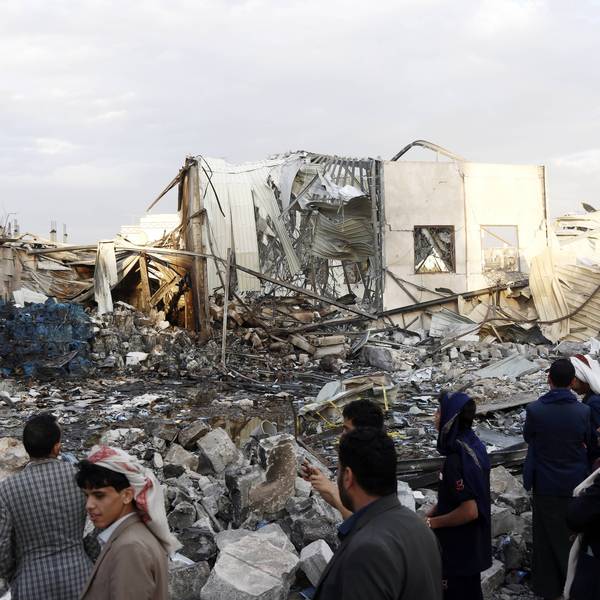


A man cries as he carries his daughter while walking from an Islamic State-controlled part of Mosul towards Iraqi special forces soldiers during a battle on March 4, 2017. (Photo: Goran Tomasevic / Reuters)
Too Many Civilians Died in Mosul. We Need to Protect Them in Raqqa.
ISIS wants civilian deaths caused by the U.S. and its partners. We should not give that to them
Iraqi forces have retaken Mosul in Iraq as U.S.-backed Syrian forces close in on Raqqa, the last major urban stronghold still held by the Islamic State of Iraq and Syria. The outcome of the larger struggle is not in doubt: ISIS will be militarily defeated. The key remaining question is how many of the hundreds of thousands of civilians still trapped in Raqqa will die in the process. The world must not spare any effort to protect them.
Civilians in both cities suffered under ISIS cruelty for years, and the stories of survivors lucky enough to reach relative safety are harrowing. Last month, when I was in northern Iraq, I spoke to a woman who had just made it out of ISIS-controlled West Mosul. She told me about the hard choices she and countless other families have to make.
If they decide to stay or are unable to leave, they face daily ISIS brutality, U.S.-led air strikes that can kill hundreds of civilians at a time, imprecise artillery fire from Iraqi and Syrian Kurdish forces, food shortages, lack of clean water and non-existent medical care. Those who leave -- as she eventually did when she ran out of food and her children faced starvation -- encounter sniper fire and booby-traps planted along the way by ISIS, coalition airstrikes on fleeing convoys, and arbitrary detention of young men whom Iraqi or Kurdish forces suspect of ISIS sympathies.
This woman was in a group of 50 families who made it out, but behind them another group was captured by ISIS as they tried to flee. All of them were executed, she said, including the women and children.
However, we cannot simply blame ISIS for the rising death toll of civilians; civilian deaths and injuries from coalition actions play into their contorted agenda. The U.S.-supported coalition has both an obligation and an opportunity to do more to protect civilians from their own actions, as well as the actions of ISIS. Failing to do so reduces the odds of operational success and risks strategic failure.
Defense Secretary James Mattis recently said the U.S. anti-ISIS strategy would shift from "attrition" to "annihilation" of ISIS forces. This happened in Mosul and many fear that ISIS will make sure civilians still trapped in Raqqa die with them -- killed by either ISIS or by coalition airstrikes and street fighting between Iraqi forces and the insurgents.
There is an alternative. When it comes to battles in densely-populated cities like Mosul and Raqqa, the U.S. and its allies should choose protection over annihilation. There are good reasons for this. The first is legal. International law requires parties to a conflict to take all feasible precautions to protect civilians, and the use of intense air strikes and artillery rounds in populated areas may be deemed illegal.
Second, the U.S. and its allies have a strategic interest in making every effort to spare civilians. If the costs of winning back Mosul and Raqqa are high civilian deaths and destruction, civilians may be unwilling to recognize the legitimacy of the post-ISIS order. And the seeds of cyclical violence, retribution and the rebirth of ISIS, or something even worse, will be sown.
The bottom line is that ISIS wants civilian deaths. The U.S. and its partners should know better and not give that to them.
POLICING THE USA: A look at race, justice, media
There was civilian carnage in Mosul. Avoiding it in Raqqa will require patience, planning, coordination, resources and creativity. Use of air power and artillery needs to be strictly limited and everything should be done to open safe corridors for civilians. Specific operations to safely extract civilians should be considered, when feasible.
When deciding whether to push out or completely surround ISIS forces, the risks to civilians should be taken into account. And as much as possible, shift the heavy fighting to unpopulated or lightly populated areas. And the strategy to protect civilians -- both from U.S. air strikes and from the brutal hands of ISIS -- should be clearly communicated to civilians inside ISIS-held areas.
The world owes it to trapped civilians, and to the hope of a peaceful future for this troubled region, to do everything in its power to bring them to safety.
Federico Borello is the executive director of Center for Civilians in Conflict, which has been operating in Iraq since 2004.
An Urgent Message From Our Co-Founder
Dear Common Dreams reader, It’s been nearly 30 years since I co-founded Common Dreams with my late wife, Lina Newhouser. We had the radical notion that journalism should serve the public good, not corporate profits. It was clear to us from the outset what it would take to build such a project. No paid advertisements. No corporate sponsors. No millionaire publisher telling us what to think or do. Many people said we wouldn't last a year, but we proved those doubters wrong. Together with a tremendous team of journalists and dedicated staff, we built an independent media outlet free from the constraints of profits and corporate control. Our mission has always been simple: To inform. To inspire. To ignite change for the common good. Building Common Dreams was not easy. Our survival was never guaranteed. When you take on the most powerful forces—Wall Street greed, fossil fuel industry destruction, Big Tech lobbyists, and uber-rich oligarchs who have spent billions upon billions rigging the economy and democracy in their favor—the only bulwark you have is supporters who believe in your work. But here’s the urgent message from me today. It's never been this bad out there. And it's never been this hard to keep us going. At the very moment Common Dreams is most needed, the threats we face are intensifying. We need your support now more than ever. We don't accept corporate advertising and never will. We don't have a paywall because we don't think people should be blocked from critical news based on their ability to pay. Everything we do is funded by the donations of readers like you. When everyone does the little they can afford, we are strong. But if that support retreats or dries up, so do we. Will you donate now to make sure Common Dreams not only survives but thrives? —Craig Brown, Co-founder |
Iraqi forces have retaken Mosul in Iraq as U.S.-backed Syrian forces close in on Raqqa, the last major urban stronghold still held by the Islamic State of Iraq and Syria. The outcome of the larger struggle is not in doubt: ISIS will be militarily defeated. The key remaining question is how many of the hundreds of thousands of civilians still trapped in Raqqa will die in the process. The world must not spare any effort to protect them.
Civilians in both cities suffered under ISIS cruelty for years, and the stories of survivors lucky enough to reach relative safety are harrowing. Last month, when I was in northern Iraq, I spoke to a woman who had just made it out of ISIS-controlled West Mosul. She told me about the hard choices she and countless other families have to make.
If they decide to stay or are unable to leave, they face daily ISIS brutality, U.S.-led air strikes that can kill hundreds of civilians at a time, imprecise artillery fire from Iraqi and Syrian Kurdish forces, food shortages, lack of clean water and non-existent medical care. Those who leave -- as she eventually did when she ran out of food and her children faced starvation -- encounter sniper fire and booby-traps planted along the way by ISIS, coalition airstrikes on fleeing convoys, and arbitrary detention of young men whom Iraqi or Kurdish forces suspect of ISIS sympathies.
This woman was in a group of 50 families who made it out, but behind them another group was captured by ISIS as they tried to flee. All of them were executed, she said, including the women and children.
However, we cannot simply blame ISIS for the rising death toll of civilians; civilian deaths and injuries from coalition actions play into their contorted agenda. The U.S.-supported coalition has both an obligation and an opportunity to do more to protect civilians from their own actions, as well as the actions of ISIS. Failing to do so reduces the odds of operational success and risks strategic failure.
Defense Secretary James Mattis recently said the U.S. anti-ISIS strategy would shift from "attrition" to "annihilation" of ISIS forces. This happened in Mosul and many fear that ISIS will make sure civilians still trapped in Raqqa die with them -- killed by either ISIS or by coalition airstrikes and street fighting between Iraqi forces and the insurgents.
There is an alternative. When it comes to battles in densely-populated cities like Mosul and Raqqa, the U.S. and its allies should choose protection over annihilation. There are good reasons for this. The first is legal. International law requires parties to a conflict to take all feasible precautions to protect civilians, and the use of intense air strikes and artillery rounds in populated areas may be deemed illegal.
Second, the U.S. and its allies have a strategic interest in making every effort to spare civilians. If the costs of winning back Mosul and Raqqa are high civilian deaths and destruction, civilians may be unwilling to recognize the legitimacy of the post-ISIS order. And the seeds of cyclical violence, retribution and the rebirth of ISIS, or something even worse, will be sown.
The bottom line is that ISIS wants civilian deaths. The U.S. and its partners should know better and not give that to them.
POLICING THE USA: A look at race, justice, media
There was civilian carnage in Mosul. Avoiding it in Raqqa will require patience, planning, coordination, resources and creativity. Use of air power and artillery needs to be strictly limited and everything should be done to open safe corridors for civilians. Specific operations to safely extract civilians should be considered, when feasible.
When deciding whether to push out or completely surround ISIS forces, the risks to civilians should be taken into account. And as much as possible, shift the heavy fighting to unpopulated or lightly populated areas. And the strategy to protect civilians -- both from U.S. air strikes and from the brutal hands of ISIS -- should be clearly communicated to civilians inside ISIS-held areas.
The world owes it to trapped civilians, and to the hope of a peaceful future for this troubled region, to do everything in its power to bring them to safety.
Federico Borello is the executive director of Center for Civilians in Conflict, which has been operating in Iraq since 2004.
Iraqi forces have retaken Mosul in Iraq as U.S.-backed Syrian forces close in on Raqqa, the last major urban stronghold still held by the Islamic State of Iraq and Syria. The outcome of the larger struggle is not in doubt: ISIS will be militarily defeated. The key remaining question is how many of the hundreds of thousands of civilians still trapped in Raqqa will die in the process. The world must not spare any effort to protect them.
Civilians in both cities suffered under ISIS cruelty for years, and the stories of survivors lucky enough to reach relative safety are harrowing. Last month, when I was in northern Iraq, I spoke to a woman who had just made it out of ISIS-controlled West Mosul. She told me about the hard choices she and countless other families have to make.
If they decide to stay or are unable to leave, they face daily ISIS brutality, U.S.-led air strikes that can kill hundreds of civilians at a time, imprecise artillery fire from Iraqi and Syrian Kurdish forces, food shortages, lack of clean water and non-existent medical care. Those who leave -- as she eventually did when she ran out of food and her children faced starvation -- encounter sniper fire and booby-traps planted along the way by ISIS, coalition airstrikes on fleeing convoys, and arbitrary detention of young men whom Iraqi or Kurdish forces suspect of ISIS sympathies.
This woman was in a group of 50 families who made it out, but behind them another group was captured by ISIS as they tried to flee. All of them were executed, she said, including the women and children.
However, we cannot simply blame ISIS for the rising death toll of civilians; civilian deaths and injuries from coalition actions play into their contorted agenda. The U.S.-supported coalition has both an obligation and an opportunity to do more to protect civilians from their own actions, as well as the actions of ISIS. Failing to do so reduces the odds of operational success and risks strategic failure.
Defense Secretary James Mattis recently said the U.S. anti-ISIS strategy would shift from "attrition" to "annihilation" of ISIS forces. This happened in Mosul and many fear that ISIS will make sure civilians still trapped in Raqqa die with them -- killed by either ISIS or by coalition airstrikes and street fighting between Iraqi forces and the insurgents.
There is an alternative. When it comes to battles in densely-populated cities like Mosul and Raqqa, the U.S. and its allies should choose protection over annihilation. There are good reasons for this. The first is legal. International law requires parties to a conflict to take all feasible precautions to protect civilians, and the use of intense air strikes and artillery rounds in populated areas may be deemed illegal.
Second, the U.S. and its allies have a strategic interest in making every effort to spare civilians. If the costs of winning back Mosul and Raqqa are high civilian deaths and destruction, civilians may be unwilling to recognize the legitimacy of the post-ISIS order. And the seeds of cyclical violence, retribution and the rebirth of ISIS, or something even worse, will be sown.
The bottom line is that ISIS wants civilian deaths. The U.S. and its partners should know better and not give that to them.
POLICING THE USA: A look at race, justice, media
There was civilian carnage in Mosul. Avoiding it in Raqqa will require patience, planning, coordination, resources and creativity. Use of air power and artillery needs to be strictly limited and everything should be done to open safe corridors for civilians. Specific operations to safely extract civilians should be considered, when feasible.
When deciding whether to push out or completely surround ISIS forces, the risks to civilians should be taken into account. And as much as possible, shift the heavy fighting to unpopulated or lightly populated areas. And the strategy to protect civilians -- both from U.S. air strikes and from the brutal hands of ISIS -- should be clearly communicated to civilians inside ISIS-held areas.
The world owes it to trapped civilians, and to the hope of a peaceful future for this troubled region, to do everything in its power to bring them to safety.
Federico Borello is the executive director of Center for Civilians in Conflict, which has been operating in Iraq since 2004.