SUBSCRIBE TO OUR FREE NEWSLETTER
Daily news & progressive opinion—funded by the people, not the corporations—delivered straight to your inbox.
5
#000000
#FFFFFF
To donate by check, phone, or other method, see our More Ways to Give page.
Daily news & progressive opinion—funded by the people, not the corporations—delivered straight to your inbox.
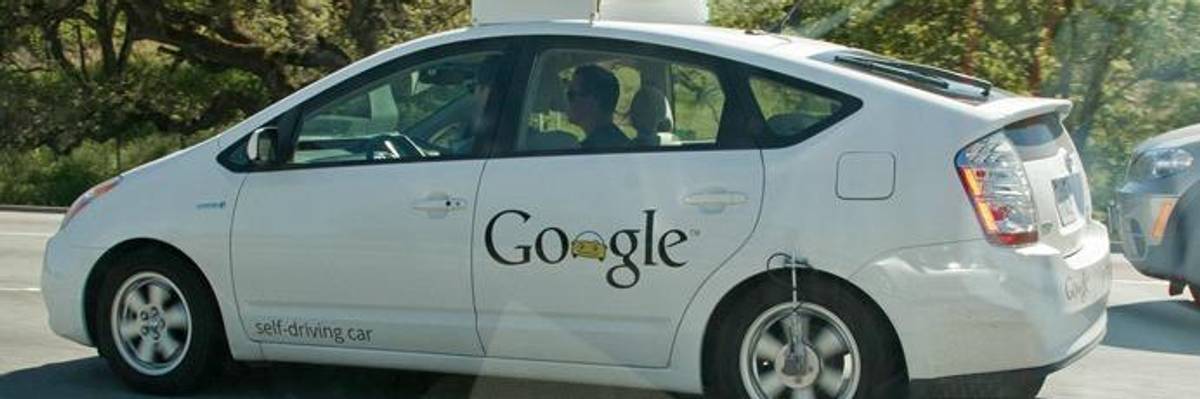
Spotted near Palo Alto, CA on US 280: the Google self-driving car.
The hype and unsubstantiated hope behind the self-driving car movement continues unabated, distracting from addressing necessities of old "mobilities" such as inadequate public transit and upgrading highway and rail infrastructure.
At a conference on Driverless Cars sponsored by the George Washington University Law School earlier this month, the legal landscape of unresolved problems and unasked questions were deliberated for a full day:
The hype and unsubstantiated hope behind the self-driving car movement continues unabated, distracting from addressing necessities of old "mobilities" such as inadequate public transit and upgrading highway and rail infrastructure.
At a conference on Driverless Cars sponsored by the George Washington University Law School earlier this month, the legal landscape of unresolved problems and unasked questions were deliberated for a full day:
What are the legal requirements that should be applied to the testing phase, the deployment phase, liability and insurance, impacts on displaced workers, cyber-security, privacy, and antitrust? A takeaway from this gathering was the number of mind-numbing unresolved systems awaiting this new, untested technology.
First, a little background - car ownership and car sales are expected to flatten or decline due to ride-sharing and a new generation of consumers that is less inclined to purchase motor vehicles. How is the industry to react? By adding high-priced value to motor vehicles, already described as computers on wheels. Voila, the race for the driverless car! The mass media took the bait and over-reported each company's sensationalized press releases, announcing breakthroughs without disclosing the underlying data. The arrogance of the algorithms, among many other variables, bypassed simple daily realties, such as bustling traffic in cities like New York.
In the shadows were the daily tribulations of Americans just trying to get to and from work, especially the poor and those who don't own a vehicle.
Don't expect driverless cars to be taking over anytime in the next few decades. Autonomous vehicles do not exist in the autonomous contexts of daily life. Start with how to fit these futuristic vehicles in a sea of over two hundred fifty million driven vehicles in the US. It's easy to score driverless vehicles in well-orchestrated courses with minimum traffic over low mileage. Apply that controlled scenario to the scale and complexity of actual roads with actual drivers in actual conditions and the difficulties multiply enormously.
The industry-from Silicon Valley to Detroit--argues safety. Robotic systems do not get drunk, fall asleep at the wheel or develop poor driving skills. But computers fail often; they are often susceptible to hacking--whether by the manufacturers, dealers or deadly actors. Hacking is a driverless car industry's nightmare and American motorists can see why. They like to remain in control and not have their engine stop, accelerate or be turned in disastrous directions by remote interventions.
Already, Volkswagen and other companies have been caught by law enforcement manipulating software emission controls on a gigantic scale.
Until that distant dream by the technocrats when all vehicles are driverless is realized, there may be less safety because of the mix of autonomous and human-operated vehicles.
On top of all this is the emerging demand to rewrite the rules so that there is less mandatory regulations (to be replaced by mere guidelines), less tort liability, less clear contractual responsibility between the many inputting companies, less openness for the data, far less privacy protections, and little attention to the awesome public investment needed for preparing highways and other facilities.
Already, Level Three--an autonomous vehicle needing emergency replacement by the surrogate human driver--is being viewed as unworkable by specialists at MIT and elsewhere. The human driver, lulled and preoccupied, can't take back control in time.
Modern mass transit has shown how drivers who choose to become passengers can relax and not have to drive. Why won't we concentrate on what can be improved and expanded to get safer, efficient, less polluting mobility?
Over forty years ago Northwestern University transportation specialists developed a plan for "personalized public transit," meaning, for example, connecting your car to a monorail system for daily commutes!
The driverless car is bursting forth without a legal, ethical and priorities framework. Already asking for public subsidies, companies can drain much-needed funds for available mass transit services and the industry's own vehicle safety upgrades in favor of a technological will-o'-the-wisp.
For a clear, detailed look at the risks posed by driverless cars, read the new report, Self-Driving Vehicles: The Threat to Consumers, by Harvey Rosenfield of Consumer Watchdog.
Dear Common Dreams reader, It’s been nearly 30 years since I co-founded Common Dreams with my late wife, Lina Newhouser. We had the radical notion that journalism should serve the public good, not corporate profits. It was clear to us from the outset what it would take to build such a project. No paid advertisements. No corporate sponsors. No millionaire publisher telling us what to think or do. Many people said we wouldn't last a year, but we proved those doubters wrong. Together with a tremendous team of journalists and dedicated staff, we built an independent media outlet free from the constraints of profits and corporate control. Our mission has always been simple: To inform. To inspire. To ignite change for the common good. Building Common Dreams was not easy. Our survival was never guaranteed. When you take on the most powerful forces—Wall Street greed, fossil fuel industry destruction, Big Tech lobbyists, and uber-rich oligarchs who have spent billions upon billions rigging the economy and democracy in their favor—the only bulwark you have is supporters who believe in your work. But here’s the urgent message from me today. It's never been this bad out there. And it's never been this hard to keep us going. At the very moment Common Dreams is most needed, the threats we face are intensifying. We need your support now more than ever. We don't accept corporate advertising and never will. We don't have a paywall because we don't think people should be blocked from critical news based on their ability to pay. Everything we do is funded by the donations of readers like you. When everyone does the little they can afford, we are strong. But if that support retreats or dries up, so do we. Will you donate now to make sure Common Dreams not only survives but thrives? —Craig Brown, Co-founder |
The hype and unsubstantiated hope behind the self-driving car movement continues unabated, distracting from addressing necessities of old "mobilities" such as inadequate public transit and upgrading highway and rail infrastructure.
At a conference on Driverless Cars sponsored by the George Washington University Law School earlier this month, the legal landscape of unresolved problems and unasked questions were deliberated for a full day:
What are the legal requirements that should be applied to the testing phase, the deployment phase, liability and insurance, impacts on displaced workers, cyber-security, privacy, and antitrust? A takeaway from this gathering was the number of mind-numbing unresolved systems awaiting this new, untested technology.
First, a little background - car ownership and car sales are expected to flatten or decline due to ride-sharing and a new generation of consumers that is less inclined to purchase motor vehicles. How is the industry to react? By adding high-priced value to motor vehicles, already described as computers on wheels. Voila, the race for the driverless car! The mass media took the bait and over-reported each company's sensationalized press releases, announcing breakthroughs without disclosing the underlying data. The arrogance of the algorithms, among many other variables, bypassed simple daily realties, such as bustling traffic in cities like New York.
In the shadows were the daily tribulations of Americans just trying to get to and from work, especially the poor and those who don't own a vehicle.
Don't expect driverless cars to be taking over anytime in the next few decades. Autonomous vehicles do not exist in the autonomous contexts of daily life. Start with how to fit these futuristic vehicles in a sea of over two hundred fifty million driven vehicles in the US. It's easy to score driverless vehicles in well-orchestrated courses with minimum traffic over low mileage. Apply that controlled scenario to the scale and complexity of actual roads with actual drivers in actual conditions and the difficulties multiply enormously.
The industry-from Silicon Valley to Detroit--argues safety. Robotic systems do not get drunk, fall asleep at the wheel or develop poor driving skills. But computers fail often; they are often susceptible to hacking--whether by the manufacturers, dealers or deadly actors. Hacking is a driverless car industry's nightmare and American motorists can see why. They like to remain in control and not have their engine stop, accelerate or be turned in disastrous directions by remote interventions.
Already, Volkswagen and other companies have been caught by law enforcement manipulating software emission controls on a gigantic scale.
Until that distant dream by the technocrats when all vehicles are driverless is realized, there may be less safety because of the mix of autonomous and human-operated vehicles.
On top of all this is the emerging demand to rewrite the rules so that there is less mandatory regulations (to be replaced by mere guidelines), less tort liability, less clear contractual responsibility between the many inputting companies, less openness for the data, far less privacy protections, and little attention to the awesome public investment needed for preparing highways and other facilities.
Already, Level Three--an autonomous vehicle needing emergency replacement by the surrogate human driver--is being viewed as unworkable by specialists at MIT and elsewhere. The human driver, lulled and preoccupied, can't take back control in time.
Modern mass transit has shown how drivers who choose to become passengers can relax and not have to drive. Why won't we concentrate on what can be improved and expanded to get safer, efficient, less polluting mobility?
Over forty years ago Northwestern University transportation specialists developed a plan for "personalized public transit," meaning, for example, connecting your car to a monorail system for daily commutes!
The driverless car is bursting forth without a legal, ethical and priorities framework. Already asking for public subsidies, companies can drain much-needed funds for available mass transit services and the industry's own vehicle safety upgrades in favor of a technological will-o'-the-wisp.
For a clear, detailed look at the risks posed by driverless cars, read the new report, Self-Driving Vehicles: The Threat to Consumers, by Harvey Rosenfield of Consumer Watchdog.
The hype and unsubstantiated hope behind the self-driving car movement continues unabated, distracting from addressing necessities of old "mobilities" such as inadequate public transit and upgrading highway and rail infrastructure.
At a conference on Driverless Cars sponsored by the George Washington University Law School earlier this month, the legal landscape of unresolved problems and unasked questions were deliberated for a full day:
What are the legal requirements that should be applied to the testing phase, the deployment phase, liability and insurance, impacts on displaced workers, cyber-security, privacy, and antitrust? A takeaway from this gathering was the number of mind-numbing unresolved systems awaiting this new, untested technology.
First, a little background - car ownership and car sales are expected to flatten or decline due to ride-sharing and a new generation of consumers that is less inclined to purchase motor vehicles. How is the industry to react? By adding high-priced value to motor vehicles, already described as computers on wheels. Voila, the race for the driverless car! The mass media took the bait and over-reported each company's sensationalized press releases, announcing breakthroughs without disclosing the underlying data. The arrogance of the algorithms, among many other variables, bypassed simple daily realties, such as bustling traffic in cities like New York.
In the shadows were the daily tribulations of Americans just trying to get to and from work, especially the poor and those who don't own a vehicle.
Don't expect driverless cars to be taking over anytime in the next few decades. Autonomous vehicles do not exist in the autonomous contexts of daily life. Start with how to fit these futuristic vehicles in a sea of over two hundred fifty million driven vehicles in the US. It's easy to score driverless vehicles in well-orchestrated courses with minimum traffic over low mileage. Apply that controlled scenario to the scale and complexity of actual roads with actual drivers in actual conditions and the difficulties multiply enormously.
The industry-from Silicon Valley to Detroit--argues safety. Robotic systems do not get drunk, fall asleep at the wheel or develop poor driving skills. But computers fail often; they are often susceptible to hacking--whether by the manufacturers, dealers or deadly actors. Hacking is a driverless car industry's nightmare and American motorists can see why. They like to remain in control and not have their engine stop, accelerate or be turned in disastrous directions by remote interventions.
Already, Volkswagen and other companies have been caught by law enforcement manipulating software emission controls on a gigantic scale.
Until that distant dream by the technocrats when all vehicles are driverless is realized, there may be less safety because of the mix of autonomous and human-operated vehicles.
On top of all this is the emerging demand to rewrite the rules so that there is less mandatory regulations (to be replaced by mere guidelines), less tort liability, less clear contractual responsibility between the many inputting companies, less openness for the data, far less privacy protections, and little attention to the awesome public investment needed for preparing highways and other facilities.
Already, Level Three--an autonomous vehicle needing emergency replacement by the surrogate human driver--is being viewed as unworkable by specialists at MIT and elsewhere. The human driver, lulled and preoccupied, can't take back control in time.
Modern mass transit has shown how drivers who choose to become passengers can relax and not have to drive. Why won't we concentrate on what can be improved and expanded to get safer, efficient, less polluting mobility?
Over forty years ago Northwestern University transportation specialists developed a plan for "personalized public transit," meaning, for example, connecting your car to a monorail system for daily commutes!
The driverless car is bursting forth without a legal, ethical and priorities framework. Already asking for public subsidies, companies can drain much-needed funds for available mass transit services and the industry's own vehicle safety upgrades in favor of a technological will-o'-the-wisp.
For a clear, detailed look at the risks posed by driverless cars, read the new report, Self-Driving Vehicles: The Threat to Consumers, by Harvey Rosenfield of Consumer Watchdog.