SUBSCRIBE TO OUR FREE NEWSLETTER
Daily news & progressive opinion—funded by the people, not the corporations—delivered straight to your inbox.
5
#000000
#FFFFFF
To donate by check, phone, or other method, see our More Ways to Give page.
Dam builders like to claim that hydropower is the world's largest source of renewable electricity. After a century-long head start over wind and solar power, large hydropower indeed accounted for 52% of the world's renewable energy capacity in 2014. But new figures from the International Renewable Energy Agency (IRENA) show that the picture is quickly changing.
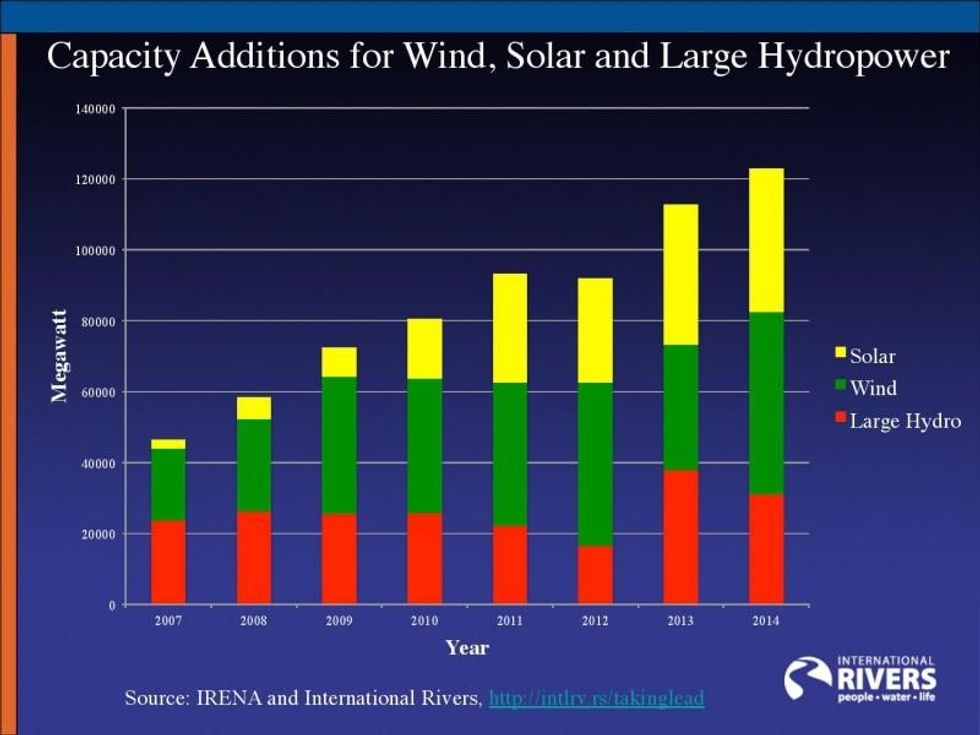
The world added 132,000 megawatt of renewable energy capacity in 2014. This is roughly equal to the full power sector capacity of Canada or France. New wind power with 51,000 megawatt and new solar power with 40,000 megawatt were the biggest factors behind this spectacular growth. New large hydropower projects contributed 31,000 megawatt. These figures confirm a long-term trend: Since 2010, wind and solar power capacity has grown by a total of 313,000 megawatt - almost four times faster than large hydropower plants.
Not all wind and solar projects are socially and environmentally benign, and not all hydropower projects of 10 megawatt and more destroy ecosystems. But overall, wind and solar projects have a smaller environmental footprint than hydropower dams, can be built closer to where people need them (including far away from the electric grid), and are more resilient to climate change. Unlike hydropower dams that can irreversibly destroy ecosystems and wipe out species, they are truly renewable sources of electricity.
Dam builders argue that wind and solar power are so intermittent that they need to be backed up by hydropower reservoirs for a reliable supply of electricity. The upsurge of wind and solar power has indeed given dam builders their own second wind. Yet the price of environmentally friendly battery power is dropping fast, and smarter grids can balance more intermittent power sources. We will not need to build more destructive dams to balance a growing share of wind and solar energy. If the current trend continues, solar power can blow dam buildings out of the water.
Based on data from 77 countries, IRENA also reports that the performance of hydropower projects is deteriorating. In 2000, hydropower plants on average generated at 44% of their capacity. By 2014, their average performance had fallen to 40%. IRENA does not offer an explanation for this trend, but whatever the reasons are, it does not bode well: Is hydropower generation dwindling under the impact of ever more serious droughts? Are farmers and industrial users withdrawing more water from rivers? Or are dam builders running out of good sites for their new projects?
While governments and private investors favor wind and solar power over hydropower, the World Bank and other international financial institutions continue to prioritize large dams. In 2014, the World Bank devoted no less than 56% of its power sector lending to large hydropower projects. (It lent 30% of its power sector funds for wind, solar and geothermal projects, and 14% for oil and gas.) The Bank is currently funding 68 large hydropower projects, and has another six in its pipeline.
Like the dam building industry, the World Bank explains that "hydropower is the world's largest source of renewable energy". This is a backward-looking argument. With the same justification, financiers could have argued for a continued focus on landline connections rather than mobile phones fifteen years ago. The future belongs to wind and solar power.
Dam builders like to claim that hydropower is the world's largest source of renewable electricity. After a century-long head start over wind and solar power, large hydropower indeed accounted for 52% of the world's renewable energy capacity in 2014. But new figures from the International Renewable Energy Agency (IRENA) show that the picture is quickly changing.
The world added 132,000 megawatt of renewable energy capacity in 2014. This is roughly equal to the full power sector capacity of Canada or France. New wind power with 51,000 megawatt and new solar power with 40,000 megawatt were the biggest factors behind this spectacular growth. New large hydropower projects contributed 31,000 megawatt. These figures confirm a long-term trend: Since 2010, wind and solar power capacity has grown by a total of 313,000 megawatt - almost four times faster than large hydropower plants.
Not all wind and solar projects are socially and environmentally benign, and not all hydropower projects of 10 megawatt and more destroy ecosystems. But overall, wind and solar projects have a smaller environmental footprint than hydropower dams, can be built closer to where people need them (including far away from the electric grid), and are more resilient to climate change. Unlike hydropower dams that can irreversibly destroy ecosystems and wipe out species, they are truly renewable sources of electricity.
Dam builders argue that wind and solar power are so intermittent that they need to be backed up by hydropower reservoirs for a reliable supply of electricity. The upsurge of wind and solar power has indeed given dam builders their own second wind. Yet the price of environmentally friendly battery power is dropping fast, and smarter grids can balance more intermittent power sources. We will not need to build more destructive dams to balance a growing share of wind and solar energy. If the current trend continues, solar power can blow dam buildings out of the water.
Based on data from 77 countries, IRENA also reports that the performance of hydropower projects is deteriorating. In 2000, hydropower plants on average generated at 44% of their capacity. By 2014, their average performance had fallen to 40%. IRENA does not offer an explanation for this trend, but whatever the reasons are, it does not bode well: Is hydropower generation dwindling under the impact of ever more serious droughts? Are farmers and industrial users withdrawing more water from rivers? Or are dam builders running out of good sites for their new projects?
While governments and private investors favor wind and solar power over hydropower, the World Bank and other international financial institutions continue to prioritize large dams. In 2014, the World Bank devoted no less than 56% of its power sector lending to large hydropower projects. (It lent 30% of its power sector funds for wind, solar and geothermal projects, and 14% for oil and gas.) The Bank is currently funding 68 large hydropower projects, and has another six in its pipeline.
Like the dam building industry, the World Bank explains that "hydropower is the world's largest source of renewable energy". This is a backward-looking argument. With the same justification, financiers could have argued for a continued focus on landline connections rather than mobile phones fifteen years ago. The future belongs to wind and solar power.
Dam builders like to claim that hydropower is the world's largest source of renewable electricity. After a century-long head start over wind and solar power, large hydropower indeed accounted for 52% of the world's renewable energy capacity in 2014. But new figures from the International Renewable Energy Agency (IRENA) show that the picture is quickly changing.
The world added 132,000 megawatt of renewable energy capacity in 2014. This is roughly equal to the full power sector capacity of Canada or France. New wind power with 51,000 megawatt and new solar power with 40,000 megawatt were the biggest factors behind this spectacular growth. New large hydropower projects contributed 31,000 megawatt. These figures confirm a long-term trend: Since 2010, wind and solar power capacity has grown by a total of 313,000 megawatt - almost four times faster than large hydropower plants.
Not all wind and solar projects are socially and environmentally benign, and not all hydropower projects of 10 megawatt and more destroy ecosystems. But overall, wind and solar projects have a smaller environmental footprint than hydropower dams, can be built closer to where people need them (including far away from the electric grid), and are more resilient to climate change. Unlike hydropower dams that can irreversibly destroy ecosystems and wipe out species, they are truly renewable sources of electricity.
Dam builders argue that wind and solar power are so intermittent that they need to be backed up by hydropower reservoirs for a reliable supply of electricity. The upsurge of wind and solar power has indeed given dam builders their own second wind. Yet the price of environmentally friendly battery power is dropping fast, and smarter grids can balance more intermittent power sources. We will not need to build more destructive dams to balance a growing share of wind and solar energy. If the current trend continues, solar power can blow dam buildings out of the water.
Based on data from 77 countries, IRENA also reports that the performance of hydropower projects is deteriorating. In 2000, hydropower plants on average generated at 44% of their capacity. By 2014, their average performance had fallen to 40%. IRENA does not offer an explanation for this trend, but whatever the reasons are, it does not bode well: Is hydropower generation dwindling under the impact of ever more serious droughts? Are farmers and industrial users withdrawing more water from rivers? Or are dam builders running out of good sites for their new projects?
While governments and private investors favor wind and solar power over hydropower, the World Bank and other international financial institutions continue to prioritize large dams. In 2014, the World Bank devoted no less than 56% of its power sector lending to large hydropower projects. (It lent 30% of its power sector funds for wind, solar and geothermal projects, and 14% for oil and gas.) The Bank is currently funding 68 large hydropower projects, and has another six in its pipeline.
Like the dam building industry, the World Bank explains that "hydropower is the world's largest source of renewable energy". This is a backward-looking argument. With the same justification, financiers could have argued for a continued focus on landline connections rather than mobile phones fifteen years ago. The future belongs to wind and solar power.