SUBSCRIBE TO OUR FREE NEWSLETTER
Daily news & progressive opinion—funded by the people, not the corporations—delivered straight to your inbox.
5
#000000
#FFFFFF
To donate by check, phone, or other method, see our More Ways to Give page.
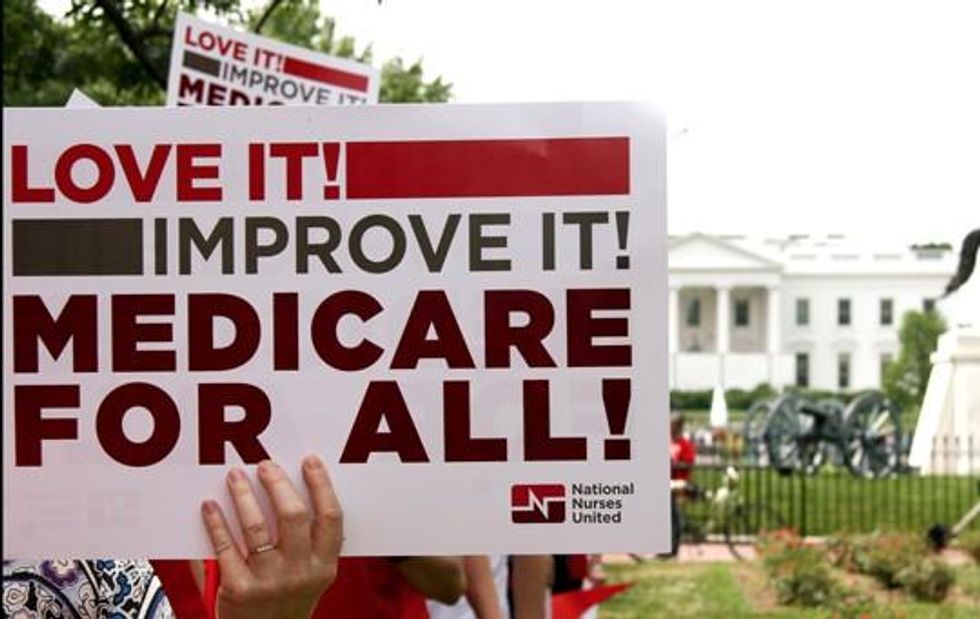
The Maine Medical Association recently updated a 2008 poll of their members that asked the question, "When considering the topic of health care reform, would you prefer to make improvements in the current public/private system (or) a single-payer system, such as a 'Medicare-for-all' approach?" In 2008, 52.3 percent favored the Medicare-for-all approach. In the updated poll, released last week, that number had risen to 64.3 percent.
It's pretty unusual for two-thirds of a group of doctors to agree on something as controversial as a single-payer health care system. Until recently, doctors formed the core resistance to "government-run" health insurance in the U.S.
A number of factors account for this impressive change, but the huge administrative burden on practicing physicians created by our plethora of private insurance schemes is certainly near the top of the list.
The other day, I spoke with a Maine physician nearing retirement and looking forward to it. She was recently returning home after a long day in her practice, carrying her "homework," a pile of administrative paperwork several inches high. Her husband asked her how she got so far behind in her paperwork. "I wasn't behind at all," she replied. She did this much paperwork, mostly insurance forms, at least twice a week.
American physicians spend at least three times as much time, money and effort on administrative work related to payment and insurance coverage as our Canadian brethren, with their single-payer system. Administrative hassle is a major factor driving more and more American doctors to sell our practices to large corporations that take care of the back-office work. The Affordable Care Act has only added to that burden. Sixty percent of doctors now work for corporations, and that number is growing.
Working for a corporate provider of health care services is a mixed bag. He who pays the piper calls the tune. As both for-profit and nonprofit health care corporations have become increasingly focused on the bottom line, doctors working for them have come under increasingly subtle and not-so-subtle pressures to generate revenue for their employers.
Some tests and procedures are more profitable than others. Increasingly, doctors' "productivity" is measured by the amount of profitable revenue we produce rather than by the results we get for our patients. But in health care, profitability is a very unreliable measure of value because doctors' fees and other health care prices are often set arbitrarily.
When we graduate from medical school, most of us take the Hippocratic Oath, swearing our primary allegiance to our patients. Young doctors tend to take their oath very seriously. Most doctors truly want to do what's best for patients, not their insurance company or our employers' bottom line.
But in today's corporatized and increasingly monetized health care environment, the demands for generation of profit often directly conflict with our clinical judgment. The belief that doctors and other healers act as stewards for our patients' welfare has long earned us a special place in society and the trust of our patients. That position and that trust, so critical to healing, is now threatened.
This conflict has made many doctors very angry. Practicing a profession that has traditionally been a calling has become a business. Doctors today are caught in a system corrupted by an excessive focus on money that is forcing us to behave in ways that conflict with our professional ethics. We are growing very tired of being told how to practice medicine by insurance company bureaucrats and corporate MBAs.
This is another major cause of the burnout experienced by increasing numbers of doctors. Many older doctors are now simply looking for a way out. Others are calling for systemwide reforms that will allow them to return to focusing on the welfare of their patients. Hence the results of the recent MMA poll.
In an excellent new book called "What Matters In Medicine", longtime Maine family doctor David Loxterkamp points out that medical care, while often using scientific jargon, methods and tools, is at its core a profession about relationships, not profits. That's something the bean-counters and policy wonks who have become increasingly influential in determining the nature of our corporatized health care system seem unable to understand.
It's time to remove corporate profit from the financing of health care, and perverse financial incentives from the direct provision of services. It's time for improved Medicare-for-all.
The Maine Medical Association recently updated a 2008 poll of their members that asked the question, "When considering the topic of health care reform, would you prefer to make improvements in the current public/private system (or) a single-payer system, such as a 'Medicare-for-all' approach?" In 2008, 52.3 percent favored the Medicare-for-all approach. In the updated poll, released last week, that number had risen to 64.3 percent.
It's pretty unusual for two-thirds of a group of doctors to agree on something as controversial as a single-payer health care system. Until recently, doctors formed the core resistance to "government-run" health insurance in the U.S.
A number of factors account for this impressive change, but the huge administrative burden on practicing physicians created by our plethora of private insurance schemes is certainly near the top of the list.
The other day, I spoke with a Maine physician nearing retirement and looking forward to it. She was recently returning home after a long day in her practice, carrying her "homework," a pile of administrative paperwork several inches high. Her husband asked her how she got so far behind in her paperwork. "I wasn't behind at all," she replied. She did this much paperwork, mostly insurance forms, at least twice a week.
American physicians spend at least three times as much time, money and effort on administrative work related to payment and insurance coverage as our Canadian brethren, with their single-payer system. Administrative hassle is a major factor driving more and more American doctors to sell our practices to large corporations that take care of the back-office work. The Affordable Care Act has only added to that burden. Sixty percent of doctors now work for corporations, and that number is growing.
Working for a corporate provider of health care services is a mixed bag. He who pays the piper calls the tune. As both for-profit and nonprofit health care corporations have become increasingly focused on the bottom line, doctors working for them have come under increasingly subtle and not-so-subtle pressures to generate revenue for their employers.
Some tests and procedures are more profitable than others. Increasingly, doctors' "productivity" is measured by the amount of profitable revenue we produce rather than by the results we get for our patients. But in health care, profitability is a very unreliable measure of value because doctors' fees and other health care prices are often set arbitrarily.
When we graduate from medical school, most of us take the Hippocratic Oath, swearing our primary allegiance to our patients. Young doctors tend to take their oath very seriously. Most doctors truly want to do what's best for patients, not their insurance company or our employers' bottom line.
But in today's corporatized and increasingly monetized health care environment, the demands for generation of profit often directly conflict with our clinical judgment. The belief that doctors and other healers act as stewards for our patients' welfare has long earned us a special place in society and the trust of our patients. That position and that trust, so critical to healing, is now threatened.
This conflict has made many doctors very angry. Practicing a profession that has traditionally been a calling has become a business. Doctors today are caught in a system corrupted by an excessive focus on money that is forcing us to behave in ways that conflict with our professional ethics. We are growing very tired of being told how to practice medicine by insurance company bureaucrats and corporate MBAs.
This is another major cause of the burnout experienced by increasing numbers of doctors. Many older doctors are now simply looking for a way out. Others are calling for systemwide reforms that will allow them to return to focusing on the welfare of their patients. Hence the results of the recent MMA poll.
In an excellent new book called "What Matters In Medicine", longtime Maine family doctor David Loxterkamp points out that medical care, while often using scientific jargon, methods and tools, is at its core a profession about relationships, not profits. That's something the bean-counters and policy wonks who have become increasingly influential in determining the nature of our corporatized health care system seem unable to understand.
It's time to remove corporate profit from the financing of health care, and perverse financial incentives from the direct provision of services. It's time for improved Medicare-for-all.
The Maine Medical Association recently updated a 2008 poll of their members that asked the question, "When considering the topic of health care reform, would you prefer to make improvements in the current public/private system (or) a single-payer system, such as a 'Medicare-for-all' approach?" In 2008, 52.3 percent favored the Medicare-for-all approach. In the updated poll, released last week, that number had risen to 64.3 percent.
It's pretty unusual for two-thirds of a group of doctors to agree on something as controversial as a single-payer health care system. Until recently, doctors formed the core resistance to "government-run" health insurance in the U.S.
A number of factors account for this impressive change, but the huge administrative burden on practicing physicians created by our plethora of private insurance schemes is certainly near the top of the list.
The other day, I spoke with a Maine physician nearing retirement and looking forward to it. She was recently returning home after a long day in her practice, carrying her "homework," a pile of administrative paperwork several inches high. Her husband asked her how she got so far behind in her paperwork. "I wasn't behind at all," she replied. She did this much paperwork, mostly insurance forms, at least twice a week.
American physicians spend at least three times as much time, money and effort on administrative work related to payment and insurance coverage as our Canadian brethren, with their single-payer system. Administrative hassle is a major factor driving more and more American doctors to sell our practices to large corporations that take care of the back-office work. The Affordable Care Act has only added to that burden. Sixty percent of doctors now work for corporations, and that number is growing.
Working for a corporate provider of health care services is a mixed bag. He who pays the piper calls the tune. As both for-profit and nonprofit health care corporations have become increasingly focused on the bottom line, doctors working for them have come under increasingly subtle and not-so-subtle pressures to generate revenue for their employers.
Some tests and procedures are more profitable than others. Increasingly, doctors' "productivity" is measured by the amount of profitable revenue we produce rather than by the results we get for our patients. But in health care, profitability is a very unreliable measure of value because doctors' fees and other health care prices are often set arbitrarily.
When we graduate from medical school, most of us take the Hippocratic Oath, swearing our primary allegiance to our patients. Young doctors tend to take their oath very seriously. Most doctors truly want to do what's best for patients, not their insurance company or our employers' bottom line.
But in today's corporatized and increasingly monetized health care environment, the demands for generation of profit often directly conflict with our clinical judgment. The belief that doctors and other healers act as stewards for our patients' welfare has long earned us a special place in society and the trust of our patients. That position and that trust, so critical to healing, is now threatened.
This conflict has made many doctors very angry. Practicing a profession that has traditionally been a calling has become a business. Doctors today are caught in a system corrupted by an excessive focus on money that is forcing us to behave in ways that conflict with our professional ethics. We are growing very tired of being told how to practice medicine by insurance company bureaucrats and corporate MBAs.
This is another major cause of the burnout experienced by increasing numbers of doctors. Many older doctors are now simply looking for a way out. Others are calling for systemwide reforms that will allow them to return to focusing on the welfare of their patients. Hence the results of the recent MMA poll.
In an excellent new book called "What Matters In Medicine", longtime Maine family doctor David Loxterkamp points out that medical care, while often using scientific jargon, methods and tools, is at its core a profession about relationships, not profits. That's something the bean-counters and policy wonks who have become increasingly influential in determining the nature of our corporatized health care system seem unable to understand.
It's time to remove corporate profit from the financing of health care, and perverse financial incentives from the direct provision of services. It's time for improved Medicare-for-all.