
Early this morning riot police broke into the Athens headquarters of ERT, Greek Radio and Television, which was officially closed by ministerial decree on June 11th but whose journalists and technicians have continued to broadcast over the Internet. After dispersing protesters outside with teargas, armoured police cleared the building room by room. Union representative Nikos Tsimpidas was last at the microphone, calling for a "magnificent demonstration, not just for ERT, not for our jobs, but for democracy itself, against...this virulent repression, this rewind through decades, for all the things we should have stood up for but couldn't ..."
Even words lose their meanings. Increasingly, a mark of the Greek crisis (not so much a crisis now as a condition) is the fragmenting of perceived reality, along with a desperate struggle to control the story of what's happening. I imagine it's always like this with authoritarian regimes--for Greece is clearly now an authoritarian regime masquerading as a democracy--but I've never seen it from close up before. We're living (as well as everything else) a war of words, a propaganda campaign designed to drown out dissenting voices--even moderate ones. Questions about whether ERT was wasteful, or padded with cronies, or captured by special interests--questions that might have been addressed in a functioning democracy--became irrelevant the day the broadcaster was shut down by fiat. This morning the other shoe dropped. The image is the message: platoons of armoured representatives of the state evicting a few dozen journalists and locking the doors with handcuffs.
As always in Greece, the message is two-faced, one visage for foreign consumption, the other for domestic. What it's supposed to say to representatives of the Troika who are, once again, in Athens (if they're stupid enough to buy it, or diplomats enough to pretend they have) is that everything's under control: we're meeting our obligations, turning around the economy, cracking down on lawlessness, breaking the unions. (The original shut-down of ERT was ostensibly designed to meet the Troika's demand for public sector lay-offs.) The message to Greeks is this: You may see a government that's scrambling to appease its creditors without upsetting its cronies, that's lost control of the streets and its own half-tamed heavies, that has no idea how to get out of the maze; you may be jobless, hungry, disoriented and lost, looking ahead at a winter without heat or hope; you may think some kind of resistance is still possible. But the evidence of your senses is false, or at least irrelevant. Look! We're installling free WiFi all across the country! Greece is a success story! And if you won't line up behind our version of reality, we have the power to persuade you. Against the voice of a man in a room with a microphone, we play helmeted troops with teargas and batons.
Of course, people won't be silenced, especially not now. (A few days ago, a bunch of Dogberries from the Greek police turned up at Radiobubble, a citizen radio station run out of a cafe in Athens, and threatened to prosecute because people were "talking too loudly" in the street outside. Perhaps they had read about it in the New York Times.) But (let them eat WiFi notwithstanding) most Greeks get their news from private television stations owned by politically well-connected oligarchs--which were given control of the digital airwaves by a vote in parliament hours before this morning's raid on ERT. And the cacophony of unsourced hysteria and conspiracy theories that has longed filled much of the Greek media, across the political spectrum, doesn't help the quest for a coherent, usable description of what's happening.
The moment when stories fragment and words lose their meanings is also one of possibility, when different futures and arrangements might emerge. The nexus of oligarchs, financial interests and politicians ruling Greece (in symbiotic struggle with its creditors) now seems determined at all costs to close that down. The sense of repression is palpable; the scary thing is how quickly you get used to it. Two weeks ago I went out to dinner with friends in Athens. As we left the taverna--almost empty on a Friday night--a heavily armoured Delta police patrol roared by, eight or ten men in black, on motorbikes, two abreast. No one even turned to look.
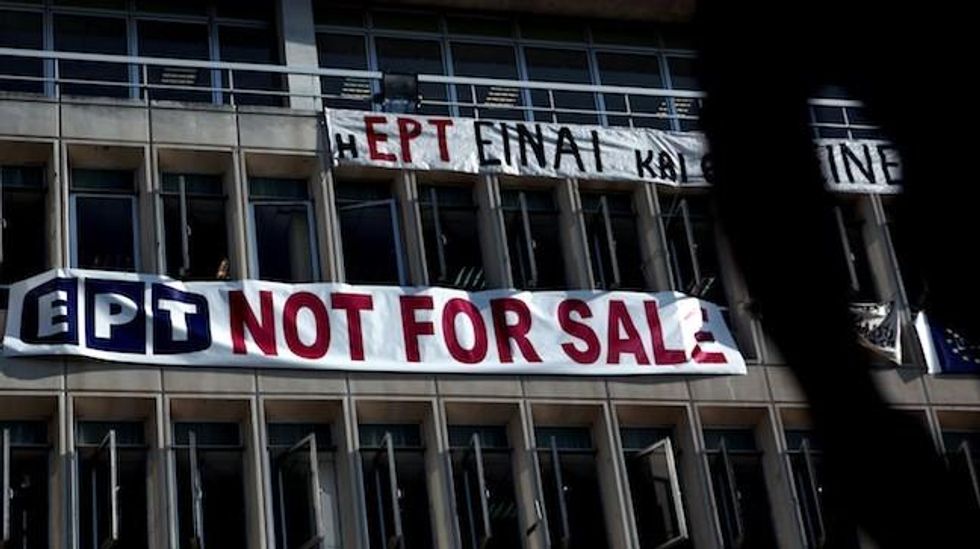
On the other hand, as I write, the left party, Syriza--some of whose MPs were violently prevented from entering ERT's headquarters this morning--is tabling a motion of no confidence in the government, to be debated tomorrow. The ruling coalition has a majority of only five MPs, some of whom blocked a motion to impose a new property tax a few days ago; of course, the pressure on them to conform will be immense. The private channels will broadcast this--with dire predictions of catastrophe--as another "thriller." Meanwhile, protesters have gathered outside ERT's headquarters in Athens and Salonika; one banner reads, "Deep Soul." And ERT journalists and musicians are still broadcasting on the internet, from the street.
Early this morning riot police broke into the Athens headquarters of ERT, Greek Radio and Television, which was officially closed by ministerial decree on June 11th but whose journalists and technicians have continued to broadcast over the Internet. After dispersing protesters outside with teargas, armoured police cleared the building room by room. Union representative Nikos Tsimpidas was last at the microphone, calling for a "magnificent demonstration, not just for ERT, not for our jobs, but for democracy itself, against...this virulent repression, this rewind through decades, for all the things we should have stood up for but couldn't ..."
Even words lose their meanings. Increasingly, a mark of the Greek crisis (not so much a crisis now as a condition) is the fragmenting of perceived reality, along with a desperate struggle to control the story of what's happening. I imagine it's always like this with authoritarian regimes--for Greece is clearly now an authoritarian regime masquerading as a democracy--but I've never seen it from close up before. We're living (as well as everything else) a war of words, a propaganda campaign designed to drown out dissenting voices--even moderate ones. Questions about whether ERT was wasteful, or padded with cronies, or captured by special interests--questions that might have been addressed in a functioning democracy--became irrelevant the day the broadcaster was shut down by fiat. This morning the other shoe dropped. The image is the message: platoons of armoured representatives of the state evicting a few dozen journalists and locking the doors with handcuffs.
As always in Greece, the message is two-faced, one visage for foreign consumption, the other for domestic. What it's supposed to say to representatives of the Troika who are, once again, in Athens (if they're stupid enough to buy it, or diplomats enough to pretend they have) is that everything's under control: we're meeting our obligations, turning around the economy, cracking down on lawlessness, breaking the unions. (The original shut-down of ERT was ostensibly designed to meet the Troika's demand for public sector lay-offs.) The message to Greeks is this: You may see a government that's scrambling to appease its creditors without upsetting its cronies, that's lost control of the streets and its own half-tamed heavies, that has no idea how to get out of the maze; you may be jobless, hungry, disoriented and lost, looking ahead at a winter without heat or hope; you may think some kind of resistance is still possible. But the evidence of your senses is false, or at least irrelevant. Look! We're installling free WiFi all across the country! Greece is a success story! And if you won't line up behind our version of reality, we have the power to persuade you. Against the voice of a man in a room with a microphone, we play helmeted troops with teargas and batons.
Of course, people won't be silenced, especially not now. (A few days ago, a bunch of Dogberries from the Greek police turned up at Radiobubble, a citizen radio station run out of a cafe in Athens, and threatened to prosecute because people were "talking too loudly" in the street outside. Perhaps they had read about it in the New York Times.) But (let them eat WiFi notwithstanding) most Greeks get their news from private television stations owned by politically well-connected oligarchs--which were given control of the digital airwaves by a vote in parliament hours before this morning's raid on ERT. And the cacophony of unsourced hysteria and conspiracy theories that has longed filled much of the Greek media, across the political spectrum, doesn't help the quest for a coherent, usable description of what's happening.
The moment when stories fragment and words lose their meanings is also one of possibility, when different futures and arrangements might emerge. The nexus of oligarchs, financial interests and politicians ruling Greece (in symbiotic struggle with its creditors) now seems determined at all costs to close that down. The sense of repression is palpable; the scary thing is how quickly you get used to it. Two weeks ago I went out to dinner with friends in Athens. As we left the taverna--almost empty on a Friday night--a heavily armoured Delta police patrol roared by, eight or ten men in black, on motorbikes, two abreast. No one even turned to look.
On the other hand, as I write, the left party, Syriza--some of whose MPs were violently prevented from entering ERT's headquarters this morning--is tabling a motion of no confidence in the government, to be debated tomorrow. The ruling coalition has a majority of only five MPs, some of whom blocked a motion to impose a new property tax a few days ago; of course, the pressure on them to conform will be immense. The private channels will broadcast this--with dire predictions of catastrophe--as another "thriller." Meanwhile, protesters have gathered outside ERT's headquarters in Athens and Salonika; one banner reads, "Deep Soul." And ERT journalists and musicians are still broadcasting on the internet, from the street.
Early this morning riot police broke into the Athens headquarters of ERT, Greek Radio and Television, which was officially closed by ministerial decree on June 11th but whose journalists and technicians have continued to broadcast over the Internet. After dispersing protesters outside with teargas, armoured police cleared the building room by room. Union representative Nikos Tsimpidas was last at the microphone, calling for a "magnificent demonstration, not just for ERT, not for our jobs, but for democracy itself, against...this virulent repression, this rewind through decades, for all the things we should have stood up for but couldn't ..."
Even words lose their meanings. Increasingly, a mark of the Greek crisis (not so much a crisis now as a condition) is the fragmenting of perceived reality, along with a desperate struggle to control the story of what's happening. I imagine it's always like this with authoritarian regimes--for Greece is clearly now an authoritarian regime masquerading as a democracy--but I've never seen it from close up before. We're living (as well as everything else) a war of words, a propaganda campaign designed to drown out dissenting voices--even moderate ones. Questions about whether ERT was wasteful, or padded with cronies, or captured by special interests--questions that might have been addressed in a functioning democracy--became irrelevant the day the broadcaster was shut down by fiat. This morning the other shoe dropped. The image is the message: platoons of armoured representatives of the state evicting a few dozen journalists and locking the doors with handcuffs.
As always in Greece, the message is two-faced, one visage for foreign consumption, the other for domestic. What it's supposed to say to representatives of the Troika who are, once again, in Athens (if they're stupid enough to buy it, or diplomats enough to pretend they have) is that everything's under control: we're meeting our obligations, turning around the economy, cracking down on lawlessness, breaking the unions. (The original shut-down of ERT was ostensibly designed to meet the Troika's demand for public sector lay-offs.) The message to Greeks is this: You may see a government that's scrambling to appease its creditors without upsetting its cronies, that's lost control of the streets and its own half-tamed heavies, that has no idea how to get out of the maze; you may be jobless, hungry, disoriented and lost, looking ahead at a winter without heat or hope; you may think some kind of resistance is still possible. But the evidence of your senses is false, or at least irrelevant. Look! We're installling free WiFi all across the country! Greece is a success story! And if you won't line up behind our version of reality, we have the power to persuade you. Against the voice of a man in a room with a microphone, we play helmeted troops with teargas and batons.
Of course, people won't be silenced, especially not now. (A few days ago, a bunch of Dogberries from the Greek police turned up at Radiobubble, a citizen radio station run out of a cafe in Athens, and threatened to prosecute because people were "talking too loudly" in the street outside. Perhaps they had read about it in the New York Times.) But (let them eat WiFi notwithstanding) most Greeks get their news from private television stations owned by politically well-connected oligarchs--which were given control of the digital airwaves by a vote in parliament hours before this morning's raid on ERT. And the cacophony of unsourced hysteria and conspiracy theories that has longed filled much of the Greek media, across the political spectrum, doesn't help the quest for a coherent, usable description of what's happening.
The moment when stories fragment and words lose their meanings is also one of possibility, when different futures and arrangements might emerge. The nexus of oligarchs, financial interests and politicians ruling Greece (in symbiotic struggle with its creditors) now seems determined at all costs to close that down. The sense of repression is palpable; the scary thing is how quickly you get used to it. Two weeks ago I went out to dinner with friends in Athens. As we left the taverna--almost empty on a Friday night--a heavily armoured Delta police patrol roared by, eight or ten men in black, on motorbikes, two abreast. No one even turned to look.
On the other hand, as I write, the left party, Syriza--some of whose MPs were violently prevented from entering ERT's headquarters this morning--is tabling a motion of no confidence in the government, to be debated tomorrow. The ruling coalition has a majority of only five MPs, some of whom blocked a motion to impose a new property tax a few days ago; of course, the pressure on them to conform will be immense. The private channels will broadcast this--with dire predictions of catastrophe--as another "thriller." Meanwhile, protesters have gathered outside ERT's headquarters in Athens and Salonika; one banner reads, "Deep Soul." And ERT journalists and musicians are still broadcasting on the internet, from the street.