

"We apologize for the inconvenience. The Marketplace is currently undergoing regularly scheduled maintenance and will be back up Monday 10/7/3013." You read it right, 3013. That was the message on the homepage of the New York state health insurance exchange website this past weekend.
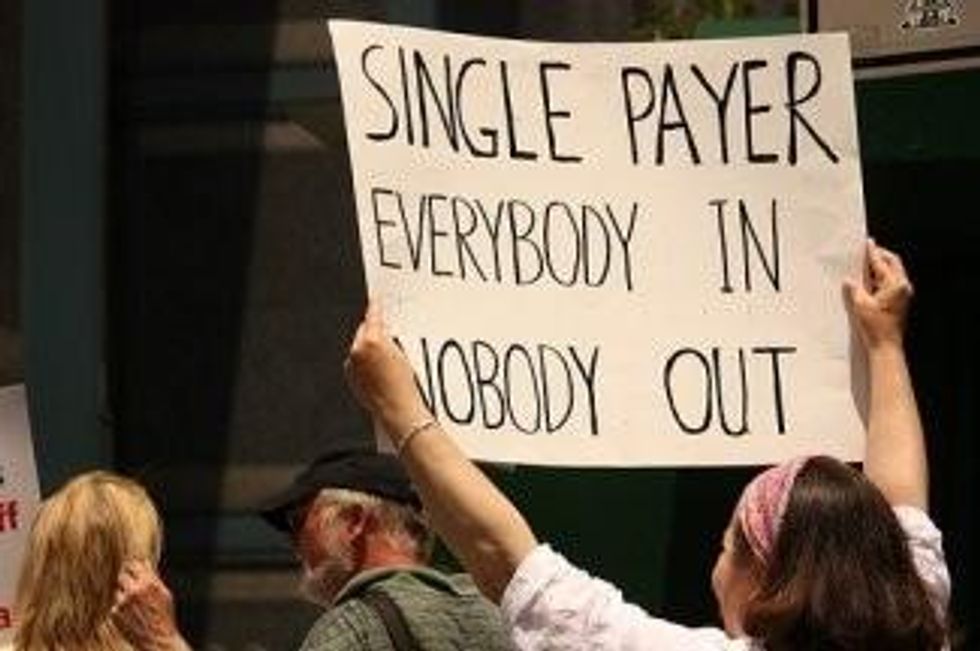
The ACA rollout occurred as Republicans shut down the government in their attempt to defund Obamacare. But their strategy backfired. Had there been no shutdown, all of the attention would have been on the disastrous rollout. The fundamental issue, at the core of the health-care dispute, is typically ignored and goes unreported: The for-profit health-insurance industry in the United States is profoundly inefficient and costly, and a sane and sustainable alternative exists--single-payer, otherwise known as expanded and improved Medicare for all. Just change the age of eligibility from 65 to zero.
"When Medicare was rolled out in 1966, it was rolled out in six months using index cards," Dr. Steffie Woolhandler told me Monday. "So if you have a simple system, you do not have to have all this expense and all this complexity and work." Woolhandler is professor of public health at CUNY-Hunter College and a primary-care physician. She is a visiting professor at Harvard Medical School and the co-founder of Physicians for a National Health Program, or PNHP. PNHP is an organization with 17,000 physicians as members, advocating for a single-payer health-care system in the U.S.
What is single-payer? Critics denounce it as "socialized medicine," while ignoring that single-payer is already immensely popular in the U.S., as Medicare. A 2011 Harris poll found that Medicare enjoyed 88 percent support from American adults, followed closely by Social Security. Woolhandler explained that with a Medicare-for-all system, "you would get a card the day you're born, and you'd keep it your entire life. It would entitle you to medical care, all needed medical care, without co-payments, without deductibles. And because it's such a simple system, like Social Security, there would be very low administrative expenses. We would save about $400 billion [per year]." Dr. Woolhandler went on, rather than "thousands of different plans, tons of different co-payments, deductibles and restrictions--one single-payer plan, which is what we need for all Americans to give the Americans really the choice they want ... not the choice between insurance company A or insurance company B. They want the choice of any doctor or hospital, like you get with traditional Medicare."
Monthly premiums in most cases are expected to decrease with Obamacare's health-exchange systems, which will enhance the transparency and ease of comparison for people shopping for a health-insurance policy. If and when the technical problems are eliminated from the online health insurance exchanges, and people can easily shop, there will likely be a huge number of people buying policies for the first time. The ACA offers important advances, which even single-payer advocates acknowledge: subsidies for low-income applicants will make insurance affordable for the first time. Medicaid expansion also will bring many poor people into the umbrella of coverage. Young people can stay on their parents' insurance until the age of 26. People with so-called pre-existing conditions can no longer be denied insurance.
While the ACA was deemed constitutional by the Supreme Court, the opinion gave states the option to opt out of the Medicaid expansion, which 26 states with Republican governors have done. A New York Times analysis of census data showed that up to 8 million poor people, mostly African-Americans and single mothers, and mostly in the Deep South, will be stranded without insurance, too poor to qualify for ACA subsidies, but stuck in a state that rejected Medicaid expansion.
So, while partisan bickering (between members of Congress who have among the best health and benefits packages in the U.S.) has shut down the government, the populace of the United States is still straitjacketed into a system of expensive, for-profit health insurance. We pay twice as much per capita as other industrialized countries, and have poorer health and lower life expectancy. The economic logic of single-payer is inescapable. Whether Obamacare is a pathway to get there is uncertain. As Dr. Woolhandler summed up, "It's only a road to single-payer if we fight for single-payer."
Denis Moynihan contributed research to this column.
"We apologize for the inconvenience. The Marketplace is currently undergoing regularly scheduled maintenance and will be back up Monday 10/7/3013." You read it right, 3013. That was the message on the homepage of the New York state health insurance exchange website this past weekend.
The ACA rollout occurred as Republicans shut down the government in their attempt to defund Obamacare. But their strategy backfired. Had there been no shutdown, all of the attention would have been on the disastrous rollout. The fundamental issue, at the core of the health-care dispute, is typically ignored and goes unreported: The for-profit health-insurance industry in the United States is profoundly inefficient and costly, and a sane and sustainable alternative exists--single-payer, otherwise known as expanded and improved Medicare for all. Just change the age of eligibility from 65 to zero.
"When Medicare was rolled out in 1966, it was rolled out in six months using index cards," Dr. Steffie Woolhandler told me Monday. "So if you have a simple system, you do not have to have all this expense and all this complexity and work." Woolhandler is professor of public health at CUNY-Hunter College and a primary-care physician. She is a visiting professor at Harvard Medical School and the co-founder of Physicians for a National Health Program, or PNHP. PNHP is an organization with 17,000 physicians as members, advocating for a single-payer health-care system in the U.S.
What is single-payer? Critics denounce it as "socialized medicine," while ignoring that single-payer is already immensely popular in the U.S., as Medicare. A 2011 Harris poll found that Medicare enjoyed 88 percent support from American adults, followed closely by Social Security. Woolhandler explained that with a Medicare-for-all system, "you would get a card the day you're born, and you'd keep it your entire life. It would entitle you to medical care, all needed medical care, without co-payments, without deductibles. And because it's such a simple system, like Social Security, there would be very low administrative expenses. We would save about $400 billion [per year]." Dr. Woolhandler went on, rather than "thousands of different plans, tons of different co-payments, deductibles and restrictions--one single-payer plan, which is what we need for all Americans to give the Americans really the choice they want ... not the choice between insurance company A or insurance company B. They want the choice of any doctor or hospital, like you get with traditional Medicare."
Monthly premiums in most cases are expected to decrease with Obamacare's health-exchange systems, which will enhance the transparency and ease of comparison for people shopping for a health-insurance policy. If and when the technical problems are eliminated from the online health insurance exchanges, and people can easily shop, there will likely be a huge number of people buying policies for the first time. The ACA offers important advances, which even single-payer advocates acknowledge: subsidies for low-income applicants will make insurance affordable for the first time. Medicaid expansion also will bring many poor people into the umbrella of coverage. Young people can stay on their parents' insurance until the age of 26. People with so-called pre-existing conditions can no longer be denied insurance.
While the ACA was deemed constitutional by the Supreme Court, the opinion gave states the option to opt out of the Medicaid expansion, which 26 states with Republican governors have done. A New York Times analysis of census data showed that up to 8 million poor people, mostly African-Americans and single mothers, and mostly in the Deep South, will be stranded without insurance, too poor to qualify for ACA subsidies, but stuck in a state that rejected Medicaid expansion.
So, while partisan bickering (between members of Congress who have among the best health and benefits packages in the U.S.) has shut down the government, the populace of the United States is still straitjacketed into a system of expensive, for-profit health insurance. We pay twice as much per capita as other industrialized countries, and have poorer health and lower life expectancy. The economic logic of single-payer is inescapable. Whether Obamacare is a pathway to get there is uncertain. As Dr. Woolhandler summed up, "It's only a road to single-payer if we fight for single-payer."
Denis Moynihan contributed research to this column.
"We apologize for the inconvenience. The Marketplace is currently undergoing regularly scheduled maintenance and will be back up Monday 10/7/3013." You read it right, 3013. That was the message on the homepage of the New York state health insurance exchange website this past weekend.
The ACA rollout occurred as Republicans shut down the government in their attempt to defund Obamacare. But their strategy backfired. Had there been no shutdown, all of the attention would have been on the disastrous rollout. The fundamental issue, at the core of the health-care dispute, is typically ignored and goes unreported: The for-profit health-insurance industry in the United States is profoundly inefficient and costly, and a sane and sustainable alternative exists--single-payer, otherwise known as expanded and improved Medicare for all. Just change the age of eligibility from 65 to zero.
"When Medicare was rolled out in 1966, it was rolled out in six months using index cards," Dr. Steffie Woolhandler told me Monday. "So if you have a simple system, you do not have to have all this expense and all this complexity and work." Woolhandler is professor of public health at CUNY-Hunter College and a primary-care physician. She is a visiting professor at Harvard Medical School and the co-founder of Physicians for a National Health Program, or PNHP. PNHP is an organization with 17,000 physicians as members, advocating for a single-payer health-care system in the U.S.
What is single-payer? Critics denounce it as "socialized medicine," while ignoring that single-payer is already immensely popular in the U.S., as Medicare. A 2011 Harris poll found that Medicare enjoyed 88 percent support from American adults, followed closely by Social Security. Woolhandler explained that with a Medicare-for-all system, "you would get a card the day you're born, and you'd keep it your entire life. It would entitle you to medical care, all needed medical care, without co-payments, without deductibles. And because it's such a simple system, like Social Security, there would be very low administrative expenses. We would save about $400 billion [per year]." Dr. Woolhandler went on, rather than "thousands of different plans, tons of different co-payments, deductibles and restrictions--one single-payer plan, which is what we need for all Americans to give the Americans really the choice they want ... not the choice between insurance company A or insurance company B. They want the choice of any doctor or hospital, like you get with traditional Medicare."
Monthly premiums in most cases are expected to decrease with Obamacare's health-exchange systems, which will enhance the transparency and ease of comparison for people shopping for a health-insurance policy. If and when the technical problems are eliminated from the online health insurance exchanges, and people can easily shop, there will likely be a huge number of people buying policies for the first time. The ACA offers important advances, which even single-payer advocates acknowledge: subsidies for low-income applicants will make insurance affordable for the first time. Medicaid expansion also will bring many poor people into the umbrella of coverage. Young people can stay on their parents' insurance until the age of 26. People with so-called pre-existing conditions can no longer be denied insurance.
While the ACA was deemed constitutional by the Supreme Court, the opinion gave states the option to opt out of the Medicaid expansion, which 26 states with Republican governors have done. A New York Times analysis of census data showed that up to 8 million poor people, mostly African-Americans and single mothers, and mostly in the Deep South, will be stranded without insurance, too poor to qualify for ACA subsidies, but stuck in a state that rejected Medicaid expansion.
So, while partisan bickering (between members of Congress who have among the best health and benefits packages in the U.S.) has shut down the government, the populace of the United States is still straitjacketed into a system of expensive, for-profit health insurance. We pay twice as much per capita as other industrialized countries, and have poorer health and lower life expectancy. The economic logic of single-payer is inescapable. Whether Obamacare is a pathway to get there is uncertain. As Dr. Woolhandler summed up, "It's only a road to single-payer if we fight for single-payer."
Denis Moynihan contributed research to this column.