

Many may be surprised, for example, that actual anarchists aren't necessarily rejoicing over the U.S. government's latest form of self-annihilation. What they see taking place is a transfer of power from one kind of oppression, by a government that at least pretends to be democratic, to another that has no such pretensions. They point out that the shutdown won't stop the NSA from spying on us, or police from enforcing laws in discriminatory ways, or migrant workers and nonviolent drug users from being imprisoned at staggering rates. The parts of government that the shutdown strips away are among those that bring us closer to being a truly free, egalitarian society: food assistance to ensure that everyone can eat, health care that more people can afford, and even public parks, where some of our greatest natural treasures are held in common. Meanwhile, ever more power is being handed over to corporations that are responsible only to their wealthiest shareholders.
Historically, the so-called libertarians of the Tea Party and anarchists have common roots. The origins of both can be traced to certain freedom-seeking strands of the Enlightenment -- including thinkers like Edmund Burke and Thomas Jefferson, as well as ones not normally taught in U.S. classrooms like William Godwin and Peter Kropotkin. It's an oddity that in the United States, the main current of libertarian thought has been twisted and inverted into a kind of monstrous stepchild. Rather than seeking an end to all forms of oppression, our libertarians want to do away with only the government kind, leaving the rest of us vulnerable to the forces of corporate greed, racial discrimination, and environmental destruction. The legacy of one firebrand Russian emigre, Emma Goldman, has been traded for that of another, Ayn Rand. The result is that, in this country, what was once the mainstream of libertarian thought -- socialist, democratic anarchism -- has become so forgotten that the word "anarchist" can be mishandled for the sake of a congressional jab.
If anarchism were really just a preference for the absence of government, as many are led to assume, Reid's usage would've been basically correct; the right-wing libertarians he's up against would be thrilled to see our government become less of an obstruction to profiteers. But, since at least the Enlightenment, anarchism has meant much more than that. The rule -- the -archy -- it seeks to dismantle is also the rule of those with too much property over those with not enough, and of those whose privilege of race or gender gives them priority over others. Anarchists seek a society in which ordinary people can freely and democratically govern themselves, organizing to meet everyone's basic needs.
Until that comes to pass, anarchists today disagree about how to relate to institutions like the pseudo-democratic U.S. government. Some, much like their counterparts on the libertarian right, advocate total withdrawal and non-participation, refusing to do things like vote or pay taxes. Others believe that for now government can be a means for pursuing anarchist-friendly ends; "it's completely realistic and rational to work within structures to which you are opposed," writes Noam Chomsky, "because by doing so you can help to move to a situation where then you can challenge those structures."
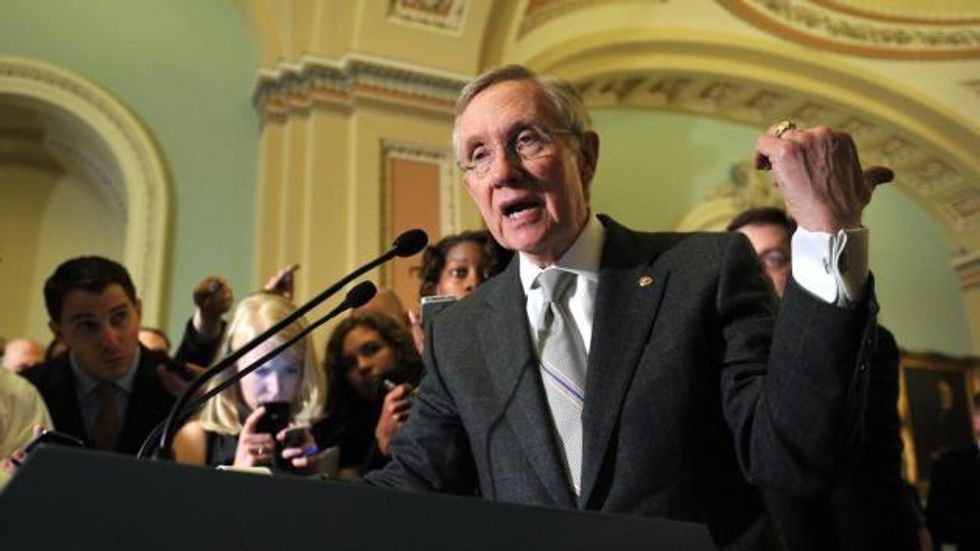
Harry Reid's utterance about "Tea Party anarchists" is a symptom of the amnesia that has befallen libertarian political thought in this country -- an amnesia that helps the capitalist class grow stronger with each sequential fiscal crisis and each shrinkage of the social safety net. He might do well to reconsider his words. While in the long run the anarchist tradition seeks to cast mighty men like him from their thrones, in the short-term effort to ensure basic necessities for more people, Reid might find himself sharing a common cause with anarchists.
Many may be surprised, for example, that actual anarchists aren't necessarily rejoicing over the U.S. government's latest form of self-annihilation. What they see taking place is a transfer of power from one kind of oppression, by a government that at least pretends to be democratic, to another that has no such pretensions. They point out that the shutdown won't stop the NSA from spying on us, or police from enforcing laws in discriminatory ways, or migrant workers and nonviolent drug users from being imprisoned at staggering rates. The parts of government that the shutdown strips away are among those that bring us closer to being a truly free, egalitarian society: food assistance to ensure that everyone can eat, health care that more people can afford, and even public parks, where some of our greatest natural treasures are held in common. Meanwhile, ever more power is being handed over to corporations that are responsible only to their wealthiest shareholders.
Historically, the so-called libertarians of the Tea Party and anarchists have common roots. The origins of both can be traced to certain freedom-seeking strands of the Enlightenment -- including thinkers like Edmund Burke and Thomas Jefferson, as well as ones not normally taught in U.S. classrooms like William Godwin and Peter Kropotkin. It's an oddity that in the United States, the main current of libertarian thought has been twisted and inverted into a kind of monstrous stepchild. Rather than seeking an end to all forms of oppression, our libertarians want to do away with only the government kind, leaving the rest of us vulnerable to the forces of corporate greed, racial discrimination, and environmental destruction. The legacy of one firebrand Russian emigre, Emma Goldman, has been traded for that of another, Ayn Rand. The result is that, in this country, what was once the mainstream of libertarian thought -- socialist, democratic anarchism -- has become so forgotten that the word "anarchist" can be mishandled for the sake of a congressional jab.
If anarchism were really just a preference for the absence of government, as many are led to assume, Reid's usage would've been basically correct; the right-wing libertarians he's up against would be thrilled to see our government become less of an obstruction to profiteers. But, since at least the Enlightenment, anarchism has meant much more than that. The rule -- the -archy -- it seeks to dismantle is also the rule of those with too much property over those with not enough, and of those whose privilege of race or gender gives them priority over others. Anarchists seek a society in which ordinary people can freely and democratically govern themselves, organizing to meet everyone's basic needs.
Until that comes to pass, anarchists today disagree about how to relate to institutions like the pseudo-democratic U.S. government. Some, much like their counterparts on the libertarian right, advocate total withdrawal and non-participation, refusing to do things like vote or pay taxes. Others believe that for now government can be a means for pursuing anarchist-friendly ends; "it's completely realistic and rational to work within structures to which you are opposed," writes Noam Chomsky, "because by doing so you can help to move to a situation where then you can challenge those structures."
Harry Reid's utterance about "Tea Party anarchists" is a symptom of the amnesia that has befallen libertarian political thought in this country -- an amnesia that helps the capitalist class grow stronger with each sequential fiscal crisis and each shrinkage of the social safety net. He might do well to reconsider his words. While in the long run the anarchist tradition seeks to cast mighty men like him from their thrones, in the short-term effort to ensure basic necessities for more people, Reid might find himself sharing a common cause with anarchists.
Many may be surprised, for example, that actual anarchists aren't necessarily rejoicing over the U.S. government's latest form of self-annihilation. What they see taking place is a transfer of power from one kind of oppression, by a government that at least pretends to be democratic, to another that has no such pretensions. They point out that the shutdown won't stop the NSA from spying on us, or police from enforcing laws in discriminatory ways, or migrant workers and nonviolent drug users from being imprisoned at staggering rates. The parts of government that the shutdown strips away are among those that bring us closer to being a truly free, egalitarian society: food assistance to ensure that everyone can eat, health care that more people can afford, and even public parks, where some of our greatest natural treasures are held in common. Meanwhile, ever more power is being handed over to corporations that are responsible only to their wealthiest shareholders.
Historically, the so-called libertarians of the Tea Party and anarchists have common roots. The origins of both can be traced to certain freedom-seeking strands of the Enlightenment -- including thinkers like Edmund Burke and Thomas Jefferson, as well as ones not normally taught in U.S. classrooms like William Godwin and Peter Kropotkin. It's an oddity that in the United States, the main current of libertarian thought has been twisted and inverted into a kind of monstrous stepchild. Rather than seeking an end to all forms of oppression, our libertarians want to do away with only the government kind, leaving the rest of us vulnerable to the forces of corporate greed, racial discrimination, and environmental destruction. The legacy of one firebrand Russian emigre, Emma Goldman, has been traded for that of another, Ayn Rand. The result is that, in this country, what was once the mainstream of libertarian thought -- socialist, democratic anarchism -- has become so forgotten that the word "anarchist" can be mishandled for the sake of a congressional jab.
If anarchism were really just a preference for the absence of government, as many are led to assume, Reid's usage would've been basically correct; the right-wing libertarians he's up against would be thrilled to see our government become less of an obstruction to profiteers. But, since at least the Enlightenment, anarchism has meant much more than that. The rule -- the -archy -- it seeks to dismantle is also the rule of those with too much property over those with not enough, and of those whose privilege of race or gender gives them priority over others. Anarchists seek a society in which ordinary people can freely and democratically govern themselves, organizing to meet everyone's basic needs.
Until that comes to pass, anarchists today disagree about how to relate to institutions like the pseudo-democratic U.S. government. Some, much like their counterparts on the libertarian right, advocate total withdrawal and non-participation, refusing to do things like vote or pay taxes. Others believe that for now government can be a means for pursuing anarchist-friendly ends; "it's completely realistic and rational to work within structures to which you are opposed," writes Noam Chomsky, "because by doing so you can help to move to a situation where then you can challenge those structures."
Harry Reid's utterance about "Tea Party anarchists" is a symptom of the amnesia that has befallen libertarian political thought in this country -- an amnesia that helps the capitalist class grow stronger with each sequential fiscal crisis and each shrinkage of the social safety net. He might do well to reconsider his words. While in the long run the anarchist tradition seeks to cast mighty men like him from their thrones, in the short-term effort to ensure basic necessities for more people, Reid might find himself sharing a common cause with anarchists.