SUBSCRIBE TO OUR FREE NEWSLETTER
Daily news & progressive opinion—funded by the people, not the corporations—delivered straight to your inbox.
5
#000000
#FFFFFF
To donate by check, phone, or other method, see our More Ways to Give page.
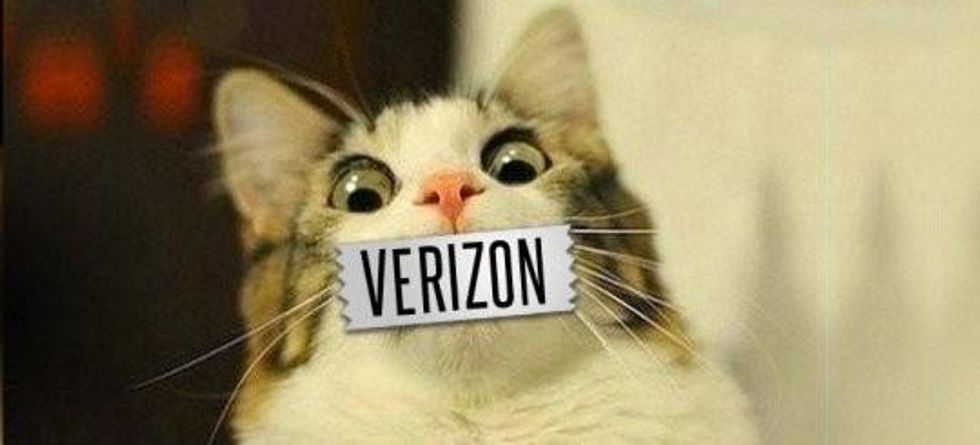
That's the day Verizon will face the Federal Communications Commission in court over the agency's Net Neutrality protections, which the company wants to overturn. If Verizon gets its way, the FCC's rules protecting Internet users from corporate abuse will disappear.
Net Neutrality isn't a new concept: The principle paved the way for the online innovations -- including the World Wide Web -- we now take for granted. As Sir Tim Berners-Lee put it, "When I invented the Web, I didn't have to ask anyone's permission."
Net Neutrality means that ISPs like AT&T, Comcast and Verizon should be in the business of selling us Internet access, and not in the business of blocking, editing or discriminating against the information we send, the sites we visit or the applications we use. It requires ISPs to keep their hands off the content and focus on providing access to the network.
Think about the phone network. We're used to being able to call who we want, when we want, without the phone company dictating what we can and can't say. Net Neutrality is the same concept applied to the Internet. It means that ISPs have no right to censor the content of websites or emails, or to slow down, favor or block applications like Spotify or Skype. It ensures that small startups and giant companies like Google can compete on an even playing field.
But companies like AT&T and Verizon want to get rid of Net Neutrality altogether. Their goal: to turn the Internet into their own private profit engine. They don't want a network that enables us to create, write, make, design, build and sell what we want -- without restrictions or the need to ask permission from gatekeepers.
Instead, these companies want an Internet that looks an awful lot like cable television: a place where you get only the news and entertainment that pad ISPs' profit margins. And they want an Internet that excludes dissident voices.
If the upcoming court case goes Verizon's way, this could actually be the future of the Internet. Unfortunately, when the FCC adopted its Open Internet rules in 2010, the agency compromised too much and based its rules on shaky legal principles. Verizon and its peers lobbied for this very approach ... and it created just the opening Verizon needed. In 2012, the company sued, claiming it has the right to "edit" the Internet.
Verizon vs. FCC is much larger than the claims of a single company. At stake is whether the Internet will remain an open medium for creativity, free expression and innovation, or a cable-like closed system that just a few ISPs control.
The stakes couldn't be higher: The FCC's ability to safeguard Net Neutrality is crucial to the future of the open Internet.
That's the day Verizon will face the Federal Communications Commission in court over the agency's Net Neutrality protections, which the company wants to overturn. If Verizon gets its way, the FCC's rules protecting Internet users from corporate abuse will disappear.
Net Neutrality isn't a new concept: The principle paved the way for the online innovations -- including the World Wide Web -- we now take for granted. As Sir Tim Berners-Lee put it, "When I invented the Web, I didn't have to ask anyone's permission."
Net Neutrality means that ISPs like AT&T, Comcast and Verizon should be in the business of selling us Internet access, and not in the business of blocking, editing or discriminating against the information we send, the sites we visit or the applications we use. It requires ISPs to keep their hands off the content and focus on providing access to the network.
Think about the phone network. We're used to being able to call who we want, when we want, without the phone company dictating what we can and can't say. Net Neutrality is the same concept applied to the Internet. It means that ISPs have no right to censor the content of websites or emails, or to slow down, favor or block applications like Spotify or Skype. It ensures that small startups and giant companies like Google can compete on an even playing field.
But companies like AT&T and Verizon want to get rid of Net Neutrality altogether. Their goal: to turn the Internet into their own private profit engine. They don't want a network that enables us to create, write, make, design, build and sell what we want -- without restrictions or the need to ask permission from gatekeepers.
Instead, these companies want an Internet that looks an awful lot like cable television: a place where you get only the news and entertainment that pad ISPs' profit margins. And they want an Internet that excludes dissident voices.
If the upcoming court case goes Verizon's way, this could actually be the future of the Internet. Unfortunately, when the FCC adopted its Open Internet rules in 2010, the agency compromised too much and based its rules on shaky legal principles. Verizon and its peers lobbied for this very approach ... and it created just the opening Verizon needed. In 2012, the company sued, claiming it has the right to "edit" the Internet.
Verizon vs. FCC is much larger than the claims of a single company. At stake is whether the Internet will remain an open medium for creativity, free expression and innovation, or a cable-like closed system that just a few ISPs control.
The stakes couldn't be higher: The FCC's ability to safeguard Net Neutrality is crucial to the future of the open Internet.
That's the day Verizon will face the Federal Communications Commission in court over the agency's Net Neutrality protections, which the company wants to overturn. If Verizon gets its way, the FCC's rules protecting Internet users from corporate abuse will disappear.
Net Neutrality isn't a new concept: The principle paved the way for the online innovations -- including the World Wide Web -- we now take for granted. As Sir Tim Berners-Lee put it, "When I invented the Web, I didn't have to ask anyone's permission."
Net Neutrality means that ISPs like AT&T, Comcast and Verizon should be in the business of selling us Internet access, and not in the business of blocking, editing or discriminating against the information we send, the sites we visit or the applications we use. It requires ISPs to keep their hands off the content and focus on providing access to the network.
Think about the phone network. We're used to being able to call who we want, when we want, without the phone company dictating what we can and can't say. Net Neutrality is the same concept applied to the Internet. It means that ISPs have no right to censor the content of websites or emails, or to slow down, favor or block applications like Spotify or Skype. It ensures that small startups and giant companies like Google can compete on an even playing field.
But companies like AT&T and Verizon want to get rid of Net Neutrality altogether. Their goal: to turn the Internet into their own private profit engine. They don't want a network that enables us to create, write, make, design, build and sell what we want -- without restrictions or the need to ask permission from gatekeepers.
Instead, these companies want an Internet that looks an awful lot like cable television: a place where you get only the news and entertainment that pad ISPs' profit margins. And they want an Internet that excludes dissident voices.
If the upcoming court case goes Verizon's way, this could actually be the future of the Internet. Unfortunately, when the FCC adopted its Open Internet rules in 2010, the agency compromised too much and based its rules on shaky legal principles. Verizon and its peers lobbied for this very approach ... and it created just the opening Verizon needed. In 2012, the company sued, claiming it has the right to "edit" the Internet.
Verizon vs. FCC is much larger than the claims of a single company. At stake is whether the Internet will remain an open medium for creativity, free expression and innovation, or a cable-like closed system that just a few ISPs control.
The stakes couldn't be higher: The FCC's ability to safeguard Net Neutrality is crucial to the future of the open Internet.