SUBSCRIBE TO OUR FREE NEWSLETTER
Daily news & progressive opinion—funded by the people, not the corporations—delivered straight to your inbox.
5
#000000
#FFFFFF
To donate by check, phone, or other method, see our More Ways to Give page.
An edited version of a presentation on the panel "Our Democracy in Crisis: The Rise of the Total Surveillance State and the War on a Free Press" organized by Chicago Area Peace Action at North Park University, Chicago, Thursday, August 29, 2013.
The issue-packed title of this event--"Our Democracy in Crisis: The Rise of the Total Surveillance State and the War on a Free Press"--offers a panelist a number of potential targets. Given the expertise of other panelists on the specifics of surveillance and journalism, I want to focus on what may seem like the least controversial part of the title, "Our Democracy," to which I would add a question mark.
Our democracy? Really? Is the U.S. system a democracy, and if so, does it belong to us? This leads to uncomfortable questions: What do we mean by democracy, and who do we mean by us? My thesis tonight is that there is little consensus on these matters, and that left/progressive organizing requires blunt assessments of rather grim contemporary realities.
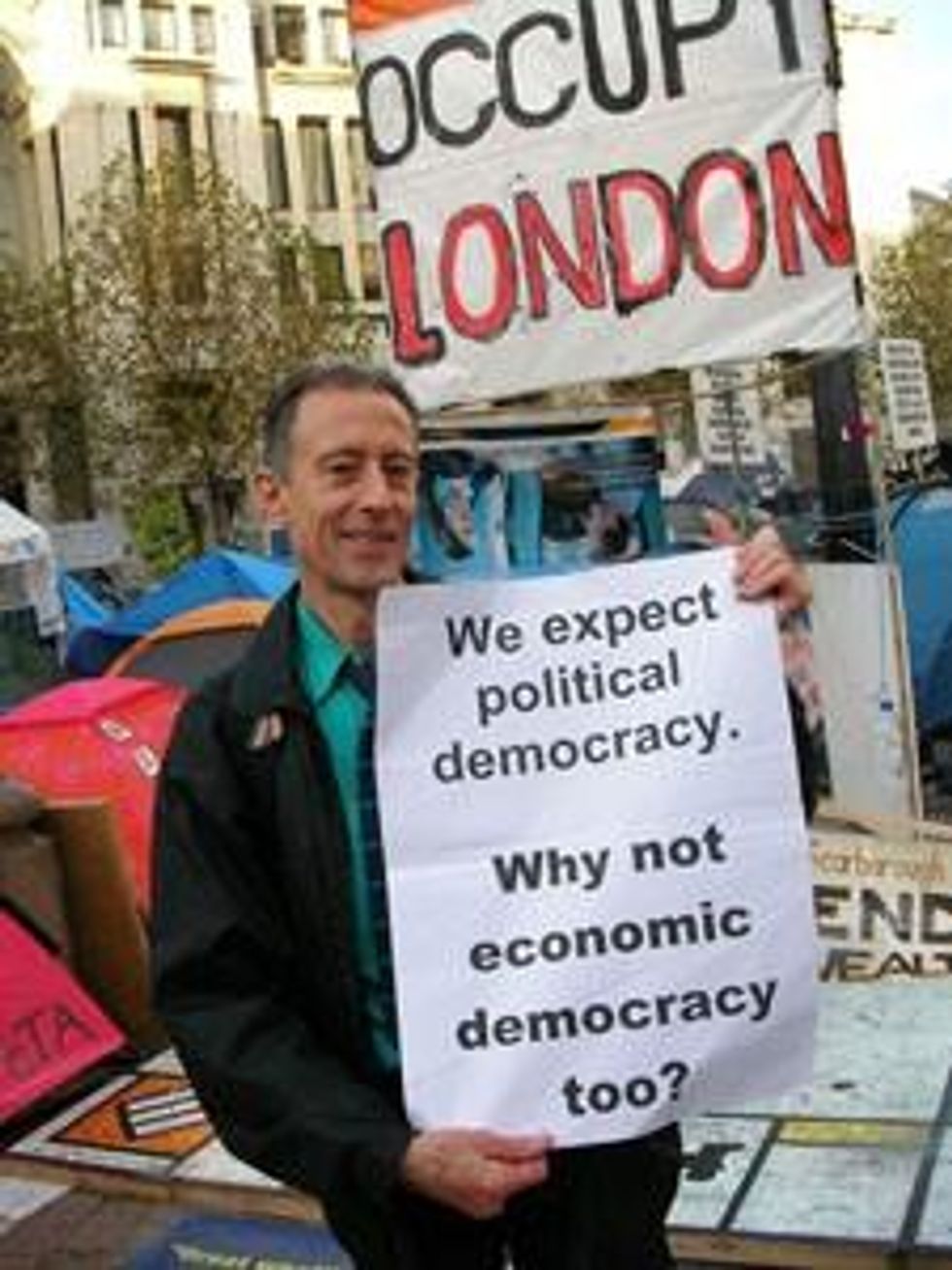
There is much about the standard story that is true, but it leaves out one crucial element: No matter who votes in elections, powerful unelected forces--the captains of industry and finance--set the parameters of political action. Voting matters, but it matters far less than most people believe, or want to believe. This raises the impolite question of whether democracy and capitalism are compatible. Is political equality possible amid widening economic inequality? Can power be distributed when wealth is concentrated?
These questions remain unspeakable in mainstream political circles, even though the economic inequality continues to widen and the distorting effects of concentrated wealth are more evident than ever. The limited successes of the Occupy movement nudged this into view, but this impolite question must be central in our conversations, raised without sectarian rhetoric and with a clearer analysis of the foundational nature of the problem.
Let me be clear: I'm not suggesting that there is nothing democratic about the contemporary United States, nor am I suggesting that we live in a fascist state. It's important to avoid rhetorical overkill. Rather, I'm simply recognizing that, counter to the mythology of the United States, no existing nation-state is a democracy in any deep sense. The question is, to what degree are the features of a society--not just the formal political process, but the economic and social structures as well--truly democratic. Formulating the question that way opens up a more meaningful discussion of those realities.
Onto the question of who we mean by us: I think we have for too long believed that the population of the United States is more "left" than it is, or at least more "left" as I define the term.
Conservatives insist this is a "center-right" country, and progressives counter that various polls suggest popular support for policies that are left of center, such as national health insurance. Whatever the outcome of that limited debate, here's what we have to acknowledge: If by "left" we mean a consistent critique of the domination/subordination dynamic that structures life in these United States, the left is essentially invisible. Such a left would be anti-capitalist and consistently critical of U.S. imperial adventures abroad. Such a left would take seriously the deeply embedded white-supremacist nature of U.S. society, as well as the devaluing and exploitation of women that is so deep that its sexual component is a routine part of pop culture. And such a left would recognize that the high-energy/high-technology industrial system that produces the much sought-after American "lifestyle" is a death cult, so fundamentally unsustainable that continued allegiance to that lifestyle guarantees catastrophic results for coming generations, and possibly for those of us currently here.
When I describe myself as being on the left, that's what I mean. I don't expect all my comrades to agree with all the points I just listed, but I would expect an acknowledgement that all those points are coherent and must be engaged. But even within the small left that exists in the United States, such agreement is hard to come by.
Summing up: We don't live in a meaningful democracy and the vast majority of people don't really want to change that.
OK, that's a bit hyperbolic, but consciously so in order to make the point that we need to come to terms with reality, and devise organizing strategies based on that reality, no matter how grim that reality is. Expanded surveillance and the suppression of critical journalism are part of the problem, but in my opinion we should be discussing them in this larger context, which is far scarier than concerns about the NSA and reporting. Wishful thinking--believing the country is on the verge of turning to progressive and left ideas--won't magically lead to progressive and left public policy.
If all this sounds a bit overwhelming, it's because reality at this moment in history is a bit overwhelming. So, I'll end with an observation made by the great writer and activist James Baldwin, who in a 1962 essay pressed the need for reality-based thinking. "Not everything that is faced can be changed," Baldwin wrote, "but nothing can be changed until it is faced."
An edited version of a presentation on the panel "Our Democracy in Crisis: The Rise of the Total Surveillance State and the War on a Free Press" organized by Chicago Area Peace Action at North Park University, Chicago, Thursday, August 29, 2013.
The issue-packed title of this event--"Our Democracy in Crisis: The Rise of the Total Surveillance State and the War on a Free Press"--offers a panelist a number of potential targets. Given the expertise of other panelists on the specifics of surveillance and journalism, I want to focus on what may seem like the least controversial part of the title, "Our Democracy," to which I would add a question mark.
Our democracy? Really? Is the U.S. system a democracy, and if so, does it belong to us? This leads to uncomfortable questions: What do we mean by democracy, and who do we mean by us? My thesis tonight is that there is little consensus on these matters, and that left/progressive organizing requires blunt assessments of rather grim contemporary realities.
There is much about the standard story that is true, but it leaves out one crucial element: No matter who votes in elections, powerful unelected forces--the captains of industry and finance--set the parameters of political action. Voting matters, but it matters far less than most people believe, or want to believe. This raises the impolite question of whether democracy and capitalism are compatible. Is political equality possible amid widening economic inequality? Can power be distributed when wealth is concentrated?
These questions remain unspeakable in mainstream political circles, even though the economic inequality continues to widen and the distorting effects of concentrated wealth are more evident than ever. The limited successes of the Occupy movement nudged this into view, but this impolite question must be central in our conversations, raised without sectarian rhetoric and with a clearer analysis of the foundational nature of the problem.
Let me be clear: I'm not suggesting that there is nothing democratic about the contemporary United States, nor am I suggesting that we live in a fascist state. It's important to avoid rhetorical overkill. Rather, I'm simply recognizing that, counter to the mythology of the United States, no existing nation-state is a democracy in any deep sense. The question is, to what degree are the features of a society--not just the formal political process, but the economic and social structures as well--truly democratic. Formulating the question that way opens up a more meaningful discussion of those realities.
Onto the question of who we mean by us: I think we have for too long believed that the population of the United States is more "left" than it is, or at least more "left" as I define the term.
Conservatives insist this is a "center-right" country, and progressives counter that various polls suggest popular support for policies that are left of center, such as national health insurance. Whatever the outcome of that limited debate, here's what we have to acknowledge: If by "left" we mean a consistent critique of the domination/subordination dynamic that structures life in these United States, the left is essentially invisible. Such a left would be anti-capitalist and consistently critical of U.S. imperial adventures abroad. Such a left would take seriously the deeply embedded white-supremacist nature of U.S. society, as well as the devaluing and exploitation of women that is so deep that its sexual component is a routine part of pop culture. And such a left would recognize that the high-energy/high-technology industrial system that produces the much sought-after American "lifestyle" is a death cult, so fundamentally unsustainable that continued allegiance to that lifestyle guarantees catastrophic results for coming generations, and possibly for those of us currently here.
When I describe myself as being on the left, that's what I mean. I don't expect all my comrades to agree with all the points I just listed, but I would expect an acknowledgement that all those points are coherent and must be engaged. But even within the small left that exists in the United States, such agreement is hard to come by.
Summing up: We don't live in a meaningful democracy and the vast majority of people don't really want to change that.
OK, that's a bit hyperbolic, but consciously so in order to make the point that we need to come to terms with reality, and devise organizing strategies based on that reality, no matter how grim that reality is. Expanded surveillance and the suppression of critical journalism are part of the problem, but in my opinion we should be discussing them in this larger context, which is far scarier than concerns about the NSA and reporting. Wishful thinking--believing the country is on the verge of turning to progressive and left ideas--won't magically lead to progressive and left public policy.
If all this sounds a bit overwhelming, it's because reality at this moment in history is a bit overwhelming. So, I'll end with an observation made by the great writer and activist James Baldwin, who in a 1962 essay pressed the need for reality-based thinking. "Not everything that is faced can be changed," Baldwin wrote, "but nothing can be changed until it is faced."
An edited version of a presentation on the panel "Our Democracy in Crisis: The Rise of the Total Surveillance State and the War on a Free Press" organized by Chicago Area Peace Action at North Park University, Chicago, Thursday, August 29, 2013.
The issue-packed title of this event--"Our Democracy in Crisis: The Rise of the Total Surveillance State and the War on a Free Press"--offers a panelist a number of potential targets. Given the expertise of other panelists on the specifics of surveillance and journalism, I want to focus on what may seem like the least controversial part of the title, "Our Democracy," to which I would add a question mark.
Our democracy? Really? Is the U.S. system a democracy, and if so, does it belong to us? This leads to uncomfortable questions: What do we mean by democracy, and who do we mean by us? My thesis tonight is that there is little consensus on these matters, and that left/progressive organizing requires blunt assessments of rather grim contemporary realities.
There is much about the standard story that is true, but it leaves out one crucial element: No matter who votes in elections, powerful unelected forces--the captains of industry and finance--set the parameters of political action. Voting matters, but it matters far less than most people believe, or want to believe. This raises the impolite question of whether democracy and capitalism are compatible. Is political equality possible amid widening economic inequality? Can power be distributed when wealth is concentrated?
These questions remain unspeakable in mainstream political circles, even though the economic inequality continues to widen and the distorting effects of concentrated wealth are more evident than ever. The limited successes of the Occupy movement nudged this into view, but this impolite question must be central in our conversations, raised without sectarian rhetoric and with a clearer analysis of the foundational nature of the problem.
Let me be clear: I'm not suggesting that there is nothing democratic about the contemporary United States, nor am I suggesting that we live in a fascist state. It's important to avoid rhetorical overkill. Rather, I'm simply recognizing that, counter to the mythology of the United States, no existing nation-state is a democracy in any deep sense. The question is, to what degree are the features of a society--not just the formal political process, but the economic and social structures as well--truly democratic. Formulating the question that way opens up a more meaningful discussion of those realities.
Onto the question of who we mean by us: I think we have for too long believed that the population of the United States is more "left" than it is, or at least more "left" as I define the term.
Conservatives insist this is a "center-right" country, and progressives counter that various polls suggest popular support for policies that are left of center, such as national health insurance. Whatever the outcome of that limited debate, here's what we have to acknowledge: If by "left" we mean a consistent critique of the domination/subordination dynamic that structures life in these United States, the left is essentially invisible. Such a left would be anti-capitalist and consistently critical of U.S. imperial adventures abroad. Such a left would take seriously the deeply embedded white-supremacist nature of U.S. society, as well as the devaluing and exploitation of women that is so deep that its sexual component is a routine part of pop culture. And such a left would recognize that the high-energy/high-technology industrial system that produces the much sought-after American "lifestyle" is a death cult, so fundamentally unsustainable that continued allegiance to that lifestyle guarantees catastrophic results for coming generations, and possibly for those of us currently here.
When I describe myself as being on the left, that's what I mean. I don't expect all my comrades to agree with all the points I just listed, but I would expect an acknowledgement that all those points are coherent and must be engaged. But even within the small left that exists in the United States, such agreement is hard to come by.
Summing up: We don't live in a meaningful democracy and the vast majority of people don't really want to change that.
OK, that's a bit hyperbolic, but consciously so in order to make the point that we need to come to terms with reality, and devise organizing strategies based on that reality, no matter how grim that reality is. Expanded surveillance and the suppression of critical journalism are part of the problem, but in my opinion we should be discussing them in this larger context, which is far scarier than concerns about the NSA and reporting. Wishful thinking--believing the country is on the verge of turning to progressive and left ideas--won't magically lead to progressive and left public policy.
If all this sounds a bit overwhelming, it's because reality at this moment in history is a bit overwhelming. So, I'll end with an observation made by the great writer and activist James Baldwin, who in a 1962 essay pressed the need for reality-based thinking. "Not everything that is faced can be changed," Baldwin wrote, "but nothing can be changed until it is faced."