SUBSCRIBE TO OUR FREE NEWSLETTER
Daily news & progressive opinion—funded by the people, not the corporations—delivered straight to your inbox.
5
#000000
#FFFFFF
To donate by check, phone, or other method, see our More Ways to Give page.
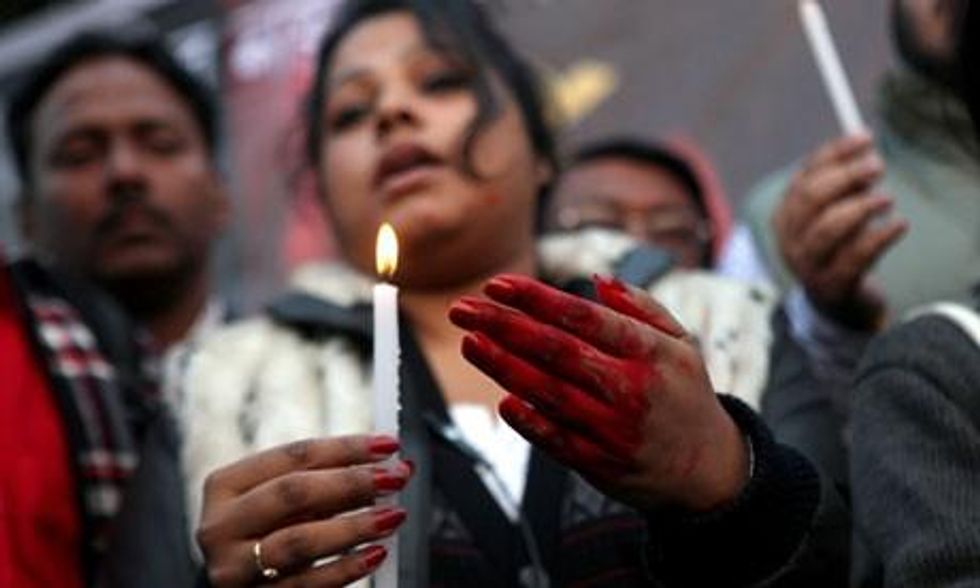
Mob sexual violence, however, carries a certain brand of particularity as a near-explicit political tool used to discourage women, who make up nearly half of the total population, from attending demonstrations. Maria S Munoz, co-founder and director of the anti-sexual assault initiative Tahrir Bodyguard, traces the advent and use of organized mob sexual assaults to the days of Mubarak, pointing to the 2005 assault of journalist Nawal Ali by hired "thugs" during a demonstration. Despite being aware of the risk of attending political demonstrations, women, Munoz notes, "have continued to share the public space in protests, becoming an essential part of the opposition's voice and presence."
The culture of sexual violence and harrassment, in Egypt, has received considerable media attention, often highlighting the efforts of groups such as Operation Anti-Sexual Harassment/Assault, HarassMap and Tahrir Bodyguard as people-powered initiatives tackling sexual violence and harassment head-on. Despite this, it is apparently still difficult to have an honest discussion over why it happens.
On 5 July, US author Joyce Carol Oates (whom I know primarily from her having never written this) decided to join in with the sea of insta-Egypt Twitter experts and opined:
Despite the brevity of "Oatesgate", the rhetorical question of a well-respected literary figure highlights popular characterizations of sexual violence and harassment when it takes place elsewhere. Rarely does sexual violence and harassment in our own societies - as it is perpetrated, prosecuted and cultured - allow the sort of cultural reductionism that seems to come with ease when sexual violence is associated with "the other".
When a 23-year-old physiotherapy intern is brutally gang-raped and beaten in Delhi, we speak of "India's woman problem"; when an incapacitated 16-year-old student is raped, photographed and filmed for six hours by peers - who share the images on social media - the incident is treated as an isolated act of unfortunate deviance and not part and parcel of a larger endemic culture that normalizes rape and the appropriation of women's bodies as public property.
Child groomers of Muslim and South Asian backgrounds become cultural ambassadors raised on a steady diet of "savage" notions of sex embedded in anti-white biases and misogyny. Revered coaches and university administrations hiding decades of child sex abuse, on the other hand, become their own victims.
Thus there are no protests, no calls of a "woman problem", no "natural" inquiries into the predominant religion when a country has ranked 13th in the world for rape, 10th for rapes per capita (pdf) and where 26,000 military service members reported sexual assault in 2012 alone. There are no popular anthropological undertakings by stiff-haired anchors of the inner secrets and dark forces of American culture, religion and society. No white American woman asks why the white American male hates "us".
None of this is to provide a level playing field for discussing sexual violence. It is to highlight how understanding of sexual violence is reliant on how it is reported and how this, in turn, is reliant on who is involved. In the case of Egypt, the extent to which there is sexual harassment and violence is abysmal and even unique in how it occurs. Yet, this violence did not emerge overnight, nor does it occur in a political and socio-economic vacuum. It is the result of decades of state, legal and political decay. It is the result of a state that itself has created a culture of acceptability of violence and torture, often sexual, inside its own walls.
In the explicit act of violating bodily sovereignty, there is an active search for the conquest of power and control in a space where these have become vulnerable. This requires no sermon, book or belief to legitimize it; it only needs submission.
Mob sexual violence, however, carries a certain brand of particularity as a near-explicit political tool used to discourage women, who make up nearly half of the total population, from attending demonstrations. Maria S Munoz, co-founder and director of the anti-sexual assault initiative Tahrir Bodyguard, traces the advent and use of organized mob sexual assaults to the days of Mubarak, pointing to the 2005 assault of journalist Nawal Ali by hired "thugs" during a demonstration. Despite being aware of the risk of attending political demonstrations, women, Munoz notes, "have continued to share the public space in protests, becoming an essential part of the opposition's voice and presence."
The culture of sexual violence and harrassment, in Egypt, has received considerable media attention, often highlighting the efforts of groups such as Operation Anti-Sexual Harassment/Assault, HarassMap and Tahrir Bodyguard as people-powered initiatives tackling sexual violence and harassment head-on. Despite this, it is apparently still difficult to have an honest discussion over why it happens.
On 5 July, US author Joyce Carol Oates (whom I know primarily from her having never written this) decided to join in with the sea of insta-Egypt Twitter experts and opined:
Despite the brevity of "Oatesgate", the rhetorical question of a well-respected literary figure highlights popular characterizations of sexual violence and harassment when it takes place elsewhere. Rarely does sexual violence and harassment in our own societies - as it is perpetrated, prosecuted and cultured - allow the sort of cultural reductionism that seems to come with ease when sexual violence is associated with "the other".
When a 23-year-old physiotherapy intern is brutally gang-raped and beaten in Delhi, we speak of "India's woman problem"; when an incapacitated 16-year-old student is raped, photographed and filmed for six hours by peers - who share the images on social media - the incident is treated as an isolated act of unfortunate deviance and not part and parcel of a larger endemic culture that normalizes rape and the appropriation of women's bodies as public property.
Child groomers of Muslim and South Asian backgrounds become cultural ambassadors raised on a steady diet of "savage" notions of sex embedded in anti-white biases and misogyny. Revered coaches and university administrations hiding decades of child sex abuse, on the other hand, become their own victims.
Thus there are no protests, no calls of a "woman problem", no "natural" inquiries into the predominant religion when a country has ranked 13th in the world for rape, 10th for rapes per capita (pdf) and where 26,000 military service members reported sexual assault in 2012 alone. There are no popular anthropological undertakings by stiff-haired anchors of the inner secrets and dark forces of American culture, religion and society. No white American woman asks why the white American male hates "us".
None of this is to provide a level playing field for discussing sexual violence. It is to highlight how understanding of sexual violence is reliant on how it is reported and how this, in turn, is reliant on who is involved. In the case of Egypt, the extent to which there is sexual harassment and violence is abysmal and even unique in how it occurs. Yet, this violence did not emerge overnight, nor does it occur in a political and socio-economic vacuum. It is the result of decades of state, legal and political decay. It is the result of a state that itself has created a culture of acceptability of violence and torture, often sexual, inside its own walls.
In the explicit act of violating bodily sovereignty, there is an active search for the conquest of power and control in a space where these have become vulnerable. This requires no sermon, book or belief to legitimize it; it only needs submission.
Mob sexual violence, however, carries a certain brand of particularity as a near-explicit political tool used to discourage women, who make up nearly half of the total population, from attending demonstrations. Maria S Munoz, co-founder and director of the anti-sexual assault initiative Tahrir Bodyguard, traces the advent and use of organized mob sexual assaults to the days of Mubarak, pointing to the 2005 assault of journalist Nawal Ali by hired "thugs" during a demonstration. Despite being aware of the risk of attending political demonstrations, women, Munoz notes, "have continued to share the public space in protests, becoming an essential part of the opposition's voice and presence."
The culture of sexual violence and harrassment, in Egypt, has received considerable media attention, often highlighting the efforts of groups such as Operation Anti-Sexual Harassment/Assault, HarassMap and Tahrir Bodyguard as people-powered initiatives tackling sexual violence and harassment head-on. Despite this, it is apparently still difficult to have an honest discussion over why it happens.
On 5 July, US author Joyce Carol Oates (whom I know primarily from her having never written this) decided to join in with the sea of insta-Egypt Twitter experts and opined:
Despite the brevity of "Oatesgate", the rhetorical question of a well-respected literary figure highlights popular characterizations of sexual violence and harassment when it takes place elsewhere. Rarely does sexual violence and harassment in our own societies - as it is perpetrated, prosecuted and cultured - allow the sort of cultural reductionism that seems to come with ease when sexual violence is associated with "the other".
When a 23-year-old physiotherapy intern is brutally gang-raped and beaten in Delhi, we speak of "India's woman problem"; when an incapacitated 16-year-old student is raped, photographed and filmed for six hours by peers - who share the images on social media - the incident is treated as an isolated act of unfortunate deviance and not part and parcel of a larger endemic culture that normalizes rape and the appropriation of women's bodies as public property.
Child groomers of Muslim and South Asian backgrounds become cultural ambassadors raised on a steady diet of "savage" notions of sex embedded in anti-white biases and misogyny. Revered coaches and university administrations hiding decades of child sex abuse, on the other hand, become their own victims.
Thus there are no protests, no calls of a "woman problem", no "natural" inquiries into the predominant religion when a country has ranked 13th in the world for rape, 10th for rapes per capita (pdf) and where 26,000 military service members reported sexual assault in 2012 alone. There are no popular anthropological undertakings by stiff-haired anchors of the inner secrets and dark forces of American culture, religion and society. No white American woman asks why the white American male hates "us".
None of this is to provide a level playing field for discussing sexual violence. It is to highlight how understanding of sexual violence is reliant on how it is reported and how this, in turn, is reliant on who is involved. In the case of Egypt, the extent to which there is sexual harassment and violence is abysmal and even unique in how it occurs. Yet, this violence did not emerge overnight, nor does it occur in a political and socio-economic vacuum. It is the result of decades of state, legal and political decay. It is the result of a state that itself has created a culture of acceptability of violence and torture, often sexual, inside its own walls.
In the explicit act of violating bodily sovereignty, there is an active search for the conquest of power and control in a space where these have become vulnerable. This requires no sermon, book or belief to legitimize it; it only needs submission.