SUBSCRIBE TO OUR FREE NEWSLETTER
Daily news & progressive opinion—funded by the people, not the corporations—delivered straight to your inbox.
5
#000000
#FFFFFF
To donate by check, phone, or other method, see our More Ways to Give page.
There's a reason "Keep Calm and Carry On" is everywhere. When people lose everything -- their economic aspirations, their their freedom, their privacy -- when there's nothing they can do to restore what they've lost -- all they have left is dignity.
Remember Saddam? Seconds before he was hanged, disheveled and disrespected, the deposed dictator held his head high, his eyes blazing with contempt as he spat sarcastic insults at his executioners. He "faced death like a lion," said his supposed body double, Latif Yahia, and no one could argue. He left this life with the one thing he could control intact.
Man, that is so not us.
You've seen the T-shirts, with their clean Gill Sans-esque lettering and iconic crown. There are mugs, postcards and posters. Of course. It's a reproduction of a propaganda poster from World War II, an (unsuccessful, because it wasn't distributed) attempt by the British government to steel jittery citizens during the Blitz.
"Keep Calm and Carry On" merch dates to 2000 but really took off after 9/11; the popularity of the image, the stoicism of its call to stiffen upper lips everywhere, and numerous parodies ("Stay Alive and Kill Zombies") has generated millions of dollars of profits, inevitably sparking lawsuits and inspiring a song by John Nolan.
Why is a meme originally prepared for a possible German invasion of the UK (which is why it wasn't released) popular now? Zizi Papacharissi, communications professor at the University of Illinois at Chicago, points to the crappy economy. "We are undergoing a profound and fairly global economic crisis, so it is natural to revisit the saying: Keep calm and carry on. It reminds us of courage shown back then, and how courage shown helped people pluck through a crisis."

What wouldn't we give for a 2001 do-over? No invasions, no Patriot Act, no Gitmo, no "extraordinary renditions," no New York Times op-ed pieces arguing in favor of "enhanced interrogation techniques." Treat 9/11 like a crime, let the FBI go after the perps. Reach out to Muslims, reconsider our carte blanche to Israel, and most of all: go slow. Don't freak out.
Perspective: 3,000 deaths is awful. 9/11 was shocking. We killed 2 million Vietnamese people, yet they're going strong. With a minimum of whining.
And yet...
Sometimes you need some perspective to your perspective.
There are times when it's appropriate to freak out. When, in fact, it's downright weird and unhealthy and wrong not to flip your lid. For example, when you get diagnosed with a terrible disease. When someone you love dies.
There are also times when big-picture, impersonal stuff, including politics and the economy, ought to make you crazy with rage or grief or...something. Not nothing. Not just keeping calm and carrying on.
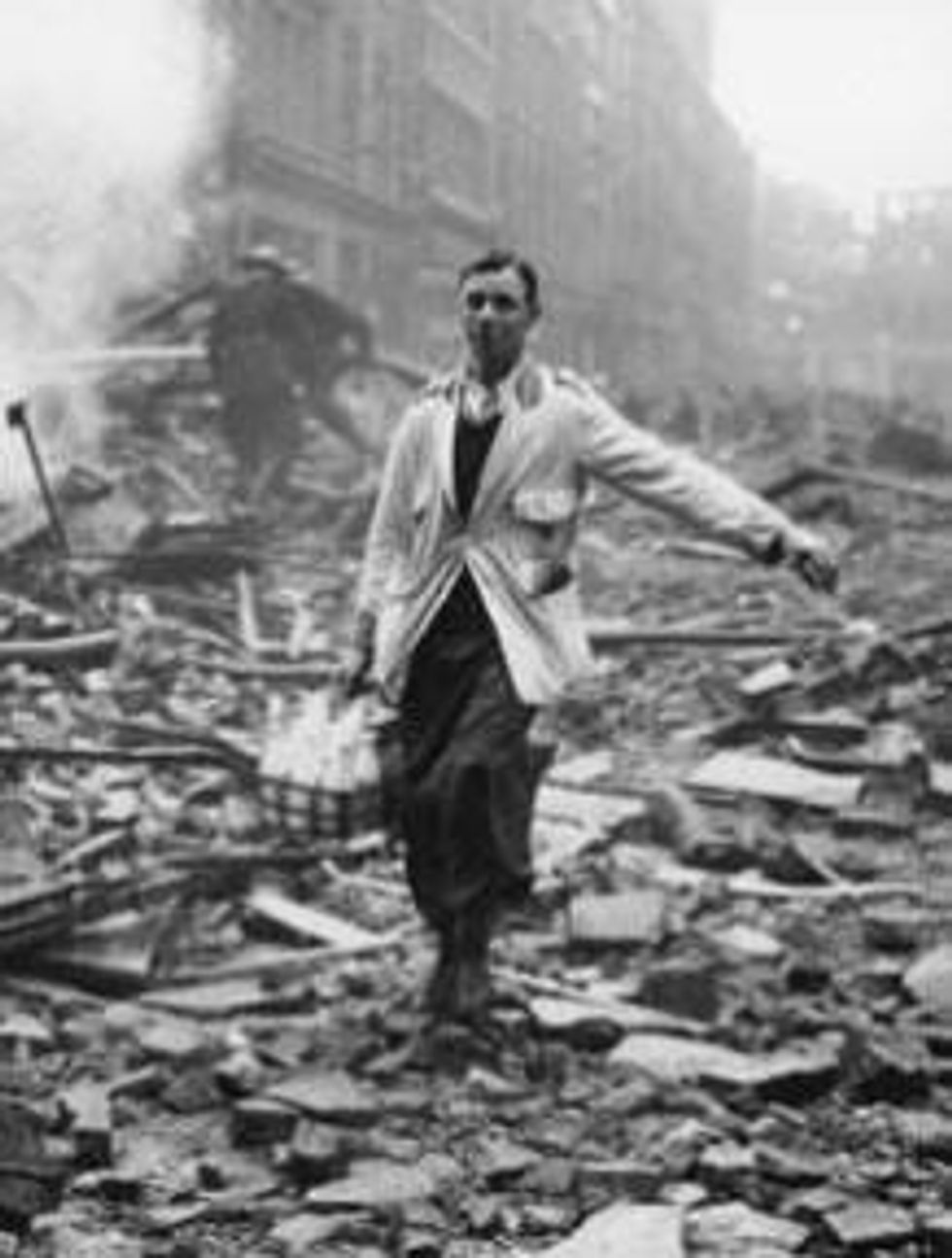
Keeping calm and carrying on was an appropriate response to the Blitz. Short of moving away from the targeted area, there's nothing you can do about bombs. Living or dying is a matter of happenstance. Keeping calm might help you make smart decisions. Panic is usually more dangerous than self-control.
The same is true of terrorism. Terrorists will kill you, or not -- probably not. You can't fix your fate.
But it is decidedly not true about the economy. Not when what is wrong with the economy is not something no one can control -- a giant meteor, bad weather, panic in the markets -- but something that most assuredly can and indeed should be, like the systemic transfer of wealth from the poor and middle-class to the rich that has characterized the class divide in Western nations since the 1970s. The appropriate, intelligent and self-preserving response to mass theft is rage, demands for action, and decisive punishment of political and economic leaders who refuse to change things.
As one revelation about the National Security Agency's spying follows another, the "Keep Calm and Carry On" meme seems less like an appeal to dignity and calm reserve than the much older, classic response of the power elite to their oppressed subjects: Shut the Fuck Up.
There's a reason "Keep Calm and Carry On" is everywhere. When people lose everything -- their economic aspirations, their their freedom, their privacy -- when there's nothing they can do to restore what they've lost -- all they have left is dignity.
Remember Saddam? Seconds before he was hanged, disheveled and disrespected, the deposed dictator held his head high, his eyes blazing with contempt as he spat sarcastic insults at his executioners. He "faced death like a lion," said his supposed body double, Latif Yahia, and no one could argue. He left this life with the one thing he could control intact.
Man, that is so not us.
You've seen the T-shirts, with their clean Gill Sans-esque lettering and iconic crown. There are mugs, postcards and posters. Of course. It's a reproduction of a propaganda poster from World War II, an (unsuccessful, because it wasn't distributed) attempt by the British government to steel jittery citizens during the Blitz.
"Keep Calm and Carry On" merch dates to 2000 but really took off after 9/11; the popularity of the image, the stoicism of its call to stiffen upper lips everywhere, and numerous parodies ("Stay Alive and Kill Zombies") has generated millions of dollars of profits, inevitably sparking lawsuits and inspiring a song by John Nolan.
Why is a meme originally prepared for a possible German invasion of the UK (which is why it wasn't released) popular now? Zizi Papacharissi, communications professor at the University of Illinois at Chicago, points to the crappy economy. "We are undergoing a profound and fairly global economic crisis, so it is natural to revisit the saying: Keep calm and carry on. It reminds us of courage shown back then, and how courage shown helped people pluck through a crisis."
What wouldn't we give for a 2001 do-over? No invasions, no Patriot Act, no Gitmo, no "extraordinary renditions," no New York Times op-ed pieces arguing in favor of "enhanced interrogation techniques." Treat 9/11 like a crime, let the FBI go after the perps. Reach out to Muslims, reconsider our carte blanche to Israel, and most of all: go slow. Don't freak out.
Perspective: 3,000 deaths is awful. 9/11 was shocking. We killed 2 million Vietnamese people, yet they're going strong. With a minimum of whining.
And yet...
Sometimes you need some perspective to your perspective.
There are times when it's appropriate to freak out. When, in fact, it's downright weird and unhealthy and wrong not to flip your lid. For example, when you get diagnosed with a terrible disease. When someone you love dies.
There are also times when big-picture, impersonal stuff, including politics and the economy, ought to make you crazy with rage or grief or...something. Not nothing. Not just keeping calm and carrying on.
Keeping calm and carrying on was an appropriate response to the Blitz. Short of moving away from the targeted area, there's nothing you can do about bombs. Living or dying is a matter of happenstance. Keeping calm might help you make smart decisions. Panic is usually more dangerous than self-control.
The same is true of terrorism. Terrorists will kill you, or not -- probably not. You can't fix your fate.
But it is decidedly not true about the economy. Not when what is wrong with the economy is not something no one can control -- a giant meteor, bad weather, panic in the markets -- but something that most assuredly can and indeed should be, like the systemic transfer of wealth from the poor and middle-class to the rich that has characterized the class divide in Western nations since the 1970s. The appropriate, intelligent and self-preserving response to mass theft is rage, demands for action, and decisive punishment of political and economic leaders who refuse to change things.
As one revelation about the National Security Agency's spying follows another, the "Keep Calm and Carry On" meme seems less like an appeal to dignity and calm reserve than the much older, classic response of the power elite to their oppressed subjects: Shut the Fuck Up.
There's a reason "Keep Calm and Carry On" is everywhere. When people lose everything -- their economic aspirations, their their freedom, their privacy -- when there's nothing they can do to restore what they've lost -- all they have left is dignity.
Remember Saddam? Seconds before he was hanged, disheveled and disrespected, the deposed dictator held his head high, his eyes blazing with contempt as he spat sarcastic insults at his executioners. He "faced death like a lion," said his supposed body double, Latif Yahia, and no one could argue. He left this life with the one thing he could control intact.
Man, that is so not us.
You've seen the T-shirts, with their clean Gill Sans-esque lettering and iconic crown. There are mugs, postcards and posters. Of course. It's a reproduction of a propaganda poster from World War II, an (unsuccessful, because it wasn't distributed) attempt by the British government to steel jittery citizens during the Blitz.
"Keep Calm and Carry On" merch dates to 2000 but really took off after 9/11; the popularity of the image, the stoicism of its call to stiffen upper lips everywhere, and numerous parodies ("Stay Alive and Kill Zombies") has generated millions of dollars of profits, inevitably sparking lawsuits and inspiring a song by John Nolan.
Why is a meme originally prepared for a possible German invasion of the UK (which is why it wasn't released) popular now? Zizi Papacharissi, communications professor at the University of Illinois at Chicago, points to the crappy economy. "We are undergoing a profound and fairly global economic crisis, so it is natural to revisit the saying: Keep calm and carry on. It reminds us of courage shown back then, and how courage shown helped people pluck through a crisis."
What wouldn't we give for a 2001 do-over? No invasions, no Patriot Act, no Gitmo, no "extraordinary renditions," no New York Times op-ed pieces arguing in favor of "enhanced interrogation techniques." Treat 9/11 like a crime, let the FBI go after the perps. Reach out to Muslims, reconsider our carte blanche to Israel, and most of all: go slow. Don't freak out.
Perspective: 3,000 deaths is awful. 9/11 was shocking. We killed 2 million Vietnamese people, yet they're going strong. With a minimum of whining.
And yet...
Sometimes you need some perspective to your perspective.
There are times when it's appropriate to freak out. When, in fact, it's downright weird and unhealthy and wrong not to flip your lid. For example, when you get diagnosed with a terrible disease. When someone you love dies.
There are also times when big-picture, impersonal stuff, including politics and the economy, ought to make you crazy with rage or grief or...something. Not nothing. Not just keeping calm and carrying on.
Keeping calm and carrying on was an appropriate response to the Blitz. Short of moving away from the targeted area, there's nothing you can do about bombs. Living or dying is a matter of happenstance. Keeping calm might help you make smart decisions. Panic is usually more dangerous than self-control.
The same is true of terrorism. Terrorists will kill you, or not -- probably not. You can't fix your fate.
But it is decidedly not true about the economy. Not when what is wrong with the economy is not something no one can control -- a giant meteor, bad weather, panic in the markets -- but something that most assuredly can and indeed should be, like the systemic transfer of wealth from the poor and middle-class to the rich that has characterized the class divide in Western nations since the 1970s. The appropriate, intelligent and self-preserving response to mass theft is rage, demands for action, and decisive punishment of political and economic leaders who refuse to change things.
As one revelation about the National Security Agency's spying follows another, the "Keep Calm and Carry On" meme seems less like an appeal to dignity and calm reserve than the much older, classic response of the power elite to their oppressed subjects: Shut the Fuck Up.