SUBSCRIBE TO OUR FREE NEWSLETTER
Daily news & progressive opinion—funded by the people, not the corporations—delivered straight to your inbox.
5
#000000
#FFFFFF
To donate by check, phone, or other method, see our More Ways to Give page.
When judicial rulings create law, it's commonly known as judicial activism."Lochnerizing" is when the courts invalidate democratically enacted laws while granting corporations constitutional rights. In a 1905 Supreme Court case, Lochner v. New York, the Court struck down a New York state law that limited the amount of hours a baker could work in a day. The Court decided the law was a violation of the constitutional liberty of contract between two "persons:" the baker and the corporation for which he worked. In so doing, the Justices assumed they knew better what was good for New York than New Yorkers did, while granting corporations constitutional rights, thus Lochnerizing the law.
On May 7th, the New York Times reported that a Federal Appeals Court struck down a National Labor Relations Board (NLRB) rule that required most corporations to post a poster with information informing workers of their right to form or join a union, to strike, to bargain collectively and to organize to improve working conditions. The court referenced previous First Amendment rulings, which prohibited government from telling people what they can and cannot say. In West Virginia State Board of Education v. Barnette, the Court correctly held that the First Amendment's free speech clause protected students from being forced to salute the American flag and say the Pledge of Allegiance in school. And, in Pacific Gas and Electric Co. v. the Public Utilities Commission, the Court decided PG&E, a utility corporation, was not required to use space on their billing envelope in order to encourage consumers to use less energy. Citing these and other cases, the court decided that the NLRB rule violated the free speech right of the corporation not to speak and that the rule also violated a federal law that prevents the board from "punishing" a corporation for "expressing its views," so long as the statements are not threats of retaliation or force against workers. A corporation's failure to post the notice would have been considered an unfair labor practice had that court not decided that the NLRB would be acting illegally by "punishing" (issuing fines) a corporation for "making a statement," in this case, for refusing to post the NLRB poster.
Gleeful about the court's corporate friendly ruling the National Association of Manufacturers (NAM) called the ruling "an important victory in the fight against an activist NLRB and its aggressive agenda." NAM pronounced to the New York Times, "The poster rule is a prime example of a government agency that seeks to fundamentally change the way employers and employees communicate. The ultimate result of the NLRB's intrusion would be to create hostile work environments where none exist"
In other words, corporations have constitutional rights, unions do not. Richard L. Trumka of the AFL-CIO responded saying, "The Republican judges of the D.C. Circuit continue to wreak havoc on workers' rights."
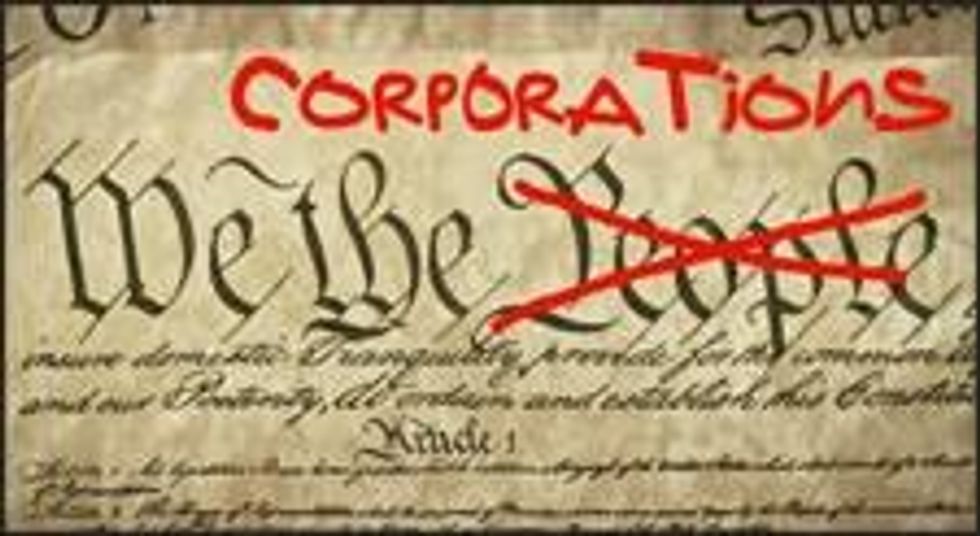
The solution to the problem is simple; we need to amend the US Constitution. Corporations are not people and crony courts across the U.S. have been wrong about that fact for over 127 years. The real judicial activism here, is in Santa Clara County v. Southern Pacific Railroad Company, when the Supreme Court decided that corporations are people entitled to constitutional rights. Since then, corporate lawyers have been using the people's courts to invalidate democracy. We at Move To Amend say, enough!
We call on our brothers and sisters in the labor movement to join us and support the We the People Amendment to the US Constitution. Until we amend the US Constitution to clearly state corporations are not people, the courts will continue to protect corporations and ignore the rights of real people. The fact that real people are mortal--that we live and we die--demands that basic labor protections be enacted in order to protect worker and public safety.
Corporate Personhood is a farce, a facade conceived to subvert the rights of real people, a fictional idea imagined to ignore democracy in the name of enriching plutocrats, and it's a legal fiction that destroys what it means to be a human being. It must end now!
Find out more about the Move To Amend Coalition and the effort to amend the US Constitution at www.movetoamend.org or call (707) 269-0984.
When judicial rulings create law, it's commonly known as judicial activism."Lochnerizing" is when the courts invalidate democratically enacted laws while granting corporations constitutional rights. In a 1905 Supreme Court case, Lochner v. New York, the Court struck down a New York state law that limited the amount of hours a baker could work in a day. The Court decided the law was a violation of the constitutional liberty of contract between two "persons:" the baker and the corporation for which he worked. In so doing, the Justices assumed they knew better what was good for New York than New Yorkers did, while granting corporations constitutional rights, thus Lochnerizing the law.
On May 7th, the New York Times reported that a Federal Appeals Court struck down a National Labor Relations Board (NLRB) rule that required most corporations to post a poster with information informing workers of their right to form or join a union, to strike, to bargain collectively and to organize to improve working conditions. The court referenced previous First Amendment rulings, which prohibited government from telling people what they can and cannot say. In West Virginia State Board of Education v. Barnette, the Court correctly held that the First Amendment's free speech clause protected students from being forced to salute the American flag and say the Pledge of Allegiance in school. And, in Pacific Gas and Electric Co. v. the Public Utilities Commission, the Court decided PG&E, a utility corporation, was not required to use space on their billing envelope in order to encourage consumers to use less energy. Citing these and other cases, the court decided that the NLRB rule violated the free speech right of the corporation not to speak and that the rule also violated a federal law that prevents the board from "punishing" a corporation for "expressing its views," so long as the statements are not threats of retaliation or force against workers. A corporation's failure to post the notice would have been considered an unfair labor practice had that court not decided that the NLRB would be acting illegally by "punishing" (issuing fines) a corporation for "making a statement," in this case, for refusing to post the NLRB poster.
Gleeful about the court's corporate friendly ruling the National Association of Manufacturers (NAM) called the ruling "an important victory in the fight against an activist NLRB and its aggressive agenda." NAM pronounced to the New York Times, "The poster rule is a prime example of a government agency that seeks to fundamentally change the way employers and employees communicate. The ultimate result of the NLRB's intrusion would be to create hostile work environments where none exist"
In other words, corporations have constitutional rights, unions do not. Richard L. Trumka of the AFL-CIO responded saying, "The Republican judges of the D.C. Circuit continue to wreak havoc on workers' rights."
The solution to the problem is simple; we need to amend the US Constitution. Corporations are not people and crony courts across the U.S. have been wrong about that fact for over 127 years. The real judicial activism here, is in Santa Clara County v. Southern Pacific Railroad Company, when the Supreme Court decided that corporations are people entitled to constitutional rights. Since then, corporate lawyers have been using the people's courts to invalidate democracy. We at Move To Amend say, enough!
We call on our brothers and sisters in the labor movement to join us and support the We the People Amendment to the US Constitution. Until we amend the US Constitution to clearly state corporations are not people, the courts will continue to protect corporations and ignore the rights of real people. The fact that real people are mortal--that we live and we die--demands that basic labor protections be enacted in order to protect worker and public safety.
Corporate Personhood is a farce, a facade conceived to subvert the rights of real people, a fictional idea imagined to ignore democracy in the name of enriching plutocrats, and it's a legal fiction that destroys what it means to be a human being. It must end now!
Find out more about the Move To Amend Coalition and the effort to amend the US Constitution at www.movetoamend.org or call (707) 269-0984.
When judicial rulings create law, it's commonly known as judicial activism."Lochnerizing" is when the courts invalidate democratically enacted laws while granting corporations constitutional rights. In a 1905 Supreme Court case, Lochner v. New York, the Court struck down a New York state law that limited the amount of hours a baker could work in a day. The Court decided the law was a violation of the constitutional liberty of contract between two "persons:" the baker and the corporation for which he worked. In so doing, the Justices assumed they knew better what was good for New York than New Yorkers did, while granting corporations constitutional rights, thus Lochnerizing the law.
On May 7th, the New York Times reported that a Federal Appeals Court struck down a National Labor Relations Board (NLRB) rule that required most corporations to post a poster with information informing workers of their right to form or join a union, to strike, to bargain collectively and to organize to improve working conditions. The court referenced previous First Amendment rulings, which prohibited government from telling people what they can and cannot say. In West Virginia State Board of Education v. Barnette, the Court correctly held that the First Amendment's free speech clause protected students from being forced to salute the American flag and say the Pledge of Allegiance in school. And, in Pacific Gas and Electric Co. v. the Public Utilities Commission, the Court decided PG&E, a utility corporation, was not required to use space on their billing envelope in order to encourage consumers to use less energy. Citing these and other cases, the court decided that the NLRB rule violated the free speech right of the corporation not to speak and that the rule also violated a federal law that prevents the board from "punishing" a corporation for "expressing its views," so long as the statements are not threats of retaliation or force against workers. A corporation's failure to post the notice would have been considered an unfair labor practice had that court not decided that the NLRB would be acting illegally by "punishing" (issuing fines) a corporation for "making a statement," in this case, for refusing to post the NLRB poster.
Gleeful about the court's corporate friendly ruling the National Association of Manufacturers (NAM) called the ruling "an important victory in the fight against an activist NLRB and its aggressive agenda." NAM pronounced to the New York Times, "The poster rule is a prime example of a government agency that seeks to fundamentally change the way employers and employees communicate. The ultimate result of the NLRB's intrusion would be to create hostile work environments where none exist"
In other words, corporations have constitutional rights, unions do not. Richard L. Trumka of the AFL-CIO responded saying, "The Republican judges of the D.C. Circuit continue to wreak havoc on workers' rights."
The solution to the problem is simple; we need to amend the US Constitution. Corporations are not people and crony courts across the U.S. have been wrong about that fact for over 127 years. The real judicial activism here, is in Santa Clara County v. Southern Pacific Railroad Company, when the Supreme Court decided that corporations are people entitled to constitutional rights. Since then, corporate lawyers have been using the people's courts to invalidate democracy. We at Move To Amend say, enough!
We call on our brothers and sisters in the labor movement to join us and support the We the People Amendment to the US Constitution. Until we amend the US Constitution to clearly state corporations are not people, the courts will continue to protect corporations and ignore the rights of real people. The fact that real people are mortal--that we live and we die--demands that basic labor protections be enacted in order to protect worker and public safety.
Corporate Personhood is a farce, a facade conceived to subvert the rights of real people, a fictional idea imagined to ignore democracy in the name of enriching plutocrats, and it's a legal fiction that destroys what it means to be a human being. It must end now!
Find out more about the Move To Amend Coalition and the effort to amend the US Constitution at www.movetoamend.org or call (707) 269-0984.