

But austerity is succeeding as politics. The German government shows no signs of taking its heavy foot off Europe's oxygen hose, and President Obama seems determined to strike a 10-year deal with the Republicans that would equal 10 years of sequesters and then some.
What might change this grim politics?
Last seek, Senator Elizabeth Warren -- how splendid to be able write the words Senator and Warren in the same sentence -- showed the way. Warren introduced her very first free-standing bill, and fittingly it was a bill to cut interest rates on student loans.
Warren's bill is only a start. It would prevent an increase in Stafford Loans, federally subsidized loans to low and middle-income families, which are slated to double in cost on July 1 from 3.4 percent interest to 6.8 percent. Warren's bill would cut the rate to the Federal Reserve lending rate to banks, currently 0.75 percent.
Senator Warren's bill would cut the rate to the Federal Reserve lending rate to banks, currently 0.75 percent.
But there is in Warren's proposal the germ of a counter-revolution against austerity politics.
Budget-balance mania is favored by elites. Regular people don't want cuts in Social Security and Medicare. The Peter G. Peterson Foundation has spent close to a trillion dollars creating one front group after another, trying to sell the proposition that we can somehow deflate our way to economic recovery. Peterson has few takers -- except among the group of people who count, beginning with President Obama.
The austerity crusade seems impervious to both logic and evidence. It will give way only when there is a popular counter-movement of real power.
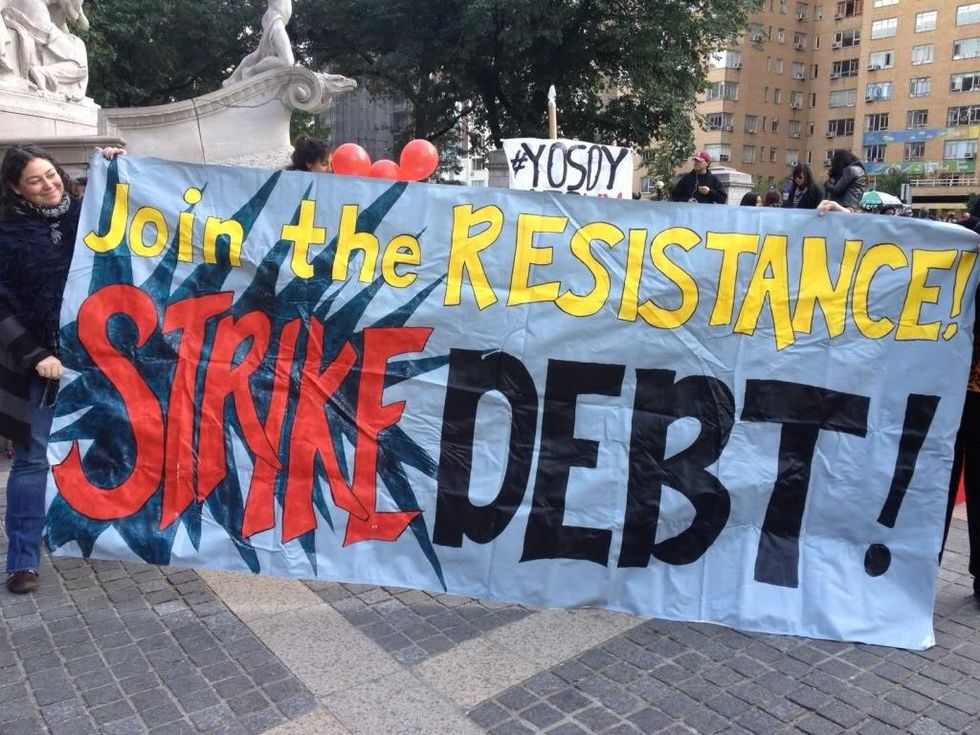
It seems to me that a mass movement for relief of college debt could be such a movement. Some 37 million students and former students have college loans, totaling more than a trillion dollars. And tens of millions of parents who were required to co-sign loans for their kids are at risk of students fall behind on their payments.
That's a lot of people -- college-educated people in their prime of life. Politicians need to hear from them. An entire generation is failing to get economic traction in a weak job market. College debt only adds to the delay young adults face in buying homes or starting families. This is not an abstract ideological proposition. It is up close and personal.
In 2010, President Obama got Congress to go partway towards reforming the student loan system. The program of federally guaranteed loans underwritten by for-profit financial companies was terminated in favor of less expensive direct federal loans. But banks and for-profit companies like Sallie Mae continued marketing non-federal loans to students. And former students carrying loans under the old programs are not able to refinance, even though rates averaging more than 7 percent are far in excess of the lenders' cost of money in a very low-interest environment.
The student loan program calls attention to the double standards of debt relief. Corporations are able to declare bankruptcy under Chapter 11 and write off old loan -- but college debt follows former students literally to the grave even if they go bankrupt. Big banks have gotten trillions of dollars of debt relief from the TARP program and the Federal Reserve's program of buying toxic assets from banks.
But there is no debt relief for students and former students. Can't we build a movement around that?
No student should have to incur debt in order to attend college.
No student should have to incur debt in order to attend college. Instead, students could incur a moderate and progressively levied surcharge on their income tax, which could be phased out for people serving the public interest in one of several professions. This provision was included on a pilot basis in the 2010 reform, and could be extended to all college borrowers.
In addition, all former students carrying college debt should be permitted to refinance loans at the Federal Reserve's lending rate to banks. The Fed's program of advancing money to banks has had little success in stimulating the economy because the banks are too risk averse to lend. The banks turn around and buy Treasury securities or leave the money in interest-bearing accounts at the Fed.
Refinancing of college debt would put the money to better use and provide an immediate stimulus to the economy. Pete Peterson and company love to invoke generational justice when they propose cutting Social Security. But debt relief for students and former students would introduce some generational fairness right now. Why doesn't the corporate-led "Fix the Debt Campaign," yet another group promoted by Peterson, start demanding that we fix the college debt?
Groups like Campus Progress, and Demos, where I am a senior fellow, have done important work bringing to light the abuses of college debt. Likewise the Consumer Financial Projection Bureau, an idea of Elizabeth Warren that has come to fruition.
There is no shortage of evidence about how a perverse college debt program is stunting the economic prospects of millions of Americans, just as there is plenty of evidence that austerity doesn't work. But evidence is not enough. We need a movement.
But austerity is succeeding as politics. The German government shows no signs of taking its heavy foot off Europe's oxygen hose, and President Obama seems determined to strike a 10-year deal with the Republicans that would equal 10 years of sequesters and then some.
What might change this grim politics?
Last seek, Senator Elizabeth Warren -- how splendid to be able write the words Senator and Warren in the same sentence -- showed the way. Warren introduced her very first free-standing bill, and fittingly it was a bill to cut interest rates on student loans.
Warren's bill is only a start. It would prevent an increase in Stafford Loans, federally subsidized loans to low and middle-income families, which are slated to double in cost on July 1 from 3.4 percent interest to 6.8 percent. Warren's bill would cut the rate to the Federal Reserve lending rate to banks, currently 0.75 percent.
Senator Warren's bill would cut the rate to the Federal Reserve lending rate to banks, currently 0.75 percent.
But there is in Warren's proposal the germ of a counter-revolution against austerity politics.
Budget-balance mania is favored by elites. Regular people don't want cuts in Social Security and Medicare. The Peter G. Peterson Foundation has spent close to a trillion dollars creating one front group after another, trying to sell the proposition that we can somehow deflate our way to economic recovery. Peterson has few takers -- except among the group of people who count, beginning with President Obama.
The austerity crusade seems impervious to both logic and evidence. It will give way only when there is a popular counter-movement of real power.
It seems to me that a mass movement for relief of college debt could be such a movement. Some 37 million students and former students have college loans, totaling more than a trillion dollars. And tens of millions of parents who were required to co-sign loans for their kids are at risk of students fall behind on their payments.
That's a lot of people -- college-educated people in their prime of life. Politicians need to hear from them. An entire generation is failing to get economic traction in a weak job market. College debt only adds to the delay young adults face in buying homes or starting families. This is not an abstract ideological proposition. It is up close and personal.
In 2010, President Obama got Congress to go partway towards reforming the student loan system. The program of federally guaranteed loans underwritten by for-profit financial companies was terminated in favor of less expensive direct federal loans. But banks and for-profit companies like Sallie Mae continued marketing non-federal loans to students. And former students carrying loans under the old programs are not able to refinance, even though rates averaging more than 7 percent are far in excess of the lenders' cost of money in a very low-interest environment.
The student loan program calls attention to the double standards of debt relief. Corporations are able to declare bankruptcy under Chapter 11 and write off old loan -- but college debt follows former students literally to the grave even if they go bankrupt. Big banks have gotten trillions of dollars of debt relief from the TARP program and the Federal Reserve's program of buying toxic assets from banks.
But there is no debt relief for students and former students. Can't we build a movement around that?
No student should have to incur debt in order to attend college.
No student should have to incur debt in order to attend college. Instead, students could incur a moderate and progressively levied surcharge on their income tax, which could be phased out for people serving the public interest in one of several professions. This provision was included on a pilot basis in the 2010 reform, and could be extended to all college borrowers.
In addition, all former students carrying college debt should be permitted to refinance loans at the Federal Reserve's lending rate to banks. The Fed's program of advancing money to banks has had little success in stimulating the economy because the banks are too risk averse to lend. The banks turn around and buy Treasury securities or leave the money in interest-bearing accounts at the Fed.
Refinancing of college debt would put the money to better use and provide an immediate stimulus to the economy. Pete Peterson and company love to invoke generational justice when they propose cutting Social Security. But debt relief for students and former students would introduce some generational fairness right now. Why doesn't the corporate-led "Fix the Debt Campaign," yet another group promoted by Peterson, start demanding that we fix the college debt?
Groups like Campus Progress, and Demos, where I am a senior fellow, have done important work bringing to light the abuses of college debt. Likewise the Consumer Financial Projection Bureau, an idea of Elizabeth Warren that has come to fruition.
There is no shortage of evidence about how a perverse college debt program is stunting the economic prospects of millions of Americans, just as there is plenty of evidence that austerity doesn't work. But evidence is not enough. We need a movement.
But austerity is succeeding as politics. The German government shows no signs of taking its heavy foot off Europe's oxygen hose, and President Obama seems determined to strike a 10-year deal with the Republicans that would equal 10 years of sequesters and then some.
What might change this grim politics?
Last seek, Senator Elizabeth Warren -- how splendid to be able write the words Senator and Warren in the same sentence -- showed the way. Warren introduced her very first free-standing bill, and fittingly it was a bill to cut interest rates on student loans.
Warren's bill is only a start. It would prevent an increase in Stafford Loans, federally subsidized loans to low and middle-income families, which are slated to double in cost on July 1 from 3.4 percent interest to 6.8 percent. Warren's bill would cut the rate to the Federal Reserve lending rate to banks, currently 0.75 percent.
Senator Warren's bill would cut the rate to the Federal Reserve lending rate to banks, currently 0.75 percent.
But there is in Warren's proposal the germ of a counter-revolution against austerity politics.
Budget-balance mania is favored by elites. Regular people don't want cuts in Social Security and Medicare. The Peter G. Peterson Foundation has spent close to a trillion dollars creating one front group after another, trying to sell the proposition that we can somehow deflate our way to economic recovery. Peterson has few takers -- except among the group of people who count, beginning with President Obama.
The austerity crusade seems impervious to both logic and evidence. It will give way only when there is a popular counter-movement of real power.
It seems to me that a mass movement for relief of college debt could be such a movement. Some 37 million students and former students have college loans, totaling more than a trillion dollars. And tens of millions of parents who were required to co-sign loans for their kids are at risk of students fall behind on their payments.
That's a lot of people -- college-educated people in their prime of life. Politicians need to hear from them. An entire generation is failing to get economic traction in a weak job market. College debt only adds to the delay young adults face in buying homes or starting families. This is not an abstract ideological proposition. It is up close and personal.
In 2010, President Obama got Congress to go partway towards reforming the student loan system. The program of federally guaranteed loans underwritten by for-profit financial companies was terminated in favor of less expensive direct federal loans. But banks and for-profit companies like Sallie Mae continued marketing non-federal loans to students. And former students carrying loans under the old programs are not able to refinance, even though rates averaging more than 7 percent are far in excess of the lenders' cost of money in a very low-interest environment.
The student loan program calls attention to the double standards of debt relief. Corporations are able to declare bankruptcy under Chapter 11 and write off old loan -- but college debt follows former students literally to the grave even if they go bankrupt. Big banks have gotten trillions of dollars of debt relief from the TARP program and the Federal Reserve's program of buying toxic assets from banks.
But there is no debt relief for students and former students. Can't we build a movement around that?
No student should have to incur debt in order to attend college.
No student should have to incur debt in order to attend college. Instead, students could incur a moderate and progressively levied surcharge on their income tax, which could be phased out for people serving the public interest in one of several professions. This provision was included on a pilot basis in the 2010 reform, and could be extended to all college borrowers.
In addition, all former students carrying college debt should be permitted to refinance loans at the Federal Reserve's lending rate to banks. The Fed's program of advancing money to banks has had little success in stimulating the economy because the banks are too risk averse to lend. The banks turn around and buy Treasury securities or leave the money in interest-bearing accounts at the Fed.
Refinancing of college debt would put the money to better use and provide an immediate stimulus to the economy. Pete Peterson and company love to invoke generational justice when they propose cutting Social Security. But debt relief for students and former students would introduce some generational fairness right now. Why doesn't the corporate-led "Fix the Debt Campaign," yet another group promoted by Peterson, start demanding that we fix the college debt?
Groups like Campus Progress, and Demos, where I am a senior fellow, have done important work bringing to light the abuses of college debt. Likewise the Consumer Financial Projection Bureau, an idea of Elizabeth Warren that has come to fruition.
There is no shortage of evidence about how a perverse college debt program is stunting the economic prospects of millions of Americans, just as there is plenty of evidence that austerity doesn't work. But evidence is not enough. We need a movement.