SUBSCRIBE TO OUR FREE NEWSLETTER
Daily news & progressive opinion—funded by the people, not the corporations—delivered straight to your inbox.
5
#000000
#FFFFFF
To donate by check, phone, or other method, see our More Ways to Give page.
Remember the 1950s horror movie "The Bad Seed"? Any remake should cast Monsanto in the title role, because whenever something scary is being done to our food, you can usually find Monsanto lurking in the shadows.
During the past two decades, this biotech behemoth has used its political connections to obtain a monopolistic grip on the creation, sale and proliferation of Frankenseeds -- the seeds of corn, cotton, soybeans and other crops that have had genetically modified organisms spliced into their natural DNA structure by corporate lab techs.
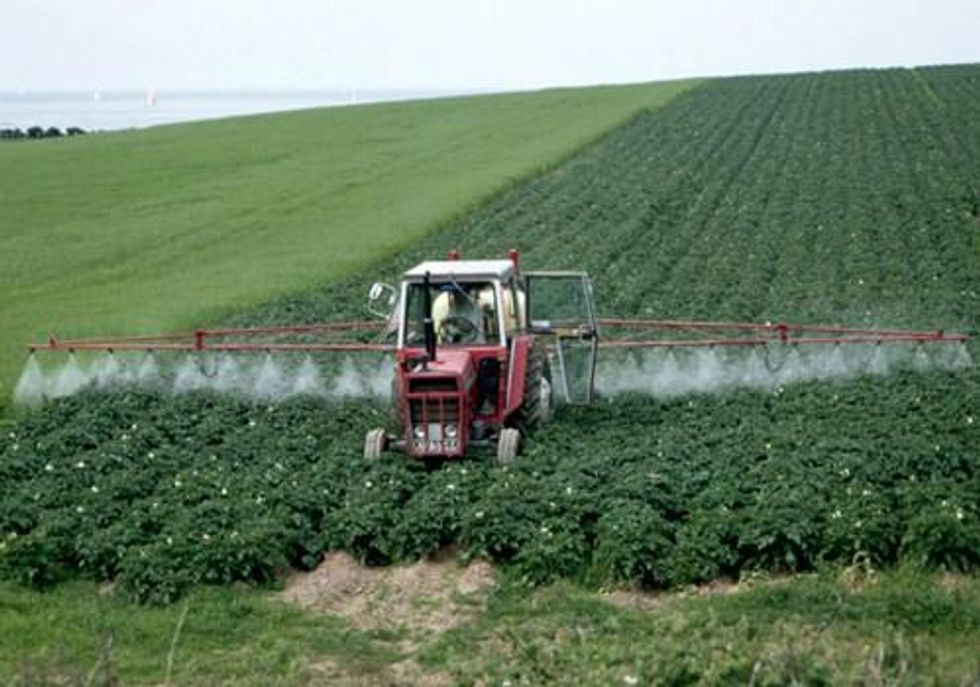
Why insert risky, inadequately tested genetically modified organisms (GMOs) into our food supply? To produce crops that can survive heavier doses of toxic pesticides -- specifically, the Roundup brand of pesticides marketed by Monsanto. The corporation gets more profit; we get more pesticides. Plus, a new manmade health and environmental risk.
That's enough to make a truly horrific movie about bad seed, but Monsanto has added to the horror by almost sadistically exerting its monopoly muscle to squeeze another unwitting victim: farmers. Yes, Monsanto's own customers!
Having patented the GMO technology, the corporation asserts that when the plants grow in a farmer's field and subsequently produce their own seeds, those second-generation seeds do not belong to the farmer, but are Monsanto's private property. Farmers are prohibited by Monsanto contracts from gathering and later planting the seeds produced by their own land.
Thus, the seed-saving ethic that has sustained agriculture all around the world for centuries has been decreed illegal to benefit Monsanto -- and the profiteering giant prowls the country to find and sue any of its own customers who dare practice the sensible art of seed saving. The bully has 75 staffers and a $10 million-a-year budget dedicated to monitoring, investigating, prosecuting and intimidating small farmers, even if some second-generation GMO seeds inadvertently crop up in their fields.
This is a case of one deep-pocketed, multibillion-dollar corporation perverting patent law in order to monopolize the sale of seeds, gouge thousands of farmers, and endanger both human health and the environment.
What a deal!
But Monsanto doesn't win them all, and sometimes it actually loses when it appears to have won.
This happened last November in the monumental food-labeling fight embodied in California's Proposition 37. This citizens' initiative would've required food marketers to tell consumers if any of their products contain ingredients with genetically manipulated DNA. Monsanto, by far the biggest manipulator, saw this simple, straightforward right-to-know proposal as a direct threat to the huge profit it reaps from selling its GMO seeds. So it revved up a campaign to kill Prop 37, not only pumping millions of its own dollars into its anti-consumer effort, but also getting a hoard of such huge processors and retailers as ConAgra, PepsiCo, Unilever and Wal-Mart to pump in many millions more.
Using their piles of political cash, deceptive advertising and outright lies, the corporate Goliaths squeaked out a narrow victory over a scrappy coalition of consumers, environmentalists, organic producers and others.
But while Big Money "won" the election, the brand-name corporations lost the hearts and minds of their own customers, for they exposed themselves as greedheads going to extremes to deny people's right to know what they're putting into their own bodies -- and into their children's bodies. That's not a winning proposition over the long haul, no matter how much political money they throw at it.
Moreover, far from feeling defeated, the pro-labeling coalition was energized by having flushed out of hiding the big-name brands that are secretly putting GMO contaminants in our food supply. Having awakened public consciousness, the grass-roots coalition has since flummoxed the genetic manipulators by not going away. Instead, it has already expanded the political fight for honesty and food purity into Connecticut, Missouri, New Mexico, Vermont, Washington state and elsewhere.
In a remarkable development, the strength of the issue and tenacity of the coalition has pushed a couple of dozen major food peddlers -- including PepsiCo and Wal-Mart -- to rethink whose side they're on. And, to Monsanto's horror, they have begun talking to coalition members about supporting a national labeling law. To keep up and help push, go to OrganicConsumers.org.
Remember the 1950s horror movie "The Bad Seed"? Any remake should cast Monsanto in the title role, because whenever something scary is being done to our food, you can usually find Monsanto lurking in the shadows.
During the past two decades, this biotech behemoth has used its political connections to obtain a monopolistic grip on the creation, sale and proliferation of Frankenseeds -- the seeds of corn, cotton, soybeans and other crops that have had genetically modified organisms spliced into their natural DNA structure by corporate lab techs.
Why insert risky, inadequately tested genetically modified organisms (GMOs) into our food supply? To produce crops that can survive heavier doses of toxic pesticides -- specifically, the Roundup brand of pesticides marketed by Monsanto. The corporation gets more profit; we get more pesticides. Plus, a new manmade health and environmental risk.
That's enough to make a truly horrific movie about bad seed, but Monsanto has added to the horror by almost sadistically exerting its monopoly muscle to squeeze another unwitting victim: farmers. Yes, Monsanto's own customers!
Having patented the GMO technology, the corporation asserts that when the plants grow in a farmer's field and subsequently produce their own seeds, those second-generation seeds do not belong to the farmer, but are Monsanto's private property. Farmers are prohibited by Monsanto contracts from gathering and later planting the seeds produced by their own land.
Thus, the seed-saving ethic that has sustained agriculture all around the world for centuries has been decreed illegal to benefit Monsanto -- and the profiteering giant prowls the country to find and sue any of its own customers who dare practice the sensible art of seed saving. The bully has 75 staffers and a $10 million-a-year budget dedicated to monitoring, investigating, prosecuting and intimidating small farmers, even if some second-generation GMO seeds inadvertently crop up in their fields.
This is a case of one deep-pocketed, multibillion-dollar corporation perverting patent law in order to monopolize the sale of seeds, gouge thousands of farmers, and endanger both human health and the environment.
What a deal!
But Monsanto doesn't win them all, and sometimes it actually loses when it appears to have won.
This happened last November in the monumental food-labeling fight embodied in California's Proposition 37. This citizens' initiative would've required food marketers to tell consumers if any of their products contain ingredients with genetically manipulated DNA. Monsanto, by far the biggest manipulator, saw this simple, straightforward right-to-know proposal as a direct threat to the huge profit it reaps from selling its GMO seeds. So it revved up a campaign to kill Prop 37, not only pumping millions of its own dollars into its anti-consumer effort, but also getting a hoard of such huge processors and retailers as ConAgra, PepsiCo, Unilever and Wal-Mart to pump in many millions more.
Using their piles of political cash, deceptive advertising and outright lies, the corporate Goliaths squeaked out a narrow victory over a scrappy coalition of consumers, environmentalists, organic producers and others.
But while Big Money "won" the election, the brand-name corporations lost the hearts and minds of their own customers, for they exposed themselves as greedheads going to extremes to deny people's right to know what they're putting into their own bodies -- and into their children's bodies. That's not a winning proposition over the long haul, no matter how much political money they throw at it.
Moreover, far from feeling defeated, the pro-labeling coalition was energized by having flushed out of hiding the big-name brands that are secretly putting GMO contaminants in our food supply. Having awakened public consciousness, the grass-roots coalition has since flummoxed the genetic manipulators by not going away. Instead, it has already expanded the political fight for honesty and food purity into Connecticut, Missouri, New Mexico, Vermont, Washington state and elsewhere.
In a remarkable development, the strength of the issue and tenacity of the coalition has pushed a couple of dozen major food peddlers -- including PepsiCo and Wal-Mart -- to rethink whose side they're on. And, to Monsanto's horror, they have begun talking to coalition members about supporting a national labeling law. To keep up and help push, go to OrganicConsumers.org.
Remember the 1950s horror movie "The Bad Seed"? Any remake should cast Monsanto in the title role, because whenever something scary is being done to our food, you can usually find Monsanto lurking in the shadows.
During the past two decades, this biotech behemoth has used its political connections to obtain a monopolistic grip on the creation, sale and proliferation of Frankenseeds -- the seeds of corn, cotton, soybeans and other crops that have had genetically modified organisms spliced into their natural DNA structure by corporate lab techs.
Why insert risky, inadequately tested genetically modified organisms (GMOs) into our food supply? To produce crops that can survive heavier doses of toxic pesticides -- specifically, the Roundup brand of pesticides marketed by Monsanto. The corporation gets more profit; we get more pesticides. Plus, a new manmade health and environmental risk.
That's enough to make a truly horrific movie about bad seed, but Monsanto has added to the horror by almost sadistically exerting its monopoly muscle to squeeze another unwitting victim: farmers. Yes, Monsanto's own customers!
Having patented the GMO technology, the corporation asserts that when the plants grow in a farmer's field and subsequently produce their own seeds, those second-generation seeds do not belong to the farmer, but are Monsanto's private property. Farmers are prohibited by Monsanto contracts from gathering and later planting the seeds produced by their own land.
Thus, the seed-saving ethic that has sustained agriculture all around the world for centuries has been decreed illegal to benefit Monsanto -- and the profiteering giant prowls the country to find and sue any of its own customers who dare practice the sensible art of seed saving. The bully has 75 staffers and a $10 million-a-year budget dedicated to monitoring, investigating, prosecuting and intimidating small farmers, even if some second-generation GMO seeds inadvertently crop up in their fields.
This is a case of one deep-pocketed, multibillion-dollar corporation perverting patent law in order to monopolize the sale of seeds, gouge thousands of farmers, and endanger both human health and the environment.
What a deal!
But Monsanto doesn't win them all, and sometimes it actually loses when it appears to have won.
This happened last November in the monumental food-labeling fight embodied in California's Proposition 37. This citizens' initiative would've required food marketers to tell consumers if any of their products contain ingredients with genetically manipulated DNA. Monsanto, by far the biggest manipulator, saw this simple, straightforward right-to-know proposal as a direct threat to the huge profit it reaps from selling its GMO seeds. So it revved up a campaign to kill Prop 37, not only pumping millions of its own dollars into its anti-consumer effort, but also getting a hoard of such huge processors and retailers as ConAgra, PepsiCo, Unilever and Wal-Mart to pump in many millions more.
Using their piles of political cash, deceptive advertising and outright lies, the corporate Goliaths squeaked out a narrow victory over a scrappy coalition of consumers, environmentalists, organic producers and others.
But while Big Money "won" the election, the brand-name corporations lost the hearts and minds of their own customers, for they exposed themselves as greedheads going to extremes to deny people's right to know what they're putting into their own bodies -- and into their children's bodies. That's not a winning proposition over the long haul, no matter how much political money they throw at it.
Moreover, far from feeling defeated, the pro-labeling coalition was energized by having flushed out of hiding the big-name brands that are secretly putting GMO contaminants in our food supply. Having awakened public consciousness, the grass-roots coalition has since flummoxed the genetic manipulators by not going away. Instead, it has already expanded the political fight for honesty and food purity into Connecticut, Missouri, New Mexico, Vermont, Washington state and elsewhere.
In a remarkable development, the strength of the issue and tenacity of the coalition has pushed a couple of dozen major food peddlers -- including PepsiCo and Wal-Mart -- to rethink whose side they're on. And, to Monsanto's horror, they have begun talking to coalition members about supporting a national labeling law. To keep up and help push, go to OrganicConsumers.org.