SUBSCRIBE TO OUR FREE NEWSLETTER
Daily news & progressive opinion—funded by the people, not the corporations—delivered straight to your inbox.
5
#000000
#FFFFFF
To donate by check, phone, or other method, see our More Ways to Give page.
"War's lingering phantoms haunt every society."
As two hellish, costly and needless wars struggle toward collapse, this is the time -- now, right this minute, before the next false alarm goes off -- for us to look honestly at the cost and quality of national security based on militarism. It's time to squeeze the romance out of war and get it through our heads that war is not inevitable.
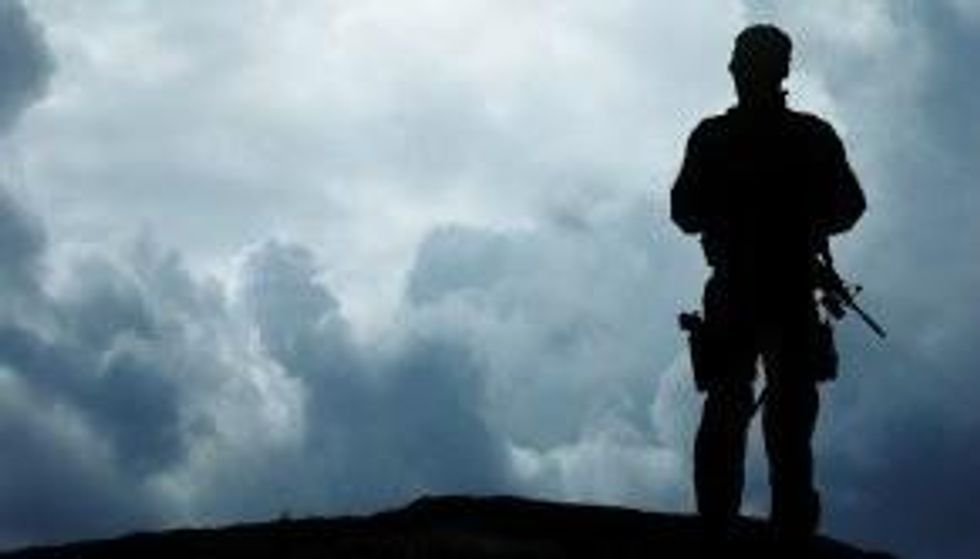
War is just another form of mass murder. Its core principle is dehumanization -- of all participants, the enemy and the good guys. This is because you can't hate, dehumanize and train to kill "the other" without dehumanizing yourself and damaging your soul.
"Kill! Kill! Kill, without mercy, Sergeant! . . . Blood! Blood! Bright red blood, Sergeant!"
The dehumanization happens at an individual level, to soldiers who, in basic training, go through an intense process of overriding their humanity and establishing "muscle memory" that allows them to kill on command; and who then participate in the killing of the enemy -- often enough, in our current wars, the killing of civilians, including children -- in battle situations.
And the dehumanization also happens, less perceptibly, perhaps, at a collective level, to whole societies that pump themselves into a war mentality and think they're protecting themselves and their values, only to see the suffering they inflict come home and the values go permanently on hold.
A new term for this brokenness, this deep loss of one's humanity, has emerged: moral injury.
The quotes are from Soul Repair: Recovering from Moral Injury after War (Beacon Press), by Rita Nakashima Brock and Gabriella Lettini. This remarkable book, published in 2012, takes a long, hard look at the dehumanizing effects of war, through the experiences of a number of vets from various wars (Vietnam, Iraq, Afghanistan) who share their suffering -- and bare their wounded souls -- to the authors.
Soul Repair is an assault on the mythology and public relations of war, on the default setting of nationhood, that: "We sleep comfortably in our beds at night because violent men do violence on our behalf." No matter how many lies are at the foundation of a given war, no matter how disastrously unnecessary and destructive -- oops -- it turns out to be in retrospect, the myth of war is ever-unsullied: This time the danger is really there. This time it's crucial that we carpet bomb civilians, then send in our boys and girls to clean out the enemy insurgents. This time it's really for democracy and the American Dream and a good night's sleep.
Just as soldiers are on the front line of the fight, they are also on the front line of its aftermath, bearing their wounds -- physical and spiritual -- by themselves. Even if they fought in a "good" war, popular, celebrated and appreciated, they are alone with what they witnessed and participated in. When a war is deeply criticized at home, bearing what one has done in it often becomes impossible.
"Self-harm is now the leading cause of death for members of the Army, which has seen its suicide rate double since 2004, peaking this past summer with 38 in July alone," Tony Dokoupil wrote in a Newsweek article about moral injury last December. "But the risk to discharged veterans may be even greater. Every month nearly 1,000 of them attempt to take their own lives. That's more than three attempts every 90 minutes, at least one of them successful. . . . 'It's an epidemic,' Secretary of Defense Leon Panetta admitted to Congress this summer. 'Something is wrong.'"
Tyler Boudreau, one of the vets quoted in Soul Repair, puts it this way: "They say war is hell, but I say it's the foyer to hell. I say coming home is hell, and hell ain't got no coordinates. . . . Hell is no place at all, so when you're there, you're nowhere -- you're lost."
Another vet, Joshua Casteel, who gained conscientious objector status in 2005, "says he began to think about why a so-called peaceful society relies on war for its security, and what it means to train ordinary young people to be killers."
This question, it seems to me, strikes at the heart of who we are as a society. Like the other vets who tell their stories in Soul Repair, he had to rebuild his life and reclaim his humanity by reaching for something beyond what could ever be gained by war. For Casteel, this meant traveling with Christian Peacemaker teams, living in war zones around the globe and establishing a peaceful presence.
Boudreau spoke stunningly about his reclamation of humanity: "Digging in has always been, for me, about killing or keeping myself from being killed. In war, soldiers score the earth with their shovels, some of them essentially digging their own graves. The first time I pressed the heel of my boot at home on a garden spade I felt the shift inside me like tectonic plates beneath the surface."
Personal stories such as these are the core of Soul Repair, but the authors push beyond the personal as well. War and its aftermath -- "war's lingering phantoms" -- belong to all of us, they write. Let's at least acknowledge those phantoms and let them unsettle us. This is the prelude to rebuilding.
"War's lingering phantoms haunt every society."
As two hellish, costly and needless wars struggle toward collapse, this is the time -- now, right this minute, before the next false alarm goes off -- for us to look honestly at the cost and quality of national security based on militarism. It's time to squeeze the romance out of war and get it through our heads that war is not inevitable.
War is just another form of mass murder. Its core principle is dehumanization -- of all participants, the enemy and the good guys. This is because you can't hate, dehumanize and train to kill "the other" without dehumanizing yourself and damaging your soul.
"Kill! Kill! Kill, without mercy, Sergeant! . . . Blood! Blood! Bright red blood, Sergeant!"
The dehumanization happens at an individual level, to soldiers who, in basic training, go through an intense process of overriding their humanity and establishing "muscle memory" that allows them to kill on command; and who then participate in the killing of the enemy -- often enough, in our current wars, the killing of civilians, including children -- in battle situations.
And the dehumanization also happens, less perceptibly, perhaps, at a collective level, to whole societies that pump themselves into a war mentality and think they're protecting themselves and their values, only to see the suffering they inflict come home and the values go permanently on hold.
A new term for this brokenness, this deep loss of one's humanity, has emerged: moral injury.
The quotes are from Soul Repair: Recovering from Moral Injury after War (Beacon Press), by Rita Nakashima Brock and Gabriella Lettini. This remarkable book, published in 2012, takes a long, hard look at the dehumanizing effects of war, through the experiences of a number of vets from various wars (Vietnam, Iraq, Afghanistan) who share their suffering -- and bare their wounded souls -- to the authors.
Soul Repair is an assault on the mythology and public relations of war, on the default setting of nationhood, that: "We sleep comfortably in our beds at night because violent men do violence on our behalf." No matter how many lies are at the foundation of a given war, no matter how disastrously unnecessary and destructive -- oops -- it turns out to be in retrospect, the myth of war is ever-unsullied: This time the danger is really there. This time it's crucial that we carpet bomb civilians, then send in our boys and girls to clean out the enemy insurgents. This time it's really for democracy and the American Dream and a good night's sleep.
Just as soldiers are on the front line of the fight, they are also on the front line of its aftermath, bearing their wounds -- physical and spiritual -- by themselves. Even if they fought in a "good" war, popular, celebrated and appreciated, they are alone with what they witnessed and participated in. When a war is deeply criticized at home, bearing what one has done in it often becomes impossible.
"Self-harm is now the leading cause of death for members of the Army, which has seen its suicide rate double since 2004, peaking this past summer with 38 in July alone," Tony Dokoupil wrote in a Newsweek article about moral injury last December. "But the risk to discharged veterans may be even greater. Every month nearly 1,000 of them attempt to take their own lives. That's more than three attempts every 90 minutes, at least one of them successful. . . . 'It's an epidemic,' Secretary of Defense Leon Panetta admitted to Congress this summer. 'Something is wrong.'"
Tyler Boudreau, one of the vets quoted in Soul Repair, puts it this way: "They say war is hell, but I say it's the foyer to hell. I say coming home is hell, and hell ain't got no coordinates. . . . Hell is no place at all, so when you're there, you're nowhere -- you're lost."
Another vet, Joshua Casteel, who gained conscientious objector status in 2005, "says he began to think about why a so-called peaceful society relies on war for its security, and what it means to train ordinary young people to be killers."
This question, it seems to me, strikes at the heart of who we are as a society. Like the other vets who tell their stories in Soul Repair, he had to rebuild his life and reclaim his humanity by reaching for something beyond what could ever be gained by war. For Casteel, this meant traveling with Christian Peacemaker teams, living in war zones around the globe and establishing a peaceful presence.
Boudreau spoke stunningly about his reclamation of humanity: "Digging in has always been, for me, about killing or keeping myself from being killed. In war, soldiers score the earth with their shovels, some of them essentially digging their own graves. The first time I pressed the heel of my boot at home on a garden spade I felt the shift inside me like tectonic plates beneath the surface."
Personal stories such as these are the core of Soul Repair, but the authors push beyond the personal as well. War and its aftermath -- "war's lingering phantoms" -- belong to all of us, they write. Let's at least acknowledge those phantoms and let them unsettle us. This is the prelude to rebuilding.
"War's lingering phantoms haunt every society."
As two hellish, costly and needless wars struggle toward collapse, this is the time -- now, right this minute, before the next false alarm goes off -- for us to look honestly at the cost and quality of national security based on militarism. It's time to squeeze the romance out of war and get it through our heads that war is not inevitable.
War is just another form of mass murder. Its core principle is dehumanization -- of all participants, the enemy and the good guys. This is because you can't hate, dehumanize and train to kill "the other" without dehumanizing yourself and damaging your soul.
"Kill! Kill! Kill, without mercy, Sergeant! . . . Blood! Blood! Bright red blood, Sergeant!"
The dehumanization happens at an individual level, to soldiers who, in basic training, go through an intense process of overriding their humanity and establishing "muscle memory" that allows them to kill on command; and who then participate in the killing of the enemy -- often enough, in our current wars, the killing of civilians, including children -- in battle situations.
And the dehumanization also happens, less perceptibly, perhaps, at a collective level, to whole societies that pump themselves into a war mentality and think they're protecting themselves and their values, only to see the suffering they inflict come home and the values go permanently on hold.
A new term for this brokenness, this deep loss of one's humanity, has emerged: moral injury.
The quotes are from Soul Repair: Recovering from Moral Injury after War (Beacon Press), by Rita Nakashima Brock and Gabriella Lettini. This remarkable book, published in 2012, takes a long, hard look at the dehumanizing effects of war, through the experiences of a number of vets from various wars (Vietnam, Iraq, Afghanistan) who share their suffering -- and bare their wounded souls -- to the authors.
Soul Repair is an assault on the mythology and public relations of war, on the default setting of nationhood, that: "We sleep comfortably in our beds at night because violent men do violence on our behalf." No matter how many lies are at the foundation of a given war, no matter how disastrously unnecessary and destructive -- oops -- it turns out to be in retrospect, the myth of war is ever-unsullied: This time the danger is really there. This time it's crucial that we carpet bomb civilians, then send in our boys and girls to clean out the enemy insurgents. This time it's really for democracy and the American Dream and a good night's sleep.
Just as soldiers are on the front line of the fight, they are also on the front line of its aftermath, bearing their wounds -- physical and spiritual -- by themselves. Even if they fought in a "good" war, popular, celebrated and appreciated, they are alone with what they witnessed and participated in. When a war is deeply criticized at home, bearing what one has done in it often becomes impossible.
"Self-harm is now the leading cause of death for members of the Army, which has seen its suicide rate double since 2004, peaking this past summer with 38 in July alone," Tony Dokoupil wrote in a Newsweek article about moral injury last December. "But the risk to discharged veterans may be even greater. Every month nearly 1,000 of them attempt to take their own lives. That's more than three attempts every 90 minutes, at least one of them successful. . . . 'It's an epidemic,' Secretary of Defense Leon Panetta admitted to Congress this summer. 'Something is wrong.'"
Tyler Boudreau, one of the vets quoted in Soul Repair, puts it this way: "They say war is hell, but I say it's the foyer to hell. I say coming home is hell, and hell ain't got no coordinates. . . . Hell is no place at all, so when you're there, you're nowhere -- you're lost."
Another vet, Joshua Casteel, who gained conscientious objector status in 2005, "says he began to think about why a so-called peaceful society relies on war for its security, and what it means to train ordinary young people to be killers."
This question, it seems to me, strikes at the heart of who we are as a society. Like the other vets who tell their stories in Soul Repair, he had to rebuild his life and reclaim his humanity by reaching for something beyond what could ever be gained by war. For Casteel, this meant traveling with Christian Peacemaker teams, living in war zones around the globe and establishing a peaceful presence.
Boudreau spoke stunningly about his reclamation of humanity: "Digging in has always been, for me, about killing or keeping myself from being killed. In war, soldiers score the earth with their shovels, some of them essentially digging their own graves. The first time I pressed the heel of my boot at home on a garden spade I felt the shift inside me like tectonic plates beneath the surface."
Personal stories such as these are the core of Soul Repair, but the authors push beyond the personal as well. War and its aftermath -- "war's lingering phantoms" -- belong to all of us, they write. Let's at least acknowledge those phantoms and let them unsettle us. This is the prelude to rebuilding.