SUBSCRIBE TO OUR FREE NEWSLETTER
Daily news & progressive opinion—funded by the people, not the corporations—delivered straight to your inbox.
5
#000000
#FFFFFF
To donate by check, phone, or other method, see our More Ways to Give page.
You're young and prone to trouble. You get triggered quickly. Someone tells you that you've screwed up and you're about to lash back. Then, instead, you think:
1. Look at the other person.
2. Say "OK."
3. Stay calm.
This is what you do. And nothing happens, except that the moment passes and life goes on. Got it?
This column is another dispatch from Chicago, murder capital of America. How many of the murders -- 506 of them last year -- were committed by people who had no grasp of this particular social skill (accepting criticism or a consequence), or any of the dozen or so others tacked to the bulletin board in the peace room at Fenger High School?
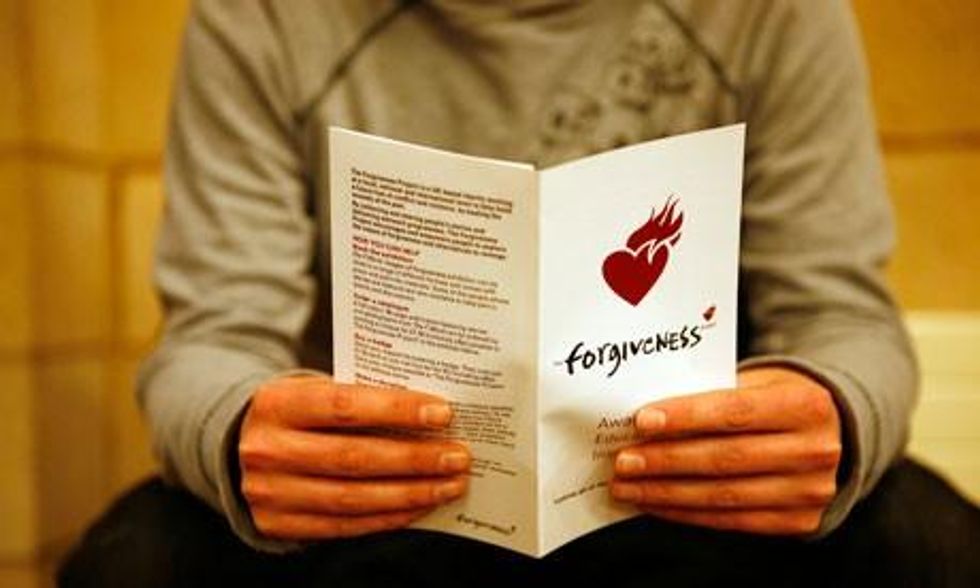
These skills, which address an array of very basic life situations -- e.g., getting no for an answer, greeting others, getting the teacher's attention, disagreeing appropriately, making an apology, accepting compliments, asking for help and many more -- come from the Father Flanagan Boys Town Classroom Social Skills list. The instructions are simple and precise and without moralizing, the equivalent of "lather, rinse, repeat."
As I sat there looking at them, I felt a sudden click of understanding: This is empowerment! Knowing how to control yourself is as crucial as knowing how to defend yourself, but its value is generally overlooked or dismissed as obvious. Yet as I contemplated these simply stated skills, I was able to imagine not knowing them -- and then imagine how disastrously out of control my life would be without such knowledge. These simple instructions are among the building blocks of personal peace.
"It's not only helping other people. It's helping us," said Ana, one of the peer juror students at Fenger I interviewed recently. "It's helped me. It used to be, you scream at me, that's the way I'm going to treat you back."
She talked about a fellow Latina student at Fenger who would "scream at me and tell me hurtful things. I learned how to calm myself down. And then she started talking to me. Now we're friends." One day in class she saw the girl -- her former enemy -- crying. When the girl saw Ana, she said, "'I was waiting for you. I really need to talk.'" She was jealous of one of Ana's other friends, but an honest discussion cleared things up. "Now she comes to me every day and tells me what she needs."
This is nothing much, and yet it's everything -- the difference between love and hatred, between connection and isolation. In a dysfunctional school or neighborhood, caught in poverty, full of broken families, the isolation and the hatred become endemic, with the predictable sorts of consequences we read about in the headlines and police stats. For instance, more than 80 percent of last year's 506 homicides, according to the New York Times, were committed in about half of Chicago's police districts -- the districts in or close to the poverty ghettoes, not the affluent neighborhoods.
While meanness, disrespect, misunderstanding and temper flare-ups are part of life everywhere, in some neighborhoods they can be life-or-death issues. Teaching social skills, empathy, respect and the ability to listen are absolutely crucial. And it can't be done half-heartedly, said Robert Spicer, Fenger's Culture and Climate coordinator and the person who facilitates the school's peer jury program. "Lives are at stake."
Fenger used to have a terrible reputation, which reached its nadir a little over three years ago when one of its students, Derrion Albert, was caught in the middle of a gang melee on his way home from school and beaten to death with two-by-fours. His murder was caught on a cellphone video and became international news.
Spicer, who had just started working at Fenger then, became, with his background in restorative justice, the point person on the school's rebuilding effort. Note well: This rebuilding wasn't centered around tighter security, more police, harsher suspensions and zero tolerance. While old-fashioned disciplinary measures are sometimes necessary at the new Fenger, punishment is never the point. The healing practices of restorative justice are now at the school's core.
"What's going to get test scores to rise," Spicer said, "is to show these students we love them."
This is not theory or wishful thinking but hard-won knowledge at one of the national epicenters of urban violence. Fenger has become an incubator for peace. Where once, said Ana, her family wouldn't even cross the street near Fenger because its reputation was so bad, now it's the center of hope and possibility. "It's just the beginning of changing the world," she said.
Letreana, a fellow peer juror, put it this way: "Usually people would say, 'Oh my God, Fenger, that's such a violent place.'" But when she attended a recent citywide restorative justice meeting, which is held every six months or so in a meeting room at Cook County Juvenile Court, "everyone was applauding us. We were rock stars."
That's because this is a movement. Most of the city and the country don't know about it yet, but it's quietly gaining a foothold in the forgotten neighborhoods, the ones that don't make the news unless a child is murdered.
You're young and prone to trouble. You get triggered quickly. Someone tells you that you've screwed up and you're about to lash back. Then, instead, you think:
1. Look at the other person.
2. Say "OK."
3. Stay calm.
This is what you do. And nothing happens, except that the moment passes and life goes on. Got it?
This column is another dispatch from Chicago, murder capital of America. How many of the murders -- 506 of them last year -- were committed by people who had no grasp of this particular social skill (accepting criticism or a consequence), or any of the dozen or so others tacked to the bulletin board in the peace room at Fenger High School?
These skills, which address an array of very basic life situations -- e.g., getting no for an answer, greeting others, getting the teacher's attention, disagreeing appropriately, making an apology, accepting compliments, asking for help and many more -- come from the Father Flanagan Boys Town Classroom Social Skills list. The instructions are simple and precise and without moralizing, the equivalent of "lather, rinse, repeat."
As I sat there looking at them, I felt a sudden click of understanding: This is empowerment! Knowing how to control yourself is as crucial as knowing how to defend yourself, but its value is generally overlooked or dismissed as obvious. Yet as I contemplated these simply stated skills, I was able to imagine not knowing them -- and then imagine how disastrously out of control my life would be without such knowledge. These simple instructions are among the building blocks of personal peace.
"It's not only helping other people. It's helping us," said Ana, one of the peer juror students at Fenger I interviewed recently. "It's helped me. It used to be, you scream at me, that's the way I'm going to treat you back."
She talked about a fellow Latina student at Fenger who would "scream at me and tell me hurtful things. I learned how to calm myself down. And then she started talking to me. Now we're friends." One day in class she saw the girl -- her former enemy -- crying. When the girl saw Ana, she said, "'I was waiting for you. I really need to talk.'" She was jealous of one of Ana's other friends, but an honest discussion cleared things up. "Now she comes to me every day and tells me what she needs."
This is nothing much, and yet it's everything -- the difference between love and hatred, between connection and isolation. In a dysfunctional school or neighborhood, caught in poverty, full of broken families, the isolation and the hatred become endemic, with the predictable sorts of consequences we read about in the headlines and police stats. For instance, more than 80 percent of last year's 506 homicides, according to the New York Times, were committed in about half of Chicago's police districts -- the districts in or close to the poverty ghettoes, not the affluent neighborhoods.
While meanness, disrespect, misunderstanding and temper flare-ups are part of life everywhere, in some neighborhoods they can be life-or-death issues. Teaching social skills, empathy, respect and the ability to listen are absolutely crucial. And it can't be done half-heartedly, said Robert Spicer, Fenger's Culture and Climate coordinator and the person who facilitates the school's peer jury program. "Lives are at stake."
Fenger used to have a terrible reputation, which reached its nadir a little over three years ago when one of its students, Derrion Albert, was caught in the middle of a gang melee on his way home from school and beaten to death with two-by-fours. His murder was caught on a cellphone video and became international news.
Spicer, who had just started working at Fenger then, became, with his background in restorative justice, the point person on the school's rebuilding effort. Note well: This rebuilding wasn't centered around tighter security, more police, harsher suspensions and zero tolerance. While old-fashioned disciplinary measures are sometimes necessary at the new Fenger, punishment is never the point. The healing practices of restorative justice are now at the school's core.
"What's going to get test scores to rise," Spicer said, "is to show these students we love them."
This is not theory or wishful thinking but hard-won knowledge at one of the national epicenters of urban violence. Fenger has become an incubator for peace. Where once, said Ana, her family wouldn't even cross the street near Fenger because its reputation was so bad, now it's the center of hope and possibility. "It's just the beginning of changing the world," she said.
Letreana, a fellow peer juror, put it this way: "Usually people would say, 'Oh my God, Fenger, that's such a violent place.'" But when she attended a recent citywide restorative justice meeting, which is held every six months or so in a meeting room at Cook County Juvenile Court, "everyone was applauding us. We were rock stars."
That's because this is a movement. Most of the city and the country don't know about it yet, but it's quietly gaining a foothold in the forgotten neighborhoods, the ones that don't make the news unless a child is murdered.
You're young and prone to trouble. You get triggered quickly. Someone tells you that you've screwed up and you're about to lash back. Then, instead, you think:
1. Look at the other person.
2. Say "OK."
3. Stay calm.
This is what you do. And nothing happens, except that the moment passes and life goes on. Got it?
This column is another dispatch from Chicago, murder capital of America. How many of the murders -- 506 of them last year -- were committed by people who had no grasp of this particular social skill (accepting criticism or a consequence), or any of the dozen or so others tacked to the bulletin board in the peace room at Fenger High School?
These skills, which address an array of very basic life situations -- e.g., getting no for an answer, greeting others, getting the teacher's attention, disagreeing appropriately, making an apology, accepting compliments, asking for help and many more -- come from the Father Flanagan Boys Town Classroom Social Skills list. The instructions are simple and precise and without moralizing, the equivalent of "lather, rinse, repeat."
As I sat there looking at them, I felt a sudden click of understanding: This is empowerment! Knowing how to control yourself is as crucial as knowing how to defend yourself, but its value is generally overlooked or dismissed as obvious. Yet as I contemplated these simply stated skills, I was able to imagine not knowing them -- and then imagine how disastrously out of control my life would be without such knowledge. These simple instructions are among the building blocks of personal peace.
"It's not only helping other people. It's helping us," said Ana, one of the peer juror students at Fenger I interviewed recently. "It's helped me. It used to be, you scream at me, that's the way I'm going to treat you back."
She talked about a fellow Latina student at Fenger who would "scream at me and tell me hurtful things. I learned how to calm myself down. And then she started talking to me. Now we're friends." One day in class she saw the girl -- her former enemy -- crying. When the girl saw Ana, she said, "'I was waiting for you. I really need to talk.'" She was jealous of one of Ana's other friends, but an honest discussion cleared things up. "Now she comes to me every day and tells me what she needs."
This is nothing much, and yet it's everything -- the difference between love and hatred, between connection and isolation. In a dysfunctional school or neighborhood, caught in poverty, full of broken families, the isolation and the hatred become endemic, with the predictable sorts of consequences we read about in the headlines and police stats. For instance, more than 80 percent of last year's 506 homicides, according to the New York Times, were committed in about half of Chicago's police districts -- the districts in or close to the poverty ghettoes, not the affluent neighborhoods.
While meanness, disrespect, misunderstanding and temper flare-ups are part of life everywhere, in some neighborhoods they can be life-or-death issues. Teaching social skills, empathy, respect and the ability to listen are absolutely crucial. And it can't be done half-heartedly, said Robert Spicer, Fenger's Culture and Climate coordinator and the person who facilitates the school's peer jury program. "Lives are at stake."
Fenger used to have a terrible reputation, which reached its nadir a little over three years ago when one of its students, Derrion Albert, was caught in the middle of a gang melee on his way home from school and beaten to death with two-by-fours. His murder was caught on a cellphone video and became international news.
Spicer, who had just started working at Fenger then, became, with his background in restorative justice, the point person on the school's rebuilding effort. Note well: This rebuilding wasn't centered around tighter security, more police, harsher suspensions and zero tolerance. While old-fashioned disciplinary measures are sometimes necessary at the new Fenger, punishment is never the point. The healing practices of restorative justice are now at the school's core.
"What's going to get test scores to rise," Spicer said, "is to show these students we love them."
This is not theory or wishful thinking but hard-won knowledge at one of the national epicenters of urban violence. Fenger has become an incubator for peace. Where once, said Ana, her family wouldn't even cross the street near Fenger because its reputation was so bad, now it's the center of hope and possibility. "It's just the beginning of changing the world," she said.
Letreana, a fellow peer juror, put it this way: "Usually people would say, 'Oh my God, Fenger, that's such a violent place.'" But when she attended a recent citywide restorative justice meeting, which is held every six months or so in a meeting room at Cook County Juvenile Court, "everyone was applauding us. We were rock stars."
That's because this is a movement. Most of the city and the country don't know about it yet, but it's quietly gaining a foothold in the forgotten neighborhoods, the ones that don't make the news unless a child is murdered.