SUBSCRIBE TO OUR FREE NEWSLETTER
Daily news & progressive opinion—funded by the people, not the corporations—delivered straight to your inbox.
5
#000000
#FFFFFF
To donate by check, phone, or other method, see our More Ways to Give page.
Last year, shortly after the shooting of then-Congresswoman Gabby Giffords, a financial analyst asked Mike Fifer--CEO of one of the largest gun companies in America--if the incident would lead to a wave of new gun sales. "The commentary from the NRA that President Obama might be coming out with some sort of speech on some sort of gun control," asked the analyst, "has that stirred gun owners and prospective gun owners to go visit the stores?"
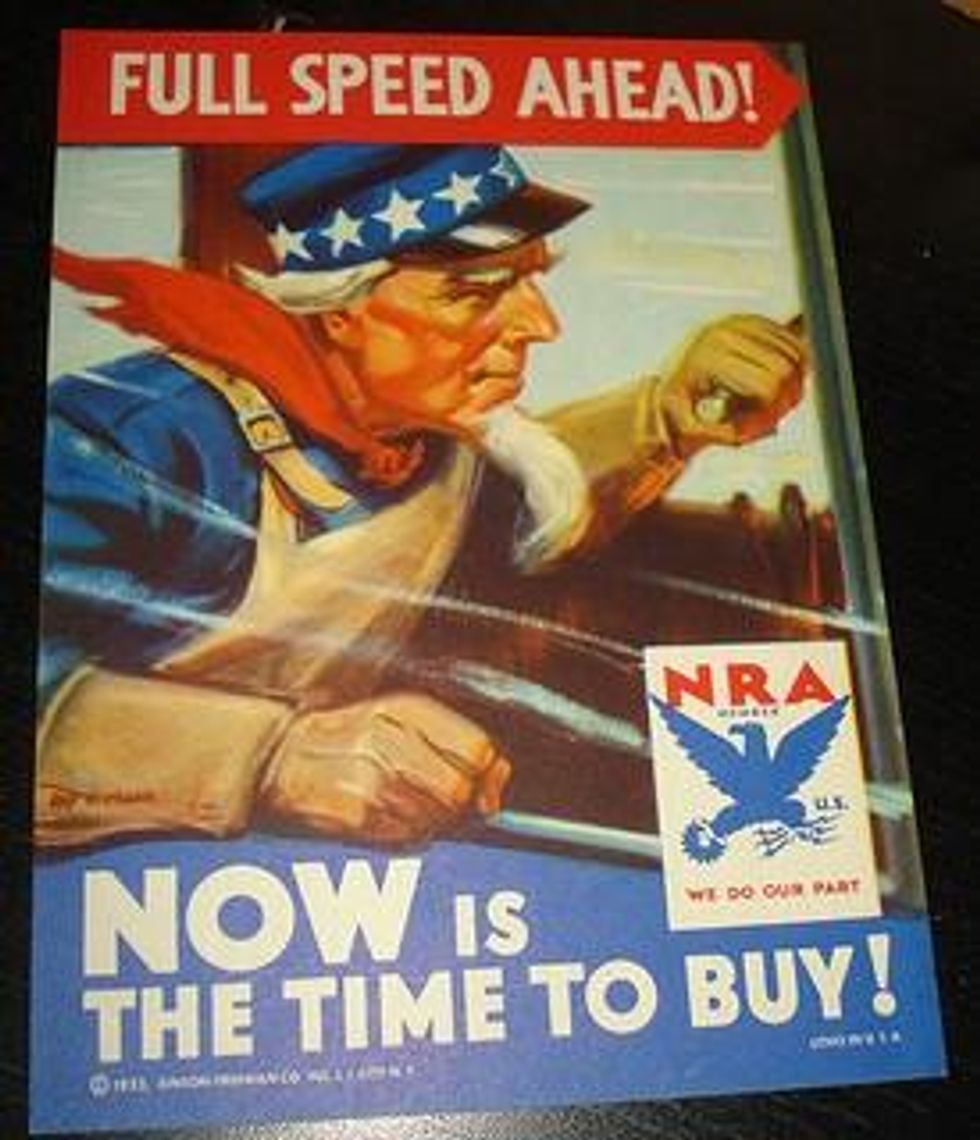
That's where the National Rifle Association comes in.
NRA-stoked fear about the government coming to seize America's guns has been a useful marketing tool to the gun industry, which must continually encourage gun-owners to buy more and more weapons.
This dynamic drives rather macabre incentives. Horrific gun violence leads to calls for gun control, which in turn leads to NRA-organized fear-mongering and conspiracy theories that inevitably results in more gun sales. What the financial analyst pondered last year with the Giffords shooting is playing out with Newtown--and the NRA and the gun industry is earning what is likely to be an unprecedented fortune.
While pundits and politicians debate the possibility of new gun restrictions in the wake of the Newtown massacre, the NRA is playing it's now-familiar role spreading paranoia, and Americans are flocking to stores to stock up on weapons--lots of them.
From Alaska to Florida, gun sales across the country are going through the roof, with thousands buying up ammunition, high-powered semiautomatic rifles and other weaponry out of concern that the federal government will enact new regulations on gun ownership. In Tennessee, officials say gun purchases likely hit an all-time high. Walmart has reportedly run out of semiautomatic rifles in five states.
And though the NRA has been roundly mocked for its public relations effort this week, officials are watching what is sure to be a flood of new cash.
Here's why: For every gun or package of ammunition sold at participating stores, a dollar is donated to the NRA. The NRA's corporate fundraising division has several special retail partnerships called "Add-A-Buck," "NRA Round-Up," and "Shooting for the Future." In some cases, these deals allow for customers to contribute a dollar or two to the NRA at the point of purchase; others, like one with Sturm, Ruger & Co., the company led by Mike Fifer, require automatic contributions to the NRA with every purchase. Many of these retail deals are linked to the NRA's 501(c)4 affiliate, which can, unlike other affiliates of the NRA, spend that money on political advertisements and lobbying.
This year alone, Midway USA, an ammunition company, has given the NRA $1 million through the Round Up program.
I've sent a message to the NRA inquiring how much the group has raised since the tragedy in Newtown from these retail partnerships, and will update this post if they respond with a figure. The NRA does not disclose donor information.
Of course, there are other ways for the gun industry to contribute to the NRA. There are multimillion-dollar corporate sponsorships for the NRA Foundation, lucrative advertising deals in NRA newsletters, and gun company underwriting for NRA trade shows. The retail partnership ensures that when gun issues are in the news, both the NRA and gun makers are flush with money.
The NRA has evolved over its 141-year history, but over the last decade, the group has become largely beholden to the gun industry. That transformation became complete in 2005, when the NRA successfully lobbied for the Protection of Lawful Commerce in Arms Act, a law that "essentially blocks federal lawsuits brought by municipalities wishing to hold gun manufacturers accountable for the bloodshed their products helped create." The law ensures gun companies cannot be held liable for the crimes committed with their products, as explained by Jarrett Murphy in the September edition of The Nation.
The election of President Barack Obama has only reaffirmed this special, profit-driven relationship between the gun industry and the NRA.
Accusations that Obama will "take away our guns," as the NRA's David Keene warns, have led a rally on Wall Street that has some gun stocks up over 400 percent since 2008. It's quite a feat of marketing, since the Obama administration has only deregulated gun ownership over the last four years.
That's why Fifer, in another candid conversation with investors last year, revealed that some in the for-profit gun industry were quietly hoping for a second Obama term. "I think half the people in the firearms industry, if asked, would hope he's not President, but then will secretly go out and vote for him again."
Last year, shortly after the shooting of then-Congresswoman Gabby Giffords, a financial analyst asked Mike Fifer--CEO of one of the largest gun companies in America--if the incident would lead to a wave of new gun sales. "The commentary from the NRA that President Obama might be coming out with some sort of speech on some sort of gun control," asked the analyst, "has that stirred gun owners and prospective gun owners to go visit the stores?"
That's where the National Rifle Association comes in.
NRA-stoked fear about the government coming to seize America's guns has been a useful marketing tool to the gun industry, which must continually encourage gun-owners to buy more and more weapons.
This dynamic drives rather macabre incentives. Horrific gun violence leads to calls for gun control, which in turn leads to NRA-organized fear-mongering and conspiracy theories that inevitably results in more gun sales. What the financial analyst pondered last year with the Giffords shooting is playing out with Newtown--and the NRA and the gun industry is earning what is likely to be an unprecedented fortune.
While pundits and politicians debate the possibility of new gun restrictions in the wake of the Newtown massacre, the NRA is playing it's now-familiar role spreading paranoia, and Americans are flocking to stores to stock up on weapons--lots of them.
From Alaska to Florida, gun sales across the country are going through the roof, with thousands buying up ammunition, high-powered semiautomatic rifles and other weaponry out of concern that the federal government will enact new regulations on gun ownership. In Tennessee, officials say gun purchases likely hit an all-time high. Walmart has reportedly run out of semiautomatic rifles in five states.
And though the NRA has been roundly mocked for its public relations effort this week, officials are watching what is sure to be a flood of new cash.
Here's why: For every gun or package of ammunition sold at participating stores, a dollar is donated to the NRA. The NRA's corporate fundraising division has several special retail partnerships called "Add-A-Buck," "NRA Round-Up," and "Shooting for the Future." In some cases, these deals allow for customers to contribute a dollar or two to the NRA at the point of purchase; others, like one with Sturm, Ruger & Co., the company led by Mike Fifer, require automatic contributions to the NRA with every purchase. Many of these retail deals are linked to the NRA's 501(c)4 affiliate, which can, unlike other affiliates of the NRA, spend that money on political advertisements and lobbying.
This year alone, Midway USA, an ammunition company, has given the NRA $1 million through the Round Up program.
I've sent a message to the NRA inquiring how much the group has raised since the tragedy in Newtown from these retail partnerships, and will update this post if they respond with a figure. The NRA does not disclose donor information.
Of course, there are other ways for the gun industry to contribute to the NRA. There are multimillion-dollar corporate sponsorships for the NRA Foundation, lucrative advertising deals in NRA newsletters, and gun company underwriting for NRA trade shows. The retail partnership ensures that when gun issues are in the news, both the NRA and gun makers are flush with money.
The NRA has evolved over its 141-year history, but over the last decade, the group has become largely beholden to the gun industry. That transformation became complete in 2005, when the NRA successfully lobbied for the Protection of Lawful Commerce in Arms Act, a law that "essentially blocks federal lawsuits brought by municipalities wishing to hold gun manufacturers accountable for the bloodshed their products helped create." The law ensures gun companies cannot be held liable for the crimes committed with their products, as explained by Jarrett Murphy in the September edition of The Nation.
The election of President Barack Obama has only reaffirmed this special, profit-driven relationship between the gun industry and the NRA.
Accusations that Obama will "take away our guns," as the NRA's David Keene warns, have led a rally on Wall Street that has some gun stocks up over 400 percent since 2008. It's quite a feat of marketing, since the Obama administration has only deregulated gun ownership over the last four years.
That's why Fifer, in another candid conversation with investors last year, revealed that some in the for-profit gun industry were quietly hoping for a second Obama term. "I think half the people in the firearms industry, if asked, would hope he's not President, but then will secretly go out and vote for him again."
Last year, shortly after the shooting of then-Congresswoman Gabby Giffords, a financial analyst asked Mike Fifer--CEO of one of the largest gun companies in America--if the incident would lead to a wave of new gun sales. "The commentary from the NRA that President Obama might be coming out with some sort of speech on some sort of gun control," asked the analyst, "has that stirred gun owners and prospective gun owners to go visit the stores?"
That's where the National Rifle Association comes in.
NRA-stoked fear about the government coming to seize America's guns has been a useful marketing tool to the gun industry, which must continually encourage gun-owners to buy more and more weapons.
This dynamic drives rather macabre incentives. Horrific gun violence leads to calls for gun control, which in turn leads to NRA-organized fear-mongering and conspiracy theories that inevitably results in more gun sales. What the financial analyst pondered last year with the Giffords shooting is playing out with Newtown--and the NRA and the gun industry is earning what is likely to be an unprecedented fortune.
While pundits and politicians debate the possibility of new gun restrictions in the wake of the Newtown massacre, the NRA is playing it's now-familiar role spreading paranoia, and Americans are flocking to stores to stock up on weapons--lots of them.
From Alaska to Florida, gun sales across the country are going through the roof, with thousands buying up ammunition, high-powered semiautomatic rifles and other weaponry out of concern that the federal government will enact new regulations on gun ownership. In Tennessee, officials say gun purchases likely hit an all-time high. Walmart has reportedly run out of semiautomatic rifles in five states.
And though the NRA has been roundly mocked for its public relations effort this week, officials are watching what is sure to be a flood of new cash.
Here's why: For every gun or package of ammunition sold at participating stores, a dollar is donated to the NRA. The NRA's corporate fundraising division has several special retail partnerships called "Add-A-Buck," "NRA Round-Up," and "Shooting for the Future." In some cases, these deals allow for customers to contribute a dollar or two to the NRA at the point of purchase; others, like one with Sturm, Ruger & Co., the company led by Mike Fifer, require automatic contributions to the NRA with every purchase. Many of these retail deals are linked to the NRA's 501(c)4 affiliate, which can, unlike other affiliates of the NRA, spend that money on political advertisements and lobbying.
This year alone, Midway USA, an ammunition company, has given the NRA $1 million through the Round Up program.
I've sent a message to the NRA inquiring how much the group has raised since the tragedy in Newtown from these retail partnerships, and will update this post if they respond with a figure. The NRA does not disclose donor information.
Of course, there are other ways for the gun industry to contribute to the NRA. There are multimillion-dollar corporate sponsorships for the NRA Foundation, lucrative advertising deals in NRA newsletters, and gun company underwriting for NRA trade shows. The retail partnership ensures that when gun issues are in the news, both the NRA and gun makers are flush with money.
The NRA has evolved over its 141-year history, but over the last decade, the group has become largely beholden to the gun industry. That transformation became complete in 2005, when the NRA successfully lobbied for the Protection of Lawful Commerce in Arms Act, a law that "essentially blocks federal lawsuits brought by municipalities wishing to hold gun manufacturers accountable for the bloodshed their products helped create." The law ensures gun companies cannot be held liable for the crimes committed with their products, as explained by Jarrett Murphy in the September edition of The Nation.
The election of President Barack Obama has only reaffirmed this special, profit-driven relationship between the gun industry and the NRA.
Accusations that Obama will "take away our guns," as the NRA's David Keene warns, have led a rally on Wall Street that has some gun stocks up over 400 percent since 2008. It's quite a feat of marketing, since the Obama administration has only deregulated gun ownership over the last four years.
That's why Fifer, in another candid conversation with investors last year, revealed that some in the for-profit gun industry were quietly hoping for a second Obama term. "I think half the people in the firearms industry, if asked, would hope he's not President, but then will secretly go out and vote for him again."