SUBSCRIBE TO OUR FREE NEWSLETTER
Daily news & progressive opinion—funded by the people, not the corporations—delivered straight to your inbox.
5
#000000
#FFFFFF
To donate by check, phone, or other method, see our More Ways to Give page.
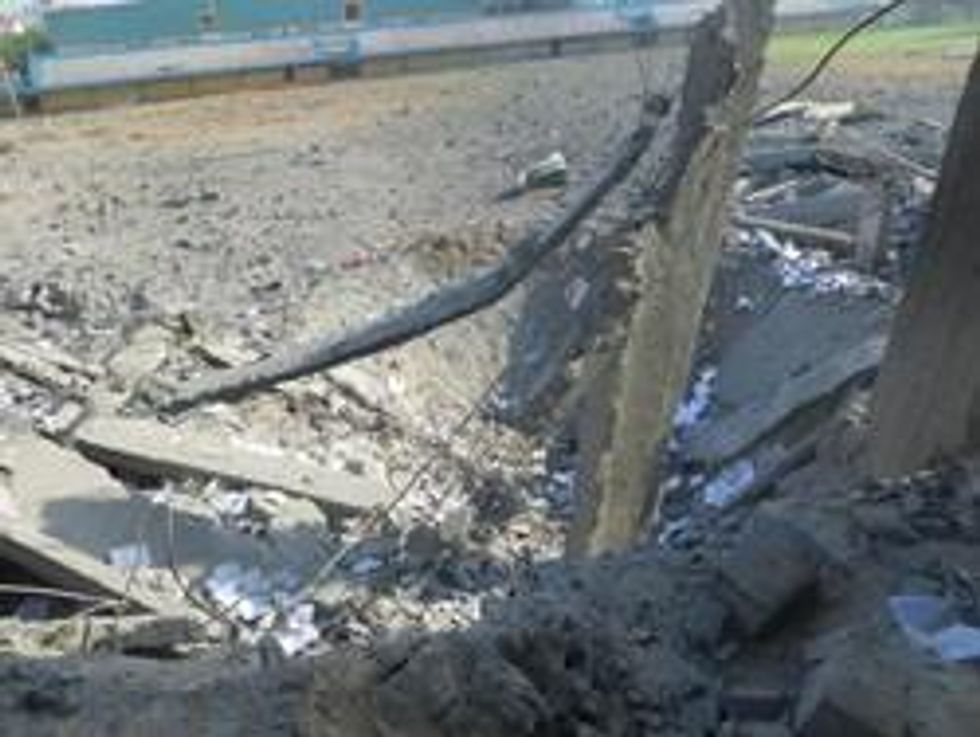
Let's start with a fact. On November 16, the Israeli Air Force bombed the 10,000-seat Palestine Stadium "into ruins." The stadium also headquartered the center for youth sports programs throughout the Gaza Strip. This is the second time Israel has flattened the facility. The first was in 2006 and the people of Gaza have spent the last six years rebuilding the fields, stands, and offices to keep the national soccer team as well as club sports alive in the region.
For those attending daily demonstrations against the carnage, this news of a stadium's destruction must also be seen as an irrelevancy. After all according to The Wall Street Journal, 90 Palestinians, including 50 civilians, have been killed in Gaza. 225 children are among the more than 700 injured and these numbers are climbing. Israeli ground troops are massing at the border and President Obama can only bring himself to defend Israel without criticism. There is only so much concern for a stadium people can be expected to muster.
I think however that we should all take a moment to ask the question, "Why?" Why has the Palestinian sports infrastructure, not to mention Palestinian athletes, always been a target of the Israeli military? Why has the Palestinian domestic soccer league only completed seven seasons since its founding in 1977? Why are players commonly subjected to harassment and violence, not to mention curfews, checkpoints, and all sorts of legal restrictions on their movement? Why were national team players Ayman Alkurd, Shadi Sbakhe and Wajeh Moshate killed by the Israeli Defense Forces during the 2009 military campaign? Why did imprisoned national team player Mahmoud Sarsak require a hunger strike, the international solidarity campaign of Amnesty International, and a formal protest from both FIFA and the 50,000-player soccer union FIFpro to just to win his freedom after three years behind bars?
The answer is simple. Sports is more than loved in Gaza (and it is loved.) It's an expression of humanity for those living under occupation. It's not just soccer and it's not just the boys. Everyone plays, with handball, volleyball, and basketball joining soccer as the most popular choices. To have several thousand people gather to watch a girls sporting event is a way of life. It's a community event designed not only to cheer those on the field, but cheer those in the stands. As one Palestinian man from Gaza said to me, "[Sports] is our time to forget where we are and remember who we are."
Attacking the athletic infrastructure is about attacking the idea that joy, normalcy, or a universally recognizable humanity could ever be a part of life for a Palestinian child. This is a critical for Israel both internationally and at home. The only way the Israeli government and its allies can continue to act with such brazen disregard for civilian life is if they convince the world that their adversaries collectively are less than human. The subway ads calling Muslims "savages", the Islamophobic cartoons and videos that are held up as examples of free speech, are all part of a quilt that says some deaths are not to be mourned.
At home, attacking sports is about nothing less than killing hope. Israel's total war, underwritten by the United States, is a war not only on Hamas or military installations but on the idea that life can ever be so carefree in Gaza as to involve play. The objective instead is to hear these words of a young girl outside Al Shifa Hospital on November 18th who said, "To the world and people: Why should we be killed and why shouldn't we have a normal childhood? What did we do to face all this?"
If you play, you can dream. If you dream, you are imagining a better world. As the great Olympian Wilma Rudolph said, "Never underestimate the power of dreams and the influence of the human spirit. The potential for greatness lives within each of us." Nothing marks the nihilism of Israel's project quite like this fact: they don't want the people of Gaza to dream. In the eyes of Benjamin Netanyahu, they are only worthy of nightmares.
Let's start with a fact. On November 16, the Israeli Air Force bombed the 10,000-seat Palestine Stadium "into ruins." The stadium also headquartered the center for youth sports programs throughout the Gaza Strip. This is the second time Israel has flattened the facility. The first was in 2006 and the people of Gaza have spent the last six years rebuilding the fields, stands, and offices to keep the national soccer team as well as club sports alive in the region.
For those attending daily demonstrations against the carnage, this news of a stadium's destruction must also be seen as an irrelevancy. After all according to The Wall Street Journal, 90 Palestinians, including 50 civilians, have been killed in Gaza. 225 children are among the more than 700 injured and these numbers are climbing. Israeli ground troops are massing at the border and President Obama can only bring himself to defend Israel without criticism. There is only so much concern for a stadium people can be expected to muster.
I think however that we should all take a moment to ask the question, "Why?" Why has the Palestinian sports infrastructure, not to mention Palestinian athletes, always been a target of the Israeli military? Why has the Palestinian domestic soccer league only completed seven seasons since its founding in 1977? Why are players commonly subjected to harassment and violence, not to mention curfews, checkpoints, and all sorts of legal restrictions on their movement? Why were national team players Ayman Alkurd, Shadi Sbakhe and Wajeh Moshate killed by the Israeli Defense Forces during the 2009 military campaign? Why did imprisoned national team player Mahmoud Sarsak require a hunger strike, the international solidarity campaign of Amnesty International, and a formal protest from both FIFA and the 50,000-player soccer union FIFpro to just to win his freedom after three years behind bars?
The answer is simple. Sports is more than loved in Gaza (and it is loved.) It's an expression of humanity for those living under occupation. It's not just soccer and it's not just the boys. Everyone plays, with handball, volleyball, and basketball joining soccer as the most popular choices. To have several thousand people gather to watch a girls sporting event is a way of life. It's a community event designed not only to cheer those on the field, but cheer those in the stands. As one Palestinian man from Gaza said to me, "[Sports] is our time to forget where we are and remember who we are."
Attacking the athletic infrastructure is about attacking the idea that joy, normalcy, or a universally recognizable humanity could ever be a part of life for a Palestinian child. This is a critical for Israel both internationally and at home. The only way the Israeli government and its allies can continue to act with such brazen disregard for civilian life is if they convince the world that their adversaries collectively are less than human. The subway ads calling Muslims "savages", the Islamophobic cartoons and videos that are held up as examples of free speech, are all part of a quilt that says some deaths are not to be mourned.
At home, attacking sports is about nothing less than killing hope. Israel's total war, underwritten by the United States, is a war not only on Hamas or military installations but on the idea that life can ever be so carefree in Gaza as to involve play. The objective instead is to hear these words of a young girl outside Al Shifa Hospital on November 18th who said, "To the world and people: Why should we be killed and why shouldn't we have a normal childhood? What did we do to face all this?"
If you play, you can dream. If you dream, you are imagining a better world. As the great Olympian Wilma Rudolph said, "Never underestimate the power of dreams and the influence of the human spirit. The potential for greatness lives within each of us." Nothing marks the nihilism of Israel's project quite like this fact: they don't want the people of Gaza to dream. In the eyes of Benjamin Netanyahu, they are only worthy of nightmares.
Let's start with a fact. On November 16, the Israeli Air Force bombed the 10,000-seat Palestine Stadium "into ruins." The stadium also headquartered the center for youth sports programs throughout the Gaza Strip. This is the second time Israel has flattened the facility. The first was in 2006 and the people of Gaza have spent the last six years rebuilding the fields, stands, and offices to keep the national soccer team as well as club sports alive in the region.
For those attending daily demonstrations against the carnage, this news of a stadium's destruction must also be seen as an irrelevancy. After all according to The Wall Street Journal, 90 Palestinians, including 50 civilians, have been killed in Gaza. 225 children are among the more than 700 injured and these numbers are climbing. Israeli ground troops are massing at the border and President Obama can only bring himself to defend Israel without criticism. There is only so much concern for a stadium people can be expected to muster.
I think however that we should all take a moment to ask the question, "Why?" Why has the Palestinian sports infrastructure, not to mention Palestinian athletes, always been a target of the Israeli military? Why has the Palestinian domestic soccer league only completed seven seasons since its founding in 1977? Why are players commonly subjected to harassment and violence, not to mention curfews, checkpoints, and all sorts of legal restrictions on their movement? Why were national team players Ayman Alkurd, Shadi Sbakhe and Wajeh Moshate killed by the Israeli Defense Forces during the 2009 military campaign? Why did imprisoned national team player Mahmoud Sarsak require a hunger strike, the international solidarity campaign of Amnesty International, and a formal protest from both FIFA and the 50,000-player soccer union FIFpro to just to win his freedom after three years behind bars?
The answer is simple. Sports is more than loved in Gaza (and it is loved.) It's an expression of humanity for those living under occupation. It's not just soccer and it's not just the boys. Everyone plays, with handball, volleyball, and basketball joining soccer as the most popular choices. To have several thousand people gather to watch a girls sporting event is a way of life. It's a community event designed not only to cheer those on the field, but cheer those in the stands. As one Palestinian man from Gaza said to me, "[Sports] is our time to forget where we are and remember who we are."
Attacking the athletic infrastructure is about attacking the idea that joy, normalcy, or a universally recognizable humanity could ever be a part of life for a Palestinian child. This is a critical for Israel both internationally and at home. The only way the Israeli government and its allies can continue to act with such brazen disregard for civilian life is if they convince the world that their adversaries collectively are less than human. The subway ads calling Muslims "savages", the Islamophobic cartoons and videos that are held up as examples of free speech, are all part of a quilt that says some deaths are not to be mourned.
At home, attacking sports is about nothing less than killing hope. Israel's total war, underwritten by the United States, is a war not only on Hamas or military installations but on the idea that life can ever be so carefree in Gaza as to involve play. The objective instead is to hear these words of a young girl outside Al Shifa Hospital on November 18th who said, "To the world and people: Why should we be killed and why shouldn't we have a normal childhood? What did we do to face all this?"
If you play, you can dream. If you dream, you are imagining a better world. As the great Olympian Wilma Rudolph said, "Never underestimate the power of dreams and the influence of the human spirit. The potential for greatness lives within each of us." Nothing marks the nihilism of Israel's project quite like this fact: they don't want the people of Gaza to dream. In the eyes of Benjamin Netanyahu, they are only worthy of nightmares.