

Happy Labor Day!
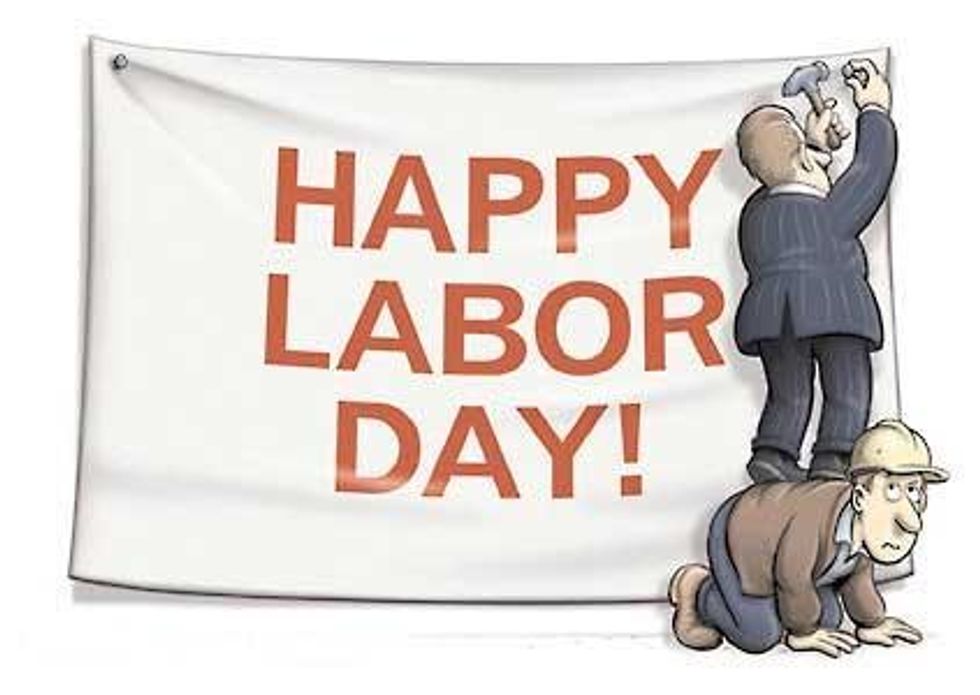
And what better time than this annual celebration of America's working stiffs to draw attention to our national economic recovery?
As those attached to the Dow Jones Average can attest, the economy is now perking along quite nicely, with the Dow up 57 percent since the dark days of 2009, presently soaring above 13,000. Also, the nation's pile of wealth has grown impressively, executive paychecks have zoomed back up to Zip-a-Dee-Doo-Dah levels, and sales at stores like Neiman Marcus and Saks Fifth Avenue are absolutely crackerjack!
The only little cloud over this otherwise sunshiny recovery is ... well, you. You people for whom Labor Day is named, that is.
Not only did Wall Street's crash knock jobs, wages, benefits, homeownership and middle-class opportunities into the ditch, but they're still stuck there -- and even sinking lower. Yet the financial elites, political establishment and media powers remain rapturously focused on the Dow, uncaring about the precipitous decline in the Doug Jones Average.
If Doug and Donna aren't prospering, neither is America, no matter how much wealth the privileged few are lavishing on luxury goods or socking away in offshore tax havens.
The stark status of the Doug was dramatically highlighted in an Aug. 24 report from the Labor Department on laid-off workers. Of the 6.1 million Americans who lost stable jobs since 2009, when the "recovery" officially began, nearly half are still out of work.
Also, more than half of those who did find jobs took big hits in pay, thus whacking their families' standard of living and holding back the economy's critically needed revival of consumer spending.
Those who've been knocked down are mostly not low-skilled poor people, but middle-class folks like Andrew McMenemy, whose software firm pulled the plug on his $80,000-a-year high-tech job in 2010. He has finally found another job, but it pays under $20,000 a year, with no benefits. At 53 years of age, McMenemy has had to move in with his father.
Knocking down the middle class is economically stupid, socially dangerous and morally wrong. The fact is that today's corporate and political leaders are wretchedly bad gardeners -- by tending to the moneyed few and ignoring America's workaday majority, they're watering the weeds and pulling the flowers.
Where's that going to lead us? Don't look now, but according to a slew of corporate executives, government policy-makers and media cheerleaders, our future is on Mars. Not that we have to move there, but we're told we can see the future in NASA's lovable Mars rover, named "Curiosity." It's presently scooting around the red planet with human-like dexterity and abilities.
Meanwhile, back on Earth, a Philips Electronics plant in the Netherlands has 128 Curiosity-styled robots making electric shavers. They are doing the same work that it takes 10 times that many humans to.
As an Aug. 19 New York Times article marveled, the arms of these techno-creatures "work with yoga-like flexibility ... well beyond the capability of the most dexterous human." Plus, exclaimed the Times, "they do it all without a coffee break -- three shifts a day, 365 days a year."
Corporations have hundreds of fully robotized manufacturing plants already in operation or planned, employing robots that are far more sophisticated than the ones pioneered by the auto industry. The manager of the Philips factory says, "(With these robots,) we can make any consumer device in the world."
Indeed, Apple's iPhone-maker in China plans to install more than a million robots to displace untold numbers of workers there. Likewise, robots are now assembling Boeing's wide-body jets, packing California lettuce in shipping boxes, making Hyundai and Tesla cars, and operating our nation's largest grocery warehouse. The Times says flatly: "This is the future."
Oh? So, what are millions of displaced human workers to do? No one knows. Worse, there's no planning for or even thinking about planning for the human future. Instead, we're getting balderdash and BS from such high-tech camp followers as Times columnist Tom Friedman, who recently gushed about the robot revolution: "This is the march of progress."
Embrace the robot economy, we're told, for it will "make America more competitive."
"More competitive" for whom and to what end? Too often, we've seen the power elites wave the flag of "progress" as they march right over the well-being of the many -- and here they come again.
Millions of unwitting working families are about to be displaced by this autocratic and avaricious rush for robotic profits. Now is the time to start a national debate on the true cost of this shift -- and to demand that we humans be factored into their "revolution."
Happy Labor Day!
And what better time than this annual celebration of America's working stiffs to draw attention to our national economic recovery?
As those attached to the Dow Jones Average can attest, the economy is now perking along quite nicely, with the Dow up 57 percent since the dark days of 2009, presently soaring above 13,000. Also, the nation's pile of wealth has grown impressively, executive paychecks have zoomed back up to Zip-a-Dee-Doo-Dah levels, and sales at stores like Neiman Marcus and Saks Fifth Avenue are absolutely crackerjack!
The only little cloud over this otherwise sunshiny recovery is ... well, you. You people for whom Labor Day is named, that is.
Not only did Wall Street's crash knock jobs, wages, benefits, homeownership and middle-class opportunities into the ditch, but they're still stuck there -- and even sinking lower. Yet the financial elites, political establishment and media powers remain rapturously focused on the Dow, uncaring about the precipitous decline in the Doug Jones Average.
If Doug and Donna aren't prospering, neither is America, no matter how much wealth the privileged few are lavishing on luxury goods or socking away in offshore tax havens.
The stark status of the Doug was dramatically highlighted in an Aug. 24 report from the Labor Department on laid-off workers. Of the 6.1 million Americans who lost stable jobs since 2009, when the "recovery" officially began, nearly half are still out of work.
Also, more than half of those who did find jobs took big hits in pay, thus whacking their families' standard of living and holding back the economy's critically needed revival of consumer spending.
Those who've been knocked down are mostly not low-skilled poor people, but middle-class folks like Andrew McMenemy, whose software firm pulled the plug on his $80,000-a-year high-tech job in 2010. He has finally found another job, but it pays under $20,000 a year, with no benefits. At 53 years of age, McMenemy has had to move in with his father.
Knocking down the middle class is economically stupid, socially dangerous and morally wrong. The fact is that today's corporate and political leaders are wretchedly bad gardeners -- by tending to the moneyed few and ignoring America's workaday majority, they're watering the weeds and pulling the flowers.
Where's that going to lead us? Don't look now, but according to a slew of corporate executives, government policy-makers and media cheerleaders, our future is on Mars. Not that we have to move there, but we're told we can see the future in NASA's lovable Mars rover, named "Curiosity." It's presently scooting around the red planet with human-like dexterity and abilities.
Meanwhile, back on Earth, a Philips Electronics plant in the Netherlands has 128 Curiosity-styled robots making electric shavers. They are doing the same work that it takes 10 times that many humans to.
As an Aug. 19 New York Times article marveled, the arms of these techno-creatures "work with yoga-like flexibility ... well beyond the capability of the most dexterous human." Plus, exclaimed the Times, "they do it all without a coffee break -- three shifts a day, 365 days a year."
Corporations have hundreds of fully robotized manufacturing plants already in operation or planned, employing robots that are far more sophisticated than the ones pioneered by the auto industry. The manager of the Philips factory says, "(With these robots,) we can make any consumer device in the world."
Indeed, Apple's iPhone-maker in China plans to install more than a million robots to displace untold numbers of workers there. Likewise, robots are now assembling Boeing's wide-body jets, packing California lettuce in shipping boxes, making Hyundai and Tesla cars, and operating our nation's largest grocery warehouse. The Times says flatly: "This is the future."
Oh? So, what are millions of displaced human workers to do? No one knows. Worse, there's no planning for or even thinking about planning for the human future. Instead, we're getting balderdash and BS from such high-tech camp followers as Times columnist Tom Friedman, who recently gushed about the robot revolution: "This is the march of progress."
Embrace the robot economy, we're told, for it will "make America more competitive."
"More competitive" for whom and to what end? Too often, we've seen the power elites wave the flag of "progress" as they march right over the well-being of the many -- and here they come again.
Millions of unwitting working families are about to be displaced by this autocratic and avaricious rush for robotic profits. Now is the time to start a national debate on the true cost of this shift -- and to demand that we humans be factored into their "revolution."
Happy Labor Day!
And what better time than this annual celebration of America's working stiffs to draw attention to our national economic recovery?
As those attached to the Dow Jones Average can attest, the economy is now perking along quite nicely, with the Dow up 57 percent since the dark days of 2009, presently soaring above 13,000. Also, the nation's pile of wealth has grown impressively, executive paychecks have zoomed back up to Zip-a-Dee-Doo-Dah levels, and sales at stores like Neiman Marcus and Saks Fifth Avenue are absolutely crackerjack!
The only little cloud over this otherwise sunshiny recovery is ... well, you. You people for whom Labor Day is named, that is.
Not only did Wall Street's crash knock jobs, wages, benefits, homeownership and middle-class opportunities into the ditch, but they're still stuck there -- and even sinking lower. Yet the financial elites, political establishment and media powers remain rapturously focused on the Dow, uncaring about the precipitous decline in the Doug Jones Average.
If Doug and Donna aren't prospering, neither is America, no matter how much wealth the privileged few are lavishing on luxury goods or socking away in offshore tax havens.
The stark status of the Doug was dramatically highlighted in an Aug. 24 report from the Labor Department on laid-off workers. Of the 6.1 million Americans who lost stable jobs since 2009, when the "recovery" officially began, nearly half are still out of work.
Also, more than half of those who did find jobs took big hits in pay, thus whacking their families' standard of living and holding back the economy's critically needed revival of consumer spending.
Those who've been knocked down are mostly not low-skilled poor people, but middle-class folks like Andrew McMenemy, whose software firm pulled the plug on his $80,000-a-year high-tech job in 2010. He has finally found another job, but it pays under $20,000 a year, with no benefits. At 53 years of age, McMenemy has had to move in with his father.
Knocking down the middle class is economically stupid, socially dangerous and morally wrong. The fact is that today's corporate and political leaders are wretchedly bad gardeners -- by tending to the moneyed few and ignoring America's workaday majority, they're watering the weeds and pulling the flowers.
Where's that going to lead us? Don't look now, but according to a slew of corporate executives, government policy-makers and media cheerleaders, our future is on Mars. Not that we have to move there, but we're told we can see the future in NASA's lovable Mars rover, named "Curiosity." It's presently scooting around the red planet with human-like dexterity and abilities.
Meanwhile, back on Earth, a Philips Electronics plant in the Netherlands has 128 Curiosity-styled robots making electric shavers. They are doing the same work that it takes 10 times that many humans to.
As an Aug. 19 New York Times article marveled, the arms of these techno-creatures "work with yoga-like flexibility ... well beyond the capability of the most dexterous human." Plus, exclaimed the Times, "they do it all without a coffee break -- three shifts a day, 365 days a year."
Corporations have hundreds of fully robotized manufacturing plants already in operation or planned, employing robots that are far more sophisticated than the ones pioneered by the auto industry. The manager of the Philips factory says, "(With these robots,) we can make any consumer device in the world."
Indeed, Apple's iPhone-maker in China plans to install more than a million robots to displace untold numbers of workers there. Likewise, robots are now assembling Boeing's wide-body jets, packing California lettuce in shipping boxes, making Hyundai and Tesla cars, and operating our nation's largest grocery warehouse. The Times says flatly: "This is the future."
Oh? So, what are millions of displaced human workers to do? No one knows. Worse, there's no planning for or even thinking about planning for the human future. Instead, we're getting balderdash and BS from such high-tech camp followers as Times columnist Tom Friedman, who recently gushed about the robot revolution: "This is the march of progress."
Embrace the robot economy, we're told, for it will "make America more competitive."
"More competitive" for whom and to what end? Too often, we've seen the power elites wave the flag of "progress" as they march right over the well-being of the many -- and here they come again.
Millions of unwitting working families are about to be displaced by this autocratic and avaricious rush for robotic profits. Now is the time to start a national debate on the true cost of this shift -- and to demand that we humans be factored into their "revolution."