
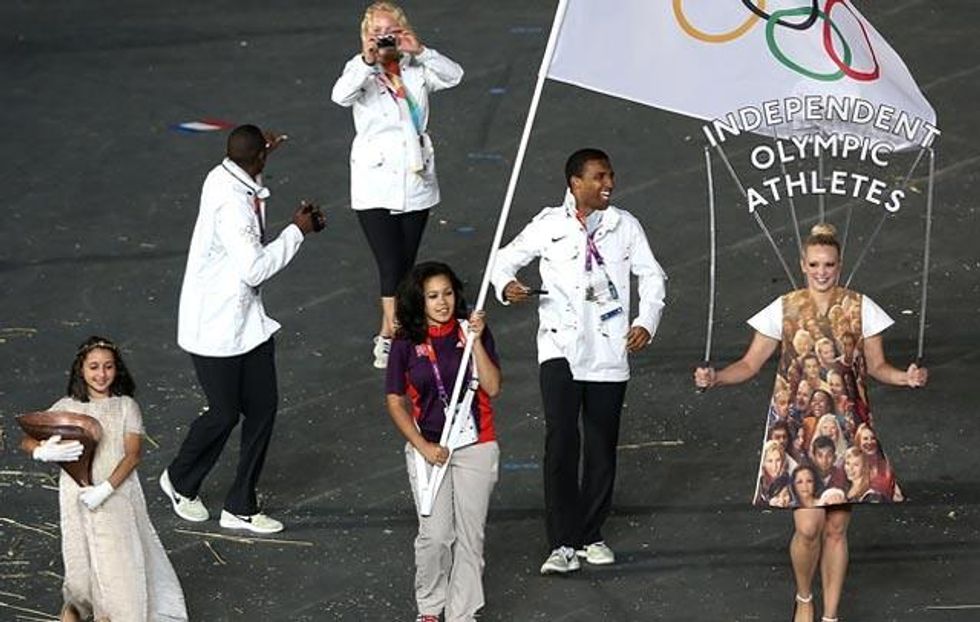
If you watched the opening ceremony for the Olympic games in London, it was hard to miss the self-described "independent Olympians." There were four of them: Guor Marial, Philipine van Aanholt, Reginald de Windt, and Lee-Marvin Bonevacia. In a celebration of international competition, their presence stood out because they were, in effect, stateless.
A stateless person is broadly defined as someone without a nationality. Though the UN's Declaration of Human Rights states that everyone has a right to a nationality, there are an estimated 12 million people worldwide who are stateless; some estimates say that the number is closer to 20 million. That number would be substantially higher if the United Nations also counted Palestinians, according to Sebastian Kohn, a program officer at the Open Society Institute.
"We believe this is a serious issue in particular because of the link to other human rights violations," says Kohn. "A big challenge in this field is that there are still relatively few actors working on this. We need to see a lot more action from governments, the UN, and civil society to try to address this problem."
So just how did this year's independent Olympians arrive at their statelessnes? As Deadspin pointed out shortly after the ceremony, the reasons were both political and logistic: Guor Marial, a marathoner, was born into civil war in what is now South Sudan. The bloodshed claimed two million lives, including eight of Marial's siblings and 25 family members in total. The violence led him to flee the country at 8 years old, first to Kenya, then to Egypt, before finally settling in Arizona. South Sudan, the world's newest nation, has yet to form a national committee that's required for countries to participate in the games, and even though Sudan extended Marial an invitation to represent that country in the games, he refused.
"Some things are more important than Olympic glory," he said recently. "If I ran for Sudan, I would be betraying my people. I would be dishonoring the two million people who died for our freedom. I want to bring honor to my country. People who just want glory, the spotlight of the Olympics, they don't care about other people. I'm fighting for independent status because I do care. When I run, I want people to see me and say, 'He is from South Sudan.' "
Still without a passport, Marial wasn't able to travel to London in time for the opening ceremony. So he watched like most of the rest of us did--while eating pizza with friends in Flagstaff, Ariz.
Reginald de Windt, a judoka, Lee-Marvin Bonevacia, a distance runner, and Philipine van Aanholt, a sailor, are all from Curaco, a former country that was part of the Netherlands Antilles. The Netherlands Antilles dissolved itself as an independent nation back in 2010, and the International Olympic Committee (IOC) no longer recognized it. Instead of competing under the Dutch flag, for which they held no real allegiance, the three athletes petitioned the committee to compete independently.
While these athletes aren't the first to compete independently at the Olympics, their stories mirror those of other stateless residents. Kohn, of the Open Society Institute, notes that the two main drivers of statelessness are discrimination and state secession, particularly in countries with often violent tensions between ethnic groups. In countries like Kuwait and Saudi Arabia, women are not allowed to pass on nationality to their offspring.
The impact of statelessness can be devastating.
Many live in poverty, are forced into underground economies, and some are at higher risk of human trafficking, according to human rights advocates. Kohn describes a vicious cycle in which stateless people are often held in detention because they are not legally allowed to be in their country of residence, but can't be deported because another country won't claim them.
Abraham Paulos knows this cycle well. As executive director of Families for Freedom, a New York City-based non-profit that works with people in the U.S. who are in deportation proceedings, Paulos says that he works with stateless residents "about once a month," and that many times people don't know they're stateless until they try to travel abroad and realize that they can't apply for a passport.
He can also speak from first-hand experience. Paulos was born in Sudan to Eritrean parents during that country's long war for independence against Ethiopia. His family later relocated to Chicago as an Ethiopian refugee, where he spent his childhood and obtained a green card. When Eritrea finally seceded from Ethiopia, the country no longer recognized Paulos as a citizen. Yet neither did Eritrea, because he was born in Sudan. The same went for Sudan.
"What we're really talking about is the law of the blood and the law of the soil," Paulos told me. "It's unlike some western states, like America, where if you're born on the land you have automatic citizenship. That's not the case for the majority of the countries. For the majority [of the world] it's the law of the blood."
For Paulos, the issue shows just how capricious man-made borders can be.
"We feel that if capital can move across borders, then so can people," he says. "There's no physical borders, just documents. It's more or less how we document a person and how that documentation reflects certain rights that person can have."
If you watched the opening ceremony for the Olympic games in London, it was hard to miss the self-described "independent Olympians." There were four of them: Guor Marial, Philipine van Aanholt, Reginald de Windt, and Lee-Marvin Bonevacia. In a celebration of international competition, their presence stood out because they were, in effect, stateless.
A stateless person is broadly defined as someone without a nationality. Though the UN's Declaration of Human Rights states that everyone has a right to a nationality, there are an estimated 12 million people worldwide who are stateless; some estimates say that the number is closer to 20 million. That number would be substantially higher if the United Nations also counted Palestinians, according to Sebastian Kohn, a program officer at the Open Society Institute.
"We believe this is a serious issue in particular because of the link to other human rights violations," says Kohn. "A big challenge in this field is that there are still relatively few actors working on this. We need to see a lot more action from governments, the UN, and civil society to try to address this problem."
So just how did this year's independent Olympians arrive at their statelessnes? As Deadspin pointed out shortly after the ceremony, the reasons were both political and logistic: Guor Marial, a marathoner, was born into civil war in what is now South Sudan. The bloodshed claimed two million lives, including eight of Marial's siblings and 25 family members in total. The violence led him to flee the country at 8 years old, first to Kenya, then to Egypt, before finally settling in Arizona. South Sudan, the world's newest nation, has yet to form a national committee that's required for countries to participate in the games, and even though Sudan extended Marial an invitation to represent that country in the games, he refused.
"Some things are more important than Olympic glory," he said recently. "If I ran for Sudan, I would be betraying my people. I would be dishonoring the two million people who died for our freedom. I want to bring honor to my country. People who just want glory, the spotlight of the Olympics, they don't care about other people. I'm fighting for independent status because I do care. When I run, I want people to see me and say, 'He is from South Sudan.' "
Still without a passport, Marial wasn't able to travel to London in time for the opening ceremony. So he watched like most of the rest of us did--while eating pizza with friends in Flagstaff, Ariz.
Reginald de Windt, a judoka, Lee-Marvin Bonevacia, a distance runner, and Philipine van Aanholt, a sailor, are all from Curaco, a former country that was part of the Netherlands Antilles. The Netherlands Antilles dissolved itself as an independent nation back in 2010, and the International Olympic Committee (IOC) no longer recognized it. Instead of competing under the Dutch flag, for which they held no real allegiance, the three athletes petitioned the committee to compete independently.
While these athletes aren't the first to compete independently at the Olympics, their stories mirror those of other stateless residents. Kohn, of the Open Society Institute, notes that the two main drivers of statelessness are discrimination and state secession, particularly in countries with often violent tensions between ethnic groups. In countries like Kuwait and Saudi Arabia, women are not allowed to pass on nationality to their offspring.
The impact of statelessness can be devastating.
Many live in poverty, are forced into underground economies, and some are at higher risk of human trafficking, according to human rights advocates. Kohn describes a vicious cycle in which stateless people are often held in detention because they are not legally allowed to be in their country of residence, but can't be deported because another country won't claim them.
Abraham Paulos knows this cycle well. As executive director of Families for Freedom, a New York City-based non-profit that works with people in the U.S. who are in deportation proceedings, Paulos says that he works with stateless residents "about once a month," and that many times people don't know they're stateless until they try to travel abroad and realize that they can't apply for a passport.
He can also speak from first-hand experience. Paulos was born in Sudan to Eritrean parents during that country's long war for independence against Ethiopia. His family later relocated to Chicago as an Ethiopian refugee, where he spent his childhood and obtained a green card. When Eritrea finally seceded from Ethiopia, the country no longer recognized Paulos as a citizen. Yet neither did Eritrea, because he was born in Sudan. The same went for Sudan.
"What we're really talking about is the law of the blood and the law of the soil," Paulos told me. "It's unlike some western states, like America, where if you're born on the land you have automatic citizenship. That's not the case for the majority of the countries. For the majority [of the world] it's the law of the blood."
For Paulos, the issue shows just how capricious man-made borders can be.
"We feel that if capital can move across borders, then so can people," he says. "There's no physical borders, just documents. It's more or less how we document a person and how that documentation reflects certain rights that person can have."
If you watched the opening ceremony for the Olympic games in London, it was hard to miss the self-described "independent Olympians." There were four of them: Guor Marial, Philipine van Aanholt, Reginald de Windt, and Lee-Marvin Bonevacia. In a celebration of international competition, their presence stood out because they were, in effect, stateless.
A stateless person is broadly defined as someone without a nationality. Though the UN's Declaration of Human Rights states that everyone has a right to a nationality, there are an estimated 12 million people worldwide who are stateless; some estimates say that the number is closer to 20 million. That number would be substantially higher if the United Nations also counted Palestinians, according to Sebastian Kohn, a program officer at the Open Society Institute.
"We believe this is a serious issue in particular because of the link to other human rights violations," says Kohn. "A big challenge in this field is that there are still relatively few actors working on this. We need to see a lot more action from governments, the UN, and civil society to try to address this problem."
So just how did this year's independent Olympians arrive at their statelessnes? As Deadspin pointed out shortly after the ceremony, the reasons were both political and logistic: Guor Marial, a marathoner, was born into civil war in what is now South Sudan. The bloodshed claimed two million lives, including eight of Marial's siblings and 25 family members in total. The violence led him to flee the country at 8 years old, first to Kenya, then to Egypt, before finally settling in Arizona. South Sudan, the world's newest nation, has yet to form a national committee that's required for countries to participate in the games, and even though Sudan extended Marial an invitation to represent that country in the games, he refused.
"Some things are more important than Olympic glory," he said recently. "If I ran for Sudan, I would be betraying my people. I would be dishonoring the two million people who died for our freedom. I want to bring honor to my country. People who just want glory, the spotlight of the Olympics, they don't care about other people. I'm fighting for independent status because I do care. When I run, I want people to see me and say, 'He is from South Sudan.' "
Still without a passport, Marial wasn't able to travel to London in time for the opening ceremony. So he watched like most of the rest of us did--while eating pizza with friends in Flagstaff, Ariz.
Reginald de Windt, a judoka, Lee-Marvin Bonevacia, a distance runner, and Philipine van Aanholt, a sailor, are all from Curaco, a former country that was part of the Netherlands Antilles. The Netherlands Antilles dissolved itself as an independent nation back in 2010, and the International Olympic Committee (IOC) no longer recognized it. Instead of competing under the Dutch flag, for which they held no real allegiance, the three athletes petitioned the committee to compete independently.
While these athletes aren't the first to compete independently at the Olympics, their stories mirror those of other stateless residents. Kohn, of the Open Society Institute, notes that the two main drivers of statelessness are discrimination and state secession, particularly in countries with often violent tensions between ethnic groups. In countries like Kuwait and Saudi Arabia, women are not allowed to pass on nationality to their offspring.
The impact of statelessness can be devastating.
Many live in poverty, are forced into underground economies, and some are at higher risk of human trafficking, according to human rights advocates. Kohn describes a vicious cycle in which stateless people are often held in detention because they are not legally allowed to be in their country of residence, but can't be deported because another country won't claim them.
Abraham Paulos knows this cycle well. As executive director of Families for Freedom, a New York City-based non-profit that works with people in the U.S. who are in deportation proceedings, Paulos says that he works with stateless residents "about once a month," and that many times people don't know they're stateless until they try to travel abroad and realize that they can't apply for a passport.
He can also speak from first-hand experience. Paulos was born in Sudan to Eritrean parents during that country's long war for independence against Ethiopia. His family later relocated to Chicago as an Ethiopian refugee, where he spent his childhood and obtained a green card. When Eritrea finally seceded from Ethiopia, the country no longer recognized Paulos as a citizen. Yet neither did Eritrea, because he was born in Sudan. The same went for Sudan.
"What we're really talking about is the law of the blood and the law of the soil," Paulos told me. "It's unlike some western states, like America, where if you're born on the land you have automatic citizenship. That's not the case for the majority of the countries. For the majority [of the world] it's the law of the blood."
For Paulos, the issue shows just how capricious man-made borders can be.
"We feel that if capital can move across borders, then so can people," he says. "There's no physical borders, just documents. It's more or less how we document a person and how that documentation reflects certain rights that person can have."