
For the second time in my life, I find myself in need of cancer care. Somehow it seems the universe conspires to put me in settings where I observe and can report on the on-going insanity of the dysfunctional U.S. healthcare system. Such was the case this week as I sat in the oncology infusion center near a prestigious medical center.
The need for a progressively financed, single standard of high quality care for all under a social insurance model - like Medicare for all for life - has never been clearer to me than it was this week. The enemy faced in cancer treatment is not the cancer itself.
Every patient is different in terms of how he or she handles cancer diagnosis and treatment. While we have built such a culture of terror around the word and the disease, having cancer does not necessarily mean one will die from cancer. It is a serious thing, but in many cases early detection and treatment means being a cancer survivor is a more likely outcome than being a cancer casualty. I like to face most of my tests and appointments alone. So for this week's visit to the infusion center, I was on my own while my husband went to his usual Friday golf play. That seems so good and normal to me in the face of something sort of lousy overall. And I like the feeling of that illusion of normalcy. Other patients bring friends or family along for support.
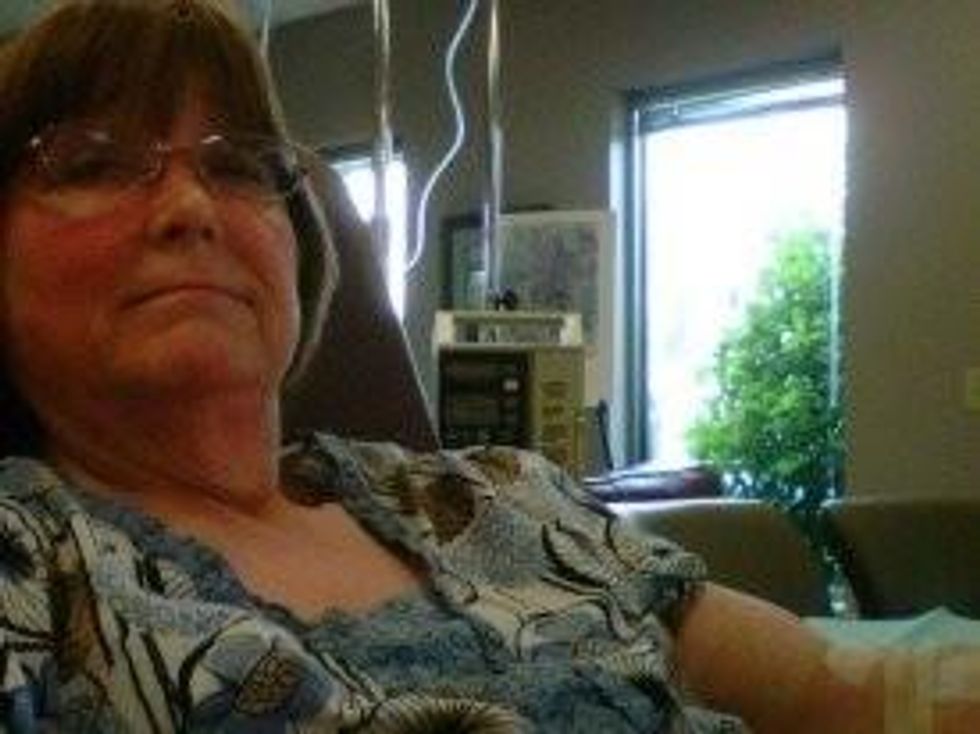
Inside the oncology center, there are banks of recliners with large arms that can accommodate I.V. lines and set-ups for drug infusions. There are four areas with four chairs each, and each section is staffed by one oncology nurse. Emily was my nurse. She asked me which chair I wanted since I was her first patient of the day, and I chose the chair where I could see everywhere else in the center. I told her I like to watch all the activity and she said that was different since most of her patients chose to sit nearest the windows. She brought my medicine, had me verify it was mine, and then hooked up my I.V., drew blood samples, and got the infusion rolling. I kicked back in the chair. Another patient in another section wore her Pittsburgh Steelers "Snuggie." That made me feel better somehow, even though I'm a Bronco's fan.
Soon, other patients arrived one by one to fill the stations. Then I noticed a couple of terrible realities. There was a woman circulating and visiting each patient as they were being infused. She identified herself as being from the financial office of the oncology practice, and on her clipboard she carried the printouts of each person's insurance and personal payment situation. She would ask quietly, "Do you have concerns about how you will cover your portion of the bills?" I felt sicker. Imagine that.
Another patient was told she'd need to pick up from her pharmacy on the way home a medication delivered in patch form that was highly recommended for use with her particular kind of chemo. She asked the nurse how expensive the patch is, and the nurse said, "It's pricey." When no one else was there, the woman used her cell phone to call the pharmacy to check on the cost of that patch. I watched her face as she heard, and though I couldn't hear the amount, I knew. She gazed out the window. When she looked back my way, I just nodded to her and smiled a bit, as I didn't want to embarrass her any more than the sick situation already had.
In yet another chair, a male patient asked how much longer his infusion would take. "I have to get to work soon. I missed too much time lately," he told Emily. She looked at the I.V. bag and told him he'd be done by noon, and he seemed comforted about that. His wife gave him a brownie and a bottle of water. I shared his worry about getting my infusion done. I was fighting feeling a bit "icky," but I didn't want anyone to notice that lest they keep me longer and delay my arrival at work.
I felt like I was watching the most horrific drama unfolding, and none of that drama was because of the cancer each of us face. The problems all related to the broken, profit-first, U.S. healthcare system controlled almost entirely by corporate interests. Cancer patients worried about money, jobs, and insurance coverage. And nurses handling four patients at a time - all of whom needed a different sort of human understanding and care - try to provide so much compassion, but it really is not possible for them to fix what is so broken. Emily told me she looked over at me a couple times and that I looked so sad. She was right, but I hadn't realized it showed.
I read a good piece recently about single-payer reform and how it would improve access to cancer care. "A study from the journal Health Affairs found that those enrolled in Medicare, the national single-payer plan, had fewer problems obtaining needed medical care, less financial hardship and higher satisfaction scores than those in private plans." Read the whole piece.
But in the infusion center, I couldn't help but think how different this scene would be for us all if we had that system we deserve to give one another - Medicare for all for life. There would have been worries and fear. But those worries would surround getting better and stronger and fighting the cancer, not worrying about the insurance company, the costs of medications, and employers who might just not want cancer patients as employees. The Los Angeles Times reported this week that a bill to allow states to move toward such a plan is pending. "In California's case, it would make coverage available to the roughly 7 million people now lacking health insurance." But that's still a long way from reality in the cancer center where I was, and for millions of us all over this nation.
For the second time in my life, I find myself in need of cancer care. Somehow it seems the universe conspires to put me in settings where I observe and can report on the on-going insanity of the dysfunctional U.S. healthcare system. Such was the case this week as I sat in the oncology infusion center near a prestigious medical center.
The need for a progressively financed, single standard of high quality care for all under a social insurance model - like Medicare for all for life - has never been clearer to me than it was this week. The enemy faced in cancer treatment is not the cancer itself.
Every patient is different in terms of how he or she handles cancer diagnosis and treatment. While we have built such a culture of terror around the word and the disease, having cancer does not necessarily mean one will die from cancer. It is a serious thing, but in many cases early detection and treatment means being a cancer survivor is a more likely outcome than being a cancer casualty. I like to face most of my tests and appointments alone. So for this week's visit to the infusion center, I was on my own while my husband went to his usual Friday golf play. That seems so good and normal to me in the face of something sort of lousy overall. And I like the feeling of that illusion of normalcy. Other patients bring friends or family along for support.
Inside the oncology center, there are banks of recliners with large arms that can accommodate I.V. lines and set-ups for drug infusions. There are four areas with four chairs each, and each section is staffed by one oncology nurse. Emily was my nurse. She asked me which chair I wanted since I was her first patient of the day, and I chose the chair where I could see everywhere else in the center. I told her I like to watch all the activity and she said that was different since most of her patients chose to sit nearest the windows. She brought my medicine, had me verify it was mine, and then hooked up my I.V., drew blood samples, and got the infusion rolling. I kicked back in the chair. Another patient in another section wore her Pittsburgh Steelers "Snuggie." That made me feel better somehow, even though I'm a Bronco's fan.
Soon, other patients arrived one by one to fill the stations. Then I noticed a couple of terrible realities. There was a woman circulating and visiting each patient as they were being infused. She identified herself as being from the financial office of the oncology practice, and on her clipboard she carried the printouts of each person's insurance and personal payment situation. She would ask quietly, "Do you have concerns about how you will cover your portion of the bills?" I felt sicker. Imagine that.
Another patient was told she'd need to pick up from her pharmacy on the way home a medication delivered in patch form that was highly recommended for use with her particular kind of chemo. She asked the nurse how expensive the patch is, and the nurse said, "It's pricey." When no one else was there, the woman used her cell phone to call the pharmacy to check on the cost of that patch. I watched her face as she heard, and though I couldn't hear the amount, I knew. She gazed out the window. When she looked back my way, I just nodded to her and smiled a bit, as I didn't want to embarrass her any more than the sick situation already had.
In yet another chair, a male patient asked how much longer his infusion would take. "I have to get to work soon. I missed too much time lately," he told Emily. She looked at the I.V. bag and told him he'd be done by noon, and he seemed comforted about that. His wife gave him a brownie and a bottle of water. I shared his worry about getting my infusion done. I was fighting feeling a bit "icky," but I didn't want anyone to notice that lest they keep me longer and delay my arrival at work.
I felt like I was watching the most horrific drama unfolding, and none of that drama was because of the cancer each of us face. The problems all related to the broken, profit-first, U.S. healthcare system controlled almost entirely by corporate interests. Cancer patients worried about money, jobs, and insurance coverage. And nurses handling four patients at a time - all of whom needed a different sort of human understanding and care - try to provide so much compassion, but it really is not possible for them to fix what is so broken. Emily told me she looked over at me a couple times and that I looked so sad. She was right, but I hadn't realized it showed.
I read a good piece recently about single-payer reform and how it would improve access to cancer care. "A study from the journal Health Affairs found that those enrolled in Medicare, the national single-payer plan, had fewer problems obtaining needed medical care, less financial hardship and higher satisfaction scores than those in private plans." Read the whole piece.
But in the infusion center, I couldn't help but think how different this scene would be for us all if we had that system we deserve to give one another - Medicare for all for life. There would have been worries and fear. But those worries would surround getting better and stronger and fighting the cancer, not worrying about the insurance company, the costs of medications, and employers who might just not want cancer patients as employees. The Los Angeles Times reported this week that a bill to allow states to move toward such a plan is pending. "In California's case, it would make coverage available to the roughly 7 million people now lacking health insurance." But that's still a long way from reality in the cancer center where I was, and for millions of us all over this nation.
For the second time in my life, I find myself in need of cancer care. Somehow it seems the universe conspires to put me in settings where I observe and can report on the on-going insanity of the dysfunctional U.S. healthcare system. Such was the case this week as I sat in the oncology infusion center near a prestigious medical center.
The need for a progressively financed, single standard of high quality care for all under a social insurance model - like Medicare for all for life - has never been clearer to me than it was this week. The enemy faced in cancer treatment is not the cancer itself.
Every patient is different in terms of how he or she handles cancer diagnosis and treatment. While we have built such a culture of terror around the word and the disease, having cancer does not necessarily mean one will die from cancer. It is a serious thing, but in many cases early detection and treatment means being a cancer survivor is a more likely outcome than being a cancer casualty. I like to face most of my tests and appointments alone. So for this week's visit to the infusion center, I was on my own while my husband went to his usual Friday golf play. That seems so good and normal to me in the face of something sort of lousy overall. And I like the feeling of that illusion of normalcy. Other patients bring friends or family along for support.
Inside the oncology center, there are banks of recliners with large arms that can accommodate I.V. lines and set-ups for drug infusions. There are four areas with four chairs each, and each section is staffed by one oncology nurse. Emily was my nurse. She asked me which chair I wanted since I was her first patient of the day, and I chose the chair where I could see everywhere else in the center. I told her I like to watch all the activity and she said that was different since most of her patients chose to sit nearest the windows. She brought my medicine, had me verify it was mine, and then hooked up my I.V., drew blood samples, and got the infusion rolling. I kicked back in the chair. Another patient in another section wore her Pittsburgh Steelers "Snuggie." That made me feel better somehow, even though I'm a Bronco's fan.
Soon, other patients arrived one by one to fill the stations. Then I noticed a couple of terrible realities. There was a woman circulating and visiting each patient as they were being infused. She identified herself as being from the financial office of the oncology practice, and on her clipboard she carried the printouts of each person's insurance and personal payment situation. She would ask quietly, "Do you have concerns about how you will cover your portion of the bills?" I felt sicker. Imagine that.
Another patient was told she'd need to pick up from her pharmacy on the way home a medication delivered in patch form that was highly recommended for use with her particular kind of chemo. She asked the nurse how expensive the patch is, and the nurse said, "It's pricey." When no one else was there, the woman used her cell phone to call the pharmacy to check on the cost of that patch. I watched her face as she heard, and though I couldn't hear the amount, I knew. She gazed out the window. When she looked back my way, I just nodded to her and smiled a bit, as I didn't want to embarrass her any more than the sick situation already had.
In yet another chair, a male patient asked how much longer his infusion would take. "I have to get to work soon. I missed too much time lately," he told Emily. She looked at the I.V. bag and told him he'd be done by noon, and he seemed comforted about that. His wife gave him a brownie and a bottle of water. I shared his worry about getting my infusion done. I was fighting feeling a bit "icky," but I didn't want anyone to notice that lest they keep me longer and delay my arrival at work.
I felt like I was watching the most horrific drama unfolding, and none of that drama was because of the cancer each of us face. The problems all related to the broken, profit-first, U.S. healthcare system controlled almost entirely by corporate interests. Cancer patients worried about money, jobs, and insurance coverage. And nurses handling four patients at a time - all of whom needed a different sort of human understanding and care - try to provide so much compassion, but it really is not possible for them to fix what is so broken. Emily told me she looked over at me a couple times and that I looked so sad. She was right, but I hadn't realized it showed.
I read a good piece recently about single-payer reform and how it would improve access to cancer care. "A study from the journal Health Affairs found that those enrolled in Medicare, the national single-payer plan, had fewer problems obtaining needed medical care, less financial hardship and higher satisfaction scores than those in private plans." Read the whole piece.
But in the infusion center, I couldn't help but think how different this scene would be for us all if we had that system we deserve to give one another - Medicare for all for life. There would have been worries and fear. But those worries would surround getting better and stronger and fighting the cancer, not worrying about the insurance company, the costs of medications, and employers who might just not want cancer patients as employees. The Los Angeles Times reported this week that a bill to allow states to move toward such a plan is pending. "In California's case, it would make coverage available to the roughly 7 million people now lacking health insurance." But that's still a long way from reality in the cancer center where I was, and for millions of us all over this nation.