SUBSCRIBE TO OUR FREE NEWSLETTER
Daily news & progressive opinion—funded by the people, not the corporations—delivered straight to your inbox.
5
#000000
#FFFFFF
To donate by check, phone, or other method, see our More Ways to Give page.
The Washington Post's David Ignatius [on Saturday] persuasively argues that President Obama, in his interview with The Atlantic's Jeffrey Goldberg, issued his most absolute and inflexible threat yet to attack Iran -- not if Iran attacks or is about to attack another country, but merely if it appears to be developing a nuclear weapon:
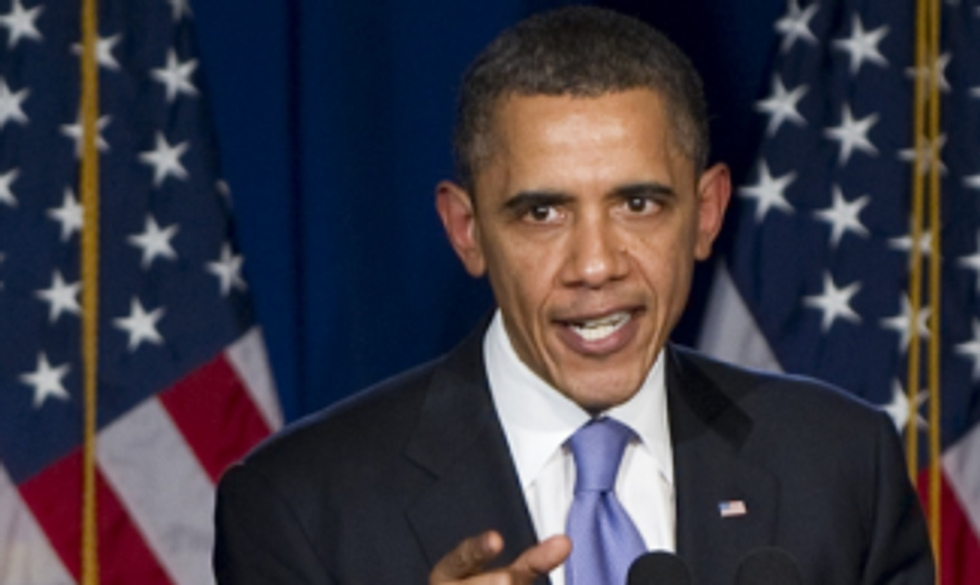
The other point that struck me was Obama's clarity about establishing a "red line" between an Iranian civilian nuclear program (acceptable) and a weapons program (unacceptable). . . . His message to Israel: If the Iranians cross this red line, the United States will attack. . . . Is Obama bluffing? Who can say, but if you're an Iranian decision maker (or, perhaps more important, Netanyahu) you have to weigh a bit more heavily the possibility that the president really does mean what he says.
And that is indeed what Obama did, as Goldberg makes clear in describing the interview:
Obama told me earlier this week that both Iran and Israel should take seriously the possibility of American action against Iran's nuclear facilities. "I think that the Israeli government recognizes that, as president of the United States, I don't bluff. . . . I think both the Iranian and the Israeli governments recognize that when the United States says it is unacceptable for Iran to have a nuclear weapon, we mean what we say." . . . In the interview, Obama stated specifically that "all options are on the table," and that the final option is the "military component."
Regardless of how one wants to rationalize these threats of an offensive military attack -- they're necessary to persuade the Israelis not to attack, they're necessary to gain leverage with Iran, etc. -- the U.N. Charter, to which the U.S. is a signatory, explicitly prohibits not just a military attack on another nation, but also the issuance of threats of such an attack. From Chapter II, paragraph 4:
All Members shall refrain in their international relations from the threat or use of force against the territorial integrity or political independence of any state, or in any other manner inconsistent with the Purposes of the United Nations.
Does this matter at all? Should we even pretend to care in any way what the U.N. Charter prohibits and whether the U.S. Government's threats to attack Iran directly violate its core provisions? I'm not asking this simple question rhetorically but rather to hear the answer.
* * * * *
Several related points: (1) for those claiming that Obama has no other viable choice but to sanction and threaten Iran, recall that his own former adviser on Iran, Vali Nasr, harshly criticized the administration last month for failing to pursue a course of negotiations with Tehran; (2) The New York Times today has two Op-Eds on the sanctions regime being imposed on Iran -- one pro and one con -- which both make the point that the primary effect of this sanction regime is to cause serious suffering, even hunger, among the Iranian people; such "crippling" sanctions are usually advocated by the very same individuals who feign such concern for The Iranian People when it comes to railing against the abuses of their government (unnamed Israeli officials were quoted in the Israeli press today urging mass hunger as a means to force Iran to concede); (3) Noam Chomsky has a very dispassionate, excellent new article laying out some clear and basic facts about the Iran situation that are rarely aired; and (4) The Atlantic's Robert Wright explains why an air attack on Iran would almost certainly require ground force activity.
UPDATE: A few other related points: (1) the U.N. Security Council in 1981 harshly condemned the Israeli air attack on Iraq's nuclear power facility as a "clear violation of the Charter of the United Nations and the norms of international conduct"; that Resolution also "call[ed] upon Israel urgently to place its nuclear facilities under IAEA safeguards" (via MediaLens, which notes that "even the US didn't abstain"); (2) former Obama Pentagon official Colin Kahl argues today that, contrary to conventional wisdom, the 1981 Israeli attack on Iraq made Iraqi proliferation more likely, not less likely; (3) a cartoon from VastLeft on Obama, Iran and sanctions; and (4) Chris Toensing of the Middle East Reserach Information Project has an excellent article rebutting the claim (issuing from the predictable circles) that Obama is not to blame for the sky-high tensions and possible war.
Read the original article with updates at Salon.com
The Washington Post's David Ignatius [on Saturday] persuasively argues that President Obama, in his interview with The Atlantic's Jeffrey Goldberg, issued his most absolute and inflexible threat yet to attack Iran -- not if Iran attacks or is about to attack another country, but merely if it appears to be developing a nuclear weapon:
The other point that struck me was Obama's clarity about establishing a "red line" between an Iranian civilian nuclear program (acceptable) and a weapons program (unacceptable). . . . His message to Israel: If the Iranians cross this red line, the United States will attack. . . . Is Obama bluffing? Who can say, but if you're an Iranian decision maker (or, perhaps more important, Netanyahu) you have to weigh a bit more heavily the possibility that the president really does mean what he says.
And that is indeed what Obama did, as Goldberg makes clear in describing the interview:
Obama told me earlier this week that both Iran and Israel should take seriously the possibility of American action against Iran's nuclear facilities. "I think that the Israeli government recognizes that, as president of the United States, I don't bluff. . . . I think both the Iranian and the Israeli governments recognize that when the United States says it is unacceptable for Iran to have a nuclear weapon, we mean what we say." . . . In the interview, Obama stated specifically that "all options are on the table," and that the final option is the "military component."
Regardless of how one wants to rationalize these threats of an offensive military attack -- they're necessary to persuade the Israelis not to attack, they're necessary to gain leverage with Iran, etc. -- the U.N. Charter, to which the U.S. is a signatory, explicitly prohibits not just a military attack on another nation, but also the issuance of threats of such an attack. From Chapter II, paragraph 4:
All Members shall refrain in their international relations from the threat or use of force against the territorial integrity or political independence of any state, or in any other manner inconsistent with the Purposes of the United Nations.
Does this matter at all? Should we even pretend to care in any way what the U.N. Charter prohibits and whether the U.S. Government's threats to attack Iran directly violate its core provisions? I'm not asking this simple question rhetorically but rather to hear the answer.
* * * * *
Several related points: (1) for those claiming that Obama has no other viable choice but to sanction and threaten Iran, recall that his own former adviser on Iran, Vali Nasr, harshly criticized the administration last month for failing to pursue a course of negotiations with Tehran; (2) The New York Times today has two Op-Eds on the sanctions regime being imposed on Iran -- one pro and one con -- which both make the point that the primary effect of this sanction regime is to cause serious suffering, even hunger, among the Iranian people; such "crippling" sanctions are usually advocated by the very same individuals who feign such concern for The Iranian People when it comes to railing against the abuses of their government (unnamed Israeli officials were quoted in the Israeli press today urging mass hunger as a means to force Iran to concede); (3) Noam Chomsky has a very dispassionate, excellent new article laying out some clear and basic facts about the Iran situation that are rarely aired; and (4) The Atlantic's Robert Wright explains why an air attack on Iran would almost certainly require ground force activity.
UPDATE: A few other related points: (1) the U.N. Security Council in 1981 harshly condemned the Israeli air attack on Iraq's nuclear power facility as a "clear violation of the Charter of the United Nations and the norms of international conduct"; that Resolution also "call[ed] upon Israel urgently to place its nuclear facilities under IAEA safeguards" (via MediaLens, which notes that "even the US didn't abstain"); (2) former Obama Pentagon official Colin Kahl argues today that, contrary to conventional wisdom, the 1981 Israeli attack on Iraq made Iraqi proliferation more likely, not less likely; (3) a cartoon from VastLeft on Obama, Iran and sanctions; and (4) Chris Toensing of the Middle East Reserach Information Project has an excellent article rebutting the claim (issuing from the predictable circles) that Obama is not to blame for the sky-high tensions and possible war.
Read the original article with updates at Salon.com
The Washington Post's David Ignatius [on Saturday] persuasively argues that President Obama, in his interview with The Atlantic's Jeffrey Goldberg, issued his most absolute and inflexible threat yet to attack Iran -- not if Iran attacks or is about to attack another country, but merely if it appears to be developing a nuclear weapon:
The other point that struck me was Obama's clarity about establishing a "red line" between an Iranian civilian nuclear program (acceptable) and a weapons program (unacceptable). . . . His message to Israel: If the Iranians cross this red line, the United States will attack. . . . Is Obama bluffing? Who can say, but if you're an Iranian decision maker (or, perhaps more important, Netanyahu) you have to weigh a bit more heavily the possibility that the president really does mean what he says.
And that is indeed what Obama did, as Goldberg makes clear in describing the interview:
Obama told me earlier this week that both Iran and Israel should take seriously the possibility of American action against Iran's nuclear facilities. "I think that the Israeli government recognizes that, as president of the United States, I don't bluff. . . . I think both the Iranian and the Israeli governments recognize that when the United States says it is unacceptable for Iran to have a nuclear weapon, we mean what we say." . . . In the interview, Obama stated specifically that "all options are on the table," and that the final option is the "military component."
Regardless of how one wants to rationalize these threats of an offensive military attack -- they're necessary to persuade the Israelis not to attack, they're necessary to gain leverage with Iran, etc. -- the U.N. Charter, to which the U.S. is a signatory, explicitly prohibits not just a military attack on another nation, but also the issuance of threats of such an attack. From Chapter II, paragraph 4:
All Members shall refrain in their international relations from the threat or use of force against the territorial integrity or political independence of any state, or in any other manner inconsistent with the Purposes of the United Nations.
Does this matter at all? Should we even pretend to care in any way what the U.N. Charter prohibits and whether the U.S. Government's threats to attack Iran directly violate its core provisions? I'm not asking this simple question rhetorically but rather to hear the answer.
* * * * *
Several related points: (1) for those claiming that Obama has no other viable choice but to sanction and threaten Iran, recall that his own former adviser on Iran, Vali Nasr, harshly criticized the administration last month for failing to pursue a course of negotiations with Tehran; (2) The New York Times today has two Op-Eds on the sanctions regime being imposed on Iran -- one pro and one con -- which both make the point that the primary effect of this sanction regime is to cause serious suffering, even hunger, among the Iranian people; such "crippling" sanctions are usually advocated by the very same individuals who feign such concern for The Iranian People when it comes to railing against the abuses of their government (unnamed Israeli officials were quoted in the Israeli press today urging mass hunger as a means to force Iran to concede); (3) Noam Chomsky has a very dispassionate, excellent new article laying out some clear and basic facts about the Iran situation that are rarely aired; and (4) The Atlantic's Robert Wright explains why an air attack on Iran would almost certainly require ground force activity.
UPDATE: A few other related points: (1) the U.N. Security Council in 1981 harshly condemned the Israeli air attack on Iraq's nuclear power facility as a "clear violation of the Charter of the United Nations and the norms of international conduct"; that Resolution also "call[ed] upon Israel urgently to place its nuclear facilities under IAEA safeguards" (via MediaLens, which notes that "even the US didn't abstain"); (2) former Obama Pentagon official Colin Kahl argues today that, contrary to conventional wisdom, the 1981 Israeli attack on Iraq made Iraqi proliferation more likely, not less likely; (3) a cartoon from VastLeft on Obama, Iran and sanctions; and (4) Chris Toensing of the Middle East Reserach Information Project has an excellent article rebutting the claim (issuing from the predictable circles) that Obama is not to blame for the sky-high tensions and possible war.
Read the original article with updates at Salon.com