
Every year, in an impressive display of raw lobby power, the AIPAC Policy Conference descends on Washington. And every year, a huge number of senators and congressmen from both parties, as well as the American president, compete to see who can be the most obsequious toward what AIPAC falsely calls "the pro-Israel movement."
Never have the stakes been higher. It's well known that Israeli Prime Minister Benjamin Netanyahu wants to go to war with Iran. He would like the United States to do the job or join Israel in an attack, or, at the very least, not stand in Israel's way. On the eve of this year's conference, Netanyahu gave new meaning to the word chutzpah by letting it be known he'll demand Obama's guarantee that Washington will go to war if Iran's nuclear program advances beyond specific "red lines"; see these reports by Haaretz's Barak Ravid and the Guardian's Chris McGreal.
Bibi is playing a high-stakes intimidation game: he knows he can count on Congress to follow the AIPAC line, as it has for many years. Legislators from both parties are already demanding White House cooperation with Israeli war aims. And he may be betting that he can make Obama pay a price this November if the president doesn't cooperate. The fact that former Mossad director Meir Dagan and other Israeli security experts, as well as US military officials like Joint Chiefs of Staff chair Martin Dempsey, are worried about the catastrophic consequences of such a war seems not to have swayed Bibi in the least.
Why is Netanyahu so certain he can sway an American president? Partly because of the power of AIPAC (in league with a broad circle of AIPAC affiliates, including the Christian Zionist lobby), which has for decades worked assiduously to keep Congress closely aligned with the most belligerent Israeli policies, chief among them the illegal colonization of the occupied Palestinian territories, now in its forty-fifth year. Legislators who get out of line are targeted in their re-election campaigns, and the lobby and its close allies use McCarthyite tactics to intimidate the press and policy circles. Infamous recent examples include smears against the Center for American Progress and Media Matters by former AIPAC-er Josh Block, which was amplified in the broader media, and by an outfit called the Emergency Committee for Israel, which ran a grotesque full-page ad attacking CAP and Media Matters in today's New York Times.
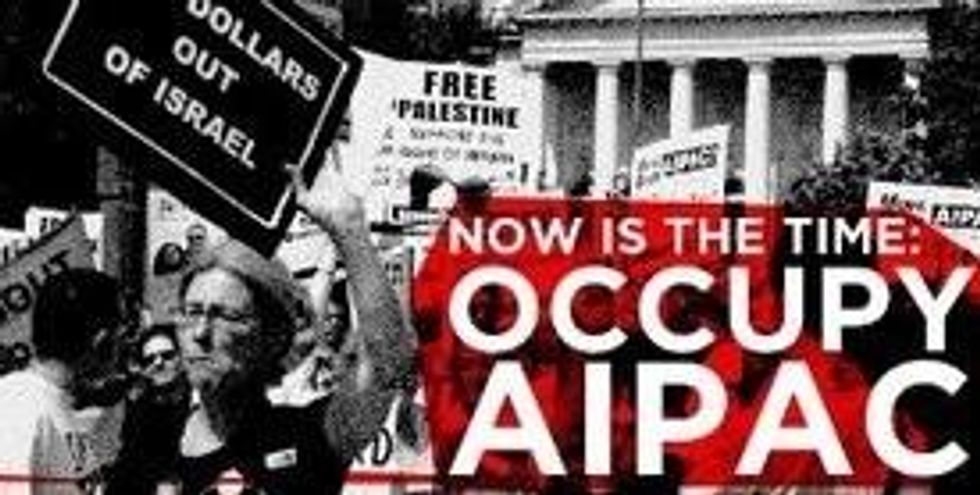
It's time for this to stop. In fact, it's time to Occupy AIPAC. This weekend, CODEPINK Women for Peace, along with the Institute for Policy Studies, Just Foreign Policy, the US Palestinian Community Network, Interfaith Peace-Builders and Jewish Voice for Peace, is organizing a summit in Washington at the same time as the AIPAC Policy Conference. Endorsed by more than 100 organizations around the country, the summit is going to shine a spotlight on AIPAC's abusive practices and discuss a more rational Middle East policy, for both Israel and the United States.
Opposition to AIPAC within the Jewish community has been growing for years; the emergence of the liberal counter-lobby J Street, along with courageous media voices like my comrades at Mondoweiss, is a testament to that. And never has the grassroots American movement against the occupation been so strong, as witnessed by the growth of the US Campaign to End the Israeli Occupation and the BDS movement, as well as Students for Justice in Palestine on college campuses. And yet the stranglehold of AIPAC and its clones on US government policy seems as toxic as ever. If that stranglehold isn't broken soon, we may become embroiled in yet another war.
Every year, in an impressive display of raw lobby power, the AIPAC Policy Conference descends on Washington. And every year, a huge number of senators and congressmen from both parties, as well as the American president, compete to see who can be the most obsequious toward what AIPAC falsely calls "the pro-Israel movement."
Never have the stakes been higher. It's well known that Israeli Prime Minister Benjamin Netanyahu wants to go to war with Iran. He would like the United States to do the job or join Israel in an attack, or, at the very least, not stand in Israel's way. On the eve of this year's conference, Netanyahu gave new meaning to the word chutzpah by letting it be known he'll demand Obama's guarantee that Washington will go to war if Iran's nuclear program advances beyond specific "red lines"; see these reports by Haaretz's Barak Ravid and the Guardian's Chris McGreal.
Bibi is playing a high-stakes intimidation game: he knows he can count on Congress to follow the AIPAC line, as it has for many years. Legislators from both parties are already demanding White House cooperation with Israeli war aims. And he may be betting that he can make Obama pay a price this November if the president doesn't cooperate. The fact that former Mossad director Meir Dagan and other Israeli security experts, as well as US military officials like Joint Chiefs of Staff chair Martin Dempsey, are worried about the catastrophic consequences of such a war seems not to have swayed Bibi in the least.
Why is Netanyahu so certain he can sway an American president? Partly because of the power of AIPAC (in league with a broad circle of AIPAC affiliates, including the Christian Zionist lobby), which has for decades worked assiduously to keep Congress closely aligned with the most belligerent Israeli policies, chief among them the illegal colonization of the occupied Palestinian territories, now in its forty-fifth year. Legislators who get out of line are targeted in their re-election campaigns, and the lobby and its close allies use McCarthyite tactics to intimidate the press and policy circles. Infamous recent examples include smears against the Center for American Progress and Media Matters by former AIPAC-er Josh Block, which was amplified in the broader media, and by an outfit called the Emergency Committee for Israel, which ran a grotesque full-page ad attacking CAP and Media Matters in today's New York Times.
It's time for this to stop. In fact, it's time to Occupy AIPAC. This weekend, CODEPINK Women for Peace, along with the Institute for Policy Studies, Just Foreign Policy, the US Palestinian Community Network, Interfaith Peace-Builders and Jewish Voice for Peace, is organizing a summit in Washington at the same time as the AIPAC Policy Conference. Endorsed by more than 100 organizations around the country, the summit is going to shine a spotlight on AIPAC's abusive practices and discuss a more rational Middle East policy, for both Israel and the United States.
Opposition to AIPAC within the Jewish community has been growing for years; the emergence of the liberal counter-lobby J Street, along with courageous media voices like my comrades at Mondoweiss, is a testament to that. And never has the grassroots American movement against the occupation been so strong, as witnessed by the growth of the US Campaign to End the Israeli Occupation and the BDS movement, as well as Students for Justice in Palestine on college campuses. And yet the stranglehold of AIPAC and its clones on US government policy seems as toxic as ever. If that stranglehold isn't broken soon, we may become embroiled in yet another war.
Every year, in an impressive display of raw lobby power, the AIPAC Policy Conference descends on Washington. And every year, a huge number of senators and congressmen from both parties, as well as the American president, compete to see who can be the most obsequious toward what AIPAC falsely calls "the pro-Israel movement."
Never have the stakes been higher. It's well known that Israeli Prime Minister Benjamin Netanyahu wants to go to war with Iran. He would like the United States to do the job or join Israel in an attack, or, at the very least, not stand in Israel's way. On the eve of this year's conference, Netanyahu gave new meaning to the word chutzpah by letting it be known he'll demand Obama's guarantee that Washington will go to war if Iran's nuclear program advances beyond specific "red lines"; see these reports by Haaretz's Barak Ravid and the Guardian's Chris McGreal.
Bibi is playing a high-stakes intimidation game: he knows he can count on Congress to follow the AIPAC line, as it has for many years. Legislators from both parties are already demanding White House cooperation with Israeli war aims. And he may be betting that he can make Obama pay a price this November if the president doesn't cooperate. The fact that former Mossad director Meir Dagan and other Israeli security experts, as well as US military officials like Joint Chiefs of Staff chair Martin Dempsey, are worried about the catastrophic consequences of such a war seems not to have swayed Bibi in the least.
Why is Netanyahu so certain he can sway an American president? Partly because of the power of AIPAC (in league with a broad circle of AIPAC affiliates, including the Christian Zionist lobby), which has for decades worked assiduously to keep Congress closely aligned with the most belligerent Israeli policies, chief among them the illegal colonization of the occupied Palestinian territories, now in its forty-fifth year. Legislators who get out of line are targeted in their re-election campaigns, and the lobby and its close allies use McCarthyite tactics to intimidate the press and policy circles. Infamous recent examples include smears against the Center for American Progress and Media Matters by former AIPAC-er Josh Block, which was amplified in the broader media, and by an outfit called the Emergency Committee for Israel, which ran a grotesque full-page ad attacking CAP and Media Matters in today's New York Times.
It's time for this to stop. In fact, it's time to Occupy AIPAC. This weekend, CODEPINK Women for Peace, along with the Institute for Policy Studies, Just Foreign Policy, the US Palestinian Community Network, Interfaith Peace-Builders and Jewish Voice for Peace, is organizing a summit in Washington at the same time as the AIPAC Policy Conference. Endorsed by more than 100 organizations around the country, the summit is going to shine a spotlight on AIPAC's abusive practices and discuss a more rational Middle East policy, for both Israel and the United States.
Opposition to AIPAC within the Jewish community has been growing for years; the emergence of the liberal counter-lobby J Street, along with courageous media voices like my comrades at Mondoweiss, is a testament to that. And never has the grassroots American movement against the occupation been so strong, as witnessed by the growth of the US Campaign to End the Israeli Occupation and the BDS movement, as well as Students for Justice in Palestine on college campuses. And yet the stranglehold of AIPAC and its clones on US government policy seems as toxic as ever. If that stranglehold isn't broken soon, we may become embroiled in yet another war.