SUBSCRIBE TO OUR FREE NEWSLETTER
Daily news & progressive opinion—funded by the people, not the corporations—delivered straight to your inbox.
5
#000000
#FFFFFF
To donate by check, phone, or other method, see our More Ways to Give page.
Almost everyone opposes cruelty to animals. In fact, 97 percent of Americans (according to Gallup) say that animals should be protected from harm, and encouragingly, a poll by Ohio State researchers found that 92 percent want farm animals to be treated well. It's hard to imagine any topic with more bipartisan support than the humane treatment of animals.
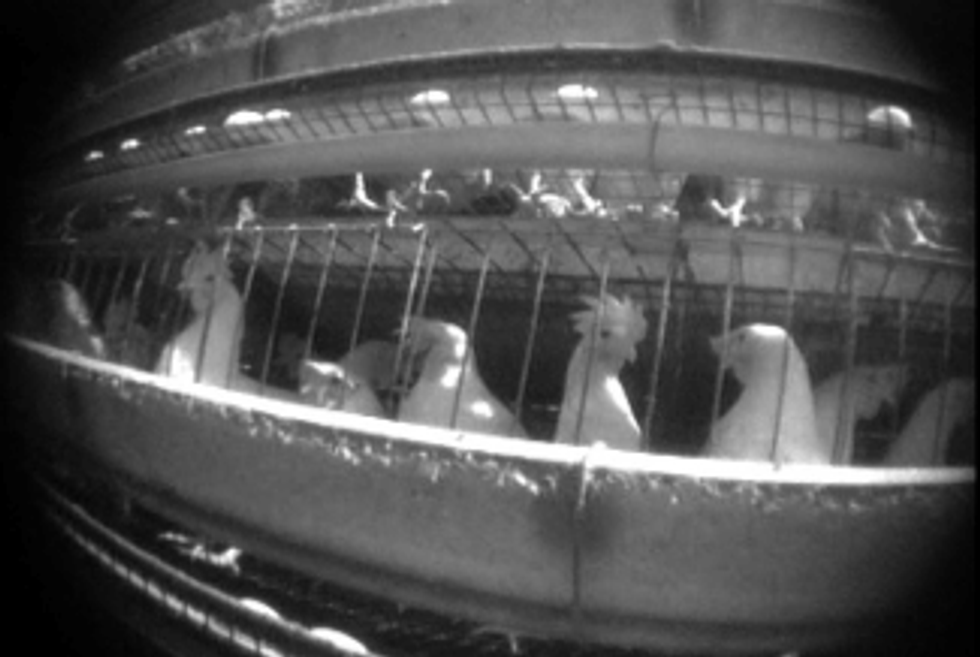
But if you've been paying attention, you know that the will of the American people on humane treatment is not in alignment with reality; the most recent evidence comes courtesy of Mercy for Animals and Brian Ross' investigative team at ABC News, which exposed a large egg operation that supplied McDonald's and other big corporations. MFA's investigators documented dead and decomposing hen carcasses in cages with live hens, workers gratuitously abusing animals in myriad ways, and (of course) the standard abuses of modern poultry farming (e.g., burning off beaks without pain relief and cramming 5 hens into tiny wire cages, where they spend their entire lives).
This was just one more in a long line of investigations by animal protection organizations; every year, we see 3-4 of these investigations, and sadly, every investigation finds new and horrific abuses--abuses that shock the conscience of all kind people.
Responsible industries would meet this stream of horrid undercover investigations with a serious commitment to change their behavior; they would promulgate strong regulations to protect animals and implement "no tolerance" policies for (at least) the sadistic abuse. And they would, as Dr. Temple Grandin has suggested, put video cameras onto their factory farms and into their slaughterhouses to monitor animal treatment. They would hire independent inspectors to review the video and make sure that there was no gratuitous abuse.
Sadly, the industry does not believe that the customer is always right. Instead, the industry's guiding philosophy appears to be "what the public doesn't know won't hurt us." So in response to investigations that document abuse, the industry is not trying to stop the abuse; instead, it's trying to stop the investigations by proposing laws that would make it illegal to investigate factory farms and slaughterhouses.
You read that right: Last year, meat and egg factory farms pushed these "whistleblower suppression" (aka: "Ag Gag") bills that criminalize taking photos of factory farms without owner permission in four states (Florida, Iowa, Minnesota, and New York) and it looks like they'll be coming back in all four of these states, and maybe more.
Another high-profile investigation makes clear why these bills are counter-productive to the good of the American people: In 2008, the Humane Society of the United States investigated a dairy cow slaughter plant that had passed all of its USDA inspections going back years and in fact had won USDA's "supplier of the year" award. Their investigation uncovered horrid cruelty to animals and unsafe meat that led to the recall of 143 million pounds of potentially dangerous meat, much of which was destined for our nation's schools. If California had one of these whistleblower suppression bills, HSUS's investigators could have been prosecuted; of course the much more likely scenario is that the investigation would not have happened, and children would have eaten those potentially lethal burgers.
So these whistleblower suppression laws would (if enacted) literally make it a crime to save human beings from dying from contaminated meat, and would also criminalize video investigations that led to employer indictments for worker safety violations, violations of civil rights and sexual harassment laws, and any other potentially illegal activity of a corporation. These are the sorts of investigations that companies and the government should be doing, but if they won't, the last thing we want to do is criminalize charities for doing them.
At Farm Sanctuary, we provide sanctuary for farm animals who have escaped the factory farming system, and we know these animals as individuals. For the same reason we would never eat cats and dogs, we also would never eat chickens, pigs, or any animals--they are individuals.
However, we also fight for an end to the worst abuses, and that's where whistleblower protection and the need to legitimately criticize the worst abuses in animal agriculture come in. If your company is so afraid of being "exposed" that you feel the need to criminalize taking pictures of your work, perhaps it's time to make changes so that you are engaged in work you can be proud of.
Almost everyone opposes cruelty to animals. In fact, 97 percent of Americans (according to Gallup) say that animals should be protected from harm, and encouragingly, a poll by Ohio State researchers found that 92 percent want farm animals to be treated well. It's hard to imagine any topic with more bipartisan support than the humane treatment of animals.
But if you've been paying attention, you know that the will of the American people on humane treatment is not in alignment with reality; the most recent evidence comes courtesy of Mercy for Animals and Brian Ross' investigative team at ABC News, which exposed a large egg operation that supplied McDonald's and other big corporations. MFA's investigators documented dead and decomposing hen carcasses in cages with live hens, workers gratuitously abusing animals in myriad ways, and (of course) the standard abuses of modern poultry farming (e.g., burning off beaks without pain relief and cramming 5 hens into tiny wire cages, where they spend their entire lives).
This was just one more in a long line of investigations by animal protection organizations; every year, we see 3-4 of these investigations, and sadly, every investigation finds new and horrific abuses--abuses that shock the conscience of all kind people.
Responsible industries would meet this stream of horrid undercover investigations with a serious commitment to change their behavior; they would promulgate strong regulations to protect animals and implement "no tolerance" policies for (at least) the sadistic abuse. And they would, as Dr. Temple Grandin has suggested, put video cameras onto their factory farms and into their slaughterhouses to monitor animal treatment. They would hire independent inspectors to review the video and make sure that there was no gratuitous abuse.
Sadly, the industry does not believe that the customer is always right. Instead, the industry's guiding philosophy appears to be "what the public doesn't know won't hurt us." So in response to investigations that document abuse, the industry is not trying to stop the abuse; instead, it's trying to stop the investigations by proposing laws that would make it illegal to investigate factory farms and slaughterhouses.
You read that right: Last year, meat and egg factory farms pushed these "whistleblower suppression" (aka: "Ag Gag") bills that criminalize taking photos of factory farms without owner permission in four states (Florida, Iowa, Minnesota, and New York) and it looks like they'll be coming back in all four of these states, and maybe more.
Another high-profile investigation makes clear why these bills are counter-productive to the good of the American people: In 2008, the Humane Society of the United States investigated a dairy cow slaughter plant that had passed all of its USDA inspections going back years and in fact had won USDA's "supplier of the year" award. Their investigation uncovered horrid cruelty to animals and unsafe meat that led to the recall of 143 million pounds of potentially dangerous meat, much of which was destined for our nation's schools. If California had one of these whistleblower suppression bills, HSUS's investigators could have been prosecuted; of course the much more likely scenario is that the investigation would not have happened, and children would have eaten those potentially lethal burgers.
So these whistleblower suppression laws would (if enacted) literally make it a crime to save human beings from dying from contaminated meat, and would also criminalize video investigations that led to employer indictments for worker safety violations, violations of civil rights and sexual harassment laws, and any other potentially illegal activity of a corporation. These are the sorts of investigations that companies and the government should be doing, but if they won't, the last thing we want to do is criminalize charities for doing them.
At Farm Sanctuary, we provide sanctuary for farm animals who have escaped the factory farming system, and we know these animals as individuals. For the same reason we would never eat cats and dogs, we also would never eat chickens, pigs, or any animals--they are individuals.
However, we also fight for an end to the worst abuses, and that's where whistleblower protection and the need to legitimately criticize the worst abuses in animal agriculture come in. If your company is so afraid of being "exposed" that you feel the need to criminalize taking pictures of your work, perhaps it's time to make changes so that you are engaged in work you can be proud of.
Almost everyone opposes cruelty to animals. In fact, 97 percent of Americans (according to Gallup) say that animals should be protected from harm, and encouragingly, a poll by Ohio State researchers found that 92 percent want farm animals to be treated well. It's hard to imagine any topic with more bipartisan support than the humane treatment of animals.
But if you've been paying attention, you know that the will of the American people on humane treatment is not in alignment with reality; the most recent evidence comes courtesy of Mercy for Animals and Brian Ross' investigative team at ABC News, which exposed a large egg operation that supplied McDonald's and other big corporations. MFA's investigators documented dead and decomposing hen carcasses in cages with live hens, workers gratuitously abusing animals in myriad ways, and (of course) the standard abuses of modern poultry farming (e.g., burning off beaks without pain relief and cramming 5 hens into tiny wire cages, where they spend their entire lives).
This was just one more in a long line of investigations by animal protection organizations; every year, we see 3-4 of these investigations, and sadly, every investigation finds new and horrific abuses--abuses that shock the conscience of all kind people.
Responsible industries would meet this stream of horrid undercover investigations with a serious commitment to change their behavior; they would promulgate strong regulations to protect animals and implement "no tolerance" policies for (at least) the sadistic abuse. And they would, as Dr. Temple Grandin has suggested, put video cameras onto their factory farms and into their slaughterhouses to monitor animal treatment. They would hire independent inspectors to review the video and make sure that there was no gratuitous abuse.
Sadly, the industry does not believe that the customer is always right. Instead, the industry's guiding philosophy appears to be "what the public doesn't know won't hurt us." So in response to investigations that document abuse, the industry is not trying to stop the abuse; instead, it's trying to stop the investigations by proposing laws that would make it illegal to investigate factory farms and slaughterhouses.
You read that right: Last year, meat and egg factory farms pushed these "whistleblower suppression" (aka: "Ag Gag") bills that criminalize taking photos of factory farms without owner permission in four states (Florida, Iowa, Minnesota, and New York) and it looks like they'll be coming back in all four of these states, and maybe more.
Another high-profile investigation makes clear why these bills are counter-productive to the good of the American people: In 2008, the Humane Society of the United States investigated a dairy cow slaughter plant that had passed all of its USDA inspections going back years and in fact had won USDA's "supplier of the year" award. Their investigation uncovered horrid cruelty to animals and unsafe meat that led to the recall of 143 million pounds of potentially dangerous meat, much of which was destined for our nation's schools. If California had one of these whistleblower suppression bills, HSUS's investigators could have been prosecuted; of course the much more likely scenario is that the investigation would not have happened, and children would have eaten those potentially lethal burgers.
So these whistleblower suppression laws would (if enacted) literally make it a crime to save human beings from dying from contaminated meat, and would also criminalize video investigations that led to employer indictments for worker safety violations, violations of civil rights and sexual harassment laws, and any other potentially illegal activity of a corporation. These are the sorts of investigations that companies and the government should be doing, but if they won't, the last thing we want to do is criminalize charities for doing them.
At Farm Sanctuary, we provide sanctuary for farm animals who have escaped the factory farming system, and we know these animals as individuals. For the same reason we would never eat cats and dogs, we also would never eat chickens, pigs, or any animals--they are individuals.
However, we also fight for an end to the worst abuses, and that's where whistleblower protection and the need to legitimately criticize the worst abuses in animal agriculture come in. If your company is so afraid of being "exposed" that you feel the need to criminalize taking pictures of your work, perhaps it's time to make changes so that you are engaged in work you can be proud of.