SUBSCRIBE TO OUR FREE NEWSLETTER
Daily news & progressive opinion—funded by the people, not the corporations—delivered straight to your inbox.
5
#000000
#FFFFFF
To donate by check, phone, or other method, see our More Ways to Give page.
Daily news & progressive opinion—funded by the people, not the corporations—delivered straight to your inbox.
One of the big journalistic
lessons of the Iraq War was that "embedded" reporters who get one side
of the story are not well suited to give accurate information to the
public.
Americans now depend on the media for accurate information about the financial crisis. This Sunday's Meet The Press
made something absolutely clear: Journalists who are "embedded" on Wall
Street and depend on Wall Street execs for access on a day-to-day basis
are ridiculously unqualified to give the public good information about
the economic crisis.
Indeed, NBC has an Erin Burnett problem. Watch and see for yourself how Burnett consistently serves an an apologist for Wall Street's worst practices:
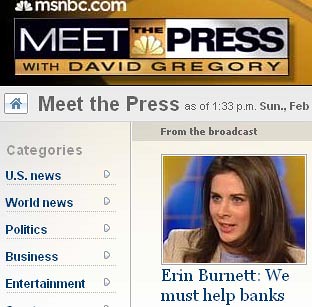
NBC even (accidentally?) admitted Burnett's pro-Wall Street bias.
Just look at the headline they put up after the show, summarizing her
main message: "Erin Burnett: We must help banks." Really?
At the end of this post, I'm going to ask you to email Erin Burnett (erin.burnett@nbcuni.com) and ask her to reform her ways.
But first, here are a few of her gems from this Sunday--all of which are also in the video.
Burnett got warmed up by talking about how the public is completely confused when we're worried how bailout recipients are spending our money:
It is amazing, when you listen to so much of the commentary
out there, that it focuses on bonuses or private jet use or, or also
just that they're not lending. None of these things, really, are, are
the real issue here...it isn't choosing Main Street vs. Wall Street.
That is a completely false choice that is being put out there.
Her "embed" status was on full display
when Claire McCaskill's comments about Wall Street bonuses came up.
Notice how dismissive Burnett is of populism (aka, politicians speaking
to the will of the people -- that quaint and silly notion):
SEN. CLAIRE McCASKILL (D-MO): They don't get it. These
people are idiots. You can't use taxpayer money to pay out $18 billion
in bonuses. What planet are these people on?(End videotape)
MR. GREGORY: Fair question, Erin?
MS. BURNETT: I understand the outrage, and you understand the
populism. There are, though--well, how should we say this? The taxpayer
money is not being used to pay the bonuses. I think people could
understand if you work for a company--right? If the three us worked for
a company, your guests, and I lost $10 billion but Steve [Forbes] over
there, he made a billion dollars. So overall the company actually loses
money, but Steve went and did his very darndest for that company and he
made money. So should he be paid for his work? That's essentially what
we're talking about here. And reasonable people could argue about this,
but many reasonable people would conclude, yes, he should be paid for
that. And I think, David, you've raised a fair point, which is maybe
it's the whole use of the word "bonus."MR. GREGORY: Mm-hmm.
MS. BURNETT: If you explained to people this is how they are
compensated, that might make a difference. But there is also a
fundamental misunderstanding. The taxpayer money isn't being taken and
paid out in the form of bonuses. It goes in a, a separate pool, shall
we say, a separate account for banks. So maybe people don't care about
that distinction, but it is there.
Say it with me: Wow!
First of all, I hope you caught the channeling of Sarah Palin in
there. Knowing that Wall Street execs are doing their "darndest" to
make money shines a whole new light on things, doesn't it?
Second, isn't it good to know that you're, how should I say this,
stupid? You thought an executive's "bonus" was a bonus! Silly member of
the public. If only you understood.
Third, can I borrow ten bucks? Thanks. "Hey, everyone, watch me make
a paper airplane with this ten bucks, and...there it goes away!" What?
No, I didn't just throw away your ten bucks. That came from a "separate
pool." Who are you anyway? Oh, a member of the public. That explains
it. You just don't, how should I say it, understand anything. Can I
borrow another ten bucks?
I've worked with a lot of reporters, and most of them are very nice
people. I'm sure Burnett is pleasant as well. But what she's doing here
professionally is a real problem, and it's NBC's problem at the end of
the day. The public simply can't afford to have economic news given to
us by Wall Street "embeds."
We need Burnett to listen to her Wall Street sources, be skeptical
of them, ask them very tough and sometimes uncomfortable questions, and
be willing to report negatively on them when they abuse the public
trust. If they never talk to her again, so be it. Donald Rumsfeld won't
talk to some reporters either -- and where is he today? Disgraced in
history.
Please email Erin Burnett today and let her know we need responsible reporting: erin.burnett@nbcuni.com
(It's also worth noting that the guests Meet The Press
invited on to discuss the economic crisis were Erin Burnett, Steve
Forbes, and Moody's Mark Zandi -- all Wall Street voices. There was no
progressive voice like Paul Krugman there to stick up for the public. If you want more balance on Meet The Press roundtables, take a moment to give them feedback here.)
Dear Common Dreams reader, It’s been nearly 30 years since I co-founded Common Dreams with my late wife, Lina Newhouser. We had the radical notion that journalism should serve the public good, not corporate profits. It was clear to us from the outset what it would take to build such a project. No paid advertisements. No corporate sponsors. No millionaire publisher telling us what to think or do. Many people said we wouldn't last a year, but we proved those doubters wrong. Together with a tremendous team of journalists and dedicated staff, we built an independent media outlet free from the constraints of profits and corporate control. Our mission has always been simple: To inform. To inspire. To ignite change for the common good. Building Common Dreams was not easy. Our survival was never guaranteed. When you take on the most powerful forces—Wall Street greed, fossil fuel industry destruction, Big Tech lobbyists, and uber-rich oligarchs who have spent billions upon billions rigging the economy and democracy in their favor—the only bulwark you have is supporters who believe in your work. But here’s the urgent message from me today. It's never been this bad out there. And it's never been this hard to keep us going. At the very moment Common Dreams is most needed, the threats we face are intensifying. We need your support now more than ever. We don't accept corporate advertising and never will. We don't have a paywall because we don't think people should be blocked from critical news based on their ability to pay. Everything we do is funded by the donations of readers like you. When everyone does the little they can afford, we are strong. But if that support retreats or dries up, so do we. Will you donate now to make sure Common Dreams not only survives but thrives? —Craig Brown, Co-founder |
One of the big journalistic
lessons of the Iraq War was that "embedded" reporters who get one side
of the story are not well suited to give accurate information to the
public.
Americans now depend on the media for accurate information about the financial crisis. This Sunday's Meet The Press
made something absolutely clear: Journalists who are "embedded" on Wall
Street and depend on Wall Street execs for access on a day-to-day basis
are ridiculously unqualified to give the public good information about
the economic crisis.
Indeed, NBC has an Erin Burnett problem. Watch and see for yourself how Burnett consistently serves an an apologist for Wall Street's worst practices:
NBC even (accidentally?) admitted Burnett's pro-Wall Street bias.
Just look at the headline they put up after the show, summarizing her
main message: "Erin Burnett: We must help banks." Really?
At the end of this post, I'm going to ask you to email Erin Burnett (erin.burnett@nbcuni.com) and ask her to reform her ways.
But first, here are a few of her gems from this Sunday--all of which are also in the video.
Burnett got warmed up by talking about how the public is completely confused when we're worried how bailout recipients are spending our money:
It is amazing, when you listen to so much of the commentary
out there, that it focuses on bonuses or private jet use or, or also
just that they're not lending. None of these things, really, are, are
the real issue here...it isn't choosing Main Street vs. Wall Street.
That is a completely false choice that is being put out there.
Her "embed" status was on full display
when Claire McCaskill's comments about Wall Street bonuses came up.
Notice how dismissive Burnett is of populism (aka, politicians speaking
to the will of the people -- that quaint and silly notion):
SEN. CLAIRE McCASKILL (D-MO): They don't get it. These
people are idiots. You can't use taxpayer money to pay out $18 billion
in bonuses. What planet are these people on?(End videotape)
MR. GREGORY: Fair question, Erin?
MS. BURNETT: I understand the outrage, and you understand the
populism. There are, though--well, how should we say this? The taxpayer
money is not being used to pay the bonuses. I think people could
understand if you work for a company--right? If the three us worked for
a company, your guests, and I lost $10 billion but Steve [Forbes] over
there, he made a billion dollars. So overall the company actually loses
money, but Steve went and did his very darndest for that company and he
made money. So should he be paid for his work? That's essentially what
we're talking about here. And reasonable people could argue about this,
but many reasonable people would conclude, yes, he should be paid for
that. And I think, David, you've raised a fair point, which is maybe
it's the whole use of the word "bonus."MR. GREGORY: Mm-hmm.
MS. BURNETT: If you explained to people this is how they are
compensated, that might make a difference. But there is also a
fundamental misunderstanding. The taxpayer money isn't being taken and
paid out in the form of bonuses. It goes in a, a separate pool, shall
we say, a separate account for banks. So maybe people don't care about
that distinction, but it is there.
Say it with me: Wow!
First of all, I hope you caught the channeling of Sarah Palin in
there. Knowing that Wall Street execs are doing their "darndest" to
make money shines a whole new light on things, doesn't it?
Second, isn't it good to know that you're, how should I say this,
stupid? You thought an executive's "bonus" was a bonus! Silly member of
the public. If only you understood.
Third, can I borrow ten bucks? Thanks. "Hey, everyone, watch me make
a paper airplane with this ten bucks, and...there it goes away!" What?
No, I didn't just throw away your ten bucks. That came from a "separate
pool." Who are you anyway? Oh, a member of the public. That explains
it. You just don't, how should I say it, understand anything. Can I
borrow another ten bucks?
I've worked with a lot of reporters, and most of them are very nice
people. I'm sure Burnett is pleasant as well. But what she's doing here
professionally is a real problem, and it's NBC's problem at the end of
the day. The public simply can't afford to have economic news given to
us by Wall Street "embeds."
We need Burnett to listen to her Wall Street sources, be skeptical
of them, ask them very tough and sometimes uncomfortable questions, and
be willing to report negatively on them when they abuse the public
trust. If they never talk to her again, so be it. Donald Rumsfeld won't
talk to some reporters either -- and where is he today? Disgraced in
history.
Please email Erin Burnett today and let her know we need responsible reporting: erin.burnett@nbcuni.com
(It's also worth noting that the guests Meet The Press
invited on to discuss the economic crisis were Erin Burnett, Steve
Forbes, and Moody's Mark Zandi -- all Wall Street voices. There was no
progressive voice like Paul Krugman there to stick up for the public. If you want more balance on Meet The Press roundtables, take a moment to give them feedback here.)
One of the big journalistic
lessons of the Iraq War was that "embedded" reporters who get one side
of the story are not well suited to give accurate information to the
public.
Americans now depend on the media for accurate information about the financial crisis. This Sunday's Meet The Press
made something absolutely clear: Journalists who are "embedded" on Wall
Street and depend on Wall Street execs for access on a day-to-day basis
are ridiculously unqualified to give the public good information about
the economic crisis.
Indeed, NBC has an Erin Burnett problem. Watch and see for yourself how Burnett consistently serves an an apologist for Wall Street's worst practices:
NBC even (accidentally?) admitted Burnett's pro-Wall Street bias.
Just look at the headline they put up after the show, summarizing her
main message: "Erin Burnett: We must help banks." Really?
At the end of this post, I'm going to ask you to email Erin Burnett (erin.burnett@nbcuni.com) and ask her to reform her ways.
But first, here are a few of her gems from this Sunday--all of which are also in the video.
Burnett got warmed up by talking about how the public is completely confused when we're worried how bailout recipients are spending our money:
It is amazing, when you listen to so much of the commentary
out there, that it focuses on bonuses or private jet use or, or also
just that they're not lending. None of these things, really, are, are
the real issue here...it isn't choosing Main Street vs. Wall Street.
That is a completely false choice that is being put out there.
Her "embed" status was on full display
when Claire McCaskill's comments about Wall Street bonuses came up.
Notice how dismissive Burnett is of populism (aka, politicians speaking
to the will of the people -- that quaint and silly notion):
SEN. CLAIRE McCASKILL (D-MO): They don't get it. These
people are idiots. You can't use taxpayer money to pay out $18 billion
in bonuses. What planet are these people on?(End videotape)
MR. GREGORY: Fair question, Erin?
MS. BURNETT: I understand the outrage, and you understand the
populism. There are, though--well, how should we say this? The taxpayer
money is not being used to pay the bonuses. I think people could
understand if you work for a company--right? If the three us worked for
a company, your guests, and I lost $10 billion but Steve [Forbes] over
there, he made a billion dollars. So overall the company actually loses
money, but Steve went and did his very darndest for that company and he
made money. So should he be paid for his work? That's essentially what
we're talking about here. And reasonable people could argue about this,
but many reasonable people would conclude, yes, he should be paid for
that. And I think, David, you've raised a fair point, which is maybe
it's the whole use of the word "bonus."MR. GREGORY: Mm-hmm.
MS. BURNETT: If you explained to people this is how they are
compensated, that might make a difference. But there is also a
fundamental misunderstanding. The taxpayer money isn't being taken and
paid out in the form of bonuses. It goes in a, a separate pool, shall
we say, a separate account for banks. So maybe people don't care about
that distinction, but it is there.
Say it with me: Wow!
First of all, I hope you caught the channeling of Sarah Palin in
there. Knowing that Wall Street execs are doing their "darndest" to
make money shines a whole new light on things, doesn't it?
Second, isn't it good to know that you're, how should I say this,
stupid? You thought an executive's "bonus" was a bonus! Silly member of
the public. If only you understood.
Third, can I borrow ten bucks? Thanks. "Hey, everyone, watch me make
a paper airplane with this ten bucks, and...there it goes away!" What?
No, I didn't just throw away your ten bucks. That came from a "separate
pool." Who are you anyway? Oh, a member of the public. That explains
it. You just don't, how should I say it, understand anything. Can I
borrow another ten bucks?
I've worked with a lot of reporters, and most of them are very nice
people. I'm sure Burnett is pleasant as well. But what she's doing here
professionally is a real problem, and it's NBC's problem at the end of
the day. The public simply can't afford to have economic news given to
us by Wall Street "embeds."
We need Burnett to listen to her Wall Street sources, be skeptical
of them, ask them very tough and sometimes uncomfortable questions, and
be willing to report negatively on them when they abuse the public
trust. If they never talk to her again, so be it. Donald Rumsfeld won't
talk to some reporters either -- and where is he today? Disgraced in
history.
Please email Erin Burnett today and let her know we need responsible reporting: erin.burnett@nbcuni.com
(It's also worth noting that the guests Meet The Press
invited on to discuss the economic crisis were Erin Burnett, Steve
Forbes, and Moody's Mark Zandi -- all Wall Street voices. There was no
progressive voice like Paul Krugman there to stick up for the public. If you want more balance on Meet The Press roundtables, take a moment to give them feedback here.)