

SUBSCRIBE TO OUR FREE NEWSLETTER
Daily news & progressive opinion—funded by the people, not the corporations—delivered straight to your inbox.
5
#000000
#FFFFFF
To donate by check, phone, or other method, see our More Ways to Give page.
Daily news & progressive opinion—funded by the people, not the corporations—delivered straight to your inbox.
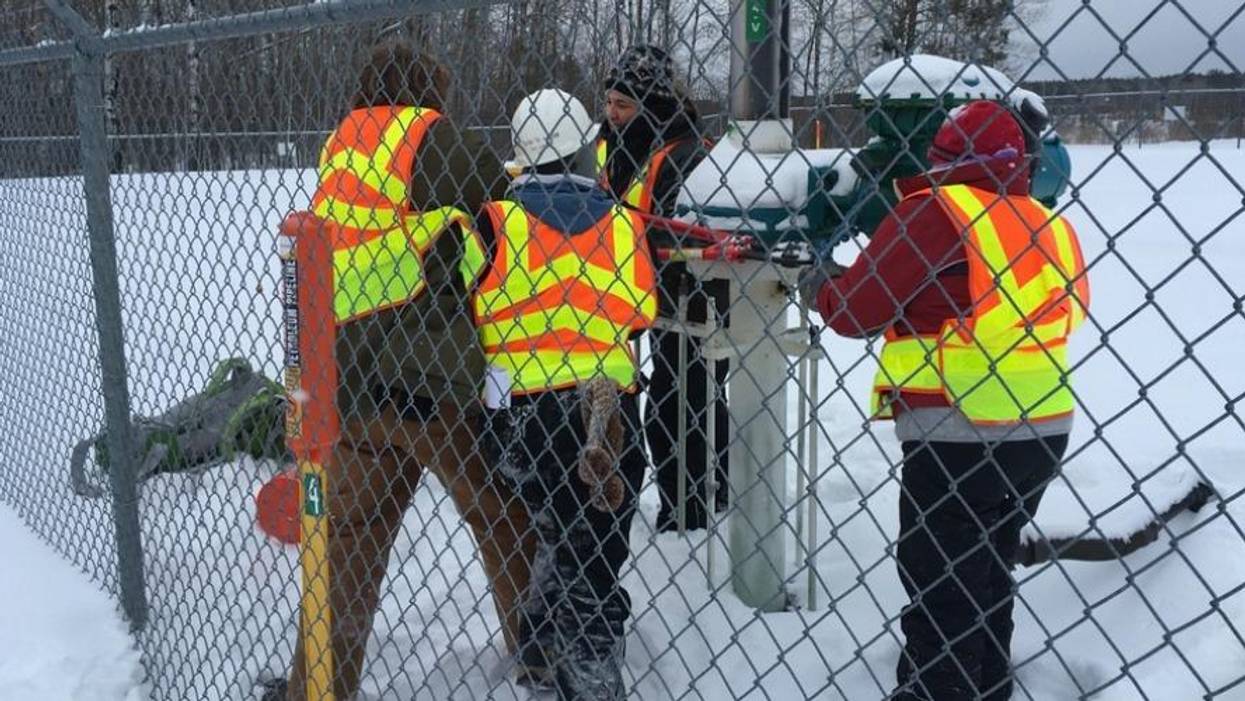
Condemning "the imminent and irreversible damage being done to the climate" by fossil fuel extraction, four Catholic Workers took non-violent action to help stem the climate crisis on Monday in northern Minnesota, shutting off valves at Enbridge Energy Lines 3 and 4.
Allyson Polman, Brenna Cussen Anglada, Michele Naar Obed, and Daniel Yildirim were identified as the Four Necessity Valve Turners who shut off the valves. They took the action to protest the pipelines which cut through Native American reservations and jeopardize fresh water resources in the region, as well as perpetuating an energy economy reliant on fossil fuels.
"The group acts in solidarity with the most vulnerable worldwide who suffer the greatest impact from climate change," said the group in a press statement. "The Four Necessity Valve Turners believe it is time to take personal responsibility for preventing the dangerous expansion of the oil industry, because governments and regulators have failed to do so."
"This act is step towards reparations for the damage that colonization has done both to the indigenous peoples of this continent and the land," said Cussen Anglada.
The group shared a video on Facebook of the action. The demonstrators shut off the valves at about 10 minutes into the video:
The group displayed a sign reading, "The time is now for unprecedented and urgent action," at the site where they shut off the valves.
The Four Necessity Valve Turners took the action despite recent reports that police in Minnesota are planning to target anti-pipeline organizers, preparing for a militarized standoff like the one that took place at Standing Rock Sioux reservation in North Dakota in 2016.
"The extraction of the tar sands oil flowing through these pipes represents an ongoing atrocity against the boreal forests of Canada," said Yildirim. "I refuse to stand by in silence as this river of death flows through the Great Lakes region."
"The Four Necessity Valve Turners believe it is time to take personal responsibility for preventing the dangerous expansion of the oil industry, because governments and regulators have failed to do so." --Four Necessity Valve TurnersThe group released a statement of intent on Twitter after they shut off the valves.
"Our species stands at death's door due to the outmoded and violent myth that some people are more important than others, and that we can live without the intricate and miraculous web of life that surrounds us," they wrote. "Even as we approach total devastation, this myth still rages, and nowhere is it more apparent than in our own backyard."
The police arrived on the scene shortly after the group shut down the valves, and took the valve turners into custody. On Twitter, the group asked for donations for their bail fund while numerous supporters expressed gratitude for their direct action.

Climate activists are cheering after a district judge in Boston on Tuesday ruled that 13 fossil fuel pipeline protesters were not responsible for any infraction because of the necessity of their actions.
Bill McKibben, who was slated to be an expert witness in their case, tweeted a celebratory "Good golly!' in response to the ruling, adding, "This may be a first in America. "
The charges the defendants faced stemmed from actions they took in 2016 to block Spectra Energy's fracked gas West Roxbury Lateral Pipeline. While they had spent a year and a half preparing a climate necessity defense to present to a jury trail, prosecutors prevented that from happening last week when they reduced the criminal charges to civil infractions. "By reducing the charges," the Climate Disobedience Center argues, "the prosecutor has avoided what could have been a groundbreaking legal case."
Judge Mary Ann Driscoll, did, however, allow each of the defendants to explain to the court why they were motivated to take part in their actions to stop the Massachusetts pipeline. After that, according to a lawyer for the defendants, she said they were not responsible by reason of necessity.
Speaking on the steps outside the courthouse following the verdict, defendant and noted climate activist Tim DeChristopher said they "asked the judge to recognize that that evidence was out there--that's it clear across our society the severity of climate change, the degree to which the government response has been a failure, and the degree to which regular folks like us have a necessity to act to prevent this harm."
"Hopefully, next time around we'll be able to do that with a jury, and we'll keep fighting," he said.
Defendant Callista Womick spoke outside the courthouse as well, saying that "it's hubristic to think we can keep poisoning the planet and keep living on it." As such, she said she took part in the protest because she saw it as "part of my duty to my fellow human beings and fellow life forms."
According to defendant Karenna Gore, director of the Center for Earth Ethics at Union Theological Seminary (and daughter of former Vice President Al Gore), what happened in the courtroom was "really important," though she noted "the irony" of being found not responsible for the infractions because "we are making ourselves responsible."
"We are part of the movement that's standing up and saying, 'We won't let this go by on our watch. We won't act like nothing's wrong,'" she said. "We're going to be speaking up in new ways," she added.
"We're going to be demanding that the people who are in elected office, and also the corporations who are putting their costs, the cost of their doing business, for their own profits... on the public, they're putting that cost on future generations. And we are taking responsibility to say 'no' to that."
Offering some hope that "reality" will prevail in a political climate seemingly bent on climate destruction, a Washington state jury on Wednesday failed to convict activist Ken Ward on two felony counts stemming from an act of civil disobedience against the fossil fuel industry.
The Climate Disobedience Center, which Ward co-founded, declared the mistrial "a resounding recognition of the threat of climate change," noting that one or more jurors refused to convict Ward on charges of sabotage and burglary for breaking into and shutting down a Kinder Morgan pipeline near Anacortes, Washington last year. Alternately, they were persuaded by his argument that he had acted out of necessity, in defense of the planet.
According to the center,
Ward's defense consisted exclusively of his motivation to confront the threat of climate change, and the defense did not contest a single piece of evidence brought by the prosecution. Several exhibits demonstrating climate science and impacts and the role of civil disobedience in societal change were permitted as evidence. Ward himself was the only witness called by the defense. The jury deliberated while looking at charts demonstrating the dramatic increase of greenhouse gasses in the atmosphere and the impacts of sea-level rise to Skagit County.
"This trial was about climate change," said Emily Johnston, who also took part in the October 2016 coordinated action that shut down tar sands pipelines along the U.S.-Canada border. "The prosecution presented only information about what Ken did on October 11, and Ken and the defense presented only information about climate change, so the only decision that the jury was making was which story mattered more. And the story of the climate crisis won."
Activist Leonard Higgins, who faces trial for shutting off Spectra Energy's Express tar sands pipeline in Montana as part of the same action, said he's "excited to see that the jury recognized the integrity, honor, and patriotism of Ken Ward, and recognized that what he did was done for all of us."
Ward was the first of the "valve turners" to appear in court and the trial was said to have "far-reaching implications for the widening pipeline protest movement and the intensifying crackdown against it," particularly in light of the fierce mobilizations expected after U.S. President Donald Trump's recent executive orders advancing the controversial Keystone XL (KXL) and Dakota Access (DAPL) pipelines.
As Ward himself explained after the decision, "In five hours, the jury was unable to decide that with all of the evidence against me, including the video of me closing the valve, that this was a crime. I didn't contest a single piece of the evidence, only presented my story and evidence of catastrophic climate change. This is a tremendous outcome."
As it stands, there will be a conference next week to determine if a new trial will be scheduled. But as Steve Kent with the Climate Disobedience Center explained to Common Dreams, the fact of the mistrial gives "an indication that one or more jurors accepted the argument that the actions were taken to prevent climate harm, and so weren't culpable. That's important legally and will have ramifications."
Wednesday's mistrial was celebrated widely across the climate movement.
Not only does this ruling bode well for the future "valve turner" trials, but it also could impact other activists who plan to confront the Trump administration with increasingly direct civil disobedience.
"The failure of the prosecution's case shows that public opinion is shifting about the need for direct action to solve the climate crisis," said Kelsey Skaggs, an attorney with the Climate Defense Project, which provided legal support to Ward alongside the Civil Liberties Defense Center. "With our political leadership failing us, we need more courageous activists like Ken to stand up to the fossil fuel industry and set an example of how normal people can effect change."
Watch Ward's testimony below:
Progressive icon and anti-war activist turned California lawmaker Tom Hayden passed on Sunday at the age of 76.
Hayden dedicated his life to peace, social justice, and activism: from the 1960s, when he helped found the New Left and worked to organize black southern sharecroppers, to building--alongside his former wife, actress Jane Fonda--a California political machine that for decades advanced progressive candidates and measures.
"If we appear to seek the unattainable, as it has been said, then let it be known that we do so to avoid the unimaginable," reads the conclusion of the Port Huron manifesto, which Hayden drafted in 1962 for the leftist organization Students for a Democratic Society.
In 1982, Hayden was elected to the California Assembly, beginning nearly two decades of service in the Assembly and state Senate. "During his tenure in the Legislature, representing the liberal Westside, Hayden relished being a thorn in the side of the powerful, including fellow Democrats he saw as too pliant to donors," the Los Angeles Times wrote on Sunday.
"He was the radical inside the system," Duane Peterson, a top Hayden advisor in Sacramento, told the Times.
Indeed, before turning to politics, Hayden was a well known student leader and activist. He had a famously extensive FBI file. In one undisclosed May 1968 bureau cable sent at the time of the Columbia University student occupation, the agency wrote: "The investigation of Hayden, as one of the key leaders of the new left movement, is of prime importance to the Bureau."

A year later, Hayden was one of the activists, known as the "Chicago 7," indicted by the Justice Department for conspiracy to incite a riot at the Democratic National Convention.
In addition to politics, Hayden also taught and authored numerous books including his most recent Hell No: The Forgotten Power of the Vietnam Peace Movement, which will be released posthumously in March 2017.
A prolific writer, he was a longtime contributor to Common Dreams and The Nation, which wrote Monday: "From helping to found the New Left in the 1960s right up to this turbulent election season, Hayden was a pillar of Democratic politics, a brilliant strategist and political thinker, and a leading advocate for a more just and equal society."
In a February 1981 essay for The Nation titled "The Future Politics of Liberalism," which was published in the wake of Ronald Reagan's presidential inauguration, Hayden outlined his idea of a just society, illustrating how economic, social, and environmental elements are all intertwined in that vision:
We need more than ever a participatory society in which persons of all life styles believe that they matter, instead of the escapist culture that absorbs millions in irrelevance. We cannot contend with the coming of external limits unless we delve more into our rich inner potentials.
It comes down to moving from a wasteful, privately oriented, self-indulgent existence to a more conserving, caring and disciplined life style. The cornerstone has to be a renewal of self-reliance, not the outmoded frontier fantasy of the Republican philosophers, but the reassertion of personal responsibility in everything from conserving resources to decentralizing services to keeping ourselves well through self-care to practicing a "right livelihood" in business. It is a change from planned obsolescence to the production of useful goods that last, from consumer madness to the achievement of inner satisfactions, from the opulence of Jay Gatsby to the frugal self-assurance of Henry David Thoreau.
More important than money and technique in elections is the factor of motivation and vision. The Democrats (or someone else) will return to national leadership when they are inspired again.
After the news of his death, many on the left took to social media to mourn the loss of a longtime progressive champion and express their gratitude for his inspiring legacy:
According to wife Barbara Williams, Hayden died after a long illness. He suffered a stroke in 2015 after, as he put it, "tramping around the dark pits of fracking wastewater for two days in the suffocating wastelands of [California's] Kern County." He is also survived by "their adopted son, Liam; Troy Garity, his son with Fonda; and his sister, Mary Hayden Frey," as well as "stepdaughter Vanessa Vadim and her two children," the Times reports.
Five activists shut down all the tar sands pipelines crossing the Canada-U.S. border Tuesday morning, in a bold, coordinated show of climate resistance amid the ongoing fight against the Dakota Access pipeline.
| #ShutItDown Tweets |
The activists employed manual safety valves to shut down Enbridge's line 4 and 67 in Leonard, Minnesota; TransCanada's Keystone pipeline in Walhalla, North Dakota; Spectra Energy's Express pipeline in Coal Banks Landing, Montana; and Kinder-Morgan's Trans-Mountain pipeline in Anacortes, Washington.
The activists, who planned the action to coincide with the International Days of Prayer and Action With Standing Rock, expressed feeling "duty bound to halt the extraction and combustion of fossil fuels...in the absence of any political leadership" to address the withering goal of keeping global temperature increase beneath the 2degC climate threshold.
"I have signed hundreds of petitions, testified at dozens of hearings, met with most of my political representatives at every level, to very little avail," said 64-year-old mother Annette Klapstein of Bainbridge Island, Washington, who was arrested just before publication. "I have come to believe that our current economic and political system is a death sentence to life on earth, and that I must do everything in my power to replace these systems with cooperative, just, equitable and love-centered ways of living together. This is my act of love."
Fifty-nine-year-old Ken Ward of Corbette, Oregon, who was also arrested, said, "There is no plan of action, policy or strategy being advanced now by any political leader or environmental organization playing by the rules that does anything but acquiesce to ruin. Our only hope is to step outside polite conversation and put our bodies in the way. We must shut it down, starting with the most immediate threats--oil sands fuels and coal."
The action comes two days after a U.S. federal court of appeals lifted an injunction on the Dakota Access project, to the dismay of the Indigenous water protectors and their supporters across the U.S. and Canada.
"Because of the climate change emergency, because governments and corporations have for decades increased fossil fuel extraction and carbon emissions when instead we must dramatically reduce carbon emissions; I am committed to the moral necessity of participating in nonviolent direct action to protect life," added activist Leonard Higgins, 64, from Eugene, Oregon.
The activists are all members of the group Climate Direct Action, which is providing live updates on the coordinated shut-downs on its website and Facebook page. Others shared statements in support, as well as images and videos of the actions on social media with the hashtag #shutitdown.
Tim DeChristopher's Climate Disobedience Action Fund is also supporting the action and has set up a legal fund for the activists' defense.
"Drained" from taking local municipalities to court over fracking bans, a fossil fuel industry group is now considering charging local officials who suggest such prohibitions with criminal prosecution, new reporting by the Pittsburgh Post-Gazette revealed Tuesday.
In the face of federal governmental inaction, more and more local municipalities have passed bans on fracking to address the mounting public health and environmental problems caused by the toxic drilling process. In fact, according to the Post-Gazette, since Pittsburgh passed its ordinance in 2010, more than 100 other localities have followed suit.
In Pennsylvania, which is the second largest producer of fracked gas in the nation, as well as elsewhere, the drilling industry has aggressively challenged these bans--but, according to Kevin Moody, general counsel for the Pennsylvania Independent Oil & Gas Association, that "fight is draining and doesn't seem to be deterring municipal officials from attempting to block oil and gas development."
Alternately, Moody told the Post-Gazette that he's been "exploring" the concept of criminal prosecution for years but finally found a fitting statute to test it out.
"It's called official oppression," the newspaper explained, "and makes it a second degree misdemeanor for a public official to deny or impede someone's rights or privileges with the knowledge such actions are illegal. The penalty is up to two years in prison and a fine of up to $5,000."
Moody specifically cited the recent action taken by Grant Township as an "egregious example" that should be challenged. In the face of ongoing litigation over its fracking ban, the Pennsylvania community last spring adopted the country's first municipal charter establishing a local bill of rights codifying environmental and democratic rights.
At the time of its adoption, noted climate activist Tim DeChristopher, called it "one of the boldest moves to stop the natural gas industry's attacks on our communities, climate, and democracy."
But Moody claims that the charter, which was drafted by the Franklin County-based nonprofit Community Environmental Legal Defense Fund (CELDF), is illegal. If a judge agrees with him, Moody could use that decision "to say municipal officials know what they're doing is not legal when they deny gas companies the right to operate within their borders. From there, other options could surface," such as filing a private criminal complaint against or impeaching local officials, the Post-Gazette reported.
Chad Nicholson, Pennsylvania organizer for CELDF, said the threat of criminal prosecution once again illustrates "the sense of privilege and entitlement" that the fossil fuel industry holds over the communities they try to "bully into submission."
On Wednesday, 23 people were arrested protesting Spectra Energy's fracked gas pipeline in West Roxbury, Massachusetts. Longtime climate activist Tim DeChristopher was one of about 30 people who ventured onto the Spectra pipeline construction site in an attempt to nonviolently stop work. Local residents and politicians have long opposed the West Roxbury Lateral pipeline, which they say is dangerous for the pipeline to run alongside a quarry where there is frequent blasting.
On Wednesday, 23 people were arrested protesting Spectra Energy's fracked gas pipeline in West Roxbury, Massachusetts. Longtime climate activist Tim DeChristopher was one of about 30 people who ventured onto the Spectra pipeline construction site in an attempt to nonviolently stop work. Local residents and politicians have long opposed the West Roxbury Lateral pipeline, which they say is dangerous for the pipeline to run alongside a quarry where there is frequent blasting. During the action, DeChristopher and 11 others climbed inside the pipeline trench and refused to budge for almost two hours before being forcibly removed by firefighters. DeChristopher drew a comparison between the trenches of the gas pipeline and the mass graves recently dug in Pakistan in anticipation of a climate-fueled heat wave.
The climate movement was out in force on Saturday as demonstrators from Australia to Philadelphia laid their bodies down and raised their voices up to demand a just transition to renewable energy.
In Newcastle, Australia, over 1,000 kayaktivists and other protesters shut down operations at the nation's largest coal export port.
"For the first time in a very long while, no coal came into or left Newcastle Port today," organizers with climate action group 350 Australia wrote in an end-of-day recap of the dramatic occupation.
"Kayakers blocked the harbour entrance in the largest flotilla ever seen here. While at the same time over 60 people blocked the only coal transport train line into the port, preventing any coal from getting to port for over six hours," they said. "Other brave folk suspended themselves from coal loaders and mooring lines of major coal assets."
Dramatic images of the protest are available here.
Student Jesse Kalic, who was among the 66 protesters arrested over the course of the action, told reporters, "We are putting ourselves at risk by being here today but we feel that it's far riskier to not take action on climate change."
The port shut down is part of a massive international civil disobedience campaign against fossil fuels known as Break Free 2016 that launched last week with demonstrations in Wales, the Philippines, and New Zealand.
Kicking off the wave of resistance in the United States, hundreds of residents and climate activists rallied outside the Philadelphia Energy Solutions (PES) refinery in South Philadelphia to protest a proposed oil refinery expansion and import/ export facility.
The Right to Breathe Mobilization amplified the voices of community members whose health is already impacted by the presence of the fossil fuel industry.
"I am concerned about the fact that Philadelphia Energy Solutions wants to expand a refinery that has been poisoning the air in our neighborhoods for decades," said longtime resident Doreen Rich, who carried an oversized sunflower sign.
"Everybody in my house has asthma, and I got 1-2-3 kids that got asthma," she said. "We do not need anymore pollutants in this city."
Echoing the message of the global campaign, Rich added: "I think Philadelphia can go in a different direction, I think we can develop an economy moving in a green direction, instead of sticking with this fossil fuel dinosaur economy that locks us into fracking, locks us into pollution."
Over the next week, large demonstrations are planned across the United States, including in Washington state, Chicago, Denver, Los Angeles, upstate New York, and Washington, D.C..
And as the climate movement continues to hone its demands, namely a just and rapid transition to 100 percent renewable energy, Secretary of the Interior Sally Jewell drew fire this week for calling the "keep it in the ground" movement naive.
"It's going to take a very long time before we can wean ourselves from fossil fuels, so I think that to keep it in the ground is naive, to say we could shift to 100 percent renewables is naive," Jewell said.
Tim Ream, an activist with the group WildEarth Guardians, told the Desert Sun that Jewell "needs to get past the 'keep it in the ground' slogan and look at the real policy request, which is to end new leases" of federal land for fossil fuel exploitation. Ream and others also shared their dismay with the U.S. official on Twitter:
For one community attempting to stop fracking wastewater injection wells, civil disobedience just became a sanctioned civic right.
The community is Grant Township, Pa., which, in November 2015, had fought off the Pennsylvania General Energy Company (PGE) and the Pennsylvania Independent Oil and Gas Association (PIOGA), assertion that fossil fuel companies had a 'right' to inject wastewater by adopting the country's first municipal charter establishing a local bill of rights codifying environmental and democratic rights.
"I will do whatever it takes to provide our residents with the tools and protections they need to nonviolently resist aggressions like those being proposed by PGE." --Stacy Long, Grant Township Supervisor
But facing ongoing litigation with PGE, the township has taken another creative approach to protect itself by passing a new ordinance on Tuesday that protects those taking direct action to uphold the charter from arrest. According to a press release from Community Environmental Legal Defense Fund (CELDF), which has helped the township craft its charter and wage its legal battle:
If a court does not uphold the people's right to stop corporate activities threatening the well-being of the community, the ordinance codifies that, "any natural person may then enforce the rights and prohibitions of the charter through direct action." Further, the ordinance states that any nonviolent direct action to enforce their Charter is protected, "prohibit[ing] any private or public actor from bringing criminal charges or filing any civil or other criminal action against those participating in nonviolent direct action."
"We're tired of being told by corporations and our so-called environmental regulatory agencies that we can't stop this injection well!" stated Grant Township Supervisor Stacy Long. "We're being threatened by a corporation with a history of permit violations, and that corporation wants to dump toxic frack wastewater into our Township."
Long continued, "I live here, and I was also elected to protect the health and safety of this Township. I will do whatever it takes to provide our residents with the tools and protections they need to nonviolently resist aggressions like those being proposed by PGE."
Among those expressing support for the ordinance is noted climate activist Tim DeChristopher, who said, "I'm encouraged to see an entire community and its elected officials asserting their rights to defend their community from the assaults of the fossil fuel industry."
He took to Twitter to praise the move as well, calling it "one of the boldest moves to stop the natural gas industry's attacks on our communities, climate and democracy."
"Something gravely important had gone missing. Something related to reverence--to holding on to the ineffable wonder of what already is, caring for what little remains, being cognizant of how quickly we're losing it. As we attempt to develop new energy sources and figure out how to feed ourselves and inhabit this warming world, we need to remember what, apart from technological worship, drops us to our knees."
"Something gravely important had gone missing. Something related to reverence--to holding on to the ineffable wonder of what already is, caring for what little remains, being cognizant of how quickly we're losing it. As we attempt to develop new energy sources and figure out how to feed ourselves and inhabit this warming world, we need to remember what, apart from technological worship, drops us to our knees."
--Meera Subramanian, "The Age of Loneliness"
In every corner of society, the battle between fossil fuels and renewable energy is reaching a fever pitch.
At the federal level in the U.S., the renewable energy tax credit has been extended, which gives wind and solar a fighting chance in the market. Employment in these sectors has soared, growing by 123% since 2010. Indeed, some states like New York and Massachusetts are competing to one-up each other in their support for green energy technologies.
At the same time, the collapse in oil prices and the recent moratorium on new federal coal leases has meant that oil and gas are competing more stridently than ever before with renewables for market share. Despite wind and solar potential across the country, certain states like Utah continue to extend a generous helping hand in the form of tax exemptions to oil and gas, including extreme energy sources like oil shale and tar sands oil. Unproven and risky technologies are deployed as experiments, tested on the public and the environment.
We know that fossil fuel extraction has to stop to curb climate change. Yet global production exceeds demand by more than 1 million barrels daily. In the U.S. we are currently storing the largest volume of oil since the Great Depression. Proposals for oil and gas projects keep coming--especially domestic power plants, pipelines, and new extraction sites--that displace wind and solar and further entrench communities in fossil fuel dependence.
How do we--as advocates, as neighbors, as collective stewards of our planet--navigate this dynamic? How can we ensure that the struggles against fossil fuels and for renewable energy are strengthening and reinforcing one another?
Two landscapes of struggle
A new narrative is emerging out of the struggle against extreme energy extraction. As more communities are exposed to fossil fuel projects, people are witnessing their health and commons being bartered for corporate profit by government. And they are coming together to stop harmful projects that threaten the places and people they love. In claiming the right to a healthy environment, communities are also claiming their authority to act based in a responsibility to protect this right, and calling on the government to fulfill its own responsibility.
These claims are giving rise to new roles, organizing strategies, research agendas, and legal principles. People are translating their sense of grief and urgency into a new understanding of the role of government and the law: protecting financial capital and private interests is not the primary goal of democracy. This narrative of resistance is growing, even in places like Utah that have deep legacies of extraction, where climate justice battles are playing out in the use of public, trust, and tribal lands. The recent focus on agency-regulated land is because of the role that local government plays in promoting fossil fuel development. The Utah Bureau of Land Management effectively denies climate change is even happening.
"The simultaneous peril and potential of this moment is asking all of us to reconsider old narratives and arrangements of power."
Home to part of the Green River Formation, the largest known oil shale deposit in the world, and half of the nation's bitumen (tar sands) deposits, Utah's unconventional oil potential is in the billions of barrels, making it an oft-overlooked key player in the global fossil fuel boom-or-bust. Its renowned landscapes are already threatened by the nation's first tar sands mine, oil shale strip-mines, and a long and continuing history of fracking, mining, and pumping for fossil fuels. When oil prices are high, companies flock to the area with pitches of new, "safer," and more "environmentally friendly" (but unproven) extraction technologies. Utah agencies grant corporations the right to experiment with their patents with little to no precaution. When prices are low, they close up shop and wait. But often, great damage has already been done. And in the future, these energy rushes could become more enduring, as conventional sources of oil are exhausted or become more expensive to dig up.
In Utah, political and economic interests have distorted otherwise straightforward decisions about how to best protect the commons. The School and Institutional Trust Lands Administration (SITLA), created in the 1990s, manages income from state lands with the aim of sustainably funding public education. SITLA is mandated to accomplish this responsibility by giving private corporations the right to make a profit from the lands, with no reciprocal burden on investors to prove they can remediate any damage to the environment. Once the land is strip-mined and the water polluted, they can no longer be considered assets of present or future generations. So in other words, SITLA's strategy for funding its mission guarantees that it will fail in its mission.
Meanwhile, community funds from oil and gas royalties are spent on infrastructure for more extraction, not to benefit the towns and without any deference to widespread appreciation for the abundant, wild landscape. In Uintah County, the heart of Utah's fossil fuel boom, this means county-funded mega projects such as the Seep Ridge Road Improvement Project that turned a dirt road into a 45-mile-long superhighway. The idea was rejected 20 years ago, but $86.5 million later ($61 million of which paid for by community funds), the road now provides access for oil and gas companies through one of the last remaining pieces of wilderness in the state. Why, in the face of a dying domestic coal industry, would Utah's Community Board invest $53 million in a deep-water port in Oakland, CA to export Utah coal, when it could be funding transitions to sustainable energy jobs in the state's rural communities most heavily impacted by the end of coal?
That the government continues to lease land for extraction during a historic oil glut--while also effectively denying the scientific consensus on climate change--reveals that it is not only corporate interests who see their primary role as maximizing short-term revenue over the long-term trusteeship of the commons. Often, public agencies do too.
In response, organizers in Utah are coming together around a common alternative agenda. Climate justice groups like Utah Tar Sands Resistance, Peaceful Uprising, Canyon Country Rising Tide, and Elders Rising for Intergenerational Justice are leading public protests and nonviolent direct actions. Joining them as allies are concerned environmental and public health groups like Utah Physicians for a Healthy Environment, Utah Moms for Clean Air, Living Rivers, and the Mormon Environmental Stewardship Alliance, which have made the connections between their traditional issues and climate change.
Their nonviolent strategy is to build opposition and delay operations, not to interfere with the livelihoods of workers. Central to the climate justice groups' organizing is the recognition of environmental racism inherent in these energy projects, many of which are on or adjacent to Indian lands. Organizers are also tying local narratives to national initiatives. The most recent disruptions of Utah's BLM oil and gas lease auctions was organized by grassroots groups partnering with each other and the broader "Keep It in the Ground" campaign. Partnerships like these give local groups access to resources and a broader media outreach. Conversely, the national campaigns are only effective because of actions that are directly shaped by their local contexts.
In the Northeast, resistance to fracked gas infrastructure is growing in strength. The fight was certainly helped by New York Governor Andrew Cuomo's decision to ban fracking in December 2014--the movement as a whole got a shot in the arm, and New York-based organizations that previously had focused on obtaining a drilling ban were freed up to focus more directly on the system of pipelines, compressor stations, and power plants that compose the full ecosystem of fracked gas.
But make no mistake: the grassroots have been opposing fracked gas infrastructure long before any statewide or nationwide organizations were making it a priority. Groups like FANG, We Are Seneca Lake, ResistAIM, Rising Tide Vermont, Stop the West Roxbury Lateral, and Protect Orange County have launched civil disobedience campaigns in which hundreds of people have been arrested to protect their communities, while others such as Stop the Pipeline, SEnRG, CELDF and many others have initiated canny legal and political battles. The momentum against fracked gas infrastructure is undeniable.
And it's in reaction to a full-scale onslaught by the fracking industry. Beginning in 2006, we witnessed a drilling boom in the Northeast states (most notably in Pennsylvania) thanks to their location above a gas-rich shale formation known as the Marcellus Shale. All of that gas must get to market, be pressurized, and (in many cases) converted into generation power, so the production boom spurred a contemporaneous boom in fracked gas infrastructure. Pipelines and compressor stations are crisscrossing the northeast, cutting through pristine wilderness, small farms, and rural communities (for a map of this infrastructure in New York State, visit YOU ARE HERE).
In both Utah and New York, the specific qualities of the fossil fuel infrastructure threat--its geographic distribution across varied communities, the undemocratic manner in which projects are approved, the utter lack of redress through standard legal and regulatory channels--have shaped the character of its resistance. The groups fighting back tend to follow a common narrative: pockets of neighbors, most of whom were not involved in activism before, learned about a threat to their homes and began to explore the regulatory options available for stopping the project. As they go through the process and reach out to other groups, they go through a terrible learning curve--no one is going to save them (the Federal Energy Regulatory Commission, whose ostensible purpose is to regulate interstate gas infrastructure projects, has been commandeered by industry, and many commissioners have long histories of working for the very companies they purport to oversee).
This radicalizes many groups and drives them toward escalating forms of resistance. All the preconditions are met for what Francis Fox Piven calls a "poor people's movement"--spontaneous, nonhierarchical, authentically grassroots action, driven by actors whose lives and communities are directly impacted by the success or failure of the uprising.
Alternative visions
Renewable energy is part of a set of alternative visions that tangibly help anti-fossil fuel campaigns. In New York, being able to push for wind power in the same location helped the campaign against the Port Ambrose LNG project. This indicates one productive way that struggles against fossil fuels and for renewables can interact with one another--a relationship of maintaining communication with policy makers for that visionary piece, while staying firmly rooted in communities that are being targeted as sacrifice zones.
In practice, this can mean working with networks that were built during anti-fossil-fuel infrastructure campaigns to push for renewables, as in the case of the Port Ambrose fight. Staying rooted in and accountable to frontline communities also means changing who has authority over energy decisions in the first place--and indeed, many activists have learned that rearranging and localizing authority over power may actually be the most important step in moving toward green energy.
Utah offers a good case study in how a shift away from state-level authority could tangibly assist the transition away from fossil fuels: campaigns against Utah's BLM and SITLA agencies for mismanaging public and trust land were strengthened by arguing that the government has a mandated responsibility to pass on the land unimpaired to future generations on behalf of local residents. Utah has vast and diverse renewable energy potential. However, unlike many other states in the region, it does not have a mandatory renewable portfolio standard, meaning green energy goals are voluntary. Utah's recent 2016 legislative session made it clear that the state intends to continue to incentivize fossil fuels and curtail investment in renewables. While groups like Utah Clean Energy and HEAL Utah continue to advocate for alternatives at the legislative level, grassroots groups are showing up at lease auctions and public hearings to demand that government stop bidding on the planet's future.
"The law has been stolen from everyday people trying to determine how we live together on this land."
And individual, small-scale victories are being leveraged toward something bigger in concrete ways. Bottom-up resistance groups are connecting the climate crisis to local injustices, not just in one town but across multiple borders. The theory is: if we can stop the permitting of a multi-state pipeline in one jurisdiction, we can possibly stop the whole pipeline; if we can stop a pipeline permit, we are more likely to shut down a tar sands mine; if we can shut down a mine, then we challenge the usefulness of another port or processing plant, and we are one step closer to avoiding climate catastrophe, and one step closer to a time when fossil fuel infrastructure projects are never proposed in the first place.
This fight is understood by more and more people to be a contest of ideologies--a battle between an emerging renewable energy industry whose strength lies in its accountability to and support from everyday people, versus a fossil fuel industry whose contempt for those impacted by its day-to-day operations has never been clearer. The law has been stolen from everyday people trying to determine how we live together on this land. The old narrative would suggest that government is failing to act on the climate crisis; radicalizing many communities is the new understanding that government is in fact actively participating in exacerbating it. And so upwelling out of this harsh, often overwhelming reality are principles rooted in relationships and accountability. People are stepping into a new understanding of agency and power: we have the authority to act.
Consider for instance, the recent exchange between Spectra Energy and New York Governor Andrew Cuomo, in which the midstream energy firm explicitly declared that it would ignore the order of the elected representative of the people of New York to cease construction on a dangerous high-pressure gas pipeline--or the fact that Tim DeChristopher served nearly two years in federal detention for "disrupting" what was later deemed an illegal auction of Utah public land (a fact that DeChristopher's attorneys were prevented from telling the jury).
More than ever before, we must keep both the future and the past in clear sight--a past of borders and laws that were designed to favor industry, and a future of communities that have full agency over their energy choices and land. And the work is happening all over, led in large part by Indigenous people, and especially women (last fall the first ever treaty was signed by Indigenous women leaders of North and South America declaring solidarity in the movement to protect Mother Earth from extraction).
The simultaneous peril and potential of this moment is asking all of us to reconsider old narratives and arrangements of power. Organizers are going back to some of the foundational principles of democracy and traditional knowledge to frame their resistance strategies, as well as the pathways forward. They are challenging assumptions about civil disobedience and criminality. Youth are suing the federal government for failing to do their job. Make no mistake: radical inclusion is hard and often painful, but as more people are radicalized by what they are witnessing, they are also seeing that they are not alone. We, the people, are working together, because it is our responsibility to meet this global moment with everything we have.