

SUBSCRIBE TO OUR FREE NEWSLETTER
Daily news & progressive opinion—funded by the people, not the corporations—delivered straight to your inbox.
5
#000000
#FFFFFF
To donate by check, phone, or other method, see our More Ways to Give page.
Daily news & progressive opinion—funded by the people, not the corporations—delivered straight to your inbox.
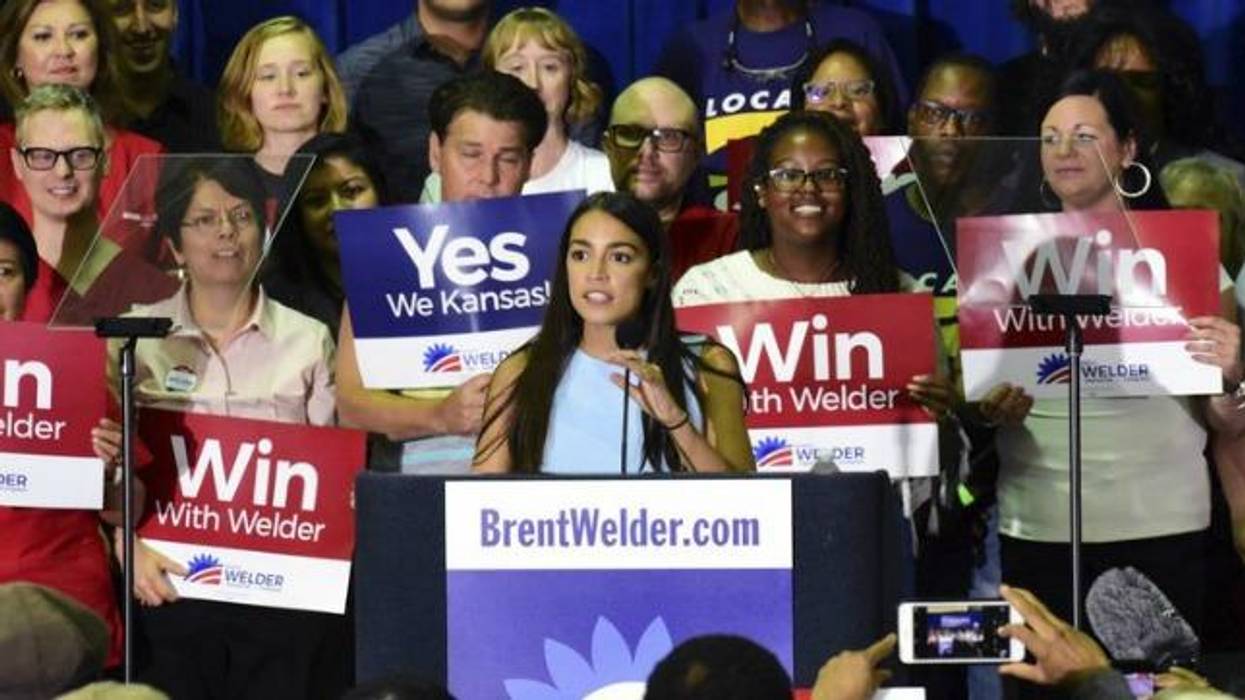
"And they said it won't work in the Midwest."
That was how New York democratic socialist Alexandria Ocasio-Cortez opened her speech at a packed and enthusiastic rally in Kansas City Friday night, one of two events the 28-year-old congressional candidate held alongside Sen. Bernie Sanders (I-Vt.) in an effort to prove that an agenda confronting entrenched corporate power and demanding economic justice has far-reaching appeal.
"Whether you live in Vermont or the Bronx or Kansas, you are outraged by a situation in which three people in this country own more wealth than the bottom half of America."
--Sen. Bernie Sanders
The two rallies on Friday--both of which were filled to capacity, with the Wichita event drawing an estimated 4,000 Kansans--were organized on behalf of progressive congressional candidates James Thompson and Brent Welder, both of whom are running on platforms that mirror those of Sanders and Ocasio-Cortez: Medicare for All, a living wage, tuition-free public college, robust support for unions, and other central progressive priorities.
"I'm running for Congress because billionaires and giant corporations have too much control over our government," Welder, a former labor attorney who doesn't accept corporate cash, said to applause Friday evening. "As a worker's rights advocate and labor lawyer, I've spent my career fighting the giant corporations that rig the economy against workers and our community."
Since Ocasio-Cortez's landslide victory over corporate Democratic Rep. Joe Crowley in New York's primary last month, pundits and Democrats alike have raised doubts about the viability of democratic socialism beyond "the coasts" and have cautioned candidates against sprinting "too far to the left" in Midwestern states like Kansas.
If the overflowing rallies and electric atmosphere at Fridays' rallies are any evidence, these warnings couldn't be more wrong-headed.
"Whether you live in Vermont or the Bronx or Kansas, you are outraged by a situation in which three people in this country own more wealth than the bottom half of America," Sanders said during the afternoon event for Thompson, a civil rights lawyer who hails from the Koch brothers' home district of Wichita.
"I just do not accept what the pundits are talking about when they say blue state and red state and purple state," Sanders added. "I believe that any state in this country where working people are struggling is a state prepared to fight for justice."
Ocasio-Cortez echoed Sanders' sentiment Friday afternoon, arguing "there is hope for the progressive movement" wherever there are working-class people, adding that Kansans can achieve progressive change in their state with the same grassroots tactics that propelled her to an upset win last month: Organizing relentlessly and knocking on doors.
"Corporations are buying politicians left and right. We've seen a lot of that in Kansas, and I think it's clear that has hurt working people."
--James Thompson, Kansas congressional candidate
"If you have never knocked on a door before, I am talking to you," Ocasio-Cortez declared. "If you have never voted before, I am talking to you."
At present, every U.S. senator and representative from Kansas is a Republican, the governor's mansion and the Kansas legislature are dominated by the GOP, and the state is still struggling to recover from former Gov. Sam Brownback's catastrophic "conservative experiment," which included massive tax breaks for the rich and deep spending cuts to public services like healthcare and education.
Ocasio-Cortez, Sanders, Welder, and Thompson all decried such austerity and fealty to corporate interests and billionaires like the Kochs on Friday, while clearly arguing that politics-as-usual from the Democratic Party will not be enough to overcome these powerful interests.
"Corporations are buying politicians left and right. We've seen a lot of that in Kansas, and I think it's clear that has hurt working people," Thompson said. "So I think there should be a few of us in Washington who just can't be bought off, who are just going to be on the side of the unions."
As for the current Republican-controlled Congress and White House that are hell-bent on gutting Medicare, Medicaid, and Social Security in the service of delivering more tax cuts to the wealthiest Americans, Sanders concluded: "They ain't gonna do it, because we are gonna stop them."
Watch the full event for Thompson:
Watch the full event for Welder:
Part one:
Part two:
To know is nothing at all; to imagine is everything.
--Anatole France, The Crime of Sylvestre Bonnard
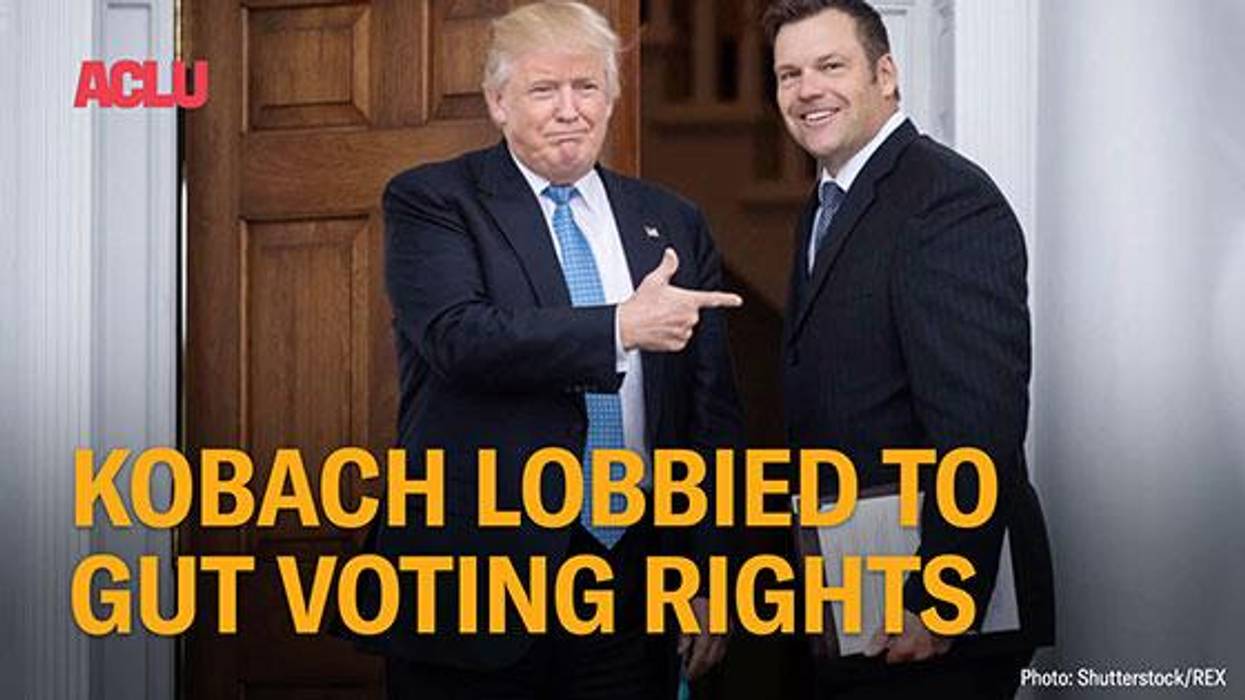
It's not that he's ever been far away. It's just that whenever he returns, it causes the casual observer to marvel at how a great education could produce such a distorted intelligence and twisted mind. The good news is that soon he will leave the national stage in order to return to his home state and favor its voters with his peculiar views of government. A graduate of Harvard, Oxford, and Yale Law School, he is proof that, as one University President put it, some years back, when speaking of college graduates, "you can never be sure they are educated." He is Kris Kobach.
Kris is remembered for a number of peculiar triumphs that occurred during the last two years. It was he, who while serving on the Republican Platform Committee of the Republican National Convention, successfully inserted language into the platform that addresses illegal immigration in the manner now demanded by the country's Resident Fool who has found shelter in the White House. The language he successfully inserted was: "The border wall must cover the entirety of the southern border and must be sufficient to stop both vehicular and pedestrian traffic." In furtherance of this project, eight sample walls have now been constructed in Texas, the prettiest of which is described as being a pale blue and white and resembles in some respects a split level home. The wall was not Kris's only platform success. He inserted into that platform language pertaining to gay marriage and stating that the U.S. Supreme Court's opinion legalizing it was obviously incorrect.
Although Kris serves as Kansas's Secretary of State, he has enjoyed serving as the vice-chair of the Presidential Advisory Committee on Election Integrity. Vice President Pence was the chair of that Committee, but Kris assumed the role of leader which was singularly appropriate since he is more in tune with perceived election fraud than almost anyone in the country. At the time the Advisory Committee was created, he said: "As the chief election officer of a state, ensuring the integrity of elections is my number one priority. The work of this commission will assist all state elections officers in understanding, and addressing, the problem of voter fraud." There were probably few people in the country with Kris's experience.
As Secretary of State of Kansas Kris had sought to impose a requirement that anyone wanting to register to vote in that state offer proof of citizenship before registering. He claimed that was needed to put an end to voter fraud. Unimpressed, the federal judge who declined to permit that requirement to go forward in federal elections, and had a much keener understanding of the scope of the problem than Kris, observed that: "There is evidence of only three instances where noncitizens actually voted in a federal election between 1995 and 2015," and during that time only 14 non-citizens attempted to register. While serving on the Advisory Commission, Kris claimed on Breitbart news that he had found proof that 5,51l voters who voted in New Hampshire in the 2016 election were not eligible to vote. He based that on the fact that the voters lacked New Hampshire drivers' licenses when they registered, and failed to obtain them after voting. It turned out that there is no requirement that someone registering to vote in New Hampshire using an out of state driver's license is required to obtain a New Hampshire driver's license after voting.
The Commission on which Kris served has been dissolved. Its activities have been referred to the Department of Homeland Security (DHS). Kris says he will continue as an advisor to that department, presumably so his expertise will not go to waste. Tyler Houten, a spokesperson for the DHS, said that: "Mr. Kobach is not advising the Department on this matter." Whether he will be involved or not, Kris has found another way to spend his time that he hopes will prove to be more successful than his tilting at the windmill of imaginary voter fraud. He hopes to become Governor of Kansas. Since he has made his mark as incompetent in his recent efforts, he may be well qualified to become the governor since Sam Brownback, the man he would replace, has the second lowest approval rating of any sitting governor according a survey by Morning Consult. Through creative tax reductions initiated by Governor Brownback, it is anticipated that the state's deficit will exceed $280 million this year.
Governor Brownback has been nominated to serve as Ambassador at large for international religious freedom and, if confirmed, will be replaced by Jeff Colyer, the lieutenant governor. Mr. Colyer has already said he will run for the position in the 2018 election, and if Governor Brownback is confirmed, he will be running as the incumbent. Kris believes his successes in bringing failed lawsuits attacking imaginary voter fraud, his claim to have seen voter fraud in New Hampshire, where none existed, and his mistaken description of himself as an advisor to the DHS, are proof that he would be a worthy successor to Governor Brownback. He is right. Whether that is what Kansas voters are hoping for, only time will tell.
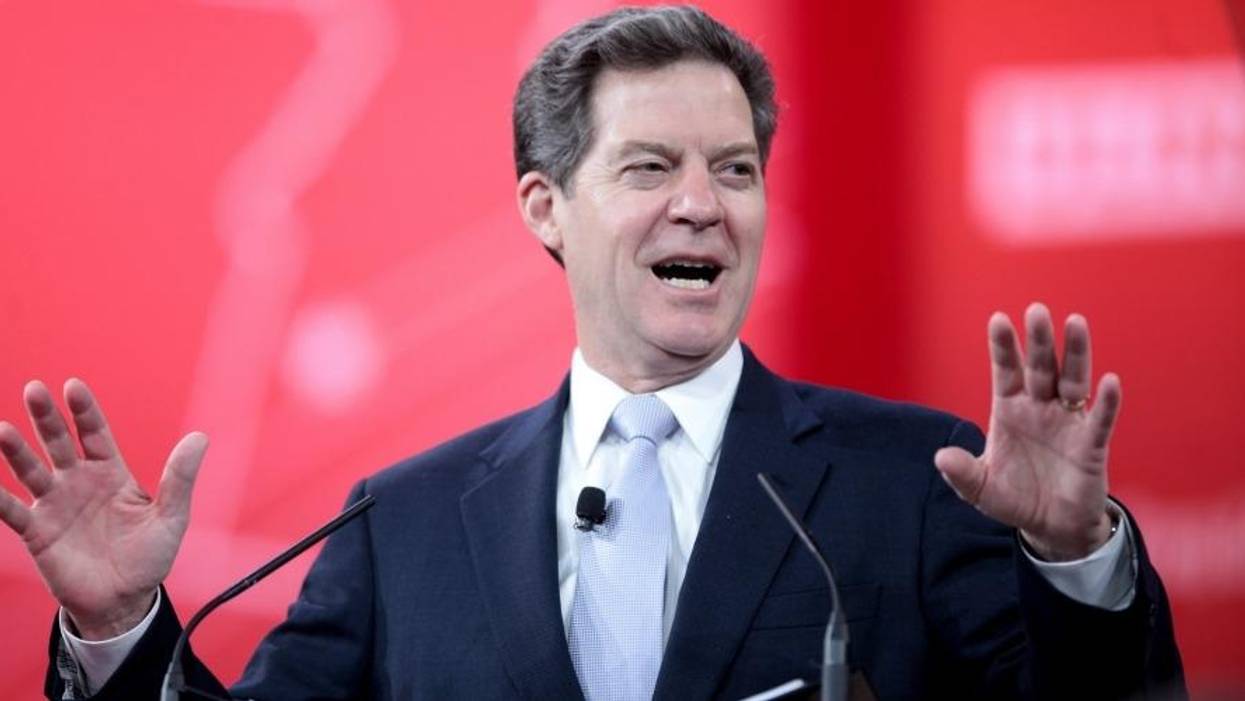
Republicans scrambled on Wednesday to put the final touches on the catastrophic tax proposal they rolled out this week. But the progressive lawmakers and activists gathered in front of the U.S. Capitol were already clear on their message: not one penny in tax cuts for the wealthy and corporations.
At the Rally to Resist the Republican Tax Scam, lawmakers, including Senators Elizabeth Warren and Bernie Sanders, detailed the damage they expected to see from the Trump tax plan. But one speaker already had personal experience with the "trickle down" policy touted by Republicans. As she spoke to the crowd, Kansas resident Sarah LaFrenz was clear: there's no cutting taxes without slashing public services.
LaFrenz knows this well because Kansas Governor Sam Brownback successfully sold her home state the lie that tax cuts lead to economic growth. Under the governor's leadership, Kansas passed cuts so deep that they were called experimental.
Brownback said his tax plan would be "like a shot of adrenaline into the heart of the Kansas economy." He promised the cuts would help create jobs -- similar to what the national GOP claims the Trump tax bill will do. But instead, it devastated the state's economy. Now, only five years later, the state legislature is reversing the policy, widely considered a failure.
But Republicans refuse to learn from those mistakes. Instead, they hope to repeat them at the national level. LaFrenz won't let that happen without warning Americans about what those tax cuts could mean.
"What happened in Kansas is an incredibly personal story for me, because every single person that I know from home was deeply affected by this," LaFrenz said. "As a mother of three children, I have seen firsthand what this experiment has done to our people."
Who continues to pay the price of this failed tax policy? The kids of Kansas. Take, for example, the treatment of youth in foster care. "The state of Kansas has literally lost children because we decided to trim spending in this reprehensible manner," LaFrenz said, referencing the 70 kids missing from the state's foster care system.
Members of the Kansas legislature were surprised last month when they learned that the Department for Children and Families cannot account for dozens of foster children that were supposed to be under state care. But the foster system, managed by private contractors, has faced high turnover from social workers hoping to leave the heavy caseloads and low pay behind.
The budget dysfunction also deeply affects Kansas schools. As LaFrenz pointed out, the Kansas Supreme Court has ruled multiple times that the state's low education spending is unconstitutional. But the state's tax system continues to burden the legislature as it considers how to adequately fund schools.
LaFrenz wants the lessons from Kansas to echo across the country. After her speech, she headed inside the halls of Congress to let lawmakers know that policies like the ones they're floating have already had an enormous impact on her community. As she exited the rally, she left some parting words of advice.
"I am here today to implore you all to learn from Kansas. When they decide to starve our public services in order to give tax cuts to rich folks, our lives are endangered, we are harmed, and we sometimes lose people altogether."
In a move characterized as a decisive rejection of a right-wing experiment that closely resembles the tax proposals President Donald Trump has touted for months, Kansas lawmakers overrode a veto by Republican Governor Sam Brownback on Tuesday night in order to roll back existing tax cuts and prevent cuts that were scheduled for the near future.
"Congratulations to Kansas for voting to roll back outrageous tax cuts for the wealthy that devastated the state."
--Sen. Bernie SandersKansas Republicans have, for the last several years, been forced to contend with how the tax cuts--passed in 2012 as part of what Gov. Brownback called a "real live experiment"--have devastated the state's public services, particularly education and healthcare.
As such, the lawmakers' actions on Tuesday were, for many, worthy of applause.
"Congratulations to Kansas for voting to roll back outrageous tax cuts for the wealthy that devastated the state," Bernie Sanders (I-Vt.) wrote on Twitter in response to the news.
In statement released on Wednesday, Nick Johnson of the Center on Budget and Policy Priorities (CBPP) joined lawmakers and activists in celebrating the move, calling it a "striking repudiation of far-right wing economic orthodoxy."
"Kansas's five-year experiment shows us what happens when we try to tax-cut our way to prosperity," Johnson added, "but the legislature's action reminds us that we have other options."
Tuesday's vote also presented a chance to consider what may be on the horizon as the Republican Party, with Trump at the helm, gears up to craft legislation that would slash taxes for the wealthiest Americans.
If Kansas is any guide, analysts have noted, such a move could prove disastrous.
"Kansas's five-year experiment shows us what happens when we try to tax-cut our way to prosperity."
--Nick Johnson, Center on Budget and Policy Priorities"I've long argued there's just no evidence to support the claims made by the trickle-downers," wrote Jared Bernstein, a senior fellow at CBPP, in an op-ed for the Washington Post. But, he added, "If facts could kill the myth of trickle-down tax cuts, I'd have given the eulogy at its graveside lo these many years ago."
On the question of whether Trump or Republicans on Capitol Hill will learn from the Kansas experiment, Bernstein sounded a pessimistic note.
"It is not immaterial that the same folks who pushed the Kansas cuts are behind the Trump cuts," he observed. "In Kansas, to better serve the vast majority of their constituents, policymakers said 'no' to that cynical play. I hope I'm wrong, but in D.C., I fear the will of the majority to represent those outside the top 1 percent is not nearly so strong."
Following the end of the longest legislative session in state history, which dragged on an extra 23 days, Kansas Governor Sam Brownback on Tuesday signed a massive budget deal into law that includes a $384 million tax hike--mostly on the poor.
It's the largest tax increase ever introduced in the state, and more than half of it will come from sales tax and cigarette tax, which financial experts have long warned are regressive and punitive for low-income people as they force them to pay a larger percentage of their earnings than someone in a higher bracket.
The deal upholds many of the tax cuts Brownback introduced in 2012, which gave an annual $24,000 windfall to wealthy Kansans--which they will keep--but drove tax rates up for the poorest 20 percent of the state. It also cuts $50 million from the state budget.
Brownback went whole hog to convince lawmakers to pass the deal, including crying and calling legislators from his granddaughter's birth.
Kelly Davis, midwest regional director at the Institution on Taxation and Economic Policy, explained the deal thusly:
Early on in his tax-cutting frenzy, the Governor offered that Kansas was a "real live experiment" for other states in terms of showing the positive impact of supply-side economics. Those words have come back to haunt him and other supporters of trickle-down economic theories. If Kansas is an experiment, Friday's vote makes it clear that the experiment failed.
...Kansas's tax changes, even the provision that allegedly exempts 380,000 low-income people from income taxes, will do nothing to alter the fact that the Sunflower State earlier this year earned a spot on ITEP's "Terrible Ten" list because it has 9th most regressive tax structure in the country.
As the Kansas City Star points out, the higher sales taxes could backfire in border towns, as residents could simply cross state lines to do their shopping in neighboring Missouri, where the food tax will soon be five times lower.
The move is part of a trend of Republican-led states pushing tax schemes that exclusively benefit the rich and exclusively burden the poor.
The budget becomes law just months after Brownback signed into a law a controversial welfare bill that places strict limits on benefits and how they may be spent.
"Home! And this is my room--and you're all here! And I'm not going to leave here ever, ever again, because I love you all! And--Oh, Auntie Em--there's no place like home!"
Words spoken by Dorothy upon returning to Kansas from the Land of OZ.
-- L.Frank Baum, The Wizard of Oz
"Home! And this is my room--and you're all here! And I'm not going to leave here ever, ever again, because I love you all! And--Oh, Auntie Em--there's no place like home!"
Words spoken by Dorothy upon returning to Kansas from the Land of OZ.
-- L.Frank Baum, The Wizard of Oz
Had she known she would not have clicked her heels three times. That was the number of clicks it took to transport her from the Land of Oz back home to Kansas. If she had known what Kansas would become, she would have stayed in the Land of Oz. While there, after all, she played a vital role in the Cowardly Lion getting courage, the Scarecrow brains and the Tin Woodman a heart. None of those qualities is possessed by most of the legislators in the Kansas state legislature. There is only one character from the Wizard of Oz who would be happy in Kansas today-the Wizard. As he acknowledged, when his true identity was discovered by Dorothy and her friends, "I am a humbug." That does not, of course, mean that he couldn't be as good a governor as Sam Brownback who is now serving. But this isn't about Sam or the Wizard. It's about the state legislature.
Kansas legislators have distinguished themselves by demonstrating through their actions that they lack brains, hearts and courage. On April 16, 2016 Governor Sam Brownback signed the Hope, Opportunity and Prosperity for Everyone Act, known as the HOPE Act. Although it applies to everyone in Kansas, a reading of the Act discloses that it affects only a few. The few it affects are families on welfare. One of the legislators (who sounded like the Tin Woodman might have sounded before he got a heart) explained the Act's purpose. It is to make sure, said he, "that Kansans have a high quality of life. And you don't have high quality of life if you don't have a job." The law doesn't provide employment but it includes work and job training requirements for those on welfare. It also provides that lifetime benefits for those on welfare are limited to 36 months, a powerful incentive to get work since the alternative is no benefits and no means of support. The legislation helps welfare recipients by spelling out the kinds of things for which welfare benefits cannot be used. If those prohibitions were not enumerated, welfare recipients might squander the $300 a month that they receive on some of the proscribed items not realizing that buying those things are not in their best interest. The legislative summary enumerates the things for which welfare funds may not be used. The funds may not be used in a "liquor store, casino, gaming establishment. . .nail salon, lingerie shop. . . vapor cigarette store, psychic or fortune telling business, movie theater, swimming pool, cruise ship . . . ." Since the average welfare recipient in Kansas receives less than $300 per month, it is unlikely he or she will be able to book a cruise. However, as every conscientious legislator knows, one can't be too careful and people on welfare may be ignorant as well as poor and might squander their benefits had the statute not included guidance. Helping people on welfare spend their money wisely was not the Kansas legislature's only contribution to good governance.
On May 19, 2015, it was reported that the legislature had decided to make itself the arbiter of Kansas Supreme Court decisions. In 2014 the legislature passed a law that took away from the Missouri Supreme Court the right to control the budgets and leadership of local courts because the legislature wanted that control to be local. A Kansas judge sued to invalidate that law and the case is now pending. If successful, control of all state courts would be returned to the Kansas Supreme Court which would be in accordance with the Missouri Constitution The legislature is less concerned with whether its actions are constitutional, than with the fact that the Supreme Court might take it upon itself to find the legislature's actions to be unconstitutional. Accordingly, as part of the budget it adopted in 2015 it included language that provides that if the 2014 law is "stayed or is held to be invalid or unconstitutional" certain provisions of the budget, including funding for the courts "are hereby declared to be null and void." The legislators, who don't get the separation of powers idea, intend with this language to encourage the courts to rule in favor of the 2014 legislation lest they lose all funding including for salaries of all employees, including judges.
Wherever Dorothy now is, she is probably trying desperately to click her heels three times. That is what it took to get her from Oz to Kansas. It might work in reverse. It would certainly be worth a try. If any of my readers is visiting Kansas and observes citizens jumping up and down trying to click their heels three times, offer them a word of encouragement. They need and deserve it.